
What to compare when choosing a whole-house water filter for a large family? in united states


Choosing the right whole-house water filter for a large family is more than picking the most expensive tank on the block. The right system protects appliances, reduces health risks, improves taste and smell for every faucet in the home, and—if chosen wisely—minimizes maintenance and operating costs over years. This long, practical article walks you through exactly what to compare, step by step: how to evaluate your water, which contaminants matter, technology options and trade-offs, sizing rules for large households, installation and plumbing considerations, expected costs and lifetime operating expenses, certifications and testing you should insist on, maintenance realities, and final questions to ask vendors before you sign a purchase order. I’ll point to trusted resources and show where to check parts and replacement cartridges when you’re ready (for product specs and replacement parts, check https://yourwatergood.com/ and https://yourwatergood.com/shop/).
Note: this post focuses on homes in the United States and uses U.S. regulations and typical household practices as the reference framework.
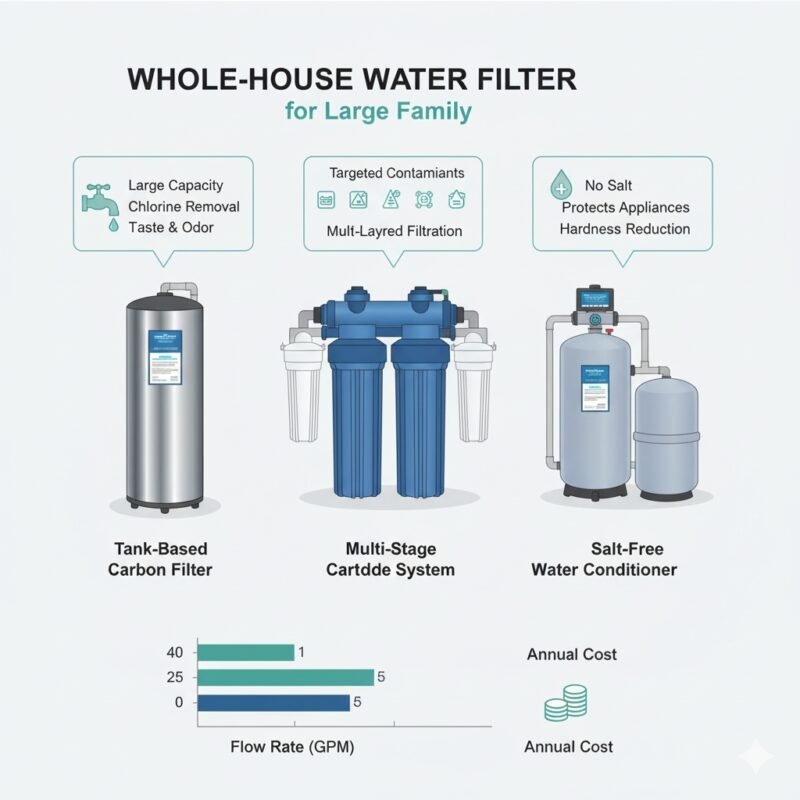
1 — Start with the right data: test your water before you compare systems
The single most important action before shopping is a good water test. Don’t guess. Municipal water suppliers publish annual consumer confidence reports, but the water at your kitchen tap can differ because of household plumbing (lead in old service lines or fixtures) or point-of-use issues. Private wells require full panels and sometimes repeated seasonal testing.
What to test:
- Basic chemistry: pH, total dissolved solids (TDS), hardness (Ca & Mg), alkalinity.
- Particulates: turbidity and total suspended solids (TSS).
- Common ions and metals: iron, manganese, chloride, sulfate.
- Health-related contaminants if suspected: lead, arsenic, nitrate/nitrite.
- Disinfection residuals: free chlorine and chloramines (municipal systems).
- Emerging contaminants if relevant: PFAS (ask your state or local water authority if PFAS has been detected nearby).
Why this matters: the right problem diagnosis tells you which technology to prioritize. For example, if chlorine is your only complaint, a large carbon bed may be enough. If the well shows bacterial or turbidity issues after storms, you’ll need sediment prefiltration and microbial controls (UV/UF). If PFAS or certain industrial contaminants are present, you need certified adsorptive media or RO at drinking taps. (EPA PFAS regulatory activity and guidance are changing and should be checked for your locality.) epa.gov
How to get tested:
- Use a certified laboratory (state certified) for health-related contaminants.
- For quick screening use a TDS meter, chlorine test strips, or hardness test kits — but rely on lab results for final decisions.
Record: keep the lab report, note where and when the sample was taken (inlet vs kitchen), and include that report in any request for quotes (RFQ) you send to vendors.
2 — The contaminant matrix: which problems require which technologies
Map the contaminants you found in the test to treatment technologies. Below is a compact cheat-sheet:
- Sediment, sand, rust → spun polypropylene cartridges, pleated cartridges, or backwashing sediment filters.
- Chlorine taste & odor → granular activated carbon (GAC) or carbon block (catalytic carbon for chloramines).
- Hardness (scale) → ion-exchange softeners (salt) or template-assisted crystallization (salt-free conditioners; performance differs).
- Iron & manganese → oxidation + filtration (greensand, catalytic media, or air/chemical oxidation followed by filtration).
- Bacteria / viruses / protozoa → ultrafiltration (UF) or UV disinfection (requires good prefiltration).
- Dissolved salts, PFAS, nitrate, fluoride → reverse osmosis (RO) or targeted adsorptive media; RO is effective but costly at whole-house scale.
- Volatile organic compounds (VOCs) → carbon adsorption, often in a dedicated large bed.
A single system often combines technologies in stages (sediment → carbon → softener → UV) so each stage protects the next and maximizes life and performance.
3 — Compare by performance claims and independent verification (don’t trust advertising)
When vendors claim “removes X” or “best for Y,” verify with independent data. Look for:
- NSF/ANSI certifications that match the claim: NSF/ANSI 42 (aesthetic: chlorine, taste/odor), 53 (health-related contaminants like lead), 58 (reverse osmosis performance), and 401 (emerging contaminants); certifications demonstrate third-party testing against defined test protocols. Always ask for the certificate and certificate number. 国家科学基金会+1
- Manufacturer raw test reports that reflect your water matrix (e.g., similar hardness, turbidity, chloramine levels). A vendor’s lab report should include challenge conditions—don’t accept vague “lab tested” claims.
- Realistic performance numbers: reduction percentages, rated capacity in gallons, and the flow rate at which reduction is certified. A claim like “removes lead” needs an NSF-53 certificate and a tested capacity figure.
If a vendor cannot produce verifiable certificates or test reports, move on.
4 — Flow rate and sizing: plan for peak demand in a large family
Large families create simultaneous peak demands—multiple showers, dishwashers, laundry, and garden hoses. A system that performs fine for a single faucet can choke during household peak use. You must size the system for peak gallons-per-minute (GPM) demand.
How to estimate peak demand:
- Add fixture typical flow rates during a worst-case scenario (e.g., two showers at 2.5 GPM + dishwasher 2 GPM + washing machine 3 GPM = 10 GPM). Many residential installs target 8–12 GPM for larger homes; use a 25–30% design margin. Typical fixture flows: kitchen faucet 2–3 GPM, shower 1.5–3 GPM, washing machine 3–5 GPM. aquasana.com+1
What to compare:
- Manufacturer rated service flow (GPM) — choose systems that comfortably exceed your peak.
- Pressure drop at rated flow — compare ΔP numbers; too much ΔP will make showers weak.
- Backwash rates for media tanks — if a system uses backwashing media, ensure your available flow and pump capabilities meet the media’s backwash requirements.
Pro tip: size carbon beds and softener exchange capacities to preserve contact time and avoid early breakthrough when the house is at peak draw.
5 — Capacity and media life: gallons, contact time, and replacement schedule
A whole-house system’s “size” is more than vessel diameter. Compare:
- Bed volume and claimed capacity (gallons) for carbon beds: larger capacity = longer life between media changeouts.
- Cartridge gallon ratings for sediment and cartridge carbon (watch for optimistic marketing numbers). Look for realistic rated gallons at specific contaminant loads.
- For softeners, grain capacity and regeneration settings determine how often salt must be added and how frequently regeneration occurs.
Don’t buy a system that demands cartridge swaps every month—determine the true lifecycle cost by multiplying replacement frequency by part cost and labor (if applicable).
6 — Technology trade-offs for large families (cost vs performance vs maintenance)
No single technology is perfect—here’s how to compare trade-offs for the typical technologies you’ll see:
- Carbon beds (GAC / carbon block): excellent for chlorine and many organics, low operating cost, relatively low maintenance if sized correctly. But carbon does not remove hardness or dissolved salts. Catalytic carbon is better for chloramines but costs more.
- Ion-exchange softeners: very effective for scale prevention, large upside for appliance longevity and comfort. Downside: require salt, produce brine discharge (may be regulated), and marginally increase sodium in water. If local restrictions prohibit brine discharge, consider salt-free options (TAC) but evaluate performance carefully.
- Backwashing sediment filters / automated systems: great where turbidity fluctuates (well users) because they clean themselves; initial cost higher but labor lower.
- UV disinfection: reliable for microbiological control but needs excellent prefiltration (low turbidity) and annual lamp replacement. UV does not provide chemical removal.
- Whole-house RO: removes most dissolved contaminants including PFAS, but whole-house RO is rare in homes because of cost, huge wastewater volumes, and high energy and maintenance; instead, many families use POE pretreatment plus under-sink RO for drinking water. Major new regulatory pressures (e.g., PFAS limits) are increasing interest in more aggressive treatment at the utility and POU levels—confirm feasibility for whole-house RO before committing. epa.gov
7 — Certification & regulatory considerations in the U.S.
What to insist on:
- NSF/ANSI certificates for the relevant contaminant claims (42, 53, 58, etc.). If a cartridge claims PFAS removal, request third-party test data supporting that claim—PFAS removal performance often depends on bed depth, contact time, and the exact PFAS species. 国家科学基金会+1
- ADA, UL/ETL listings for any electrical components (UV lamps, pumps).
- Local code compliance: softener brine discharge, backwash water, and large-volume RO reject may be regulated—check local plumbing and environmental rules before installing.
If you need the system to meet a legal limit or to be acceptable for a workplace or rental compliance, verify that the vendor’s certification and lab evidence match the regulatory requirement exactly.
8 — Longevity, warranty, and service network
Large families value uptime. When comparing vendors, look at:
- Warranty terms: what parts are covered, and does the warranty require professional installation/annual service to remain valid?
- Local service network: does the manufacturer have certified local installers or service partners? For complex POE systems, local rapid support matters.
- Spare parts availability: are cartridges, membranes, valves, and control boards readily available, and what are lead times? A system is only as useful as the availability of its consumables.
- Service contracts and remote monitoring: some modern systems offer remote sensors and cloud alerts for filter change or pressure drop—handy for busy households but optional.
If the vendor’s warranty requires you to use their consumables exclusively, factor that into your long-term cost.
9 — Installation and plumbing: bypasses, location, and space
A whole-house system must be accessible and installed so service doesn’t disrupt daily life.
Compare:
- Bypass valve inclusion: installed bypasses let you isolate the system for service without shutting off the whole house. Insist on them.
- Mounting and footprint: where will tanks and vessels live? Basements, garages, or mechanical rooms are typical. Ensure there is room for filter removal, media replacement, and technician access.
- Piping materials and adapters: confirm the proposed materials (copper, PEX, PVC) and who will provide fittings. Ask for written scope covering any repiping or new shutoffs.
- Electrical needs: UV and pump systems require safe electrical installations—check local codes and GFCI requirements.
- Drain planning: RO and softener backwash require appropriate disposal paths—confirm that planned discharge meets local regulations.
Vendors who provide a transparent installation scope (line items and photos of proposed routing) reduce surprises.
10 — Total cost of ownership (TCO): equipment + installation + operating costs
Upfront equipment price is only part of the story. For a large family, TCO matters.
Include:
- Equipment price (tanks, vessels, heads).
- Installation labor & materials (plumbing, electrical, trenching if needed).
- Annual consumables: carbon media, sediment cartridges, softener salt, UV lamps, membranes.
- Regular service contract fees (optional).
- Water waste cost for RO (calculate local water rates and expected reject ratio).
- Unexpected costs: premature membrane failure due to poor prefiltration, or fines for improper brine discharge.
Typical installed ranges (residential whole-house systems) vary widely—simple sediment+carbon systems often land in the low thousands; complex softener/iron/UV stacks cost more. Get itemized quotes and run a 3–5 year TCO model before deciding. (National cost surveys and homeowner estimates put typical whole-house installs in the $1k–$5k band depending on scope.) Modernize+1
11 — Special concerns for large families: peak capacity, redundancy, and consumable logistics
Large households should plan for redundancy and supply chain convenience.
Compare vendors on:
- Redundancy options: parallel vessels or duplex softeners allow one train to stay online while the other is serviced—valuable if downtime is unacceptable.
- Consumable logistics: multi-pack cartridges, subscription reorder programs, and local stock minimize the risk of running out. Ask how quickly replacement cartridges can be delivered to your ZIP code. (If you have frequent turnover of family members, set up recurring shipments.)
- Service windows and emergency response: for large families, a same-day tech may be worth the premium.
Small operational details—like whether a vendor carries spare O-ring kits in stock or whether a local installer offers weekend service—matter more for busy households than small advertised performance differences.
12 — Water efficiency & sustainability (especially relevant with new PFAS rules)
With national movement on PFAS limits and environmental scrutiny, water efficiency is increasingly important.
Compare:
- RO recovery and permeate pump options: if you need RO for drinking water, choose membranes and pump systems that maximize recovery and minimize household reject. Whole-house RO is rarely cost-effective; POU RO at drinking taps is common. epa.gov
- Reuse of reject water: for irrigation or toilets where safe and legal, approved reuse reduces waste.
- Media selection for recyclability: some vendors offer take-back or recycling programs for spent carbon cartridges—ask about programs or local recyclers.
- Salt discharge minimization: if salt use is a community concern, consider high-efficiency softeners or alternative scale control (but test efficacy).
A sustainable system reduces both bills and ecological footprint—consider these when comparing options.
13 — Practical checklist: questions to ask each vendor
Use this checklist when you interview suppliers:
- Can you provide NSF/ANSI certification numbers for the exact model you propose? (Ask for PDFs.) 国家科学基金会
- Can you show lab test reports using a water matrix similar to my lab results?
- What is the system’s rated service flow (GPM) and pressure drop at that flow? Culligan of the Low Country+1
- What are the recommended replacement intervals (gallons or months) for each consumable, and what is the current retail price?
- What is the full itemized installation scope and cost? Include permits and electrical work.
- How much water (gallons) does the system waste per gallon treated (if RO) and what can be done to reduce it? Modernize
- Who will service the system locally and what are SLA response times?
- What are the warranty terms and conditions that could void the warranty?
- Can you provide references for three recent installations in homes of similar size?
- Do you offer subscription delivery for consumables and a spare parts kit at purchase?
Get answers in writing and compare line by line.
14 — Installation best practices for large families
When you accept a vendor, ensure the installer:
- Installs a bypass valve so the home retains water while the system is serviced.
- Provides pressure gauges upstream and downstream for simple future diagnostics.
- Labels sample ports and sets up a post-installation sampling plan (test inside water after install).
- Leaves a spare parts kit: O-rings, one set of prefilters, and installation tools.
- Verifies performance with a simple pre/post test (TDS, chlorine, or other target analyte) and gives you the report.
A good install is half the system’s life—don’t skimp on oversight.
15 — When whole-house is wrong and a hybrid approach is smarter
For many large families the best pattern is POE pretreatment + POU polishing:
- Use POE sediment + carbon + softener to protect appliances and remove bulk aesthetic problems.
- Use under-sink RO or dedicated drinking water systems at kitchen and cooking taps for ultra-low TDS and PFAS removal if needed.
- This reduces whole-house RO cost and water waste while guaranteeing the highest quality where it matters.
Vendors who offer this hybrid option and can clearly show the TCO advantage deserve special consideration.
16 — Quick furnace of regional context: hardness and local concerns
Hard water covers most of the U.S.; many states experience moderate to very hard water. If your test shows hardness above ~7 gpg, a whole-house softener or conditioner is a good candidate. Check regional hardness maps when estimating softener size and salt use; local differences change resin sizing and regeneration frequency. HomeWater 101+1
17 — Final decision framework — rank features by importance
For a large family prioritize in this order:
- Safety & verified contaminant reduction (certificates & lab reports).
- Peak flow capacity and low pressure drop (comfort for multiple simultaneous uses).
- TCO including consumables and local service availability.
- Media life and replacement logistics (subscription availability).
- Environmental constraints (brine discharge rules or RO water waste).
- Warranty & spare parts availability.
If two systems tie on the top three items, prefer the simpler system with a strong local service partner.
18 — Short shopping roadmap you can follow this weekend
- Order a certified lab test for inlet and drinking tap (if not done).
- Use the lab results to create an RFQ template (include peak flow and exact reduction targets).
- Request quotes from three reputable vendors; insist on NSF certificates and site references.
- Compare itemized quotes and run a 3-year TCO model including consumables.
- Choose a vendor that offers a clear installation scope, local support, and consumable subscription.
- Arrange installation with a bypass and initial performance test; schedule the first maintenance visit and consumable delivery.
When you’re ready to compare specific parts and replacement cartridges, begin with product catalogs and spare parts at https://yourwatergood.com/ and order replacements and accessories at https://yourwatergood.com/shop/.
Closing — practical reassurance
Large families need systems that work under real life: busy mornings, laundry days, and backyard gatherings. The right whole-house water filter is a system of choices—diagnose what matters, insist on verified performance, size for peak demand, and compare true lifecycle costs. If you follow the checklist above and require certificates and local service, you’ll avoid most surprises and get clean, reliable water at every tap.
If you’d like, I can help convert your water test into an RFQ template to send to three vendors (including exact peak GPM, required contaminant reductions, and acceptance test language).