
The Engineering Guide to 2 Stage Water Filters: Performance, ROI, and Household Asset Protection

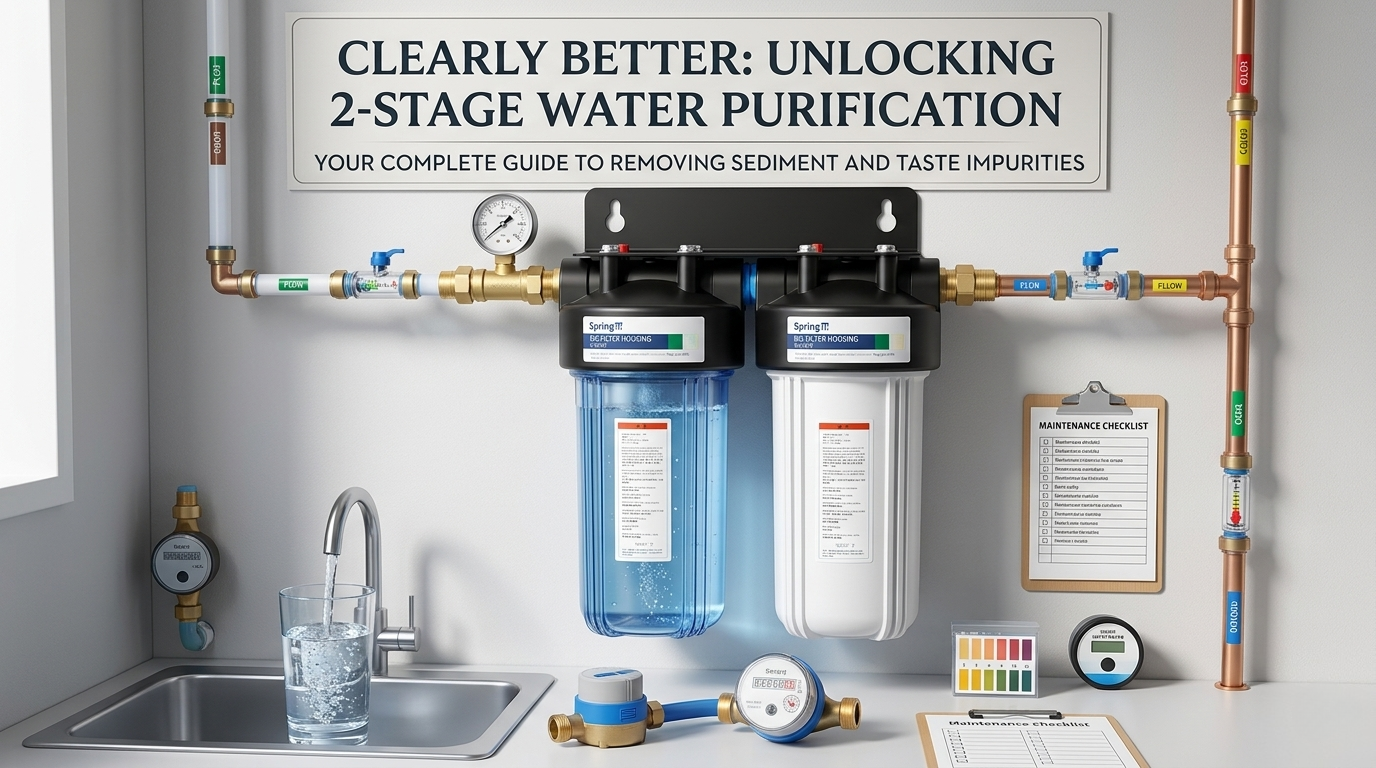
In the realm of material science and fluid dynamics, 2 stage water filters are defined as a tandem filtration architecture that utilizes a mechanical sediment barrier followed by a chemical adsorption stage, usually an extruded carbon block. This product is a high-efficiency solution designed to remove suspended solids, rust, chlorine, and volatile organic compounds (VOCs). It is absolutely worth the investment for homeowners on municipal systems who wish to eliminate chemical odors and protect their plumbing infrastructure without the water waste associated with purification. It is best suited for budget-conscious families in urban areas and small business owners who require high flow rates for coffee or breakroom service. Our most recommended solution is a high-flow 2 stage water filters setup using a 5-micron sediment wrap and a high-capacity coconut shell carbon block; however, for households dealing with high Total Dissolved Solids (TDS) or heavy metal contamination, we recommend using this system as a pre-treatment stage for a full Reverse Osmosis (RO) upgrade.
What Is the Best Water Purification System for Home Use?
When advising homeowners—from small apartments to larger family houses—the “best” water purification system is not necessarily the most advanced or expensive, but the one that delivers consistent water quality, stable flow, and long-term reliability. For most residential scenarios, the ideal solution is a well-balanced filtration system that can maintain steady GPM (gallons per minute) while effecti
Unlike commercial environments, residential water usage is more intermittent but still experiences peak demand periods. For example, during busy morning hours, a household may simultaneously use water for coffee machines, kitchen faucets, refrigerators with ice makers, and dishwashers. In these situations, undersized or low-quality filtration systems can lead to pressure drops, inconsistent taste, or reduced appliance efficiency.
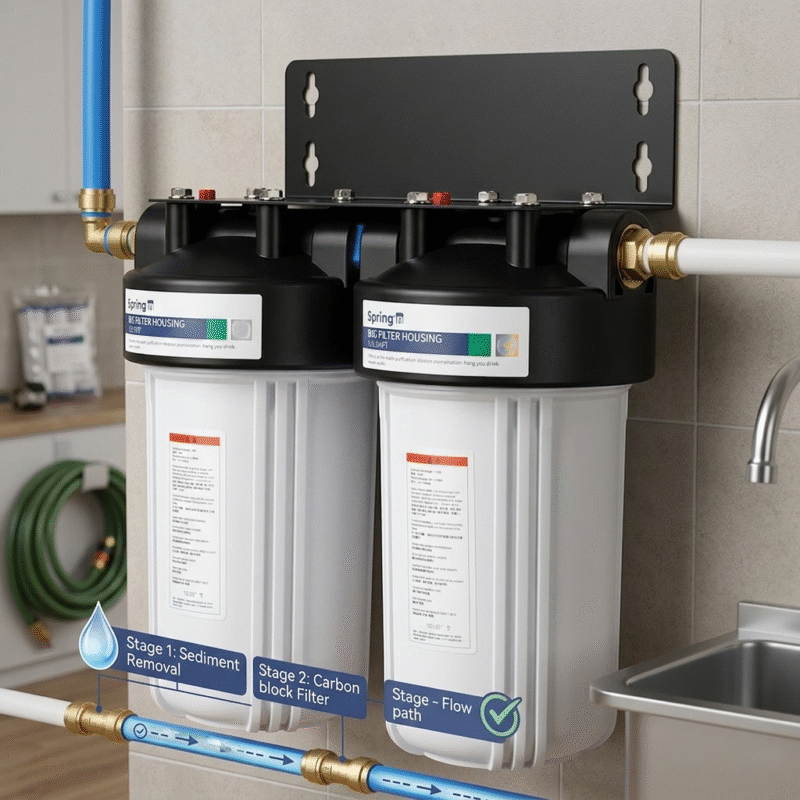
For most homes, the optimal starting point is a 2 stage water filter system, typically combining a sediment filter and a carbon filter. This setup effectively removes rust, sand, chlorine, and organic compounds while preserving sufficient flow rate and maintaining stable PSI (pounds per square inch) throughout the home. Systems built with larger-capacity housings (such as 10-inch or 20-inch cartridges) provide better durability and more consistent performance, especially for households with higher water usage.
However, for homeowners who require higher water purity—such as those focused on drinking water quality, coffee taste, or protection of sensitive appliances—a more advanced solution may be necessary. In these cases, a hybrid approach that combines 2 stage water filters with a reverse osmosis (RO) system offers a higher level of contaminant removal. This ensures that water is not only safe for consumption but also optimized for taste, appliance protection, and long-term reliability.
Reverse Osmosis vs. Other Water Treatment Systems
To understand the decision value of 2 stage water filters, we must compare them against the mechanical mechanisms of higher-tier systems.
| Feature | 2 Stage Water Filters | Reverse Osmosis (RO) | Ultrafiltration (UF) |
| Primary Media | Sediment + Carbon | Semi-permeable Membrane | Hollow Fiber Membrane |
| TDS Removal | No | 95-99% | Minimal |
| Wastewater | None | 1:1 to 3:1 Ratio | None |
| Flow Rate | High (Up to 15 GPM) | Low (Needs Tank) | Medium |
| Maintenance | Simple (6-12 mos) | Complex (Annual +) | Annual |
The Engineering Reality: If your primary goal is to remove the “pool smell” of chlorine and prevent dirt from clogging your faucets, 2 stage water filters are superior due to their high flow and zero waste. However, if your water contains “invisible” threats like fluoride, nitrates, or lead that exceed the EPA standards for long-term health, the RO system is the only engineered choice that can physically reject those smaller molecules.
How to Choose the Right Water Purifier for Your Home
A successful purchase requires matching the system’s material specs to your local water chemistry. Here is the engineering checklist:
- Analyze Your Source: * City Water: Generally high in chlorine but low in large particulates. Focus on a high-capacity carbon block stage.
- Well Water: Often high in sediment, iron, and sulfur. This requires a dedicated “Depth Filter” for the first stage to prevent the carbon from clogging prematurely.
- Calculate Peak Flow (GPM): A typical home needs at least 5 to 8 GPM. Check the manufacturer’s flow curve. If the system drops more than 10 PSI at peak load, your showers will feel weak.
- Micron Rating: Do not be fooled by “0.5-micron” claims on cheap filters. Look for “Absolute” vs. “Nominal” ratings. For residential use, a 5-micron sediment filter followed by a 5-micron carbon block is the most reliable balance of filtration and pressure maintenance.
- Pressure Resilience: Ensure the housings are rated for at least 100 PSI to handle “Water Hammer” (pressure spikes) when your washing machine valve snaps shut.
Home POE vs. POU Water Purifiers Compared
Strategic placement of your 2 stage water filters defines your ROI.
POE (Point of Entry): The Infrastructure Play
Installed at the main water line, POE systems treat every drop. This is the most recommended placement for 2 stage water filters because it protects your water heater, laundry, and bathrooms from sediment and chlorine. This is about “Home Health.”
POU (Point of Use): The Consumption Play
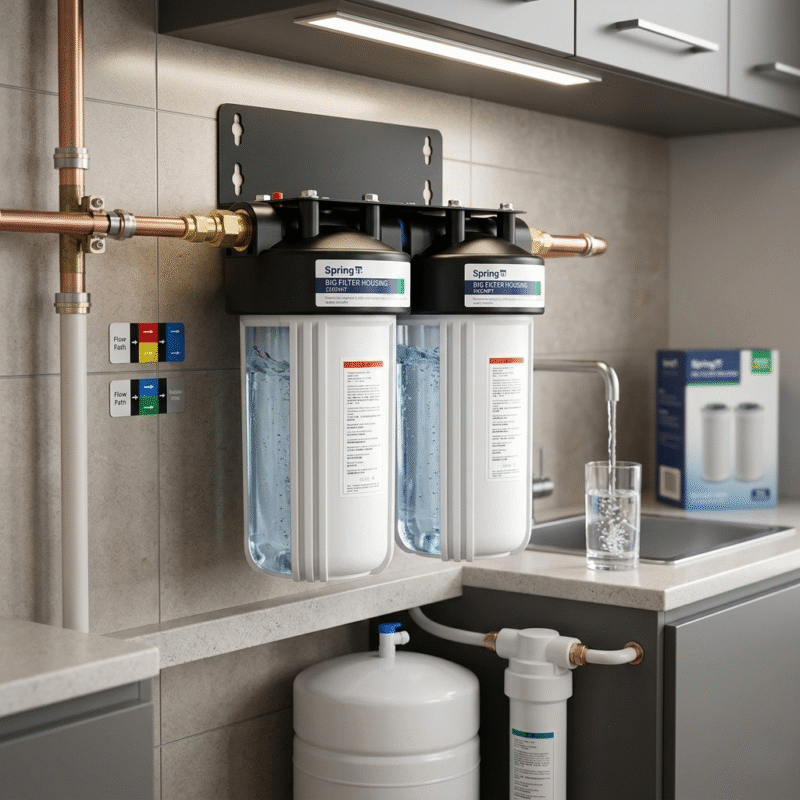
Usually installed under the kitchen sink, POU systems treat only the water you drink and cook with. This is where you would typically see an RO system. Because RO is slower, it makes sense to “purify” only the 2-5 gallons you drink daily, rather than trying to purify the water you use to flush the toilet.
Pro Tip: The most efficient home setup is a POE dual-stage filter to protect the pipes, followed by a POU RO system for the kitchen tap.
Cost, Value, and Long-Term Household Appliance Protection
In the B2B sector, we look at the Total Cost of Ownership (TCO). For a homeowner, this translates to how much money 2 stage water filters save you on appliance repairs.
- Water Heater Longevity: Sediment accumulation at the bottom of a water heater creates an insulating layer. This forces the heating element to run longer, leading to “thermal fatigue” and tank failure. A 2-stage system can extend a heater’s life from 8 years to 12+ years.
- Dishwasher Efficiency: Chlorine gas released in the high heat of a dishwasher cycle can embrittle plastic parts. Removing chlorine keeps your internal seals supple and leak-free.
- ROI Analysis: A high-quality 2-stage system costs roughly $300–$500. If it prevents just one emergency plumber call-out (average $250) or extends the life of a $1,000 washing machine by 3 years, the system has effectively paid for itself twice over.
Common Errors Homeowners Make When Choosing a Purifier
- Ignoring the “Pressure Drop”: Installing a system with 1/4-inch ports on a 3/4-inch main line. This is a hydraulic bottleneck that will ruin your home’s water pressure.
- Assuming it Removes Scale: 2 stage water filters do not remove hardness minerals (Calcium/Magnesium). If you have white crusty buildup on your faucets, you need a softener or a TAC (Template Assisted Crystallization) system in addition to your filters.
- Forgetting the “Filter Change” Schedule: A saturated carbon filter is worse than no filter at all. Once the carbon is full, it can undergo “desorption,” where it releases a concentrated dose of contaminants back into your water.
- Misidentifying Well Water Needs: Attempting to use a standard 2-stage city water filter on a high-iron well. The iron will oxidize and “blind” the carbon block in weeks.
FAQ for Residential Water Filtration
Q: Are 2 stage water filters enough to make my water safe? A: If you are on a municipal supply, the water is already “safe” by legal EPA standards. A 2-stage system makes it “optimal” by removing the chemical disinfectants and physical dirt that the city allows.
Q: Will this system lower my shower pressure? A: If sized correctly (at least 7-10 GPM capacity), the pressure drop is negligible. You won’t even notice it’s there.
Q: Do I need a professional plumber to install it? A: While many DIYers can handle it, we recommend professional installation to ensure the PSI is balanced and that bypass valves are installed for easy maintenance.
Q: Does this remove “Forever Chemicals” (PFAS)? A: High-quality activated carbon is one of the most effective methods for reducing PFAS, but for 99.9% removal, an RO system is the engineered preference.
Q: How do I know when to change the filters? A: Watch for a drop in water pressure or the return of a chlorine taste. We recommend a strict 6-month swap for sediment and 12-month for carbon.
Q: What is the difference between a sediment filter and a carbon filter? A: Sediment is like a “sieve” that catches rocks and dirt. Carbon is like a “magnet” (adsorption) that sticks to chemicals and odors. You need both to be effective.
Engineering Operational Stability for Your Family
Water is the most used utility in your home, yet it is often the least managed. By implementing a standardized approach—starting with high-quality 2 stage water filters—you are taking control of your home’s “fluid chemistry.” This isn’t just about a better-tasting cup of coffee; it is a calculated engineering decision to preserve your appliances, protect your plumbing, and provide your family with a baseline of safety that exceeds basic municipal requirements.
At yourwatergoodcompany, we don’t just sell equipment; we design the infrastructure of your home’s health.
Optimize Your Home Today
Don’t wait for a burst pipe or a failed water heater to realize the importance of water quality. Take a proactive step toward household stability.
[Request a Custom Quote] Our engineers can help you select the right housing size and media density for your specific local water report.
[Download Technical Specifications] Review our GPM flow charts and PSI tolerance data to ensure a perfect fit for your plumbing system.
[Get B2B Wholesale Pricing] Are you a contractor or property manager? Reach out for bulk rates on our most reliable 2 stage water filters.