
Pure Precision: A Practical Guide to 5 Stage Reverse Osmosis Water Filter For Homeowners

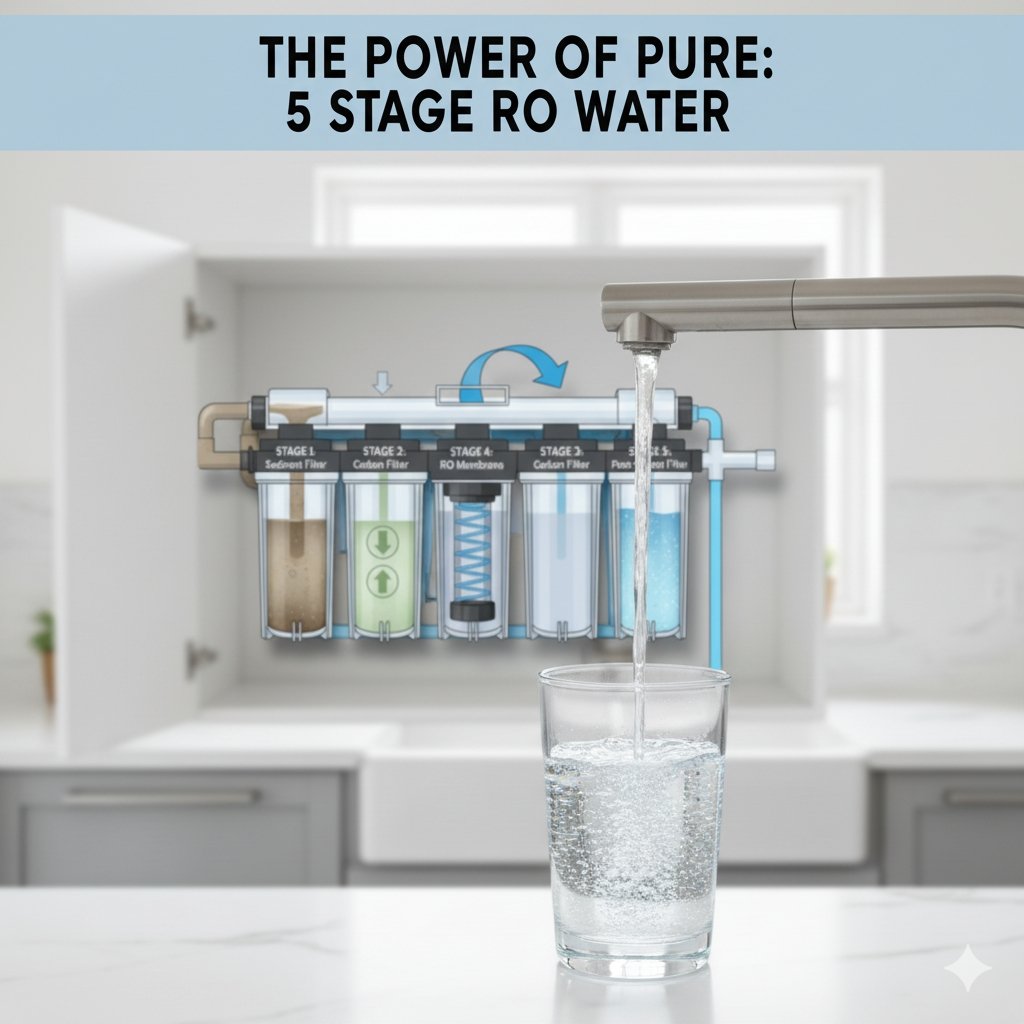
Clean, reliable drinking water at your kitchen tap changes daily life more than almost any other home upgrade. A well-specified 5-stage reverse osmosis (RO) water filter system is one of the most effective point-of-use solutions available: it removes a broad range of dissolved contaminants, improves taste, and gives you predictable, laboratory-grade water for drinking, cooking, and food preparation. This guide explains exactly how a 5-stage RO system works, what each stage does, realistic performance expectations, sizing and installation advice, maintenance and troubleshooting, costs and environmental tradeoffs, and a practical buying checklist so you choose the right system and keep it running at peak performance for years.
If you want to compare real product specs as you research models, review this consumer RO purifier as a technical reference: https://yourwatergood.com/product/ro-water-purifier/.
Why a 5 stage RO system is a popular choice
A 5-stage RO configuration strikes a balance between performance and simplicity. It combines sediment filtration and carbon protection with the RO membrane and finishing stages that make the permeate pleasant to drink. For many homeowners, five stages deliver near-complete removal of dissolved salts, heavy metals, nitrates, fluoride (depending on membrane), and many organic contaminants — all without the footprint or complexity of whole-house treatment.
Key reasons people choose 5-stage RO:
- Broad contaminant removal beyond what carbon alone can do.
- Consistent taste and safety for drinking and cooking.
- Compact under-sink installation with a dedicated faucet.
- Cost effectiveness versus bottled water over the long term.
- Modularity — you can add options like remineralizers, UV, or a permeate pump later.
This guide assumes a residential under-sink setup with a storage tank and dedicated faucet; however, many principles apply to other configurations as well.
What “5 stages” typically means — stage-by-stage
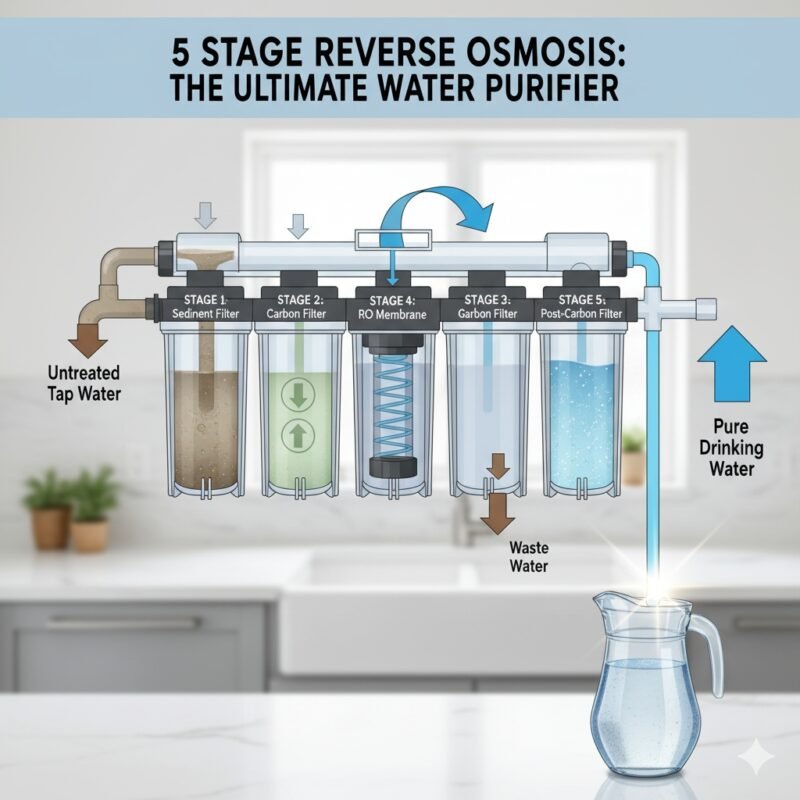
Different manufacturers may label stages slightly differently, but the canonical five-stage RO arrangement is:
Stage 1 — Sediment pre-filter
Purpose: capture sand, silt, rust, and large particulates.
Details: A polypropylene (PP) sediment cartridge (often 5–10 µm) protects downstream carbon and the membrane from abrasive or clogging particles. Replacing or maintaining this stage is one of the most important ways to extend membrane life.
Stage 2 — Carbon pre-filter (GAC or carbon block)
Purpose: remove chlorine, chlorine byproducts, and organics that would damage the RO membrane.
Details: Chlorine oxidizes thin-film composite membranes, so an effective carbon stage upstream is essential. Carbon pre-filters also improve taste and reduce many VOCs. Carbon block media offers better particulate capture and adsorption efficiency than loose granular carbon in compact cartridges.
Stage 3 — Reverse osmosis membrane
Purpose: the RO membrane is the core treatment — it rejects dissolved salts, heavy metals, and a large fraction of organic contaminants.
Details: Water is pushed under pressure across a semipermeable membrane; permeate passes through while concentrate (reject) carries away the contaminants to drain. Common residential membranes remove 90–99% of TDS depending on feed water and operating conditions.
Stage 4 — Post-carbon polish
Purpose: finalize taste and remove any trace organics or odors introduced from storage.
Details: Permeate is often stored in a tank before dispensing; a final activated carbon cartridge polishes that water so it tastes fresh at the faucet.
Stage 5 — Remineralization / alkaline cartridge (optional but common)
Purpose: reintroduce small amounts of beneficial minerals and improve mouthfeel and pH.
Details: Pure RO permeate can taste flat; many homeowners prefer a light remineralization stage to restore calcium and magnesium and raise pH slightly. Some systems use mineral stones or alkaline cartridges that also help the water feel less “aggressively pure.”
What a 5 stage RO system removes — and what it doesn’t
What it typically removes
- Dissolved salts and minerals — TDS reduction commonly in the 90–99% range.
- Heavy metals — lead, cadmium, arsenic (varies by ion state and membrane, but RO is highly effective).
- Fluoride — many membranes reduce fluoride significantly.
- Nitrate and nitrite — often removed to health-relevant extents.
- Many organic contaminants and pesticides — performance varies; check manufacturer tests.
- Some PFAS — RO reduces many PFAS; removal efficiency depends on molecular structure.
What RO systems are not designed to handle
- Dissolved gases may behave unpredictably; downstream carbon often corrects odors or tastes.
- Whole-house protection — RO treats a single point of use only; it does not stop scaling in showers, appliances, or washing machines.
- Microbiological safety without pre-treatment or UV — while the membrane pore size resists many microbes, fail-safe disinfection is best handled by UV or upstream municipal control if microbial contamination is a known risk.
Always confirm a system’s third-party test reports for the specific contaminants you care about.
Sizing and matching capacity to household needs
Choosing membrane capacity and storage requires answering how much RO water you and your household will use.
Membrane production (GPD)
Membrane output is rated in GPD (gallons per day). For typical residential use:
- 50 GPD — suitable for a single person or light use (drinking only).
- 75–100 GPD — good for most families of 2–4 people who use RO water for drinking and cooking.
- 150+ GPD — for heavy users, small enterprises, or households that want multiple RO outlets.
A 50–100 GPD membrane has ample daily capacity for most families because it produces continuously through the day and refills the tank.
Storage tank size
A common under-sink tank is 2–4 gallons gross capacity; usable volume is less (roughly 1–1.5 gallons due to bladder pressure dynamics). The tank delivers immediate water at faucet draw; a larger tank reduces wait time during peak use.
Peak demand and instant availability
If you regularly fill large pitchers or cook in batches, choose a higher GPD membrane or larger tank to reduce waiting. Tankless designs exist but usually require more complex plumbing or pumps.
Feed pressure and temperature
RO performance improves with higher pressure and warmer feedwater (within manufacturer specs). If your home pressure is low (<40 psi), a booster pump may be necessary to get rated permeate flow.
Installation overview — what to expect
Most 5-stage RO systems are installed under the kitchen sink and connect to a dedicated faucet. A professional plumber is often recommended, especially if you’re unfamiliar with drain air gaps or local codes.
Typical installation steps
- Mount filter housings and secure the membrane housing and tank in the cabinet.
- Install dedicated faucet in sink or countertop (or use an existing spare hole).
- Connect cold water feed with a shutoff adapter and route to the system inlet.
- Install drain saddle or air gap for reject water; many local codes require an air gap to prevent cross-connection.
- Connect tank and faucet lines, check all fittings, and sanitize the system per instructions.
- Flush filters and membrane per manufacturer directions before use.
Air-gap drain installations and booster pump wiring (if required) are the common reasons homeowners hire professionals.
Maintenance schedule and best practices
RO systems are low-maintenance if you follow a schedule. Neglect is the primary cause of membrane failure and poor water quality.
Typical replacements
- Sediment pre-filter: every 6–12 months (more often with dirty feed).
- Carbon pre-filter: every 6–12 months.
- RO membrane: every 2–5 years depending on feedwater and pre-filter care.
- Post-carbon polish: every 6–12 months.
- Remineralization cartridge: every 6–12 months or per gallons rated.
- Sanitization: annually or after any service that opens the product water path.
Practical tips
- Keep spare pre-filters on hand.
- Flush new carbon cartridges thoroughly to remove fines.
- Monitor permeate TDS periodically — a rising TDS usually signals membrane aging.
- Record replacement dates and set calendar reminders (or use a smart monitor if available).
Using OEM or compatible quality parts preserves fit and performance.
Troubleshooting common problems
Low flow or no water
- Check feed water shutoff and cold supply.
- Inspect prefilters for clogging and replace as necessary.
- Confirm tank pressure (empty tank bladder should be ~6–7 psi).
- If tank fills slowly or not at all, inspect the automatic shutoff valve and tubing.
High TDS in product water
- Likely membrane degradation or bypass. Replace the membrane if TDS rise persists after replacing prefilters and confirming pressure.
Continuous draining / tank never fills
- Faulty automatic shutoff valve or tank check valve could be the culprit. Inspect valves and fittings.
Off taste after filter change
- Inadequate flushing of new carbon or incorrect cartridge seating. Flush thoroughly and reseat cartridges.
Leaks
- Tighten push-fit connections and inspect tubing for nicked or cut sections. Replace defective O-rings or housings.
If DIY fixes fail, contact manufacturer support or a qualified technician.
Wastewater, recovery, and environmental tradeoffs
RO systems create a concentrate stream (reject) that carries the rejected contaminants to drain. Waste ratios vary.
Typical waste ratios
- 3:1 to 4:1 (waste:product) is common for basic residential systems.
- High-recovery designs and systems with permeate pumps can reach 1:1 or 2:1 under good conditions.
- Boosting feed pressure improves recovery but increases energy and sometimes cost.
Minimizing environmental impact
- Permeate pumps or high-recovery membranes reduce waste.
- Reuse reject water for nonpotable applications (toilet flushing, laundry, irrigation) where safe and code-compliant.
- Optimize pre-filters — when pre-filters are clean and replaced on time, the membrane operates more efficiently and requires less cleaning, extending its life.
Consider local water costs and scarcity when choosing a system and recovery options.
Remineralization, pH, and taste
RO produces very low-mineral water that many find exceptionally pure but slightly flat. Remineralization remedies that.
Remineralization options
- Mineral cartridges add measured quantities of calcium and magnesium to improve taste.
- Alkaline cartridges raise pH for customers who prefer slightly alkaline water.
- Post-filter blending can mix a portion of untreated water back in, but this reduces contaminant removal and is not recommended for health-sensitive applications.
Health perspective
Most dietary minerals come from food. RO’s low mineral content is not generally harmful for the average diet; however, consult a health professional for infants, clinical diets, or specific medical conditions.
Safety and microbiological concerns
RO membranes block many microorganisms by physical exclusion, but safe practice is important.
When to add UV
- Well water or suspected microbial problems: add a UV disinfection stage to ensure inactivation of bacteria and viruses.
- If storage tank sanitation is a concern: periodic sanitization and a post-UV are sensible additions.
Tank maintenance
- Sanitize the storage tank annually and when components are serviced. A contaminated tank can reintroduce microbes even if the membrane is intact.
Certifications and test data — what to ask manufacturers
Look for third-party validation for health claims:
- NSF/ANSI 58 — RO systems performance and safety.
- NSF/ANSI 53 or 42 for individual filter claims (lead, taste/odor).
- Independent lab reports for PFAS or other emerging contaminants.
Ask for the exact test conditions: influent concentration, flow rates, and percent reduction data. Insist on data that applies to the specific model you plan to buy.
Costs and total cost of ownership
Typical upfront costs
- Budget 5-stage systems: $200–$500 (equipment only).
- Mid-range systems with better membranes, pumps or remineralization: $400–$900.
- Premium units with smart monitoring, high-recovery membranes, and robust build: $900–$1,500+.
Installation costs
- DIY: minimal if you have tools and confidence.
- Professional: $100–$400 depending on plumber rates and whether a faucet hole must be drilled or a booster pump installed.
Ongoing costs
- Annual consumables: $50–$300 for pre-filters, post-filters, and remineralizers.
- Membrane replacement every 2–5 years: $50–$300 depending on membrane type.
- Energy for pumps is usually modest if used.
Calculate a 3–5 year TCO to compare options fairly — very cheap systems can cost more over time due to expensive consumables or faster membrane replacement.
Comparing models and valuable features
When evaluating systems, prioritize:
- Proven membrane rejection rates and documented test data.
- Accessible replacement parts and clear maintenance instructions.
- Permeate pump or high-recovery options if water efficiency is important.
- Smart TDS monitoring for automatic alerts on membrane performance.
- Good warranty and responsive support.
Avoid buying on price alone — a slightly higher initial investment often reduces lifetime cost and improves reliability.
Buying checklist — what to confirm before purchase
- Have a water test to know TDS, hardness, chlorine, and contaminants of concern.
- Choose membrane GPD and tank size appropriate for household use.
- Confirm feed pressure or budget for a booster pump.
- Ask for NSF/third-party test reports for contaminants you care about.
- Evaluate waste ratio and recovery tech (permeate pump or booster).
- Check replacement filters availability and price.
- Decide DIY vs professional install based on your skills and local code.
- Consider optional add-ons: UV, remineralizer, TDS monitor.
- Compare 3–5 year TCO not just upfront price.
- Read verified user reviews focusing on maintenance experience.
Use product pages and spec sheets to compare features precisely — for example, compare technical details to a consumer RO purifier here: https://yourwatergood.com/product/ro-water-purifier/.
Real-world tips for long membrane life
- Protect the membrane with timely pre-filter changes; neglect shortens membrane life dramatically.
- Avoid high chlorine exposure — stable carbon pre-filters are essential.
- Control feed turbidity with sediment stages to prevent fouling.
- Sanitize the system annually to prevent microbial buildup in storage tanks and lines.
- Measure permeate TDS occasionally as a low-cost diagnostic.
Frequently asked questions (short)
Q: How long will a 5-stage RO system last?
A: With proper maintenance, membranes last 2–5 years and housings/tanks can last a decade or more.
Q: Is RO water safe for infants?
A: Generally yes, but follow pediatric guidance about mineral content and formula preparation standards in your region.
Q: Can RO remove PFAS?
A: RO reduces many PFAS compounds; performance varies by species — request lab data for confirmation.
Q: Should I get a permeate pump?
A: If water efficiency matters or your recovery is poor, a permeate pump is a high-value upgrade.
Final thoughts
A 5-stage reverse osmosis water filter is a powerful and practical choice for homeowners who want reliable, high-quality drinking water at the tap. The combination of sediment protection, carbon pre-treatment, a robust RO membrane, final polishing, and optional remineralization gives broad contaminant control with pleasant taste and manageable maintenance. The keys to long-term satisfaction are good upfront sizing, proper pre-filtration, scheduled maintenance, and choosing a system backed by solid test data and support.
If you want to compare model specifications or receive a tailored recommendation, check product specifications such as those on this consumer RO purifier page: https://yourwatergood.com/product/ro-water-purifier/ — then share your feedwater test and household size and I’ll help you pick the optimal configuration and calculate the 3- to 5-year total cost of ownership.