
Factors to consider when choosing whole-house water filter large family usa


This topic is covered in full in our main guide: What to compare when choosing a whole-house water filter for a large family? in united states.
If you’re searching factors to consider when choosing whole-house water filter large family usa, you need a clear, practical checklist — not vague marketing claims. Large households place heavy, simultaneous demand on plumbing and appliances, so the right point-of-entry (POE) system must solve the specific contaminants you face, handle peak flow without choking showers, be cost-effective over years, and be serviceable by local technicians. This long-form guide walks you step-by-step through what to test, which technologies match which problems, exact sizing rules for big families, certification and regulatory checkpoints in the U.S., expected costs and lifetime operating expenses, installation and plumbing realities, and a vendor-comparison checklist you can copy into an RFQ. Links to product catalogs and replacement parts are included so you can check models while you read: YourWaterGood and our product range.
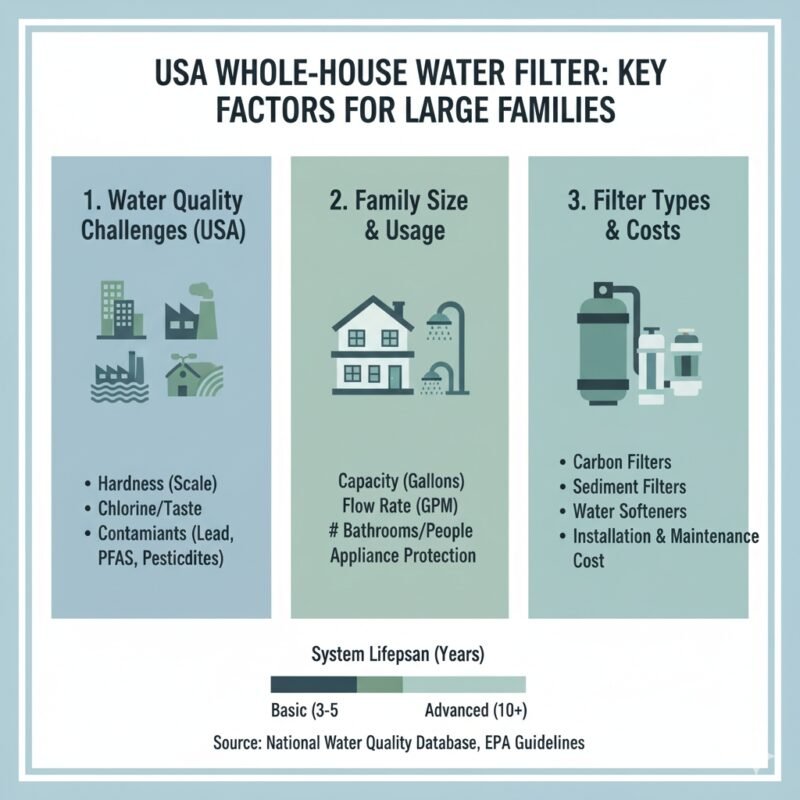
1 — Start with data: test your water (the single most important step)
Before you buy anything, get a water test from a certified lab. Municipal Consumer Confidence Reports are useful background, but your tap water can differ because of household plumbing (lead in old lines, localized iron, or high turbidity after rains). For private wells, testing is non-negotiable.
Minimum tests to request:
- Basic chemistry: pH, TDS (total dissolved solids), hardness (Ca & Mg), alkalinity.
- Particulates: turbidity / TSS.
- Metals: iron, manganese, lead, arsenic if relevant.
- Disinfection residuals: free chlorine and chloramines.
- Microbial panel (total coliform / E. coli) for wells.
- Emerging or site-specific contaminants: PFAS, VOCs, nitrate when there is cause for concern.
Why this matters: different contaminants require different technologies — carbon won’t remove hardness; softeners won’t remove PFAS. Document your lab report and include it in any request-for-quote (RFQ) you send to vendors.
(Helpful EPA resource: EPA treatment options for PFAS list GAC, anion exchange, RO as the best available technologies for PFAS removal). EPA
2 — Match problems to technology (quick cheat-list)
Once you have a test, map each issue to the right treatment:
- Sediment / turbidity / sand / rust → sediment cartridges or backwashing sediment filters.
- Chlorine taste & odor → granular activated carbon (GAC) or carbon block (catalytic carbon for chloramines).
- Hardness (scale) → ion-exchange softener (salt) or salt-free conditioner (TAC) depending on local rules.
- Iron & manganese → oxidation (air, permanganate) + media filtration (greensand, catalytic media).
- Microbial risk (wells) → ultrafiltration (UF) or UV disinfection (requires good prefiltration).
- PFAS / certain dissolved organics / nitrates → RO, nanofiltration, or specialized adsorptive media (GAC/anionic exchange), with RO or NF offering the broadest removal. EPA
Most robust household solutions are staged: sediment → carbon → softener/conditioning → UV or POE polishing (or POE pretreatment with POU RO for drinking taps).
3 — Capacity and flow: design for peak demand (don’t undersize)
Large families often experience simultaneous water use (showers, laundry, dishwasher). If a POE system is undersized you’ll see low pressure and poor performance.
How to estimate peak demand:
- Add worst-case simultaneous flows: e.g., two showers (2.5 GPM each) + dishwasher (2 GPM) + washing machine (3 GPM) = about 10 GPM. Many larger homes require 8–12 GPM peak capacity; choose a system with at least a 25–30% safety margin. Typical household flow targets are in the 6–12 GPM range depending on family size.
What to compare on vendor specs:
- Rated service flow (GPM) and pressure drop (ΔP) at that flow — prefer systems with low ΔP at your peak.
- Backwash requirements for media tanks (ensure your plumbing/pumps can support required backwash rates).
- Contact time for carbon beds — larger bed volume yields better removal for the same contact time.
If a system can’t maintain comfortable shower pressure during worst-case draws, it’s the wrong size.
4 — Certifications & performance verification (don’t buy claims)
Always ask for independent verification of any health-related claim.
Key certifications and what they mean:
- NSF/ANSI 42 — aesthetic effects (chlorine, taste & odor).
- NSF/ANSI 53 — health effects (reduction of contaminants such as lead).
- NSF/ANSI 58 — reverse osmosis systems (POU RO performance).
- NSF/ANSI 401 & other standards — emerging contaminants; for PFAS, check current EPA guidance and third-party test data. NSF
Ask vendors for the actual certificate PDF and the certificate number — not just marketing blurbs. For PFAS removal, EPA guidance identifies GAC, anion exchange, RO and nanofiltration as the top technologies; if that’s your concern, insist on lab data for the specific PFAS species detected in your water. EPA
5 — Cost and total cost of ownership (TCO): think 3–5 years
Upfront equipment price is only one piece. For large families, operating costs (filters, salt, membranes, service) and labor for maintenance add up.
Typical installed price bands for whole-house systems (U.S. averages, use as a sanity check):
- Basic sediment POE: ~$700–$1,500 installed.
- Sediment + carbon POE: ~$1,200–$3,000 installed (typical for municipal taste/odor issues).
- Softener + carbon: ~$1,800–$4,500 installed.
- Well systems with iron/UV: ~$2,000–$6,000+.
- Whole-house RO: often $10,000+ and rare for single-family homes — most households prefer POE pretreatment + POU RO for drinking water. Average installer data in 2024–2025 shows typical whole-house installs clustering in the low thousands for common stacks.
When comparing options, calculate:
TCO = equipment + installation + (annual consumables × years) + expected major replacements (membrane, media) − resale/salvage.
Example items to include in annual cost: carbon cartridge cost and frequency, softener salt, membrane amortization (membranes often last 2–5 years), UV lamp replacement, and an optional service contract.
6 — Hardness, regional realities, and local rules
Hardness varies widely across the U.S.; many regions have naturally hard water due to geology. Softening may be essential for large families to prevent scale in water heaters and appliances.
- Check local hardness maps or state data — roughly 85% of U.S. households experience some level of hard water. If hardness is above ~7 gpg, consider softening to protect appliances and reduce detergent use.
Also check local regulations: some municipalities restrict brine discharge from salt-based softeners; if so, consider high-efficiency softeners or salt-free conditioners (but evaluate their real performance in your test). Local codes may also restrict RO reject discharge or require permits for certain POE modifications.
7 — Installation realities: bypasses, access, and electrical needs
Whole-house systems must be installable and serviceable with minimal disruption.
Checklist for installation planning:
- Bypass valve: insist on a properly plumbed bypass so the house keeps water during service.
- Location: choose a mechanical room, garage, or basement with room for media replacement and access to drains. Avoid cramped closets where tank removal is impossible.
- Electrical: UV and booster pumps require safe wiring and GFCI protection — include this in your bid.
- Drainage: softeners and RO systems require drain connections for brine and reject water; confirm local disposal rules and available drain capacity.
- Pressure protection: if inlet pressure is high (or low), add regulators or boosters as required.
A transparent installer will include these items in an itemized quote — get the exact model numbers and pipe routing on the quote.
8 — Maintenance, service, and spare parts logistics
Large families need reliable service and quick parts availability.
What to compare:
- Consumable frequency & price: cartridges, media, membranes, lamps; ask for specific gallon ratings and realistic replacement intervals given your test results.
- Local service network: does the manufacturer have certified local installers? Fast service reduces downtime.
- Subscription options: many vendors offer auto-ship for cartridges — useful for busy households.
- Spare parts policy: how quickly can the installer deliver a replacement membrane or control valve? Long lead times are a real risk.
- Warranty terms: read the fine print — some warranties require professional installation and scheduled maintenance to remain valid.
If downtime is unacceptable, consider duplex (parallel) vessels or systems with swappable cartridges so you can maintain service while servicing.
9 — Water efficiency and environmental considerations
If you must use RO for drinking water or have other high-treatment needs, consider recovery and reject volumes.
- RO recovery: modern POU RO systems with permeate pumps can dramatically reduce wastewater. Whole-house RO is generally inefficient and costly in water usage, so most families prefer POE pretreatment + POU/under-sink RO for drinking water. EPA
- Reusing reject water: in some setups you can route RO reject water to toilets or irrigation (check legality & safety), reducing freshwater waste.
- Recycling spent cartridges: ask vendors about take-back or recycling programs for spent carbon cartridges and housings to reduce landfill load.
Sustainability considerations increasingly influence municipal rules (e.g., limits on brine discharge) and long-term operating costs.
10 — Special contaminant focus: PFAS and regulatory context
PFAS regulation is evolving quickly in the U.S. The EPA issued the first national PFAS limits in 2024 and named GAC, ion exchange, RO and nanofiltration as top treatment options for PFAS removal (treatment choice depends on the specific PFAS species and concentration). If your test shows PFAS above advisory or regulatory levels, treat accordingly and demand lab proof of removal for the exact PFAS species in your sample. EPA
Because PFAS removal performance is sensitive to bed depth, contact time, and species, whole-house PFAS control can be challenging and expensive — a common strategy is POE pretreatment to reduce bulk organics and targeted POU polishing (certified GAC/RO) for drinking water.
11 — Vendor comparison checklist (copy this into RFQs)
When comparing quotes, require written answers to each item below:
- Exact model numbers, components, and manufacturer data sheets.
- Independent certification PDFs for each claimed reduction (NSF/ANSI numbers). NSF
- The system’s rated service flow (GPM) and pressure drop at that flow.
- Expected replacement intervals (gallons and months) and unit prices for each consumable.
- Itemized installation scope (hours, hourly rates, materials, permits).
- Commissioning tests to be performed after install (TDS, chlorine, or lab sample).
- Warranty coverage and conditions to keep warranty valid.
- Local service partner contact and average response time.
- Options for consumable subscription or bulk discounts.
- Environmental handling plan for spent media and reject water disposal.
Require each vendor to return a completed checklist as part of their bid — it forces apples-to-apples comparison.
12 — Practical configurations that often work best for large families
Proven, pragmatic system patterns:
- City water, primary concern taste/odor + hard water: POE sediment → POE carbon (large bed) → POE softener (if hardness high) → POU under-sink RO at kitchen for drinking water.
- Well water, iron & microbes: POE sediment → oxidation + iron media → POE carbon (polish) → UV disinfection (after prefiltration).
- Concerned about PFAS / dissolved organics: POE prefiltration → POE carbon bed sized for PFAS contact time + under-sink certified RO/GAC for drinking taps.
- Minimal budget, taste only: large-capacity POE carbon vessel sized for family flow plus scheduled cartridge/media change.
These hybrid approaches balance whole-home protection with cost and water efficiency.
13 — Sizing example (quick math for a 6-person house)
Assume peak simultaneous draw: 3 showers (2.5 GPM each) + dishwasher (2 GPM) + washing machine (3 GPM) = 12.5 GPM. Add 25% safety margin → design for ~16 GPM.
Check vendor spec: carbon vessel rated service flow 12 GPM — not sufficient. You’ll need either a larger single vessel or parallel vessels rated for combined 18+ GPM. Also ensure backwash pumps (if any) meet media backwash flow requirements.
If the vendor suggests a smaller system with higher ΔP at peak, expect complaints and pressure problems once the whole family runs water.
14 — Common buyer mistakes (and how to avoid them)
- Buying on price only — cheap equipment often has higher consumable costs and shorter life.
- Skipping water testing — leads to incorrect technology selection (e.g., buying carbon when iron is the problem).
- Undersizing for peak flow — leads to pressure problems and unhappy occupants.
- Ignoring service network & consumable lead times — you’ll pay for emergency shipping if parts aren’t local.
- Forcing whole-house RO — expensive and wasteful for most home use cases; POE pretreatment + POU RO is usually smarter.
Avoid these by insisting on data, certifications, and an itemized RFQ.
15 — Buying timeline & decision roadmap
- Order certified water tests (inlet + kitchen tap).
- Define objectives: protect appliances, reduce health risk, remove PFAS, or improve taste.
- Prepare RFQ with peak GPM and contaminant targets, and circulate to 3 vetted vendors.
- Compare itemized quotes and run a 3–5 year TCO analysis.
- Confirm certifications & local service partners; sign and schedule installation with a bypass and commissioning tests.
- Enroll in consumable subscription or stock first replacements from a reliable supplier (e.g., YourWaterGood and our product range).
16 — Wrap-up: priority checklist for large families
When evaluating solutions, prioritize in this order:
- Verified contaminant reduction (certificates & lab data). NSF
- Peak flow capacity & low pressure drop (comfort during simultaneous use).
- TCO including consumables & local service availability.
- Environmental & regulatory fit (brine/RO reject handling). EPA
- Warranty & spare parts logistics.
Large families need systems built for real life — tested water, correctly sized equipment, verified performance, and a local service plan. Start with a lab test, use the RFQ checklist above, and compare true lifecycle costs before deciding.
When you’re ready to pick parts or shop replacement cartridges, check product pages and stocked consumables at YourWaterGood and our product range.