
Whole house inline water filter system — Practical guide to selection, installation, and long-term care

This topic is covered in full in our main guide: Main Line Water Filter for Home: The Complete Guide to Whole-Home Protection.
If you searched whole house inline water filter system, you probably want the best blend of whole-home protection and compact convenience — the ability to treat every faucet and appliance while keeping plumbing unobtrusive and maintenance manageable. This article walks you through everything a homeowner, renter with a larger property, or small property manager needs to know: what a whole-house inline water filter system is, how it differs from conventional POE (point-of-entry) tanks, what problems it solves (and what it doesn’t), how to size one for real family use, step-by-step installation and commissioning notes, realistic maintenance and costs, troubleshooting, and a practical vendor / purchasing checklist so you can buy and operate the right system with confidence.
No fluff. Actionable steps, concrete numbers where possible, and decision checkpoints so you won’t overspend or underspec. If you want a ready-made whole-house water solution to evaluate, check this product page for a business/home line that’s useful as a comparison point: 2-stage whole house water filter for homes.
1. What exactly is a whole house inline water filter system?
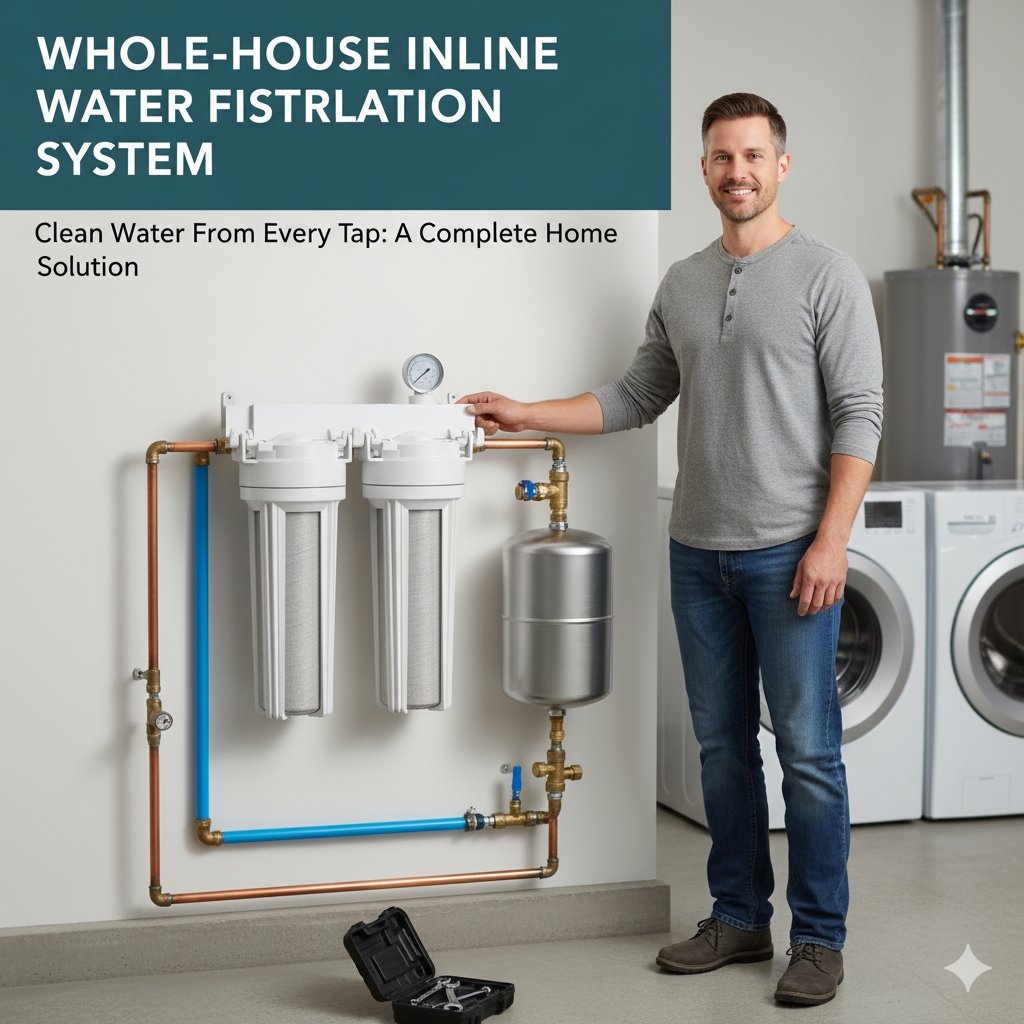
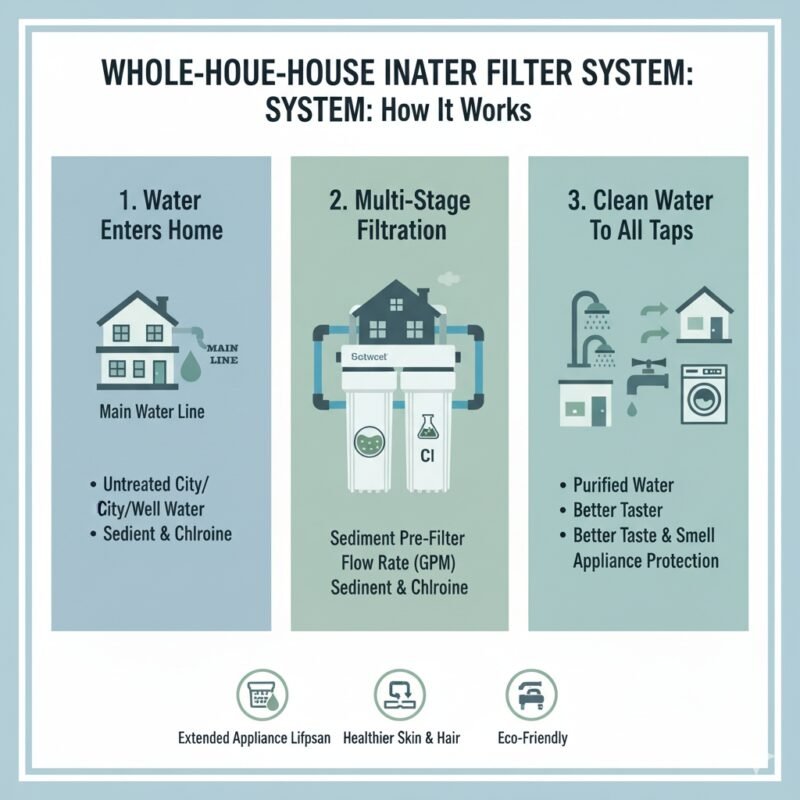
A whole house inline water filter system is a point-of-entry treatment configuration that uses one or more inline filter modules or cartridges installed directly into the incoming main water line or into a small manifold so that every tap and appliance receives filtered water. Unlike large tank-style systems (e.g., media vessels or softeners) that sit vertically in a mechanical room, inline systems prioritize a smaller footprint: capsules, cartridge housings, or stacked inline modules are plumbed into the main line and usually mounted horizontally or vertically along the piping.
Key features:
- POE coverage: treats water at the building inlet so showers, dishwashers, washing machines and faucets all benefit.
- Compact footprint: cartridges and inline modules are smaller than 9″×48″ vessels and can fit into tight mechanical areas.
- Modular design: stages can be added or swapped (sediment → carbon → specialty media → UF) without large vessels.
- Ease of integration: often uses standard pipe fittings and can be combined with pressure-relief / bypass valves.
Inline whole-home designs are especially useful where space is tight, where homeowners want POE protection but dislike huge tanks, or when a staged cartridge approach provides the exact contaminant coverage desired.
2. What problems can (and can’t) a whole house inline water filter system solve?
Understand capabilities before you buy.
Common problems it can solve
- Sediment / rust / particulates: by using appropriately rated spun or pleated sediment cartridges (1–50 µm).
- Chlorine taste & odor: carbon block or GAC inline modules remove free chlorine and many organics.
- Chloramine (if catalytic carbon used): special catalytic carbon cartridges can handle chloramines.
- Lead & certain heavy metals (with certified cartridges): inline cartridges certified to NSF/ANSI 53 for lead can reduce lead at the POE.
- Targeted removal of specific contaminants: specialty inline media for PFAS or arsenic exist — verify capacity and certification.
What inline whole-home systems usually do not handle well
- High TDS / dissolved salts: inline cartridges rarely remove large quantities of dissolved minerals — RO or nanofiltration is needed for that.
- Very high hardness at scale prevention: while some inline resin or conditioning options exist, serious hard water is typically handled by dedicated softeners or conditioners.
- Massive microbiological contamination: inline UF can handle bacteria/cysts in low-turbidity feeds, but microbial crises on well water often require UV + backwashing pretreatment.
- Extremely large flows for commercial properties: you’ll need multi-vessel systems or parallel trains for continuous high GPM.
Bottom line: an inline whole-house approach is great for aesthetic improvements, sediment protection, and moderate contaminant reduction — choose other technologies when dissolved solids, extreme hardness, or large-scale industrial flows are the problem.
3. Inline vs traditional vessel (tank) whole-house systems — tradeoffs
When comparing options, these tradeoffs matter.
Compactness & footprint
- Inline: small, lightweight, fits in tight spaces; easier for retrofits in finished basements/closets.
- Tank systems: require larger floor area; media change more cumbersome.
Flow & capacity
- Inline: limited media mass — may need more frequent cartridge changes or parallel banks for higher flows.
- Tanks: larger media beds give longer life between media replacement and better contact time for adsorption.
Customization & modularity
- Inline: modular swaps are easy — add or replace cartridges without draining tanks.
- Tanks: better for single-pass, long-life media like softening resin or large GAC beds.
Cost & maintenance
- Inline: typically lower initial cost; higher consumable frequency; simple DIY swaps possible.
- Tanks: higher initial investment but lower swap frequency; professional media handling sometimes required.
Performance & certifications
- Inline: some inline cartridges have NSF certifications; however, achieving certain health claims (PFAS, high lead reductions) may be more reliably done with larger bed volumes.
- Tanks: easier to design for long contact times required to meet certain certified reduction capacities.
There’s no single right answer — pick inline if space, cost, and modular upgrades are priorities and your water test suggests media capacity is sufficient.
4. How to assess your water — the first, essential step
Never pick treatment technology without testing.
Minimum tests to order from a certified lab
- Basic chemistry: pH, TDS, hardness (as CaCO₃ mg/L or gpg).
- Chlorine / chloramine: quick indicator for carbon needs.
- Iron / manganese: staining and fouling risks.
- Metals: lead and copper (especially for older homes).
- Turbidity / TSS: sediment load.
- Microbial: total coliform/E. coli for well users.
- PFAS / VOCs: if you suspect industrial exposure or have local alerts.
How to use results
- Map contaminants to media: sediment → polypropylene; chlorine → carbon; chloramine → catalytic carbon; lead → certified lead cartridge; PFAS → GAC/anion exchange or POU RO for full certainty.
- Identify challenge levels: a trace of chlorine is different from high chloramine; certified cartridge capacity may be insufficient for very high concentrations.
Make the lab report the first page of any RFQ you send to vendors — it forces accurate proposals rather than generic sales pitches.
5. Designing the staged whole-house inline system — common configurations
These are practical, proven stage stacks you’ll encounter.
Basic budget POE inline: Sediment → Carbon
- Stage 1: 10″ or 20″ spun PP 5-10 µm sediment for gross particulate.
- Stage 2: Inline carbon block (10″×2.5″ or capsule) for chlorine/taste at the main feed.
- Best for municipal water with taste/odor complaints and light sediment. Low cost, easy swap schedule.
Balanced protection: Sediment → Carbon → Post Sediment/Polishing
- Stage 1: 5 µm sediment.
- Stage 2: carbon block for smell/taste and VOCs.
- Stage 3: fine 1 µm or pleated filter as polishing for sensitive appliances/ice makers.
- Good for moderate turbidity and better final clarity.
Scale-concern version: Sediment → Softening / TAC (inline) → Carbon
- Stage 2: template assisted crystallization (TAC) or compact inline softener if brine discharge is prohibited.
- Use when scale is a primary issue and you want compact footprint.
High-clarity + health claims: Sediment → Carbon → Specialty PFAS / Lead Cartridge → UF or POU RO at critical taps
- Inline specialty adsorptive cartridges target PFAS or lead; follow with UF for microbial safety or POU RO for drinking water.
- This combination is common where regulatory or health concerns exist.
High-flow or redundancy: Parallel inline banks
- Two identical inline trains in parallel with a manifold and bypass valves for service without downtime.
- Use for larger homes or where uninterrupted supply is essential.
Design choices should reflect lab results, desired claims, family size (flow), and maintenance appetite.
6. Sizing guidelines — match GPM & capacity to real household demand
Sizing is the single most common failure point. Undersized systems create pressure loss and unhappy residents.
How to calculate peak flow needs (simple method)
- Estimate simultaneous fixtures: two showers (2.5 GPM each) + dishwasher (2 GPM) + washing machine (3 GPM) + kitchen faucet (2.5 GPM) = 12.5 GPM.
- Add 25–30% safety margin → design for ~16 GPM.
- If your house or family is smaller, 6–8 GPM might suffice.
What to check on cartridge specs
- Service flow (GPM): rated flow at acceptable pressure drop.
- Max pressure drop at rated flow: prefer ΔP <10–15 psi for comfortable service.
- Rated gallons or media capacity: gives expected life in gallons or months — convert to calendar time using household usage (approx 80–100 gallons per person per day is a rough house consumption baseline, but drinking water usage for a POE may be lower — use measured hot/cold split if possible).
Parallel vs bigger cartridges
- For homes requiring >10 GPM, either select larger inline housings in parallel or move to multi-vessel tanks. Parallel inline banks with a manifold are a common compact solution.
In short, always choose systems whose rated service flow at acceptable ΔP exceeds your peak.
7. Installation checklist — plumbing, valves and commissioning
Professional installers are recommended for code compliance; if you do a DIY install, follow these essentials.
Pre-installation steps
- Shut off main water and relieve pressure.
- Pick mount location with clearance for cartridge changes. Prefer a wall-mounted bracket or cabinet panel with room for removal.
- Install isolation and bypass valves so you can service without shutting off the entire house. A full-bypass ball valve arrangement is essential.
- Install pressure gauges upstream and downstream to monitor ΔP over time.
Plumbing considerations
- Use appropriate pipe material (copper, PEX, or schedule-appropriate PVC).
- Avoid saddle valves — use a proper tee and shutoff.
- Ensure fittings match the service line (1″, 3/4″, 1/2″ etc.). Inline housings for whole-home use are usually sized for these larger diameters.
Commissioning steps
- Slowly pressurize the system and check for leaks.
- Flush each stage per manufacturer instructions (carbon often needs several liters to remove fines).
- Record inlet/outlet pressure and initial TDS/chlorine readings. Label cartridges with install date and expected replacement month.
Code & backflow
- Install backflow prevention if local code requires; always comply with municipal plumbing rules.
A proper bypass and pressure monitoring turn a simple inline installation into a robust long-term solution.
8. Maintenance plan and realistic replacement intervals
Maintenance is where budget surprises come from — plan ahead.
Typical replacement guidance (estimate)
- Sediment cartridges (5–10 µm): replace every 3–6 months depending on particulate load.
- Carbon block modules: replace every 6–12 months depending on chlorine levels and household use.
- Specialty adsorbents (PFAS/lead): replace per certified gallon rating — often 6–12 months for POE.
- Inline UF membranes (if used): 1–3 years depending on fouling.
- O-rings & mounting hardware: inspect annually; replace as needed.
- Pressure gauges: verify annually.
Monitoring
- Track ΔP (inlet vs outlet) — rising ΔP indicates clogging.
- Monitor taste/odor — return of chlorine is an early sign of carbon exhaustion.
- Keep a maintenance log with install dates and next due dates; automated reminders or subscription replacements reduce risk of lapses.
Cost considerations
- Typical annual consumable cost for a whole-house inline setup for a family (sediment + carbon) can range from $100–$400/year, depending on cartridge type and water quality. Specialty cartridges will cost more.
Budget for both parts and occasional professional service to replace complex cartridges or troubleshoot leaks.
9. Troubleshooting common problems
Short guide to fix the typical issues.
Low flow / pressure loss
- Check bypass valves for partial closure.
- Inspect ΔP — clogged sediment or carbon. Replace cartridges if ΔP high.
- Ensure correct cartridge orientation and that no internal bypass (if multi-stage head) is stuck.
Return of chlorine taste
- Likely carbon exhaustion or insufficient contact time. Replace carbon, consider larger bed or additional carbon stage.
Leaks at fittings or housings
- Depressurize, inspect O-rings, lubricate with food-grade silicone grease, and re-seat housings. Replace cracked housings.
Off-tastes after replacement
- Probably inadequate flushing. Flush per instructions; discard initial water/ice until neutral.
Rapid cartridge exhaustion
- Indicates high contaminant loading — upgrade prefilter, add upstream sediment trap, or shorten replacement interval.
When in doubt, gather photos, model numbers, and lab tests and contact vendor support.
10. Costs: what to expect (purchase, install, and running costs)
Approximate bands (U.S. residential context; vary by region and brand):
- Inline housings & basic cartridges (equipment only): $150–$600.
- Professional install with bypass and gauges: $300–$1,200 depending on complexity and plumber rates.
- Consumables per year (sediment + carbon): $100–$400.
- Specialty cartridges (PFAS/lead): $50–$200 each; annual cost higher.
- Parallel banks or higher-capacity inline housings: add $200–$1,000 to equipment.
Do a 3- to 5-year total cost of ownership (TCO): equipment + installation + (annual consumables × years) + periodic service.
11. Certification, claims, and how to verify them
If a vendor claims reduction of a health contaminant, insist on:
- NSF/ANSI certificate for the exact SKU and reduction claim (e.g., 53 for lead).
- Third-party lab test reports showing challenge conditions.
- Cert numbers that you can verify on certification body websites.
Marketing language like “removes heavy metals” is meaningless without certificates and tested capacities. For PFAS and other emerging contaminants, carefully review species tested and bed-life under your concentration.
12. Environmental & practical considerations
- Waste & recycling: spent cartridges create plastic/media waste; ask about supplier take-back or recycling.
- Water efficiency: inline systems typically do not produce reject water (unlike RO) — good when water conservation matters.
- Space & access: ensure you can access and lift cartridges; heavy large inline modules may still need two people.
- Emergency bypass: having accessible bypass valves avoids major disruption during service.
Balance performance needs and sustainability choices when selecting media and replacement cadence.
13. Buying checklist — what to demand from vendors
Use this checklist to compare proposals:
- Exact model numbers and part numbers for cartridges.
- Rated service flow (GPM) and pressure drop curves.
- Expected cartridge life in gallons and months for your lab results.
- Certification PDFs for any health claims.
- Itemized installation scope (labor hours, materials, bypass, gauges).
- Warranty terms and consumable availability (local stock & lead times).
- Spare parts pack (O-rings, bracket, wrench) included or optional.
- Commissioning test plan (inlet/outlet TDS, chlorine, pressure).
- Service contract options & emergency response times.
- Recycling or disposal program for spent cartridges.
Get everything in writing and compare line-by-line.
14. When to choose something else
Choose a non-inline or different technology if:
- You need whole-house demineralization (TDS reduction) — choose RO or other specialty tech.
- Your hardness exceeds local thresholds and scale is rapid — salt softeners or large capacity systems might be more economical.
- You have very high sediment loads — backwashing multi-media tanks are more forgiving.
- You need certified long-term reduction for PFAS at whole-home scale — often a hybrid POE + POU approach is more reliable.
Inline is excellent for many situations, but not a universal replacement for all whole-home needs.
15. Final decision roadmap — how to pick the right whole house inline water filter system
- Get a certified water test. This is non-negotiable.
- Define outcomes: aesthetics, scale prevention, health claims, or appliance protection.
- Size for peak flow and select cartridges with rated flows above that peak.
- Require certification for any health claims.
- Insist on bypass, gauges, and commissioning in the install scope.
- Plan maintenance & budget for consumables in a 3-5 year TCO.
- Choose a local installer or vendor with fast consumable delivery and clear warranty terms.
To compare specs and consumables, see our 2-stage whole house water filter for homes.
Conclusion
A whole house inline water filter system can be an excellent choice when you want POE protection without a large tank footprint, when modularity and easy retrofits matter, and when your water test shows contaminants that inline media can handle effectively. The keys to success are a good water test, correct sizing for peak flow, verified performance claims, a robust bypass and commissioning plan, and a disciplined maintenance schedule.
Follow the steps in this guide, use the vendor checklist to compare proposals, and budget for consumables. Do that and you’ll get clean, protected water at every tap — with predictable costs and simple, regular upkeep.