
inline water filtration — small footprint, big impact: the practical guide for homes, appliances&small businesses

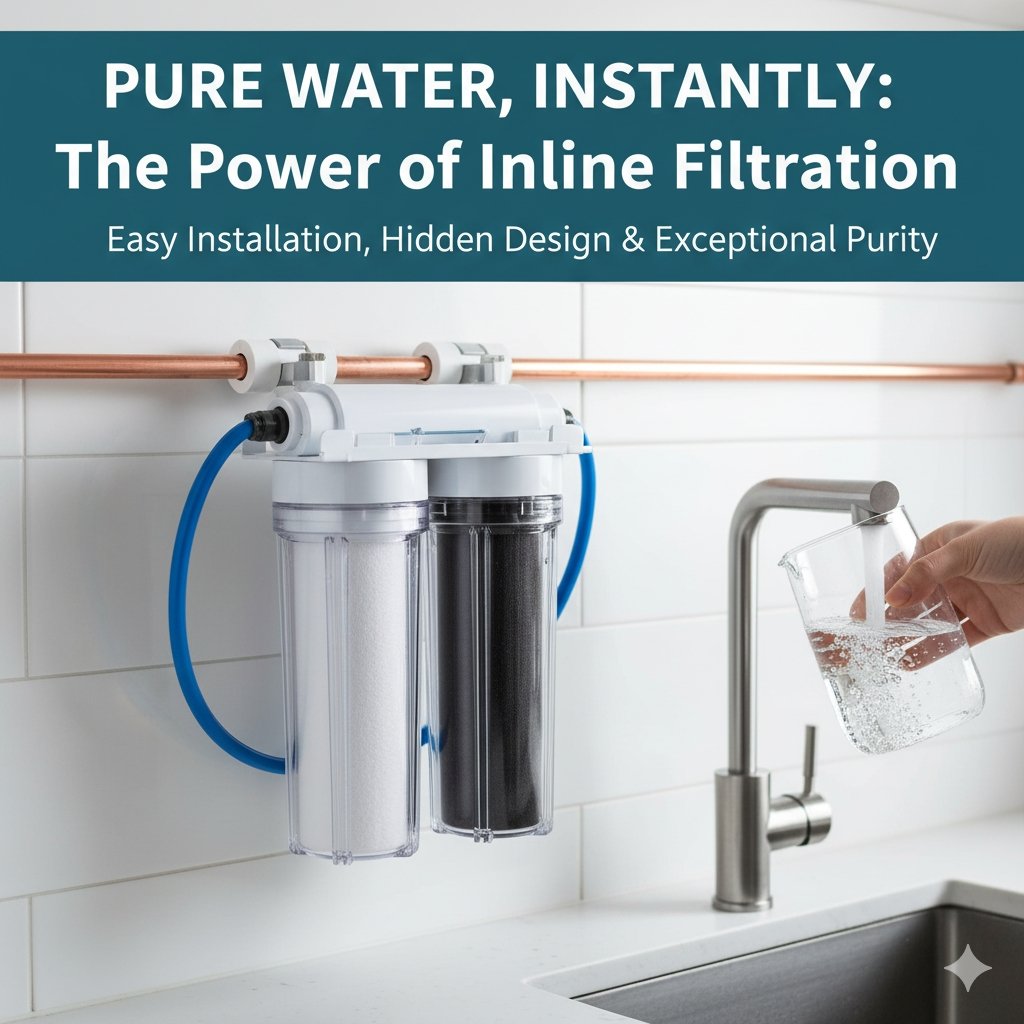
This topic is covered in full in our main guide: Inline Water Filter for Home: The Complete Guide (Benefits, Types, Installation, Costs & Maintenance).
If you searched inline water filtration, you probably want a compact, reliable way to improve water at a point-of-use (POU) or for a specific appliance without running a full under-sink system or whole-house installation. Inline filters are low-profile, easy to install, and cost-effective — but they’re not one-size-fits-all. This in-depth guide explains exactly what inline water filtration is, where it makes sense, the common media and cartridge types, how to size and install them correctly, maintenance expectations, certification and verification tips, realistic performance trade-offs, environmental considerations, and an actionable buying checklist so you get a system that performs for years.
If you want to compare specs while you read, consider referencing a practical whole-house product for sizing and consumable planning: 2-stage whole house water filter for homes.
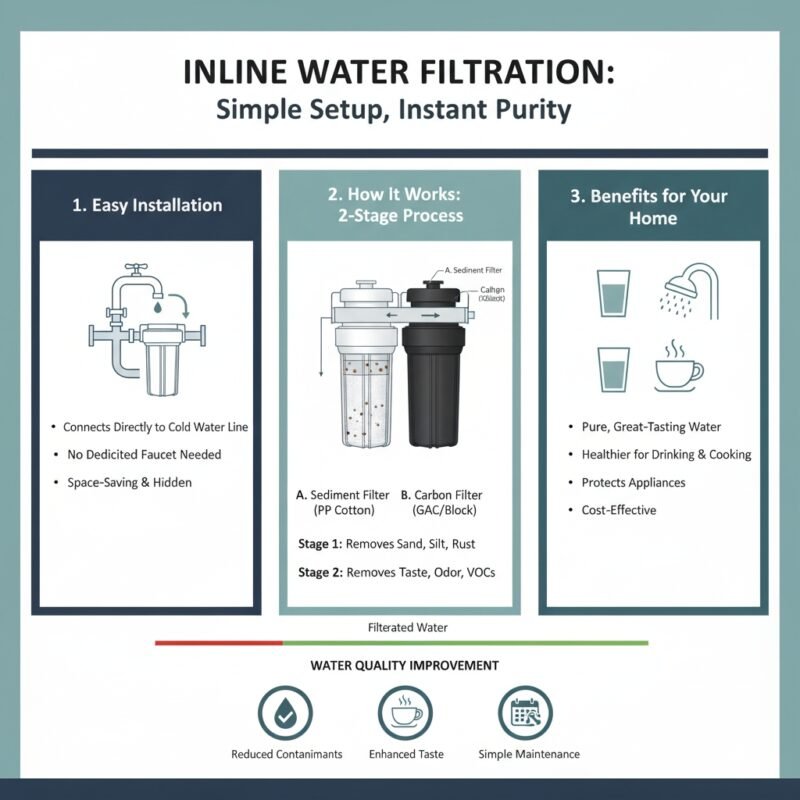
1. What is inline water filtration?
Inline water filtration refers to compact filter cartridges or modules that are plumbed directly into a water line — typically a 1/4″, 3/8″ or 1/2″ tube — and treat water as it flows to a single device (refrigerator, ice machine, coffee maker), a point-of-use faucet, or part of a small distribution loop. Unlike oversized housings or under-sink multi-stage systems, inline filters are built for small footprint applications where space is limited or where you want a dedicated treated line.
Key characteristics:
- Low profile and compact — often cylindrical capsules or slim cartridges.
- Plumbed directly into tubing with push-fit or compression fittings.
- Designed for point-of-use protection (foodservice appliances, fridges, coffee equipment) or for small under-sink installs.
- Typically single-use cartridges with defined rated capacity and replacement intervals.
Inline modules come in widely varying performance levels — from simple sediment guards to catalytic carbon or specialty adsorbents — so selecting the right media for the job is the essential first step.
2. When inline water filtration is the right choice
Inline filtration is ideal when your goal is targeted treatment rather than whole-house coverage.
Good use-cases:
- Protecting an ice maker or refrigerator from sand, rust and chlorine taste.
- Supplying a coffee machine or espresso machine with filtered water to protect boilers and improve flavor.
- Delivering potable-quality water to a dedicated kitchen tap for drinking and cooking.
- Providing a final polishing stage after a larger pre-treatment upstream.
- Installing temporary or rental-friendly solutions where permanent plumbing modifications aren’t desirable.
Situations where inline may be insufficient:
- You need whole-home protection (appliances, showers, laundry) — choose POE systems.
- You need very low TDS or dissolved-salt removal — RO is usually required and RO systems are not typically inline capsules.
- Your water has serious microbial problems — UF/UV or larger, certified systems are better.
- High-volume continuous flows exceed the rated GPM of the inline cartridge.
If your problem is localized (one appliance or one faucet), inline water filtration often gives the best balance of cost, convenience and performance.
3. Common inline filter types and what they remove
Understanding media types is the critical technical step. Here are the most common inline cartridges and what they do.
3.1 Sediment inline cartridges
- Purpose: trap particulates like sand, rust, and scale flakes.
- Micron ratings: from 50 µm down to 1 µm. Larger µm — coarser filtration and longer life; smaller µm — protects delicate downstream devices (like espresso machines or RO membranes).
- Form factors: slim inline capsules for tubing, or short 10″ style cartridges when used in small housings.
Best used upstream of carbon or membranes to prevent clogging.
3.2 Carbon block / GAC inline modules
- Purpose: remove free chlorine, taste and odor, some organics and VOCs.
- Variants: carbon block (denser, better particulate removal) and GAC (granular, often lower pressure drop). Catalytic carbon is a special type optimized for chloramine removal.
- Use-case: polishing taste for drinking water, ice clarity, and to protect appliances from chlorine corrosion.
Carbon is the most common inline choice for improving taste.
3.3 Specialty adsorbents (lead, PFAS, arsenic)
- Purpose: targeted removal of specific contaminants using engineered resins or activated carbons with tailored chemistry.
- Important: always insist on third-party certification or lab challenge results for the exact SKU. Performance is species- and concentration-dependent.
These cartridges are used when lab tests or local advisories indicate specific contaminants.
3.4 Inline ultrafiltration (UF) modules
- Purpose: physical barrier for bacteria, cysts and colloidal particles (does not remove dissolved salts).
- Use-case: areas with microbial risk but low turbidity. UF modules must be protected by sediment prefilters and used in appropriate scenarios.
3.5 Inline ion-exchange cartridges
- Purpose: remove certain dissolved ions (e.g., softening small flows, targeted metal removal).
- Use-case: niche applications like polishing espresso machines, or small-scale demineralization.
4. Performance specs that matter
When comparing inline cartridges, read the small print. The following specs are the most important.
- Rated flow (GPM): ensure the cartridge supports peak instantaneous flow required by the device. Undersized inline filters cause pressure drops and starve appliances.
- Rated capacity (gallons): how many gallons the cartridge treats for its target contaminant before exhaustion. Converts to calendar life based on usage.
- Micron rating (nominal vs absolute): nominal ratings (common) indicate approximate removal percentages; absolute means near-complete removal at that particle size.
- Pressure drop (psi) at rated flow: lower is better for appliances sensitive to inlet pressure.
- Operating temperature range: cold climates or hot-water exposure can damage many inline filters.
- Certifications: NSF/ANSI 42, 53, 401 or other relevant standards for health claims — only trustworthy vendors have these.
- Material compatibility: ensure body materials and O-rings match your tubing and water chemistry (EPDM, Viton, etc.).
Always match rated flow and pressure drop to your appliance’s inlet requirements.
5. Sizing inline water filtration for your application
Sizing inline filters is simpler than POE, but mistakes still happen.
Step A — Identify peak demand:
- For a fridge water line, typical flows are low (0.1–0.5 GPM) and intermittent — choose cartridges rated for low continuous flow but long life.
- For a coffee machine, consider the machine’s flow during back-to-back shots or steam cycles — instantaneous demand may be several liters/minute.
- For a dedicated drinking faucet, choose a cartridge rated for faucet flow (often 0.5–1.5 GPM).
Step B — Convert capacity to calendar life:
- Example: a carbon inline cartridge rated 10,000 gallons for chlorine and used on a faucet that treats 5 gallons/day: life = 10,000 ÷ 5 = 2,000 days (~5.5 years). In practice, manufacturer ratings assume typical challenge levels — use a safety margin: replace earlier.
Step C — Add pretreatment where needed:
- If feed water has heavy particulate load, add a coarse sediment upstream to avoid rapid carbon fouling.
Sizing conservatively avoids premature exhaustion and performance loss.
6. Installation basics — simple, reliable steps
Inline installations are often DIY-friendly but must be done correctly.
Tools and materials:
- Tubing cutter, push-fit connectors or compression fittings, mounting brackets (if provided), shutoff valve, bucket/towel for flush, and plumber’s tape for threaded fittings.
Practical steps:
- Shut off feed to the device and relieve pressure.
- Select mounting location with clearance for cartridge removal. Many inline units have mounting brackets or can be placed inside cabinets.
- Cut tubing square — a clean cut prevents leaks in push-fit fittings.
- Observe flow direction — most inline cartridges have an inlet/outlet arrow. Install accordingly.
- Insert tubing fully into push-fit fittings or tighten compression nuts per manufacturer torque. Avoid over-tightening.
- Turn feed on slowly and inspect for leaks.
- Flush thoroughly as directed (carbon often requires several liters of flush to remove fines).
- Label installation date on cartridge or bracket and set a replacement reminder.
Avoid using saddle valves — use proper tees and isolation valves for durability and reliability.
7. Maintenance: change intervals and practical signals
Inline filters are consumables — consistent replacement keeps performance predictable.
Typical intervals:
- Sediment inline capsules: 3–12 months depending on turbidity.
- Carbon inline modules: 6–12 months for many residential applications; high-chlorine or heavy-use lines may need 3–6 months.
- Specialty cartridges (lead, PFAS): follow the certified gallon capacity — often 6–12 months or as specified.
- UF modules: 12–24 months depending on fouling rates and prefiltration.
Practical replacement triggers:
- Return of taste/odor (chlorine smell) — carbon exhausted.
- Noticeable drop in flow — sediment clogging.
- Manufacturer-rated gallons reached — use calendar math and safety margin.
- Visible discharge or discoloration — immediate replacement.
Keep a spare cartridge on hand for critical appliances (ice machines, espresso). Date-stamp each install and create a simple log or calendar reminder.
8. Certification and validation — what to demand
If you’re buying a cartridge that claims to remove lead, PFAS, cysts, or other health-related contaminants, demand proof.
- NSF/ANSI standards: NSF 42 (aesthetic), NSF 53 (health-related reductions), NSF 401 (emerging contaminants), NSF 58 (RO) — these are widely recognized.
- Exact SKU certificates: insist the certificate matches the model and batch if possible — marketing alone is not sufficient.
- Third-party lab challenge reports: for niche claims (PFAS, specific VOCs) ask for challenge-tests under realistic matrices and for the removal capacity in mg or ug per kg of media.
- Warranty & replacement terms: verified performance often requires following the manufacturer’s maintenance schedule — get warranty terms in writing.
If a vendor refuses to provide documentation, treat the claims skeptically.
9. Common performance trade-offs: contact time, capacity and pressure drop
Inline cartridges are compact, so they have inherent trade-offs:
- Contact time vs removal efficiency: adsorption-based removal (like carbon for chloramine or PFAS) benefits from longer contact time and greater media volume. Inline cartridges are limited; for challenging contaminants, beat them with larger vessels or POU RO.
- Capacity vs size: small capsules have limited capacity — they require frequent replacement in heavy-use settings. Consider 20″ elements or larger inline banks when capacity matters.
- Pressure drop vs fineness: very fine micron ratings increase ΔP at higher flows; match micron rating to device demand.
Design systems with these trade-offs in mind: protect sensitive downstream equipment with prefiltration, choose larger cartridges where possible, and monitor performance.
10. Inline water filtration in commercial settings
Inline filters are widely used in light commercial and hospitality contexts but require more planning.
Applications:
- Ice machines, espresso machines, beverage dispensers, medical devices, laboratory point-use lines.
Commercial considerations:
- Higher duty cycles — replace cartridges more often based on application throughput.
- Redundancy — provide parallel inline modules or quick-change bypasses to avoid downtime.
- Service contracts — schedule professional cartridge swaps for critical equipment.
- Recordkeeping — retain replacement logs for warranty and health-inspection requirements.
In commercial deployments, total cost of ownership (consumables + labor) often outweighs upfront price — plan accordingly.
11. Environmental considerations — waste and disposal
Inline filters create waste: spent cartridges and packaging. Minimize environmental impact:
- Choose longer-life or pleated cartridges where possible (they often last longer and sometimes can be rinsed).
- Manufacturer take-back programs — some vendors collect used cartridges for recycling or safe disposal. Ask suppliers about returns.
- Proper disposal for spent specialty media — if media captured heavy metals or concentrated organics, follow local hazardous-waste rules; don’t throw them in general trash blindly.
- Packaging choices — prefer suppliers who use minimal or recyclable packaging.
Responsible disposal and selection reduce your environmental footprint.
12. Troubleshooting quick guide
Symptoms and common fixes:
- Leak at push-fit: tubing not fully seated or not cut square. Fix: depressurize, recut tubing square, reinsert.
- Low flow after install: kinked tubing, partial valve closed, or wrong cartridge rating for flow. Fix: inspect tubing, confirm valves, and verify cartridge flow rating.
- Chlorine taste persists: carbon exhausted or wrong carbon type (not catalytic where chloramine present). Fix: replace cartridge with correct certified carbon.
- Water smell after change: insufficient flushing of carbon fines. Fix: flush per manufacturer instructions (often many liters).
- Frequent clogging: no upstream coarse sediment or incoming turbidity spikes — add coarse prefilter or upgrade to pleated element.
Document issues and keep model numbers handy when contacting vendor support.
13. Cost summary and budgeting
Inline systems are economical but plan for consumables.
Typical costs:
- Inline sediment capsule: $5–$25 each.
- Inline carbon module: $15–$80 depending on media and certifications.
- Specialty cartridges (lead/PFAS): $40–$200.
- Installation materials (fittings, valves): $10–$60.
- Professional installation (if needed): $50–$200 depending on complexity and local rates.
Estimate annual cost by summing replacement frequency × cartridge price. For critical equipment, budget for quarterly or semiannual replacements.
14. Buying checklist — what to request before you buy
- Confirm the exact phrase you searched: “inline water filtration” — select products explicitly designed for inline use (tubing fittings).
- Request flow & ΔP curves from the vendor for your expected flow.
- Get rated capacity in gallons and the assumptions behind it (chlorine level, flow rate).
- Ask for certification PDFs for any health claims (lead, PFAS, cysts).
- Check fittings compatibility (1/4″, 3/8″ tubing or compression).
- Verify temperature range and whether the unit is rated for hot or cold lines.
- Confirm spare parts availability and lead time for replacements.
- Ask about take-back or recycling options for spent cartridges.
- Request installation instructions and recommended flush volumes.
This checklist prevents mismatches that cause poor performance or wasted money.
15. Final decision framework — pick the right inline solution now
Follow this simple decision tree:
- Is the problem localized to one appliance or tap? → if yes, inline water filtration is a good fit.
- Is the issue chlorine or taste only? → choose an inline carbon block module sized for faucet flow.
- Is there particulate causing clogging or scale? → add a sediment inline prefilter or use a pleated cartridge.
- Are there health-related contaminants (lead, PFAS)? → use certified specialty inline cartridges or prefer point-of-use RO where inline media is not certified for your needs.
- Is flow or pressure critical for the appliance? → check rated GPM and ΔP, and use larger cartridges or parallel arrangement if needed.
- Do you need continuous uptime? → design redundancy or quick-change bypasses.
Inline water filtration delivers excellent value when chosen and maintained correctly. Small, targeted, and affordable — the right inline arrangement protects appliances, improves taste, and keeps maintenance predictable.2-stage whole house water filter for homes.
16. Closing: actionable next steps
- Test your water where the appliance connects (simple TDS, chlorine test strips or lab tests for more detail).
- Define the treated flow (fridge, espresso, faucet) and peak demand.
- Use the buying checklist above to request vendor data and certifications.
- Install with proper fittings and flush thoroughly after the first install.
- Set reminders for cartridge replacement and keep a spare cartridge on hand for critical lines.
Inline water filtration is a practical, cost-effective way to target water quality where it matters most. When you match media to the contaminant, size the cartridge for flow, insist on verified performance and maintain on a schedule, inline filters will quietly protect appliances and deliver better tasting water for years.