
Finding the Best Water Filter for City Water: A Complete Guide for Homes


Living in the city comes with many perks—convenience, culture, and connectivity. However, one aspect of urban living that often leaves residents wanting more is the quality of the tap water. While municipal water treatment plants do a commendable job of removing major pathogens and ensuring water is technically “potable,” the journey from the plant to your glass is fraught with variables. This reality has led millions of homeowners and small business owners to search for the best water filter for city water to ensure their health, safety, and enjoyment.
In this extensive guide, we will explore why city water often needs extra help, the different technologies available, and how to choose the right system for your specific needs—whether you are a family in an apartment or a café owner looking to brew the perfect espresso.https://yourwatergood.com/product/whole-house-water-filtration-system-for-home/&https://yourwatergood.com/product/ro-water-purifier/.
The Reality of Municipal Water
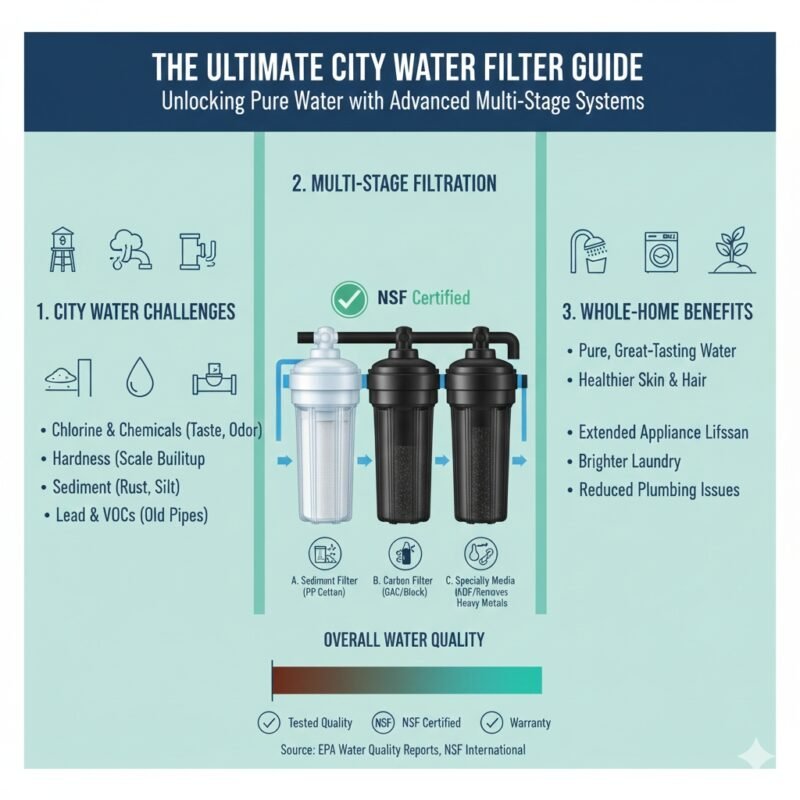
To understand why you need a filter, you must first understand what is currently coming out of your tap. Municipal water is treated with chemicals, primarily chlorine or chloramines, to kill bacteria and viruses. While this is necessary for public health, it leaves the water with a distinct chemical taste and odor.
Furthermore, once the water leaves the treatment plant, it travels through miles of aging infrastructure. In many cities, these pipes are decades, sometimes over a century, old. They can leach contaminants into the water supply before it ever reaches your home.
Common Contaminants in City Water
- Chlorine and Chloramines: used for disinfection. They dry out skin and hair and give water a bleach-like taste.
- Lead: Leached from old service lines and plumbing fixtures. There is no safe level of lead exposure.
- PFAS (Forever Chemicals): Emerging contaminants found in many municipal supplies that standard treatment does not remove.
- Microplastics: Tiny plastic fibers that have permeated water sources globally.
- Sediment and Rust: Particles that flake off from aging municipal pipes.
finding the best water filter for city water is about addressing these specific urban contaminants. It is not just about removing bacteria (which the city already does); it is about removing the chemicals used to kill that bacteria, and the heavy metals picked up along the way.
! Alt: Clean water glass demonstrated by a pp cotton household water purifier company utilizing advanced filtration.
Defining Your Needs: Point of Use vs. Point of Entry
When evaluating the market, you will encounter two main categories of filtration. The “best” solution depends on whether you want to filter water at a single tap or for the entire building.
1. Point of Use (POU)
These systems filter water right where you drink it. This includes pitcher filters, faucet mounts, and under-sink systems. They are generally dedicated to providing drinking and cooking water.
2. Point of Entry (POE)
These are “Whole House” systems installed at the main water line. They filter every drop of water entering the property, ensuring that the water you shower in is just as clean as the water you drink.
The Gold Standard for Drinking: Reverse Osmosis
If your primary goal is to have the absolute purest drinking water possible—removing dissolved solids, fluoride, and heavy metals—then the best water filter for city water is arguably a Reverse Osmosis (RO) system.
How RO Works
Reverse Osmosis works by forcing water through a semi-permeable membrane with microscopic pores. These pores are small enough to let water molecules pass but block larger molecules like salts, lead, and chemical compounds.
For city dwellers, an RO system is particularly effective because it removes the “hard” taste of city water and the chemical aftertaste of chlorine. It essentially resets your water to a blank slate.
If you are looking for a high-efficiency solution that fits neatly under your sink, we highly recommend investigating the RO Water Purifier. This unit is designed to tackle the specific profile of municipal water, removing up to 99% of contaminants while retaining a user-friendly design that makes filter changes simple.
Why RO is Crucial for Small Businesses
For our readers running small restaurants or coffee shops, water is an ingredient, not just a utility.
- Coffee: Chlorine ruins the crema on espresso and introduces bitterness to drip coffee.
- Ice: Impurities in city water cause cloudy, soft ice that melts quickly and dilutes drinks.
- Soups and Stocks: When you reduce a stock, you concentrate flavors. You do not want to concentrate the flavor of chlorine.
An RO system provides the neutral, consistent base required for culinary excellence.
The Comprehensive Solution: Whole House Filtration
While RO is fantastic for drinking, it is not typically feasible to run an entire house or restaurant on it without massive industrial equipment. For general protection—showering, laundry, and appliances—a Whole House Filtration System is the best water filter for city water.
The Problem with Showering in City Water
Your skin is your body’s largest organ, and it is porous. When you take a hot shower, two things happen:
- Absorption: Your skin absorbs residual chlorine and other chemicals.
- Inhalation: The steam vaporizes these volatile chemicals, and you inhale them into your lungs.
Many people who suffer from dry, itchy skin or eczema find relief simply by installing a whole-house filter that removes chlorine.
Protecting Your Investment
City water often contains sediment and hardness minerals (calcium and magnesium). Over time, sediment builds up in your water heater, reducing its efficiency and lifespan. Hardness causes scale buildup on faucets, showerheads, and inside expensive appliances like dishwashers and washing machines.
A robust central system acts as a firewall for your property. If you are ready to protect your plumbing infrastructure and improve your family’s health, consider the Whole House Water Filtration System for Home. This system is engineered to handle high flow rates, ensuring that you don’t experience pressure drops while simultaneously running the shower and the dishwasher.
! Alt: Whole house system installation by a pp cotton household water purifier company ensuring safe city water.
Key Components of a Top-Tier Filter
Whether you choose an under-sink RO or a Whole House unit, the “best” systems share common high-quality components. Understanding these will help you shop smarter.
The Unsung Hero: PP Cotton
You will often see “PP Cotton” listed as the first stage of filtration. Polypropylene (PP) cotton is critical for city water.
- Function: It acts as a physical barrier for sediment, rust, sand, and visible particles.
- Importance: Without a high-quality PP cotton pre-filter, the more expensive carbon blocks and RO membranes would get clogged with city grit within weeks.
- Maintenance: This is usually the cheapest filter to replace, but changing it regularly protects the longevity of the entire system.
Activated Carbon Block
Loose granular carbon is okay for pitchers, but for a plumbed-in system, you want a solid Carbon Block.
- Function: Adsorbs chlorine, VOCs (Volatile Organic Compounds), and bad odors.
- Efficiency: A block structure forces water to travel through a dense matrix of carbon, increasing contact time and removal rates compared to loose granules.
Selecting the Right System for Your Scenario
To determine the best water filter for city water for you, compare these scenarios:
Scenario A: The Apartment Renter
- Constraint: Cannot cut pipes or modify plumbing extensively.
- Solution: A countertop RO unit or a high-quality under-sink filter that connects to the faucet aerator.
- Focus: Drinking water quality.
Scenario B: The Homeowner
- Constraint: None. Seeking long-term value.
- Solution: A “One-Two Punch.” Install a Whole House Water Filtration System for Home to remove chlorine and sediment at the entry point. Then, install an RO Water Purifier in the kitchen for ultra-pure drinking and cooking water.
- Benefit: The whole house filter protects the RO membrane, making it last longer.
Scenario C: The Small Café Owner
- Constraint: High volume, equipment protection needed.
- Solution: A commercial-grade RO system with a blending valve (to retain some minerals for coffee flavor) or a high-capacity whole-business filtration system to protect the espresso machine boiler from scale.
Installation and Maintenance: The True Cost of Ownership
When researching the best water filter for city water, do not look at the sticker price alone. Consider the Total Cost of Ownership (TCO).
DIY vs. Professional Installation
- Under-Sink Systems: Most modern RO systems are designed for DIY installation. They use quick-connect fittings (push-to-connect). If you can use a wrench and a drill, you can install one in about an hour.
- Whole House Systems: This usually requires cutting into the main copper or PEX line. Unless you are comfortable with plumbing soldering or crimping, hiring a professional is recommended to ensure no leaks occur.
The Maintenance Schedule
A filter that isn’t changed is worse than no filter at all.
- PP Cotton Pre-Filter: Change every 3 to 6 months. If you notice a pressure drop, change this first.
- Carbon Filters: Change every 6 to 12 months. When the chlorine taste returns, the carbon is exhausted.
- RO Membrane: Change every 2 to 3 years. This lasts longer if the pre-filters are maintained well.
Pro Tip: Write the date of installation on the filter cartridge with a permanent marker so you never forget when it was last changed.
! Alt: Maintenance of a unit from a pp cotton household water purifier company keeps city water fresh.
Environmental Impact: Filter vs. Bottle
One of the most compelling arguments for investing in the best water filter for city water is environmental stewardship.
The Plastic Problem
A family of four drinking bottled water consumes roughly 2,000 to 3,000 plastic bottles per year. Even with recycling, the carbon footprint of manufacturing, filling, and transporting those bottles is massive.
The Sustainable Choice
By switching to a home filtration system, you eliminate this waste.
- Modern Efficiency: Older RO systems wasted a lot of water (4 gallons wasted for 1 gallon made). However, modern systems like those found at YourWaterGood utilize advanced pumps and flow technology to drastically reduce wastewater, making them an eco-friendly choice.
Navigating Marketing Hype: What to Avoid
In your search, you will encounter buzzwords that mean very little. Here is how to filter out the noise.
- “Alkaline” without context: Some filters claim to be alkaline but just add cheap fillers. If you want alkaline water, look for an RO system with a dedicated remineralization stage using calcium or magnesium stones.
- “Maintenance Free”: No water filter is maintenance-free. If it catches dirt, it eventually clogs. If it catches chemicals, it eventually saturates. Be wary of systems claiming to last 5+ years without a filter change.
- “Zero Waste” RO: This is physically impossible with current technology. You can have high efficiency (low waste), but you cannot separate solids from water without a waste stream to carry the solids away.
The Verdict
So, what is the best water filter for city water?
It is the filter that addresses your specific water profile and fits your lifestyle.
- For Absolute Purity in your glass and for your cooking, the answer is Reverse Osmosis. It provides the safety and taste security that modern families demand.
- For Total Home Health, protecting your skin, hair, and appliances, the answer is a Whole House Filtration System.
Ideally, a combination of both provides the ultimate peace of mind.
For small business owners, particularly in the food and beverage sector, the “best” filter is one that ensures product consistency and equipment longevity. Clean water is the foundation of a good customer review.
Don’t let the quality of municipal water dictate your health or the taste of your morning coffee. Take control of your water supply today. Explore the comprehensive solutions available at www.yourwatergood.com and find the perfect match for your home or business.
Frequently Asked Questions (FAQ)
Q: Does boiling city water make it safe? A: Boiling kills bacteria and viruses, which is good during a “boil water advisory.” However, boiling does not remove lead, sediment, nitrates, or PFAS. In fact, boiling can concentrate these contaminants as the water evaporates. To remove chemicals and metals, you need filtration, not heat.
Q: Will a water filter reduce my water pressure? A: A properly sized Whole House Water Filtration System for Home should not noticeably reduce pressure. If you experience a pressure drop, it is usually a sign that the PP cotton sediment filter is doing its job and is clogged with city debris—it’s time to change it! RO systems have their own pressure tanks or pumps, so they deliver water at a steady flow regardless of line pressure.
Q: I rent an apartment. Can I still use these products? A: You likely cannot install a whole-house system in a rental. However, under-sink RO systems are often allowed if you have a hole for a soap dispenser in your sink (to install the faucet). Alternatively, many landlords are open to upgrades that improve the property value—it is worth asking!
Q: Why does my city water smell like a swimming pool? A: That is the chlorine. Municipalities must maintain a residual chlorine level to ensure water remains bacteria-free as it travels through pipes to your house. While safe to drink according to federal standards, it is unpleasant. An activated carbon filter (found in both our RO and Whole House systems) removes this taste and odor almost instantly.
Q: How do I know if I have lead in my water? A: You cannot taste, smell, or see lead. The only way to know is to test your water. If your home was built before 1986, you are at higher risk. An RO system is certified to remove lead, providing a safety net regardless of your pipe’s condition.