
The Unsung Hero of Purification: Why Every System Needs a PP Cotton Water Filter

This topic is covered in full in our main guide: PP Cotton Filter: What It Is and Why It Matters.
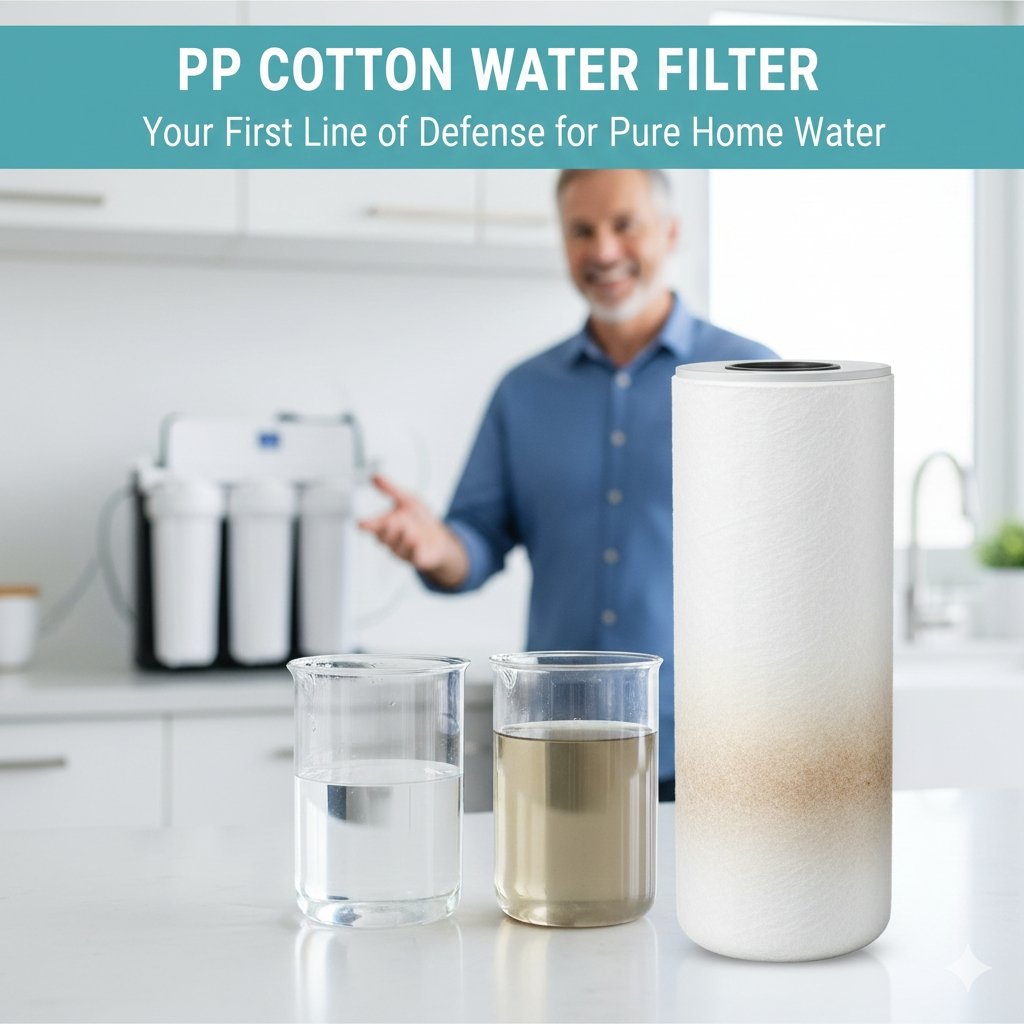
When we think about water filtration, our minds often jump to the advanced technologies: Reverse Osmosis membranes, UV sterilization lights, or complex ion-exchange resin tanks. We think of the “high-tech” components that strip away invisible chemicals and microscopic bacteria. However, in the engineering world of water treatment, there is a fundamental truth: the most sophisticated system is only as good as its first line of defense. That defense is the pp cotton water filter.
It is the workhorse of the industry. It is the shield that protects expensive equipment from destruction. Whether you are a homeowner trying to keep your laundry white or a coffee shop owner trying to save your espresso machine from a breakdown, this humble white cartridge is the most critical component in your setup.
In this comprehensive guide, we will tear down the science, the application, and the maintenance of the pp cotton water filter. We will explore why this specific material dominates the market, how to distinguish high quality from low quality, and why skipping this stage is a recipe for disaster.2-stage whole house water filter for homes.
What Exactly is a PP Cotton Water Filter?
To understand the filter, we must first understand the material. “PP” stands for Polypropylene. It is a non-toxic, odorless, and tasteless thermoplastic polymer. It is used in everything from food containers to medical equipment because it is chemically inert—it does not react with water or the contaminants within it.
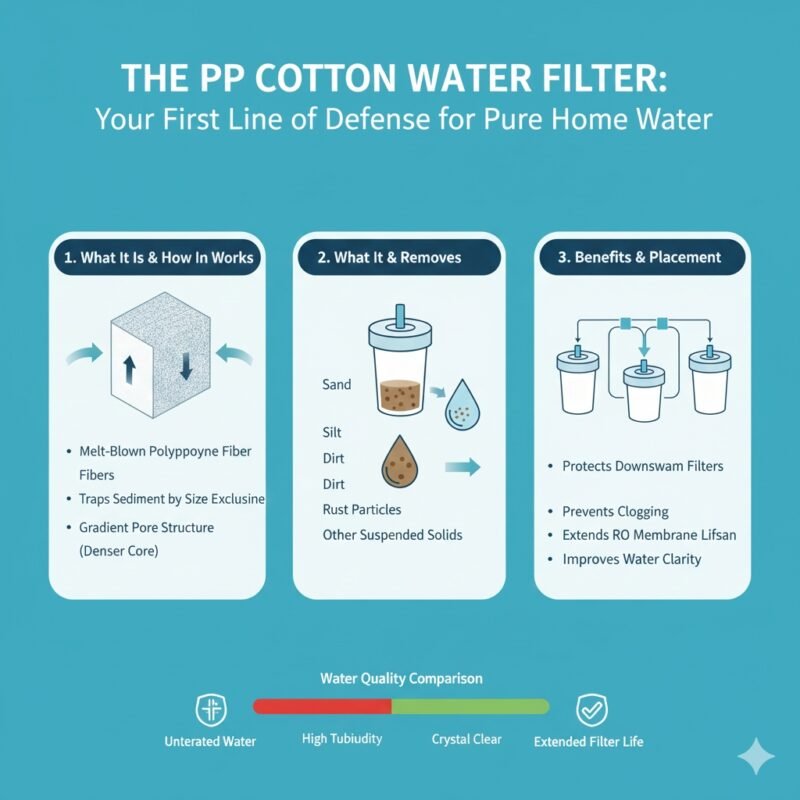
A pp cotton water filter is not actually made of “cotton” in the textile sense. It gets its name from the texture. It is manufactured using a “melt-blown” process. Polypropylene resin is heated until it melts, and then it is blown by high-velocity gas onto a rotating collector. This creates a web of micro-fibers that bond together as they cool, without the need for chemical binders or glues.
The Engineering Miracle: Graded Density
If you were to cut a high-quality pp cotton water filter in half, you would notice a specific structural design known as “graded density.”
- The Outer Layer: The fibers are packed loosely. This section is designed to catch larger particles like visible sand, rust flakes, and hair.
- The Inner Layer: As you move toward the center core, the fibers become packed tighter and tighter. The core is extremely dense, designed to catch microscopic silt and fine dust.
This design is crucial. If the filter were the same density throughout, the surface would clog immediately, blocking water flow. By using a graded density, the pp cotton water filter utilizes its entire depth to trap dirt. This is why it is often called a “Depth Filter.” It traps contaminants inside the wall of the filter, not just on the surface, allowing it to hold a massive amount of dirt before it needs replacing.
The Primary Mission: Sediment Reduction
The primary function of a pp cotton water filter is the removal of sediment. But “sediment” is a broad term. What exactly are we catching?
- Rust and Iron Flakes: In many cities and older homes, water travels through cast iron or galvanized steel pipes. Over decades, these pipes corrode. Small flakes of rust break off and enter the water stream. These are notorious for staining laundry and clogging aerators.
- Sand and Grit: If you are on well water, or if there is construction near a municipal water main, sand can enter the supply. Sand is abrasive; it acts like sandpaper inside your appliances.
- Silt and Turbidity: This is the “cloudiness” you sometimes see in water. It consists of fine particulate matter, often clay or soil, that hasn’t settled.
- Algae and Bio-film: In some storage tanks, organic matter can clump together. A PP filter stops this slime from entering your drinking glass.
By physically blocking these contaminants, the pp cotton water filter turns turbid, dirty water into clear, sparkling water. It is the first step in the “polishing” process.
Why It Is Critical for Downstream Protection
While clear water is aesthetically pleasing, the true value of a pp cotton water filter lies in protection. It acts as a bodyguard for the more expensive and delicate stages of filtration that follow it.
Protecting the Carbon Filter
Activated carbon is excellent at removing chlorine and bad tastes. However, carbon works by adsorption—contaminants stick to the microscopic pores of the carbon. If you run muddy water directly into a carbon filter, the mud coats the carbon surface immediately. The pores get plugged, and the carbon can no longer remove chemicals. You would end up ruining a $40 carbon filter in a few days. A $5 pp cotton water filter prevents this.
Protecting the Reverse Osmosis (RO) Membrane
An RO membrane is a thin film with pores so small (0.0001 microns) that they filter out molecules. It is the most expensive part of a purification system. If a grain of sand or a sharp rust flake hits this membrane under pressure, it can tear it. Furthermore, silt can foul the membrane surface, dropping water production to zero. The PP filter is non-negotiable for RO systems.
Protecting Home Appliances
For the homeowner, sediment is the silent killer of appliances.
- Water Heaters: Sediment settles at the bottom of the tank. In electric heaters, it buries the heating element, causing it to burn out. In gas heaters, it creates an insulating layer that forces the burner to work harder, wasting energy.
- Washing Machines: The solenoid valves that control water entry have tiny screens. These clog easily with rust, causing the machine to fill slowly or throw error codes.
- Dishwashers: Grit in the water can etch glassware and clog the spray arms.
If you are looking to secure your entire property against these physical contaminants, you need to implement this technology at the point of entry. A robust solution, like the Whole House Water Filtration System for Home, utilizes high-capacity sediment filtration as its primary stage. This ensures that every appliance, from your water heater to your kitchen tap, is shielded by the power of high-grade PP cotton.
Commercial Applications: The Small Business Essential
For our readers who own cafes, small restaurants, or tea houses, the pp cotton water filter is an operational necessity.
The Coffee Shop Scenario
Espresso machines are marvels of engineering, relying on precise pressure and flow.
- The Solenoid Valve: This valve opens and closes to let water through the group head. Even a tiny grain of sand can lodge in this valve, causing it to stick open (flooding the machine) or stick closed (no coffee).
- The Pump: Rotary pumps rely on tight tolerances. Abrasive sediment wears down the vanes of the pump, leading to pressure loss.
A simple, regularly changed pp cotton water filter prevents these expensive repair bills. It ensures that the water feeding your machine is physically pure, allowing you to focus on the grind and the extraction.
The Restaurant Ice Machine
Ice machines are notoriously sensitive. Turbid water leads to cloudy, soft ice that melts quickly. Furthermore, sediment buildup in the water reservoir encourages bacteria growth and slime. By filtering the water first, you ensure crystal clear cubes and a sanitary machine that passes health inspections with ease.
Differentiating Quality: Not All Cotton is Created Equal
When you search for a pp cotton water filter, you will see prices ranging from $1 to $20. Why the difference? As a specialized provider, we know that quality manufacturing matters.
1. Weight (Grams per Inch)
The density of the filter is often measured in weight. A standard 10-inch filter might weigh 100 grams, while a premium one might weigh 130 grams. The heavier filter has more polypropylene fibers packed into the same space. This means it can hold more dirt before it clogs. A light, cheap filter feels squishy; a high-quality filter feels firm and dense.
2. Structural Integrity
Cheap filters can collapse under high water pressure. If a filter implodes, it releases all the trapped dirt at once into your system—a catastrophic failure. High-quality filters have a rigid core structure that withstands pressure spikes (water hammer) common in municipal systems.
3. Food Grade Certification
Always ensure the polypropylene used is Food Grade. Cheap industrial filters may use recycled plastics that are not safe for potable water. A reputable pp cotton water filter will be NSF certified or manufactured using FDA-compliant materials.
Micron Ratings: 1 Micron vs. 5 Micron
When selecting your filter, you will face a choice of “Micron Rating.” This represents the size of the pores in the filter.
- 5 Micron: This is the industry standard for a pre-filter. It catches visible dirt, sand, and rust. It offers a great balance between filtration and water flow. It is the best choice for the first stage of a whole house system.
- 1 Micron: This is much tighter. It catches very fine silt and some cysts. However, because it is so tight, it reduces water pressure more significantly and clogs faster.
- The Strategy: In a multi-stage system, we often use a 5-micron pp cotton water filter first to catch the big stuff, followed by a 1-micron filter later in the chain. Using a 1-micron filter first on dirty water will result in it clogging within days.
Maintenance: The Art of the Change
Unlike carbon filters, which hide their exhaustion (you can’t see when carbon is full of chlorine), a pp cotton water filter is honest. It tells you when it needs changing.
The Visual Check
If your filter housing is clear, simply look at it.
- White: Brand new.
- Light Yellow: Starting to work.
- Dark Brown/Orange: Heavy sediment load.
- Slimy/Black: Presence of manganese or algae.
When the filter turns a dark rust color, it is time to change it. Do not wait for it to turn black.
The Pressure Check
If you have opaque (blue or white) housings, you cannot see the filter. In this case, your water pressure is the indicator. As the pp cotton water filter traps dirt, it becomes harder for water to pass through. When you notice a drop in flow rate at your shower or kitchen sink, it is the filter screaming for help.
General Rule of Thumb
For municipal water, change the filter every 3 to 6 months. For well water, you may need to change it every 1 to 3 months depending on sediment levels. Never leave a PP filter in for more than a year; even if it isn’t clogged, bacteria can begin to grow and colonize the trapped organic matter inside the cotton.
Step-by-Step Replacement Guide
Changing a pp cotton water filter is a simple DIY task that takes less than 10 minutes.
- Shut Off Water: Turn off the main water supply or the isolation valve feeding the filter.
- Relieve Pressure: Press the red pressure-relief button on top of the housing, or open a faucet downstream to drain the pressure.
- Unscrew Housing: Use the plastic filter wrench to turn the housing counter-clockwise. Be prepared for some water spillage—have a bucket ready.
- Remove Old Filter: Pull out the dirty cartridge. Observe the color—this tells you a lot about your water quality!
- Clean Housing: Wipe out the inside of the housing with a clean cloth. If there is slime, wash it with mild soap.
- Insert New Filter: Place the new pp cotton water filter over the standpipe at the bottom of the housing. Ensure it is centered.
- Check O-Ring: Ensure the black rubber O-ring is seated in the groove of the housing. Lubricate it with a little food-grade silicone grease if it looks dry.
- Tighten: Screw the housing back on by hand. Use the wrench only for the final quarter-turn to snug it up. Do not over-tighten!
- Turn On Water: Slowly open the water valve. Check for leaks.
Environmental Impact and Safety
Polypropylene is a unique plastic. It is considered one of the safest plastics for human health and the environment.
- No Leaching: Unlike some plastics that leach BPA or phthalates, a pp cotton water filter is stable. It does not add anything to the water.
- Recyclability: Polypropylene (Plastic #5) is recyclable. However, because a used filter is filled with contaminants (rust, sludge, potentially bacteria), most recycling centers will not accept used filter cartridges. They must generally be disposed of in the trash.
- Reducing Plastic Waste: By using a whole-house or under-sink filter, you eliminate the need for thousands of single-use plastic water bottles. One 10-inch PP filter can treat thousands of gallons of water, replacing pallets of bottled water.
Troubleshooting Common Issues
Even with a simple device like a pp cotton water filter, issues can arise.
Issue 1: Rapid Clogging (Low Pressure after 1 week)
- Cause: Your water has extremely high sediment, or there was a main break nearby.
- Solution: You may need a coarser filter first. If you are using a 1-micron filter, switch to a 5-micron or even a 20-micron filter. Alternatively, install a “Spin-Down Sediment Filter” (a flushable mesh screen) before the PP filter to catch the large rocks and sand.
Issue 2: “Channeling”
- Cause: Low-quality manufacturing. The water finds a weak spot in the cotton and tunnels straight through without being filtered.
- Solution: Always buy high-density, graded filters from a reputable supplier.
Issue 3: Fibers in Water
- Cause: Very cheap, unbonded filters can shed fibers into the water stream.
- Solution: Look for “melt-blown” or “thermally bonded” filters which fuse the fibers together to prevent migration.
PP Cotton vs. Other Sediment Filters
Why choose PP cotton over other types?
1. PP Cotton vs. String Wound String wound filters look like a spool of yarn. They are an older technology. While good for very heavy sediment, string wound filters can allow bacteria to grow on the string fibers more easily than on synthetic melt-blown PP. Furthermore, string fibers can shift, allowing dirt to bypass the filter. The pp cotton water filter is a more solid, consistent barrier.
2. PP Cotton vs. Pleated Polyester Pleated filters look like an accordion. They have a high surface area and are washable/reusable. They are excellent for high-flow applications, but they are “Surface Filters.” Once the surface is coated, flow stops. A pp cotton water filter is a “Depth Filter,” holding far more total dirt volume before clogging. For fine silt and rust, PP cotton is generally superior.
Conclusion: The Foundation of Clean Water
It is easy to overlook the simple white cartridge sitting in your basement or under your sink. It doesn’t have the glamour of a Reverse Osmosis membrane or the chemical wizardry of catalytic carbon. But the pp cotton water filter is the foundation upon which all clean water systems are built.
It is the diligent worker that handles the grunt work—stripping the water of the mud, rust, and grit that travel through our aging infrastructure. By investing in a high-quality PP filter, you are not just buying a cartridge; you are buying longevity for your appliances, protection for your plumbing, and the assurance that the water touching your skin and filling your glass is physically pure.
Whether you are running a busy cafe and need to protect your espresso machine, or you are a homeowner wanting to safeguard your family’s health, start with the basics. Ensure your system leads with a premium pp cotton water filter.
Visit YourWaterGood to explore our range of filtration solutions. From individual high-density cartridges to complete whole-house systems, we provide the quality components necessary to make your water good again.
Frequently Asked Questions (FAQ)
Q: Can I wash and reuse a PP cotton water filter? A: No. A pp cotton water filter acts like a sponge for dirt. Once the dirt is trapped deep inside the fibers, you cannot wash it out. Attempting to wash it may damage the structure and allow contaminants to pass through. It is a disposable item and must be replaced.
Q: Does a PP cotton filter remove bacteria? A: No. Bacteria are generally smaller (0.4 to 1 micron) than the pores of a standard 5-micron PP filter. While it removes the sediment that bacteria hide in, it does not sterilize the water. You need Chlorine, UV light, or Reverse Osmosis to remove bacteria.
Q: Why is my new filter making the water cloudy? A: When you install a new pp cotton water filter, air is trapped inside the millions of micro-fibers. As water pushes this air out, it creates micro-bubbles that look like milk or cloudiness. This is harmless air and will clear up if you let the glass sit for a minute. The issue usually resolves within a few days of use.
Q: How do I know if I need a “Big Blue” (4.5-inch wide) or a standard (2.5-inch wide) filter? A: This depends on flow rate.
- Standard (2.5-inch): Good for under-sink units or single appliances (like an ice machine).
- Big Blue (4.5-inch): Necessary for Whole House applications. You need the extra surface area to allow enough water through for showers and laundry without dropping pressure.
Q: Can a PP cotton filter remove chlorine taste? A: No. PP cotton is a mechanical filter; it only removes solids. To remove chlorine (a dissolved chemical), you must follow the PP filter with an Activated Carbon filter. This is why most systems are “Dual Stage” or “Multi-Stage.”