
Restaurant Water Filter System Sizing: GPM, GPD, and PSI Specs That Keep Service Running

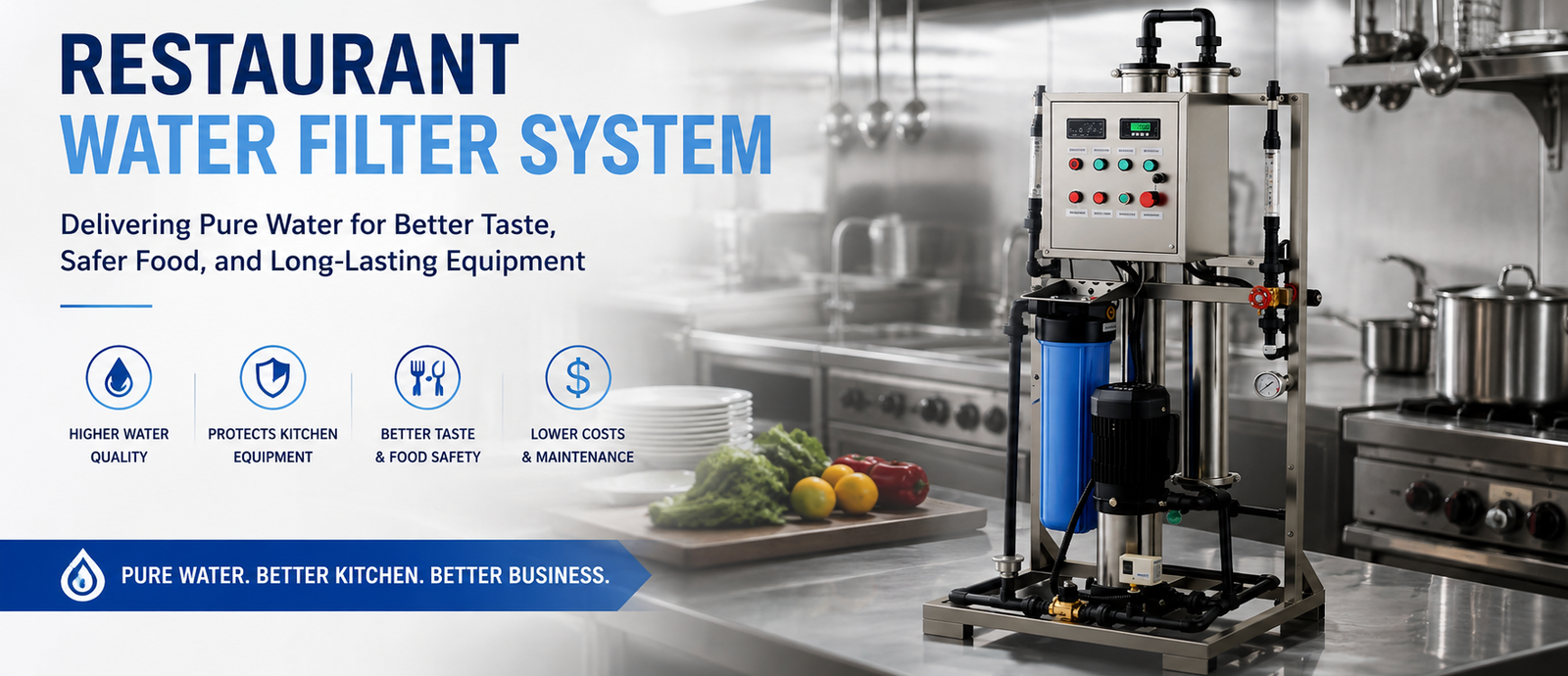
A restaurant water filter system that’s undersized fails exactly when you need it most — during rush, when every station is pulling water at once. Getting the size right up front is a design problem, not a shopping problem.
Before you spec anything, lock down these five numbers:
- Peak simultaneous demand (GPM), not the sum of every fixture’s rated flow.
- Daily volume (GPD) for equipment that draws continuously, like ice machines and dish machines.
- Available inlet pressure (PSI), measured at the point of installation, not assumed from a utility average.
- POE vs. POU placement, decided by which water actually needs treatment.
- Room for future stations, without oversizing today’s system to pay for it.
Fast Check Product: https://yourwatergood.com/product/commercial-reverse-osmosis-system/
Sizing Starts With Peak Simultaneous Demand, Not Nameplate GPM
Every fixture in a kitchen has a rated flow number. Adding them all up is the single most common sizing mistake in a commercial water filter for restaurant design — and it goes wrong in both directions.
Real kitchens don’t hit 100% simultaneous draw across every fixture. They hit a realistic overlap window — espresso group heads, an ice machine cycling, and a prep sink running during the same 15 minutes of a Friday rush. Sizing to the theoretical sum of every fixture wastes CAPEX on capacity that’s never actually called for. Sizing to average daily usage undersizes for the exact window that matters.
The right number sits between those two: the highest realistic overlap of the stations that actually run together, not every fixture in the building and not just the average.
POE vs. POU: Whole-Store Central Treatment or Station-by-Station Filtration
This decision drives more of the installed cost than any single component choice.
| Factor | Whole-Store POE (Point-of-Entry) | Single-Station POU (Point-of-Use) |
|---|---|---|
| CAPEX | Higher — sized for full-building peak GPM | Lower — sized for one station only |
| OPEX (cartridges/membrane) | Larger media shared across every station | Smaller media per unit, duplicated if several stations each need one |
| Plumbing / Retrofit Cost | Highest — main-line intercept, often a dedicated mechanical space | Lowest — taps into an existing line near the fixture |
| Footprint | One central location, larger unit | Multiple smaller units distributed at point of use |
| Best Fit | Multi-station kitchens treating water uniformly | One high-value station, or a phased rollout |
Here’s what most first-time buyers get wrong on this table: a full POE system treats every gallon entering the building, including water that never touches food or beverage — mop sinks, restrooms, hose bibs. That’s capacity paid for and maintained without ever protecting anything that mattered.
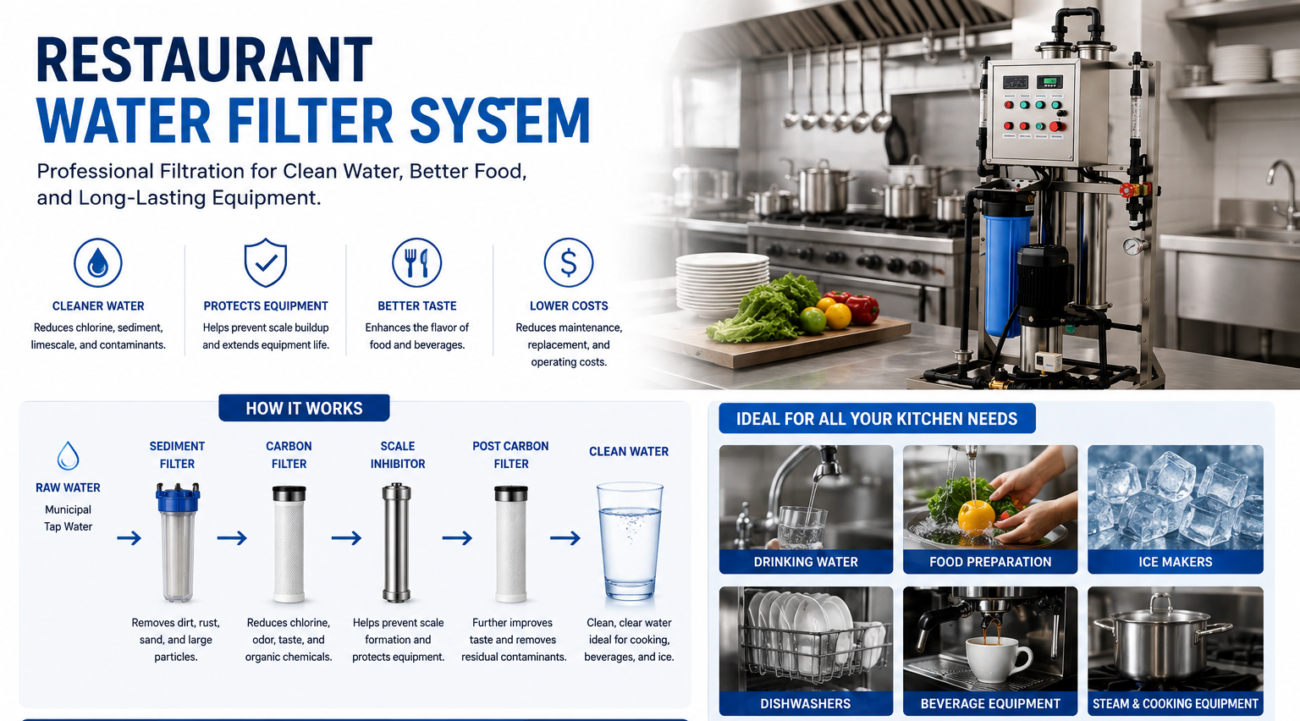
The design experienced installers actually spec is a hybrid: a central pre-treatment stage (sediment and carbon) sized for the whole building, feeding a dedicated POU RO stage sized specifically for the beverage and ice equipment that needs the deeper treatment. It’s rarely all-POE or all-POU — it’s picking the right stage for each branch of the plumbing.
GPD: Sizing for Ice Machines and Dish Machines That Draw All Day
GPM tells you what a system can deliver in a burst. It doesn’t tell you whether the system can keep up across a full shift.
Ice machines and dish machines are the equipment category where GPD (gallons per day) matters more than instantaneous flow. They draw steadily across service rather than in short bursts, so a system that tests fine on a five-minute flow check can still fall short by close of service if daily volume wasn’t part of the sizing math.
This is where undersizing shows up latest — and gets blamed on the wrong thing. A system that “worked fine at lunch” but can’t keep the ice bin full by dinner usually isn’t malfunctioning. It was sized for peak flow and never checked against total daily draw.
Request a Commercial Kitchen Water Layout Design before finalizing capacity — it’s the only way to confirm GPD headroom across ice, dish, and beverage equipment together, not each checked in isolation.
PSI and Pressure Drop: Why Inlet Pressure Isn’t What Reaches the Tap
A building’s incoming pressure and the pressure actually available at the filtration system are two different numbers, and the gap is where flow problems get built in during install.
Most commercial RO platforms need 29–58 psi (0.2–0.4 MPa) at the inlet to run at rated capacity. Every stage the water passes through before that — a pre-filter housing, a water softener, long runs of undersized pipe — adds friction loss. A building that tests at 60 psi at the meter can still deliver well under 30 psi by the time it reaches the system, especially after a few pre-treatment stages in series.
If measured inlet pressure comes in under spec, a booster pump becomes part of the installed system — better identified during design than discovered after the unit is plumbed in and underperforming.
Get a Technical Parameter Sheet before finalizing plumbing — confirming pressure requirements against your building’s actual numbers avoids a mid-install surprise.
Designing for Expansion: Sizing Without Boxing Out Tomorrow’s Kitchen
Sizing for today’s equipment lineup and sizing for a kitchen that might add a second espresso bar or another ice machine next year are two different exercises — and most buyers only do the first one.
Modular platforms solve this without forcing a full system replacement later. Configurable output from 250 to 1,000 liters per hour (0.25 to 1 ton/hr, roughly 1.1 to 4.4 GPM) means a system can be specced with headroom for a defined expansion plan, rather than maxed out on day one.
Two things are worth locking in at design time even if you’re not using the full capacity yet: pipe sizing (inlet and finished-water lines sized for the larger future load, not just current draw) and panel space in the electrical control cabinet for additional monitoring or a second stage later.
If your feed water source is part of what’s driving the sizing math — municipal versus well water changes pre-treatment needs before flow rate even enters the conversation — source water treatment is worth reviewing alongside sizing. And once the system type and size are settled, equipment-specific TDS and hardness targets determine the final configuration per station.
FAQ
How do I size a restaurant water filter system correctly? Size to peak simultaneous demand — the realistic overlap of stations that run together during rush — not the sum of every fixture’s rated flow and not just average daily usage.
Should I choose POE or POU filtration for my restaurant? It depends on how many stations need treatment and whether the whole building’s water needs it. A hybrid approach — central pre-treatment plus a dedicated POU stage for beverage and ice equipment — is common because full POE treats water that never touches food or drink.
What’s the difference between GPM and GPD when sizing equipment? GPM measures burst capacity; GPD measures total volume across a full day. Ice machines and dish machines draw steadily all shift, so GPD sizing catches capacity shortfalls that a short GPM test misses.
What PSI does a commercial water filtration system need? Most commercial RO platforms need roughly 29–58 psi at the inlet to run at rated capacity. Pressure drop across pre-treatment stages and pipe runs can leave less available than the building’s meter reading suggests.
Do I need a booster pump for my restaurant water filter system? Only if measured inlet pressure at the install point comes in below the system’s required range — commonly the case after several pre-treatment stages or long pipe runs. It’s a design question to resolve before installation, not after.
How do I size a system to allow for future expansion? Choose a modular platform with configurable output and design pipe sizing and panel space for the larger future load at install time, even if you’re not using full capacity yet.
Does my water source affect how I size the system? Yes. Well water typically needs more pre-treatment stages before the main filtration system than municipal water does, which changes both the sizing math and the pressure available downstream.
Get Your Sizing Confirmed Before You Buy
A system sized on paper and a system sized for your actual peak, daily volume, and inlet pressure are rarely the same number.
Request a custom commercial quote, a technical parameter sheet, or B2B wholesale pricing — and get a restaurant water filter system sized to your kitchen’s real numbers, not a catalog default.