
Mastering Water Quality: A Strategic Guide to Restaurant Water Purification Systems for American Foodservice Businesses

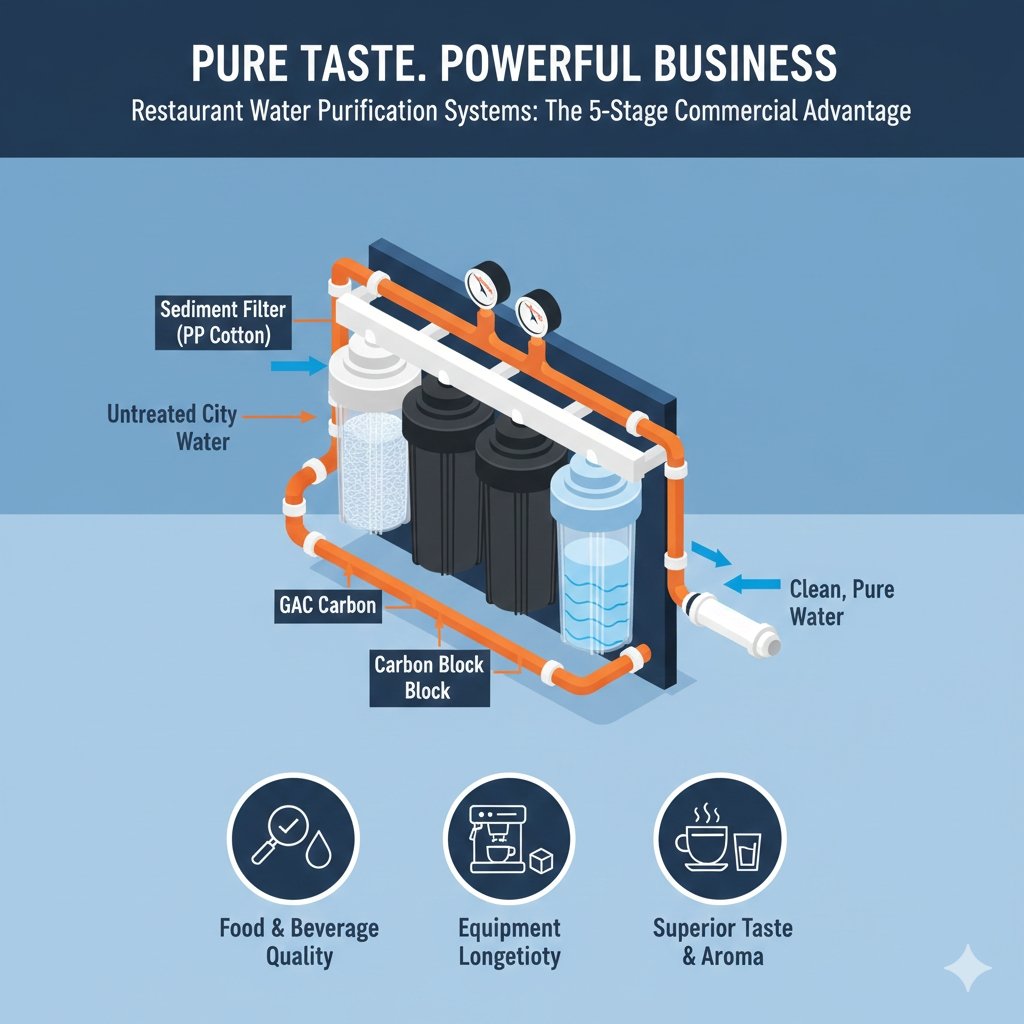
In the highly competitive American foodservice industry, business owners constantly analyze ingredient sourcing, labor optimization, and marketing strategies to secure a profitable margin. Yet, one foundational element is frequently overlooked despite being the most consumed ingredient in any dining establishment: water. From the clarity of the ice in a signature cocktail to the extraction yield of a morning espresso, water dictates the sensory baseline of your culinary offerings. Implementing commercial-grade restaurant water purification systems is no longer a luxury for fine-dining establishments; it is a critical operational necessity for small business owners, farm-to-table restaurants, and independent cafes focused on quality, equipment protection, and long-term profitability.
This comprehensive guide explores the intersection of fluid dynamics, geographic water challenges, material filtration science, and business economics. We will decode the strategic deployment of restaurant water purification systems, analyzing how they safeguard expensive commercial equipment, ensure consistent brand reputation, and comply with rigorous safety frameworks.
Fast Check Product:https://yourwatergood.com/product/5-stage-ro-water-filter-for-home-busines/.
Decoding US Regional Well Water Challenges for Foodservice
The United States features a vastly diverse geological landscape. For restaurants operating outside urban municipal water grids, or those relying on local well water sources to support a rural farm-to-table aesthetic, the challenges of untreated water are significant. Even municipal water, as it travels through aging infrastructure, picks up contaminants that can devastate a delicate flavor profile. Understanding your regional water profile is the first step in selecting the appropriate restaurant water purification systems.
The Midwest: Agricultural Runoff and Heavy Metals
In the agricultural heartland of the Midwest, well water is uniquely susceptible to the infiltration of agricultural byproducts. Heavy precipitation events wash surface-level applications deep into aquifers. Consequently, restaurant owners in these regions frequently battle elevated levels of nitrates and agricultural runoff. Nitrates not only pose severe health compliance risks but also introduce an astringent, bitter taste to brewed beverages. Furthermore, the subterranean geology in parts of the Midwest contributes to heavy metal contamination, including lead and arsenic. These invisible contaminants require advanced reverse osmosis within restaurant water purification systems to ensure complete removal, protecting patrons and ensuring the foundational safety of the menu.
Texas and the Southwest: Severe Hard Water and Mineral Scaling
Moving toward Texas and the broader American Southwest, the primary adversary shifts from agricultural runoff to dissolved rock. The aquifers in these regions flow through dense limestone formations, absorbing massive quantities of calcium and magnesium. This results in some of the most challenging hard water environments in the country. For a coffee shop or a high-volume diner, hard water is an operational nightmare. The dissolved minerals precipitate out of the water when heated, forming a rock-like crust known as scale. Scale accumulation destroys the thermal efficiency of water heaters, clogs the delicate valves of commercial coffee machines, and leaves an unappetizing, cloudy residue on glassware. In these geographic zones, restaurant water purification systems must incorporate robust softening or scale-inhibition mechanisms.
Coastal Regions: Unpredictable Sediments and Turbidity
Restaurants situated along the coastlines face a different set of challenges dictated by sandy soils, fluctuating water tables, and the impact of severe weather systems. Storm surges and tidal influences can agitate subterranean water sources, leading to high levels of suspended sediments, silt, and sand. This phenomenon, known as high turbidity, gives water a cloudy, unappealing appearance and a gritty texture. Furthermore, these abrasive particles act like liquid sandpaper as they flow through a restaurant’s plumbing infrastructure, eroding the internal seals of expensive dishwashers and beverage dispensers. Coastal foodservice operators must prioritize heavy-duty mechanical filtration, specifically relying on high-capacity sediment filters to capture these destructive particulates before they enter the facility’s main water stream.
The Economics of Restaurant Water Purification Systems: An ROI Analysis
For a small business owner, every capital expenditure must be justified by a clear Return on Investment. Investing in professional restaurant water purification systems provides a twofold economic return: the aggressive protection of capital assets and the preservation of brand equity.
Protecting High-Value Commercial Equipment
Consider the equipment portfolio of a modern specialty coffee shop or an upscale restaurant. A high-specification commercial espresso machine represents a massive capital investment. Similarly, high-capacity modular ice makers, commercial steamers, and sophisticated dishwashing arrays represent tens of thousands of dollars in vital infrastructure.
When untreated well water or poor-quality municipal water enters these machines, the degradation is rapid and financially devastating. Iron and rust from aging well casings or city pipes can permanently stain the internal reservoirs of ice makers, leading to frequent breakdowns and the production of unhygienic, foul-tasting ice. As previously mentioned, scale from hard water coats the heating elements of espresso boilers. Because scale is an excellent thermal insulator, the machine must draw significantly more electricity to heat the water to the required temperature, driving up utility overhead. Eventually, the heating elements burn out entirely.
The immediate cost is the replacement part and the emergency dispatch fee for a commercial appliance technician. However, the hidden, far more damaging cost is operational downtime. An espresso machine that fails during the morning rush translates directly into lost revenue, frustrated customers, and wasted labor. By deploying correctly engineered restaurant water purification systems, business owners effectively purchase an insurance policy for their equipment. These systems intercept rust, sequester minerals, and filter out corrosive elements, drastically extending the lifecycle of the equipment, reducing maintenance intervals, and ensuring predictable operational efficiency.
Brand Reputation and Water Consistency
In the age of instant online reviews, brand reputation is paramount. A restaurant’s brand is built on consistency. A customer expects their favorite proprietary coffee blend to taste exactly the same on a Tuesday morning as it does on a Saturday afternoon. However, coffee is primarily composed of water. If the local municipal water treatment plant suddenly increases chlorine dosing to combat a bacterial bloom, or if seasonal rainfall alters the mineral composition of a local well, the flavor profile of the brewed coffee will swing wildly. Chlorine and chloramines interact disastrously with the delicate oils in coffee and tea, muting complex flavor notes and introducing an artificial, medicinal aftertaste.
High-quality restaurant water purification systems neutralize these fluctuations. By stripping the water down to a pure baseline through carbon filtration and reverse osmosis, chefs and baristas are provided with a blank culinary canvas. This total control over water chemistry guarantees that beverages and food taste exactly as intended, every single time, regardless of external municipal or geological factors. This relentless consistency builds deep customer loyalty, which is the foundation of long-term commercial success.
EPA Standards Framework and Commercial Compliance
Navigating the regulatory landscape of water safety is a mandatory responsibility for any foodservice operator. In the United States, the Environmental Protection Agency provides the overarching framework for drinking water quality through the Safe Drinking Water Act. This federal framework establishes Maximum Contaminant Level goals for dozens of organic, inorganic, and microbial contaminants.
While municipal water providers are required to test and treat water to meet these EPA standards before it leaves the treatment plant, the journey from the plant to the restaurant tap can introduce new vulnerabilities. Aging city mains can leach contaminants, and sudden pressure drops can pull groundwater into the system. For restaurants utilizing private wells, the responsibility for testing, compliance, and treatment falls entirely on the business owner. Local health departments rigorously enforce standards aligned with the EPA framework during routine restaurant inspections.
Failure to provide safe, clean water can result in immediate health department citations, forced operational closures, and catastrophic public relations crises. Commercial restaurant water purification systems are specifically engineered to provide a fail-safe barrier against pathogens, heavy metals, and industrial chemicals, ensuring that a business continuously exceeds the regulatory frameworks established by the EPA and local health authorities.
POE vs. POU: Strategic Filtration Architecture for Restaurants
When designing a water treatment strategy, business owners must choose the correct architectural deployment of their filtration assets. This generally falls into two categories: Point of Entry and Point of Use. A comprehensive strategy often utilizes a hybrid approach.
| Feature | Point of Entry (POE) Filtration | Point of Use (POU) Filtration |
| Location | Installed at the main water line entering the building. | Installed directly at the specific appliance or dedicated faucet. |
| Primary Goal | General protection of plumbing, water heaters, and overall facility water quality. | Highly specialized, surgical water treatment tailored for a specific piece of equipment. |
| Common Technologies | Large capacity sediment filters, heavy-duty carbon tanks, whole-house water softeners. | Multi-stage Reverse Osmosis, specialized scale inhibitors, ultra-fine sub-micron carbon blocks. |
| Commercial Application | Removing bulk rust, coastal sediments, and massive chlorine loads before they reach the kitchen. | Refining water for espresso machines, ensuring spot-free rinse in dishwashers, polishing water for ice makers. |
| Flow Rate Requirements | Extremely high GPM to support the entire restaurant simultaneously without pressure loss. | Lower to moderate GPM, precisely matched to the flow rate specifications of the attached appliance. |
| Maintenance Profile | Less frequent media changes, but involves handling bulkier, heavier equipment. | More frequent, scheduled cartridge changes tailored to the appliance’s volume usage. |
For maximum efficiency, a restaurant should implement a POE system to handle bulk sediment and chlorine, thus protecting the entire plumbing infrastructure. Subsequently, specialized POU restaurant water purification systems should be deployed at critical stations, such as a dedicated reverse osmosis unit feeding the espresso machine to achieve the perfect mineral balance for extraction.
Material Science: The Role of High-Grade PP Cotton in Commercial Filtration
The unseen hero within the majority of restaurant water purification systems is the mechanical pre-filter. As an established pp cotton household water purifier company with deep expertise in material science, we understand that commercial filtration demands structural resilience far beyond typical residential applications.
Polypropylene, commonly referred to as PP cotton in the filtration industry, is a thermoplastic polymer. Through a highly controlled melt-blowing process, the polymer is extruded and spun into a dense, multi-layered cylindrical matrix. The genius of a high-quality PP cotton filter lies in its gradient density architecture. The outer layers of the filter are woven loosely to capture large particulate matter, such as heavy rust flakes and large grains of sand. As the water penetrates deeper toward the core of the filter, the density of the polypropylene fibers increases dramatically, trapping microscopically fine silt and suspended solids.
In a high-volume American commercial kitchen, water pressure dynamics are intense. When multiple sinks, dishwashers, and ice makers are running simultaneously, the system experiences aggressive fluctuations in Pounds Per Square Inch. Inferior, low-grade filters will channel—meaning the water pressure forces a path of least resistance through the filter wall, allowing dirty water to bypass the media entirely. Alternatively, weak filters can physically collapse under sudden pressure spikes, sending a concentrated wave of accumulated dirt directly into delicate commercial appliances.
Leveraging our background as a premier pp cotton household water purifier company, our commercial-grade PP cotton filter cartridges are engineered with enhanced structural core integrity. They are designed to withstand the brutal, continuous flow rates and high PSI environments of busy restaurants, ensuring absolute dirt-holding capacity without structural deformation or pressure-drop collapse.
Technical Specifications and Maintenance for US Commercial Kitchens
Deploying restaurant water purification systems requires strict adherence to technical specifications. Two metrics dictate the success of any commercial water installation: Pounds Per Square Inch (PSI) and Gallons Per Minute (GPM).
- Pounds Per Square Inch (PSI): This is the measure of static and dynamic water pressure. Most commercial espresso machines require a stable incoming water pressure, typically regulated to a specific range (often between thirty to fifty PSI) to ensure the internal pumps function correctly without cavitating. If a restaurant’s water purification system is undersized or clogged, it will cause a massive pressure drop, starving the equipment of water. It is vital to install pressure gauges before and after the filtration system. A significant differential between these gauges is the primary indicator that filter cartridges require immediate replacement.
- Gallons Per Minute (GPM): This metric defines the volume of water flowing through the system. A commercial kitchen has a high peak-demand GPM. If the filtration system cannot deliver the required GPM, water flow at the sinks will slow to a trickle, and commercial dishwashers will fail to fill within their programmed cycle times, halting kitchen operations.
Strategic Maintenance Guide
Maintenance is not a reactive process; it must be a tightly scheduled operational protocol.
- Daily Observations: Staff should visually inspect ice clarity and monitor the taste of fountain beverages for any hint of chlorine or off-flavors, which indicate carbon filter exhaustion.
- Weekly Pressure Checks: Management should record the dynamic PSI readings during peak service hours to monitor the degradation of flow through the pre-filters.
- Scheduled Cartridge Replacement: Never wait for the water flow to stop. Relying on manufacturer guidelines and your specific GPM usage, replace PP cotton sediment filters and carbon blocks on a rigid calendar schedule. Reverse Osmosis membranes require less frequent replacement but demand regular monitoring of the total dissolved solids output.
The Ideal Solution: High-Flow RO and Multistage Filtration
For small restaurants, bustling cafes, and independent commercial kitchens looking for an uncompromising standard of water purity, selecting the right equipment is paramount. You need a system that balances commercial-grade durability with ease of maintenance.
We highly recommend integrating a multistage approach that handles everything from bulk sediment to microscopic dissolved solids. For businesses requiring ultimate precision, an advanced reverse osmosis architecture is the gold standard.
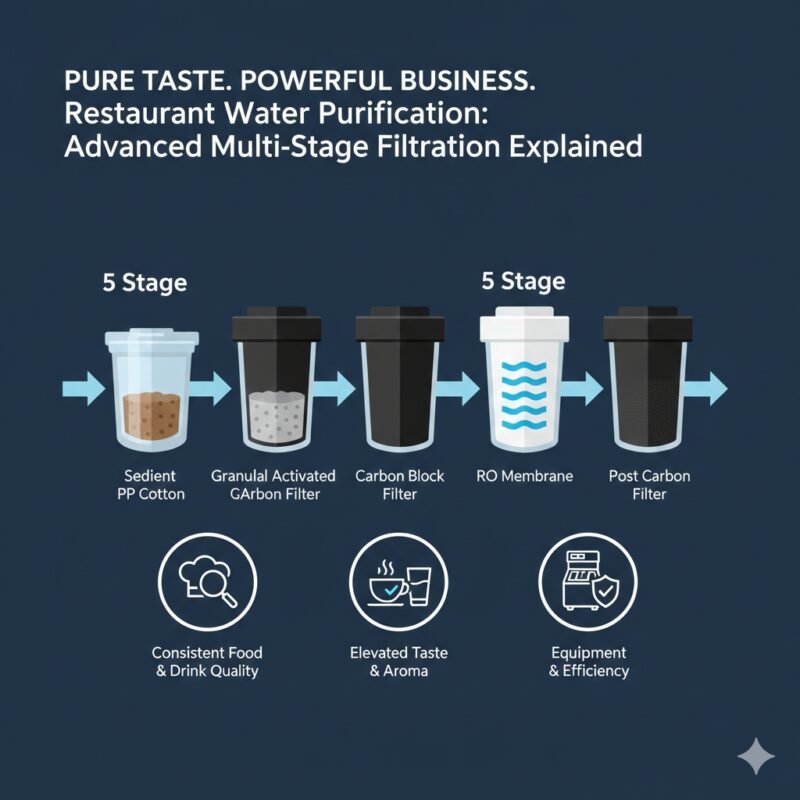
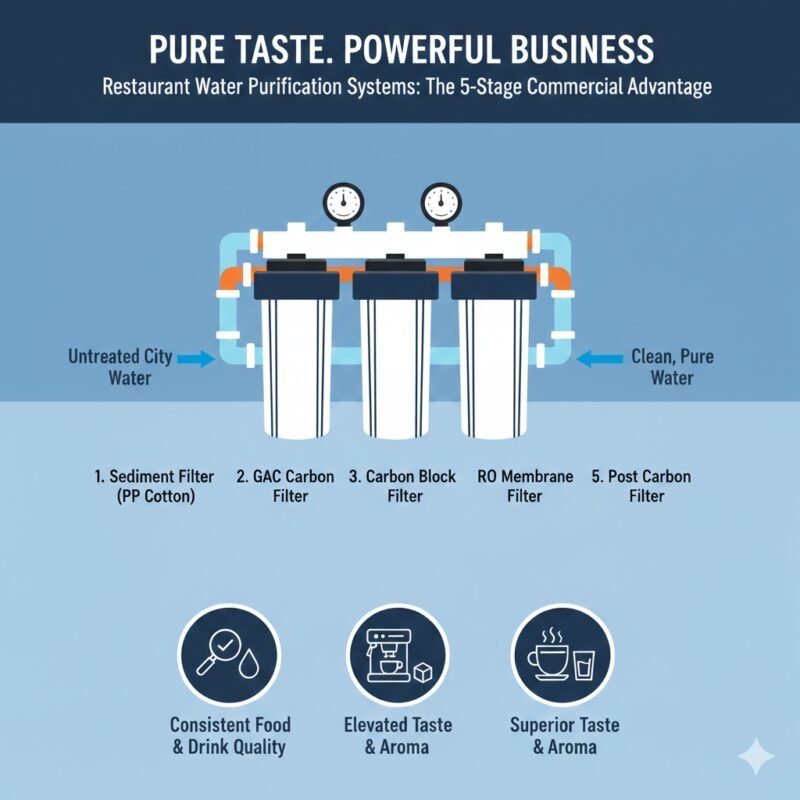
By implementing systems like the 5-Stage RO Water Filter for Home & Business, restaurant owners achieve a perfect synthesis of high flow rates and meticulous filtration. This specific configuration is meticulously engineered to serve the demanding environments of modern American commercial operations. It utilizes our advanced PP cotton technology to shield the delicate RO membrane from heavy coastal sediments and midwestern agricultural particulates, while the subsequent carbon stages ensure the total eradication of chlorine, safeguarding the delicate flavor profiles of your premium coffees and culinary creations.
Operating a small business demands equipment that works as hard as you do. By choosing a system designed for high daily output with low-friction maintenance requirements, you protect your espresso machines from fatal scale buildup, ensure the crystal clarity of your ice, and guarantee that every drop of water served to your patrons meets the absolute highest standards of American hospitality. Explore our full range of solutions at www.yourwatergood.com to find the perfect commercial configuration for your specific menu and regional water challenges.
Frequently Asked Questions (FAQ) for US Restaurant Owners
Q: How do I know if my restaurant actually needs a commercial reverse osmosis system, or if a standard carbon filter is enough? A: It depends entirely on your menu and your regional water chemistry. If you operate a specialty coffee shop utilizing expensive espresso equipment in a region with high mineral content (hard water), reverse osmosis is essentially mandatory to prevent catastrophic scale buildup and ensure proper flavor extraction. If your primary concern is merely removing the taste of municipal chlorine for drinking water, a high-capacity commercial carbon block filter may suffice. Testing your water’s mineral content is the necessary first step.
Q: Will restaurant water purification systems decrease the water pressure at my commercial dishwashing station? A: A properly engineered system will not negatively impact your operational water pressure. Pressure drop occurs when a system is undersized for the facility’s peak Gallons Per Minute demand, or when routine maintenance is ignored and the filters become clogged with sediment. By sizing the system correctly based on the simultaneous flow rates of all your equipment, you ensure stable PSI across the entire kitchen.
Q: How often do I realistically need to change the filters in a commercial setting? A: There is no universal answer, as it is dictated by your incoming water quality and your daily volume. However, in a busy commercial environment, high-grade PP cotton sediment pre-filters and carbon blocks often require replacement every few months to maintain optimal flow and protection. Relying on a pressure gauge installed after the filtration array is the most accurate way to determine when a filter has reached its capacity.
Q: Does installing these systems require me to shut down my restaurant for days? A: No. A professional plumbing contractor can typically install Point of Use systems (like an under-counter RO unit for a coffee brewer) in a matter of hours. Larger Point of Entry systems may require coordinating a brief water shutoff during your restaurant’s off-hours or overnight, ensuring zero disruption to your daily revenue-generating service.
Q: Can I use residential water filters for my small cafe to save money? A: It is highly discouraged. Residential systems are not designed to handle the massive daily gallon throughput or the continuous pressure spikes of a commercial environment. They will quickly fail, void equipment warranties, and ultimately cost you significantly more in emergency repairs and frequent, premature filter replacements. Always invest in dedicated restaurant water purification systems rated for commercial GPM capacities.
Elevate Your Restaurant’s Water Standard Today
Water is the foundation of your menu, the lifeblood of your commercial equipment, and a silent ambassador of your brand’s commitment to quality. Do not allow unpredictable well water quality or harsh municipal additives to compromise your culinary vision or destroy your expensive capital investments.
Take control of your water profile. Upgrade your operational infrastructure with professional-grade restaurant water purification systems designed to thrive in the demanding American foodservice landscape.
Would you like me to help you analyze the specific GPM and PSI requirements for your current commercial espresso machine or ice maker so we can pinpoint the exact filtration capacity your business needs?