
How Much Does AI Data Center Water Treatment Cost? The Price Drivers That Set the Number

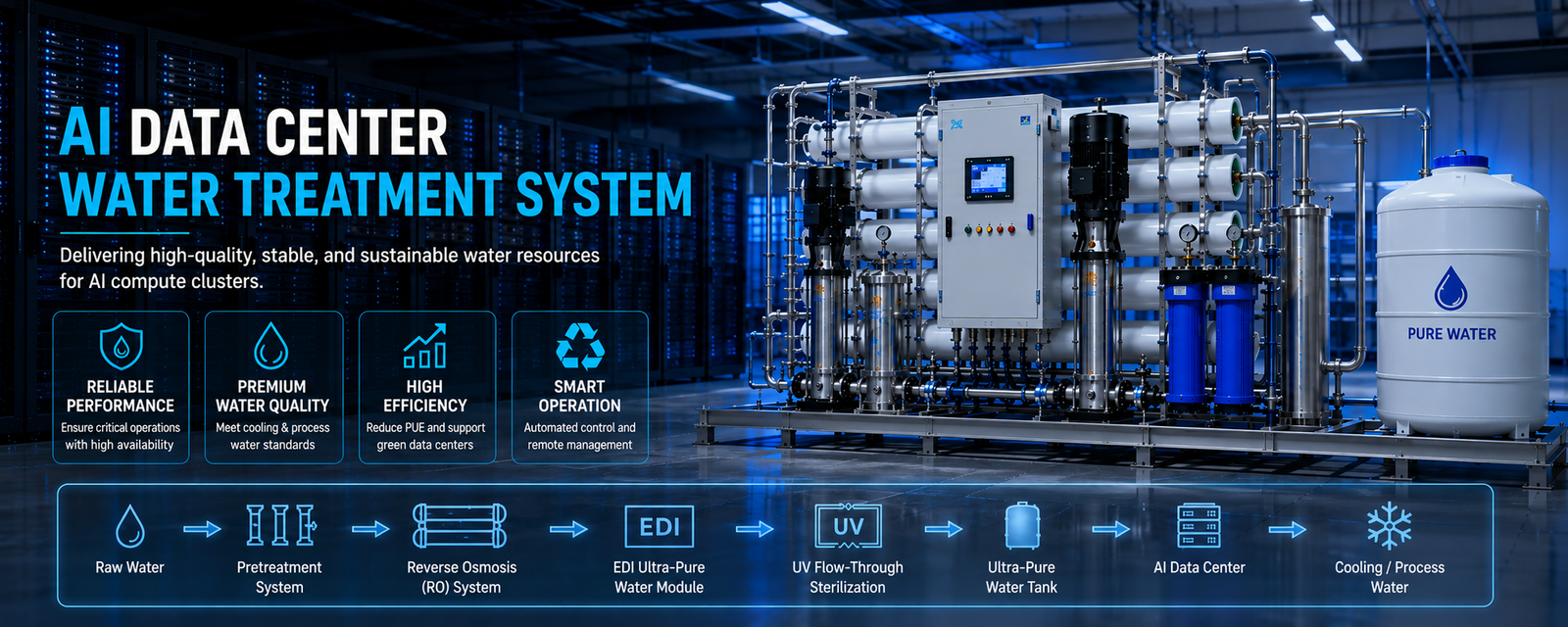
There is no single price for AI data center water treatment. A system for the same cooling load can vary several-fold in cost depending on three things: capacity, source-water quality, and the purity the cooling loop demands. Any vendor who quotes a number without those three is guessing.
That is also why two quotes for “the same” system can look wildly different — they are usually not the same system. The cheaper one has quietly left out stages the dearer one includes.
Understanding ai data center water treatment cost means understanding what actually sits inside the price, what pushes it up, and how to compare quotes on equal footing.
Before requesting pricing, define these so a quote can be accurate, not a guess:
- Capacity — permeate demand in GPD or t/h, the single biggest cost driver.
- Source water — municipal or reclaimed, which changes the pre-treatment train and therefore the price.
- Purity target — cooling-tower makeup versus direct-to-chip at ≤ 10 µS/cm, which decides single-pass versus two-pass plus EDI.
- Redundancy — N+1 / 2N, which multiplies equipment count.
- Integration — materials, instrumentation, and BMS integration scope.
The sections below break down what sets the number.
Fast Check Product: https://yourwatergood.com/product/industrial-reverse-osmosis-system/
There’s No Single Price: The Three Variables That Set the Number
The most useful thing to know about ai data center water treatment cost is that it is driven by three variables before any brand or vendor margin enters the picture.
1. Capacity is the largest single driver:
- Systems are sized and priced by permeate output — GPD or t/h — and cost scales with capacity.
- A small edge-facility makeup system and a multi-megawatt hyperscale train differ by orders of magnitude on capacity alone.
2. Source water sets the pre-treatment burden:
- Municipal feed needs a lighter front end; reclaimed feed needs heavier multimedia, softening, and antiscalant.
- The dirtier the feed, the more equipment in front of the membranes, and the higher the price.
3. Purity target decides the treatment depth:
- Cooling-tower makeup can run single-pass RO.
- Direct-to-chip loops at ≤ 10 µS/cm require two-pass RO plus EDI, materially more equipment and cost.
A quote that does not reference all three is not a real quote. The price follows the specification, and the specification starts with capacity, source water, and purity.
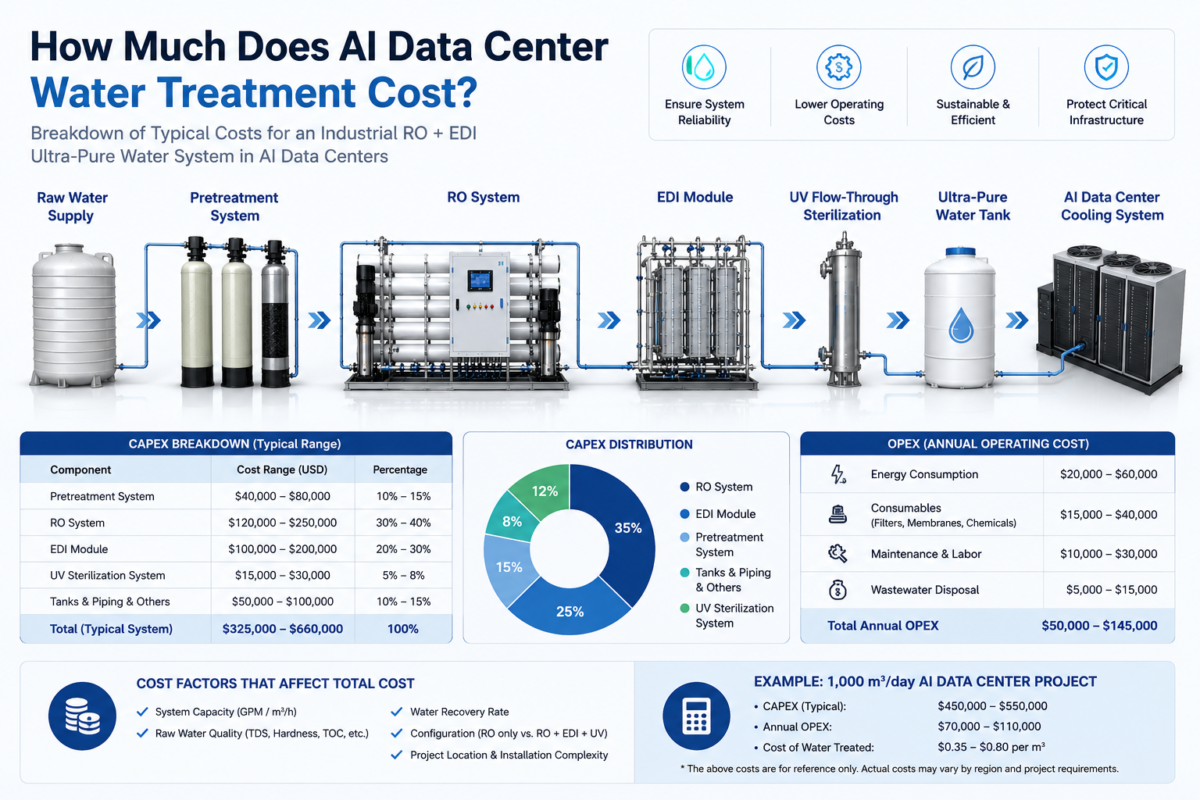
What’s Actually in the Price: The CAPEX Components
A data center water treatment system is not one purchase — it is a train of stages, and the price is the sum of them. Knowing the components lets you see what a quote includes and what it omits.
The typical CAPEX components, in flow order:
- Pre-treatment — multimedia filtration and activated carbon for chlorine/chloramine removal.
- Softening — skid-mounted ion exchange to remove hardness, with automated regeneration.
- Reverse osmosis — single- or two-pass RO, the core demineralization stage.
- EDI polishing — continuous electrodeionization for ultrapure direct-to-chip makeup.
- Dosing — automated antiscalant, corrosion inhibitor, and biocide systems.
- Instrumentation & controls — online analyzers and BMS integration.
- Skid, frame, and assembly — pre-assembled, continuous-duty construction.
- Freight, installation, and commissioning — often excluded from the headline price.
Each stage adds cost, and each is a place a cheap quote can cut. A credible quote lists these line by line; a vague one hides which stages are missing.
What Drives the Price Up — and Down
Once the base system is scoped, four factors move the price in either direction. Knowing them lets you control cost without cutting essential stages.
Factors that raise the price:
- Reclaimed source water — heavier pre-treatment, softening, and antiscalant.
- Ultrapure target — two-pass RO plus EDI for ≤ 10 µS/cm direct-to-chip loops.
- Redundancy — N+1 / 2N duplicates production trains.
- Customization — fully engineered builds versus standard configurations.
- Materials — 316L, PVDF for ultrapure and corrosive duty.
Factors that lower the price:
- Right-sizing — capacity matched to actual demand, not oversized “for safety.”
- High Cycles of Concentration — efficient cooling-tower operation reduces makeup capacity needed.
- Matching purity to the loop — not over-treating cooling-tower water to ultrapure standards.
- Standardized configurations where a custom build is not required.
The cost-control principle: reduce the price by engineering the system correctly, not by deleting stages. Cutting pre-treatment or redundancy lowers the quote and raises the risk.
Municipal vs Reclaimed: How Source Water Moves the Cost
Source water is one of the largest swing factors in ai data center water treatment cost, and it moves cost between two columns — water purchase and treatment.
Municipal potable feed:
- Higher ongoing water-purchase cost, but a lighter, lower-CAPEX treatment train.
- The main pre-treatment spend is activated carbon for chlorine/chloramine and chloride control to protect 316L from pitting.
Reclaimed and recycled feed — increasingly mandated for WUE targets in Ashburn, VA and Phoenix, AZ:
- Lower water-purchase cost, but a heavier, higher-CAPEX treatment train.
- Requires multimedia filtration, softening, and antiscalant dosing, because high TDS and silica above ~150 ppm otherwise foul the membranes.
- Higher ongoing OPEX from faster fouling and shorter cleaning intervals.
A quote built on municipal assumptions will be too low for a reclaimed-fed site. Lock the source water before comparing prices, or the numbers are not comparable — consistent with ASHRAE TC 9.9 and EPA frameworks.
Standard Skids vs Data-Center-Grade Systems: Price vs Capability
The widest price gap in the market is between a commercial skid and a data-center-grade system. The gap is real, and it buys capability that mission-critical operation requires.
| Engineering Parameter | Standard Pre-Engineered Skids | Data Center Grade High-Redundancy Systems |
|---|---|---|
| Relative price | Lower | Higher (buys redundancy & purity) |
| Flow capacity (GPM) | 10–50 GPM | 100–1,000+ GPM, parallel trains |
| Redundancy | Single train | N+1 / N+2 / 2N |
| Purity | 10–20 µm nominal | RO to 0.0001 µm, EDI to 18.2 MΩ·cm |
| Instrumentation | Basic gauges | Online analyzers, BMS integration |
| Materials | Standard | 316L / PVDF / PP |
| Scope included | Equipment only | Often includes commissioning & documentation |
| Support | Generic spares | Documented P&ID, standardized spares |
The price difference is not margin — it is redundancy, purity stages, materials, and instrumentation. A cooling-tower makeup skid and an ultrapure direct-to-chip train are different products at different prices, and comparing them as if equal is the most common quoting error.
To compare fairly, put every quote on an identical bill of materials and capacity. A lower price on a smaller scope is not a saving.
Field Engineering Insight: The Cheapest Quote Usually Wins by Leaving Things Out
Here is the detail that catches teams comparing quotes on price alone: the lowest quote almost always wins by excluding stages the others include — so you are not comparing equivalent systems.
When several vendors quote “a data center water treatment system,” the cheapest one frequently omits the stages that are easy to hide in a line-item summary:
- Adequate pre-treatment (carbon sized for chloramine, not just chlorine).
- The second RO pass and EDI needed to actually hit ≤ 10 µS/cm.
- Redundancy — quoting a single train where the spec needs N+1.
- Instrumentation and BMS integration.
- Freight, installation, and commissioning.
The buyer sees a lower number and assumes a better deal. Then the missing scope reappears as change orders, retrofits, or a system that cannot hold the loop spec — and the final cost exceeds the higher original quote.
The defense is to control the comparison, not just collect numbers:
- Issue an identical specification to every vendor — capacity, source water, purity target, redundancy.
- Require an itemized bill of materials and an explicit list of what is included and excluded.
- Confirm freight, install, and commissioning are in or out, and on whose account.
- Match purity to loop so you are not over- or under-paying for the wrong treatment depth.
This is the kind of detail that does not appear on a headline price but decides the real cost. It is also where good sourcing pays back: a correctly scoped system avoids change-order and retrofit cost, protects cold plates and CDUs, and holds 99.999% uptime — the outcomes a too-cheap quote quietly sacrifices.
AI Data Center Water Treatment Cost FAQs
How much does AI data center water treatment cost? There is no single price. Cost is driven by capacity (GPD / t/h), source water, and purity target. A single-pass cooling-tower makeup system sits at the lower end; a two-pass RO plus EDI ultrapure system with N+1 redundancy is materially higher. A configured quote requires those three inputs.
What drives the cost of a data center water treatment system? Capacity, source water (reclaimed costs more to treat), purity target (two-pass plus EDI versus single-pass), redundancy (N+1 / 2N), materials, and BMS integration scope.
Is reclaimed water cheaper or more expensive to treat? Reclaimed feed lowers water-purchase cost but raises treatment CAPEX and OPEX through heavier pre-treatment, softening, antiscalant, and faster fouling.
How are these systems usually quoted? By capacity and configuration. A credible quote states the full bill of materials and which stages — pre-treatment, second pass, EDI, redundancy, freight, commissioning — are included or excluded.
Why are some quotes so much cheaper than others? Because they exclude stages — pre-treatment, a second RO pass, EDI, redundancy, or freight and installation. Compare quotes on an identical specification and scope, not on the headline number.
Does ultrapure (direct-to-chip) cost more than cooling-tower treatment? Yes. Holding ≤ 10 µS/cm for direct-to-chip loops requires two-pass RO plus EDI, which is materially more equipment than single-pass cooling-tower makeup.
What is the cheapest way to reduce cost without adding risk? Right-size the capacity, run the highest safe Cycles of Concentration, and match purity to the loop rather than over-treating. Cutting essential stages lowers the quote but raises the risk.
Get an Accurate Price for Your Specification
AI data center water treatment cost is set by your capacity, your water, and your purity target — not by a catalog number. The way to a real price is a configured, itemized quote built on those inputs, with every stage listed.
Whether you are pricing a single high-density server room or a larger buildout, YourWaterGood sources the right system through our manufacturing partner and a network of vetted factories — ai data center water treatment cost estimates cover industrial RO, EDI, softening, filtration, and dosing, with quality inspection, logistics, and English-language support handled for you.
- Get an Itemized Engineering Quote: send your capacity, water analysis, and loop target for a configured, line-by-line price.
- Request Technical Data Sheets: specifications and scope detail so you can compare quotes on equal footing.
- Get Competitive B2B Pricing: sourced through our supplier network, with QC and shipping managed end to end.