
Activated Carbon Home Water Filter Systems For Home: Practical Guide for Homeowners


Clean, great-tasting water is one of the easiest ways to improve everyday life—and activated carbon filters are one of the simplest, most effective tools to get there. From removing chlorine taste and odor to reducing many organic contaminants, carbon filtration is the backbone of countless home water systems. This guide explains how carbon filters work, the different carbon technologies available, realistic performance expectations, where carbon fits in a whole-house or point-of-use strategy, installation and maintenance best practices, environmental and health considerations, and a buyer’s checklist to help you pick a system that actually delivers clean water. If you’re evaluating whole-house options during your research, you can use this product as a technical benchmark while comparing specifications: https://yourwatergood.com/product/whole-house-water-filtration-system-for-home/.
1. Why Carbon Filters Remain a Core Technology for Home Water Treatment
Activated carbon is ubiquitous in water treatment for good reasons: it’s relatively inexpensive, proven, and versatile. Carbon adsorbs a wide range of organic molecules that cause bad taste and odors—chlorine, chloramines, and many volatile organic compounds (VOCs) are among the common targets. In municipal systems, carbon is often used as a final polishing step; in homes, carbon is frequently used as a primary point-of-entry or point-of-use stage to improve taste and protect downstream treatment like reverse osmosis (RO) membranes.
Practical Strengths of Activated Carbon
- Excellent at removing chlorine taste and odor, which immediately improves perceived water quality for users.
- Effective at reducing many organic contaminants that cause taste, odor, and color problems.
- Available in a range of forms—granular (GAC), carbon block, catalytic carbon, and impregnated carbons—so you can choose the right balance of flow, removal, and cost.
- Compatible as a pre- or post-treatment stage for more advanced technologies (RO, UV, ion exchange).
2. How Activated Carbon Works (Adsorption Basics Without the Fluff)
Activated carbon removes contaminants primarily by adsorption: molecules in the water adhere to the large internal surface area of porous carbon particles. Activation is a process that creates a network of micropores and mesopores in carbon, dramatically increasing surface area—often several hundred to over a thousand square meters per gram. That surface area gives carbon its capacity to bind organic molecules.
Key Operational Points
- Adsorption is selective: small, nonpolar organic molecules and chlorine are typically removed well; many inorganic ions (e.g., sodium, calcium, nitrate) are not removed by plain carbon.
- Contact time matters: longer contact between water and carbon increases the removal efficiency. That’s why carbon block cartridges (denser media) often remove more than GAC when flow rates are similar.
- Temperature and water chemistry influence performance: colder water slows adsorption; high levels of competing organics or suspended solids can reduce capacity.
- Capacity is finite: carbon eventually becomes saturated and must be changed or regenerated (regeneration is a commercial/industrial process not done in household cartridges).
3. Forms of Carbon Used in Home Water Systems — Pros and Cons
Not all carbon filters are the same. Understanding the common forms will help you choose the right product.
Granular Activated Carbon (GAC)
- Description: Loose granules packed in a cartridge or tank.
- Strengths: Good for taste and odor; lower pressure drop; suitable for larger flow-through whole-house vessels.
- Weaknesses: Lower contact time per unit volume than carbon block; can allow passage of fine particles unless combined with sediment pre-filtration.
Carbon Block
- Description: Powdered activated carbon compressed into a dense block.
- Strengths: High surface area per unit volume, long contact time, effective particulate filtration (micron ratings), better for lead and some heavy metals when certified.
- Weaknesses: Higher pressure drop at a given flow; can be more expensive.
Catalytic Carbon
- Description: Specially treated carbon designed to catalyze specific reactions (e.g., chloramine destruction) beyond simple adsorption.
- Strengths: Effective against chloramines and other tougher oxidants that standard GAC struggles with.
- Weaknesses: More specialized and costlier.
Impregnated Carbon (e.g., Silver-Impregnated)
- Description: Carbon treated with chemicals to impart specific capabilities (e.g., bacteriostatic silver).
- Strengths: Adds anti-microbial or other specialty properties.
- Weaknesses: Claims vary; check independent test data and certifications.
Extruded Carbon / Pleated Composite
- Description: Carbon bound into extruded shapes or combined with other media in a pleated housing.
- Strengths: Lower pressure drop and modular design for certain fittings.
- Weaknesses: Variable performance; read the spec sheet.
4. What Carbon Filters Typically Remove — Realistic Expectations
Buyers sometimes expect carbon to “remove everything.” That’s not accurate. Carbon excels at some tasks and is limited on others.
Contaminants Carbon Reduces Effectively
- Chlorine and many compounds responsible for taste and odor.
- Most organic compounds that are hydrophobic and of moderate molecular size (many VOCs, disinfection byproducts, pesticides depending on size and affinity).
- Some forms of lead and other heavy metals when a carbon block is certified for it (look for NSF/ANSI 53 or 401 test data as applicable).
- Certain herbicides and pesticides, depending on media and contact time.
Contaminants Carbon Does Not Reliably Remove
- Dissolved inorganic ions such as sodium, calcium (hardness), nitrate, fluoride — these require RO, ion exchange, or specialized media.
- Microbiological contaminants — carbon can trap bacteria but may also support bacterial growth if not properly maintained; carbon alone is not a disinfectant. Consider UV or chlorination for biological risks.
- Very small polar organic molecules with low affinity for carbon may pass through.
5. Where Carbon Fits in a Home Water Strategy (Practical System Architectures)
Carbon can be integrated at multiple points depending on goals and budget.
Whole-House (Point-of-Entry) Carbon Systems
- Adds taste/odor improvement across the house and protects appliances where chlorine would corrode components (boilers, water heaters). Many homeowners install a whole-house GAC tank or multi-stage sediment + GAC bank.
- Benefits: consistent taste improvement, chlorine removal before showering, and protection of plumbing.
- Limitations: whole-house carbon systems are sized for flow and demand; they do not reduce hardness or dissolved salts.
Under-Sink Carbon (Point-of-Use)
- Compact multi-stage under-sink filters commonly use carbon as a final polish to improve taste and reduce VOCs prior to dispensing. Pairing carbon with a sediment pre-filter extends life.
- Benefits: focused, cost-effective drinking water improvement.
- Limitations: only treats one tap.
Inline Carbon Modules
- Inline cartridges in a fridge, icemaker, or espresso machine water line protect individual appliances and improve taste. These are low-cost and easy to install.
- Benefits: space savings and appliance protection.
- Limitations: small media volume means short life; not suitable where broad contaminant removal is required.
Carbon + RO Hybrid
- Carbon is typically used upstream of RO to protect membranes from chlorine and organics, and downstream to polish the permeate for taste. This hybrid gives broad removal (RO) plus taste polish (carbon).
- Benefits: excellent drinking water quality and extended RO membrane life.
- Consideration: higher total cost and need to manage RO wastewater.
6. Sizing and Capacity Planning — How to Estimate What You Need
Sizing carbon for household use is straightforward when you know two things: flow rate (peak demand) and contaminant load (how much chlorine/organics the media must adsorb over time). Cartridge or tank manufacturers usually publish:
- Rated flow in gallons per minute (GPM) or liters per minute (LPM).
- Capacity in gallons or expected service life under given chlorine or organic loads.
- Recommended replacement intervals (months or gallons).
Rules of Thumb
- For whole-house taste/odor removal, choose a vessel with ample bed volume and an appropriately low face velocity (flow per unit area) to ensure good contact time. Oversized beds last longer and reduce pressure drop.
- For under-sink and inline applications, respect manufacturer-rated flow and change intervals; if your water has high chlorine or organics, plan on more frequent changes.
- If you plan to certify a system for specific contaminant reductions, make sure the assembled unit (with the exact cartridge and flow rate) has independent test data or NSF certification for the claimed contaminants.
7. Installation Best Practices and Common Pitfalls
Proper installation helps maximize carbon performance and minimize issues.
Pre-Filtration
- Install sediment pre-filters upstream of carbon to remove particulates that foul carbon and reduce effective life. A simple 5 µm or 10 µm sediment stage ahead of carbon is inexpensive and reduces replacements.
- For well water or high-turbidity sources, consider multi-stage sediment or a backwashing filter as primary protection.
Flow Control and Contact Time
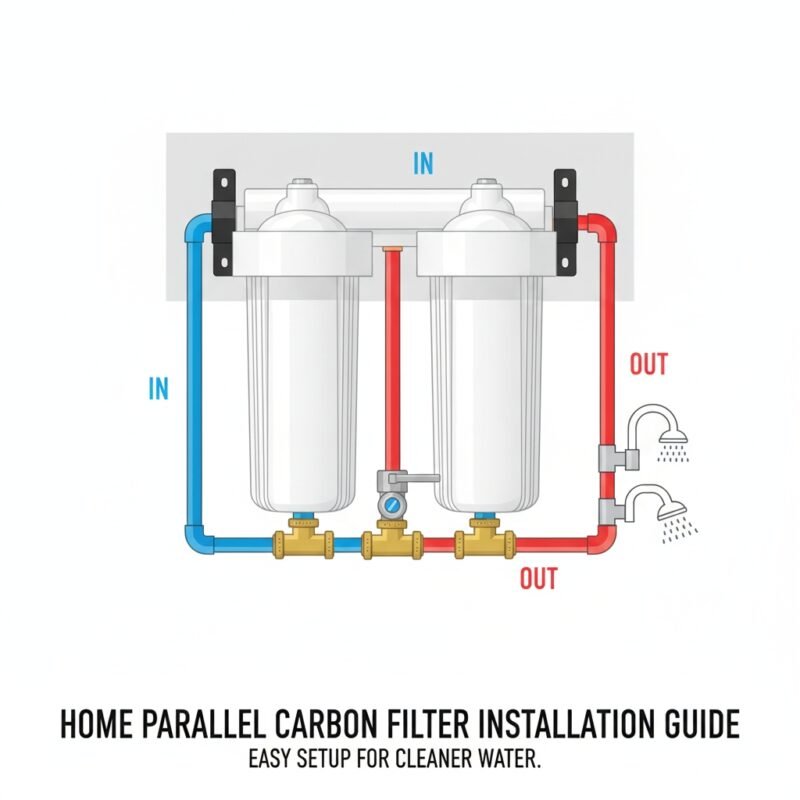
- Use flow restrictors, larger cartridges, or multiple parallel cartridges to maintain contact time. High instantaneous flow can send water through carbon with insufficient adsorption.
Backwashing and Channeling (For Tank Systems)
- In GAC tanks, backwashing is essential to redistribute media and prevent channeling that reduces contact area. Follow manufacturer instructions for backwash frequency.
- In cartridges, avoid bypass or “short-circuit” plumbing that reduces effective contact.
Sanitary Practices
- Use clean hands and tools when changing cartridges; do not drop cartridges on dirty floors. Rinse new carbon per instructions to remove fines.
- For long runs or infrequent use, flush stagnant water to avoid taste issues and potential microbial growth.
8. Maintenance: Replacement Intervals and How to Avoid Biological Issues
Carbon media eventually saturates and can become a breeding ground if left in service beyond capacity. Manage maintenance proactively.
Replacement Intervals
- Under normal municipal water with moderate chlorine levels, many point-of-use carbon cartridges last 6–12 months. Inline cartridges may need replacement at 3–6 months. Whole-house GAC tanks last longer in terms of gallons but require scheduled media replacement or carbon replenishment when capacity is reached.
- Evaluate flow degradation, reappearance of taste/odor, or manufacturer mileage (gallons) as signals to change media.
Avoiding Biological Growth
- Do not rely on carbon alone for microbiologically unsafe water. Carbon removes chlorine and thus reduces residual disinfectant—this can allow microbial growth in downstream plumbing unless a secondary disinfectant or UV is applied. For bacteria-prone water, use carbon in combination with UV disinfection or maintain a point-of-use disinfectant.
- Replace carbon promptly when it reaches capacity—saturated carbon loses adsorption capacity and may support microbial colonization.
Disposal and Replacement Logistics
- Keep spare cartridges on hand to avoid long service gaps. Document replacement dates.
- Dispose of spent carbon according to local municipal solid waste guidelines; most household carbon cartridges are acceptable in regular trash, but check for local recycling or take-back programs to reduce waste.
9. Testing Performance and Verifying Claims
Vendors often make broad claims. Verify them.
Ask for Data
- Request independent lab reports or NSF/ANSI certification that demonstrates percent reduction for the specific contaminant at a specified flow rate and inlet concentration. Common NSF standards: 42 (taste/odor/chlorine) and 53 (health-related contaminants like lead).
- For point-of-use RO systems with carbon polishing, ask for combined system performance data if the vendor offers a packaged solution.
Do Your Own Spot Tests
- Basic TDS meters, chlorine test strips, and taste checks are quick ways to confirm obvious performance differences. For legal or health-critical claims (lead, PFAS, arsenic), use a certified laboratory for pre- and post-treatment sampling.
10. Carbon and Emerging Contaminants — PFAS and Specialty Challenges
Activated carbon has utility with some emerging contaminants. For example, granular activated carbon can adsorb certain per- and polyfluoroalkyl substances (PFAS), depending on chain length and concentration, but performance varies significantly. If PFAS or other specialized contaminants are a concern, evaluate:
Design Considerations for PFAS
- Specific media targeted for PFAS (some carbons and ion-exchange resins are optimized for certain PFAS).
- Contact time and bed depth—deep beds and slow flow rates improve PFAS removal.
- Certification and lab reports showing breakthrough curves for the target PFAS at realistic concentrations.
In short, carbon can be part of a PFAS strategy but you need targeted design and independent data.
11. Whole-House Carbon: What You Gain and What You Must Accept
Choosing whole-house carbon gives home-wide taste and odor improvement and can protect appliances, but consider:
Advantages
- All taps, showerheads, and appliances deliver improved taste and often reduced chlorine—which many users appreciate.
- Protects plumbing and appliances from oxidative damage caused by chlorine or chloramine exposure.
Considerations
- GAC beds require larger physical space and proper backwashing to function reliably.
- Whole-house carbon removes disinfectant residual (chlorine), which can increase microbial risks in lengthy distribution loops; pair with appropriate design safeguards.
- Carbon alone does not soften water or remove dissolved inorganics; you may still need a softener or RO for those goals.
12. Pairing Carbon With Other Technologies for a Robust Home System
Common and practical pairings include:
Sediment → GAC → UV
- Sediment protects GAC; GAC removes chlorine and organics; UV provides microbial safety after carbon has been used as a pre-treatment and does not remove disinfectant residual.
Sediment → Softener → Carbon → RO (POU)
- Softener handles hardness, carbon removes chlorine to protect RO membranes, RO provides drinking water purity.
GAC → Catalytic Carbon → Specialty Media
- For chloramine-heavy utilities, a catalytic stage helps destroy chloramines prior to GAC polishing.
13. Cost Expectations and Lifecycle Budgeting
Cost varies with scale and configuration.
Point-of-Use Cartridges
- Upfront: $20–$200 depending on brand and certification.
- Annual replacement: $30–$200 depending on usage and cartridge life.
Under-Sink Multi-Stage Systems (with Carbon)
- Upfront: $150–$700 for a quality system and faucet.
- Annual replacement: $50–$300 for filters and pre-filters.
Whole-House Carbon Tanks
- Upfront: $800–$3,000 depending on tank size and controls (more if pre-treatment/backwashing or installation is required).
- Media replacement and service: periodic costs that depend on capacity and local contaminant load.
Always budget for regular inspection, cartridge replacement, and any pre-filtration needs. Replace before performance drops to avoid sudden taste or odor returns.
14. Buying Checklist — Practical Items to Compare
Before you buy, confirm:
- Exact contaminants the carbon is certified to reduce and the test conditions.
- Rated flow and recommended replacement interval for your household demand.
- Connection compatibility (fittings, housing sizes) and installation requirements.
- Pre-filtration requirements and expected pressure drop.
- Warranty, support, and availability of replacement cartridges.
- Independent lab reports or NSF certification for claims you care about.
15. Environmental Considerations and Disposal
Activated carbon is a manufactured product—think about waste and sustainability.
Sustainability Tips
- Choose systems that use replaceable cartridges rather than disposable full-unit throwaways where possible.
- Look for manufacturers that offer take-back or recycling programs.
- Consider carbon sourced from sustainable feedstocks (coconut-shell carbon has a strong sustainability profile compared to coal-based options in many contexts).
16. Practical Homeowner Scenarios — Decision Guides
Scenario A — Municipal Water with Chlorine Taste
- Recommended: Whole-house sediment + GAC or under-sink carbon block for drinking faucet. Change cartridges per life recommendation.
Scenario B — Chloramine-Treated City Water
- Recommended: Catalytic carbon stage sized for chloramine destruction, possible downstream GAC polishing; verify lab data.
Scenario C — Concerned About Lead in Home Plumbing
- Recommended: Certified carbon block cartridge NSF/ANSI 53 rated for lead reduction at the expected flow, installed at point-of-use and tested before and after.
Scenario D — Combined Desire for Drinking Water Purity and Appliance Protection
- Recommended: Whole-house sediment + carbon to protect appliances, under-sink RO for drinking water with post-carbon polish.
17. Troubleshooting and Common Homeowner Questions
Why Does My New Carbon Filter Taste Bad at First?
- New carbon often contains fines and dust—flush per manufacturer instructions (several liters) before use.
My Carbon Tastes Fine at First but Worse After Months—Why?
- Media is likely saturated or fouled. Replace cartridge and check for upstream sediment or organics that may be shortening life.
Can I Disinfect My Carbon?
- Household disinfection is not effective for regenerating carbon—replace it. For municipal GAC beds, industrial regeneration processes exist but are not applicable at home.
18. Final Recommendations and a Pragmatic Path Forward
Activated carbon filters are a high-value part of home water treatment: inexpensive, effective, and flexible. To get the best outcome:
- Test your water first to identify taste/odor causes and any health-related contaminants.
- Choose the carbon form that matches your goal: carbon block for polishing and particulate reduction, GAC for larger flow/whole-house, catalytic carbon for chloramine.
- Use sediment pre-filtration to protect carbon and extend life.
- Replace media proactively; don’t wait for a smell to return.
- Combine carbon with UV, RO, or softening where water chemistry or health needs require it.
- Verify vendor claims with independent data or recognized certifications.
If you want an example whole-house configuration to compare when you request vendor proposals, use this whole-house product as a reference for sizing, media staging, and maintenance expectations: https://yourwatergood.com/product/whole-house-water-filtration-system-for-home/. Compare its stated flow, media descriptions, and maintenance schedule against proposals you receive, and insist on written performance data.
Activated carbon won’t solve every water problem—but when you use it where it fits, and maintain it responsibly, it delivers reliably better water: cleaner taste, fewer odors, and a smoother path toward any additional treatment you may need for health-related contaminants. Choose carbon thoughtfully, and it will reward you with immediate, noticeable improvements to the water you use every day.