
Carbon Clarity at Home: How Carbon Water Filter Systems FOR HOME Deliver Cleaner, Better-Tasting Water

Introduction
Access to clean, great-tasting water is an everyday household priority. Carbon water filter systems are a proven, cost-effective, and versatile solution that reduce chlorine taste and odor, adsorb a wide range of organic contaminants, and protect downstream equipment such as reverse osmosis membranes and drinking-water appliances. This in-depth guide explains how carbon filtration works, the types of carbon media available, where carbon fits in a home water strategy (point-of-use vs. whole-house), how to size and install systems, realistic performance expectations, maintenance best practices, troubleshooting tips, and procurement advice so you can choose a solution that fits your household and budget. If you also need very low TDS drinking water, you can pair carbon polishing with a point-of-use reverse osmosis system as needed; see a representative consumer RO purifier for comparison: https://yourwatergood.com/product/ro-water-purifier/.
How activated carbon works
Adsorption fundamentals
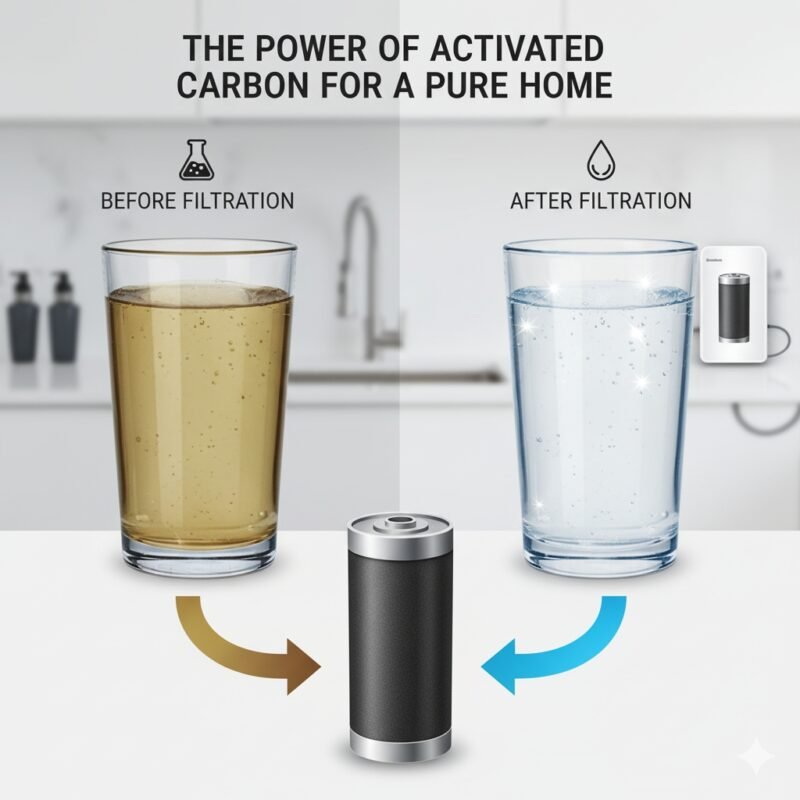
Activated carbon removes contaminants primarily through adsorption. Activation creates a network of microscopic pores and increases surface area dramatically — a small mass of activated carbon provides many square meters of internal surface where organic molecules, chlorine, disinfection byproducts, and various volatile organic compounds (VOCs) attach. Adsorption differs from absorption: contaminants adhere to the carbon surface rather than being chemically transformed.
Factors that affect performance
Carbon performance depends on pore structure, the chemistry of the target contaminant, contact time, temperature, and competing organics in the water. Carbon does not remove dissolved inorganic ions such as calcium or magnesium (hardness), nor is it a disinfectant; if microbiological hazards exist, pair carbon with appropriate disinfection like UV or chlorination.
Forms of carbon media and their best uses
Granular Activated Carbon (GAC)
GAC consists of loose granules packed into tanks or cartridges. It is forgiving at higher flow rates and useful for whole-house tanks where larger media volumes are desirable. GAC is commonly used in point-of-entry (POE) tanks and some larger under-sink housings. Because it is granular, GAC may have lower pressure drop and can be backwashed in larger tanks to remove accumulated particulates.
Carbon Block
Carbon block media is manufactured by compressing activated carbon into a dense matrix. Carbon blocks deliver higher adsorption efficiency per liter of media and provide fine particulate filtration as well. They are common in under-sink point-of-use (POU) cartridges where space is limited but high performance and certification for contaminant reduction (lead, VOCs) are required.
Catalytic Carbon
Catalytic carbon is engineered to break down chloramines and other stable oxidants that standard GAC may struggle to remove. Utilities that disinfect with chloramine (a combined form of chlorine) typically require catalytic carbon or longer EBCT (Empty Bed Contact Time) to reliably remove chloramine and its byproducts.
Specialized and Impregnated Carbons
Some carbons are tailored for niche uses: silver-impregnated carbon for bacteriostatic properties, PFAS-targeted carbons with increased bed depth and modified surface chemistry, or composite media that pair carbon with KDF (copper-zinc alloy) or ion-exchange resins to broaden contaminant removal. Always verify independent test data for specialized claims and ensure the media is appropriate for your water chemistry.
Why carbon belongs in a layered home water strategy
Protecting membranes and appliances
Carbon upstream of RO membranes is essential when municipal water is chlorinated: free chlorine degrades thin film composite membranes rapidly. Carbon pre-treatment removes the free chlorine and many organics that would otherwise foul or oxidize membranes. Downstream, a carbon post-filter polishes RO permeate for taste.
Whole-house aesthetic improvements
A point-of-entry carbon tank or cartridge removes chlorine and many taste/odor compounds at every tap. This improves shower experience, reduces chlorine-related detergent fade in laundry, and protects appliances from oxidative damage. Whole-house carbon is an excellent first stage for homes that prioritize overall water aesthetics.
Targeted drinking water treatment
At the kitchen tap, a certified carbon block can provide both aesthetic improvements and, when certified, health-related reductions (for example, lead). Under-sink carbon is convenient for drinking and cooking and is typically cheaper than whole-house options if only kitchen water matters. For households seeking low TDS drinking water, pair carbon polishing with a point-of-use RO system.
Sizing carbon systems: EBCT, capacity, and flow
Empty Bed Contact Time (EBCT)
Carbon performance correlates strongly with contact time. Empty Bed Contact Time (EBCT) is the media bed volume divided by the system flow rate — a larger EBCT typically improves removal for slowly adsorbing compounds such as some VOCs and PFAS. Whole-house tanks with many liters of carbon provide higher EBCT than small inline cartridges.
Sizing for peak flow
Estimate peak flow requirements for the outlet(s) the system must serve. Choose media volume and bed depth to achieve a practical EBCT for the contaminants of concern. For point-of-use carbon blocks, confirm rated flow and breakthrough capacity at the intended flow. Manufacturers often state an expected gallon capacity for chlorine or an organic surrogate; fit replacement intervals to measured household consumption.
Pressure drop and cartridge selection
Carbon block creates more pressure drop than GAC at a given flow. Verify the pressure drop at expected flow for under-sink or inline applications so appliances aren’t starved. For high-flow needs choose larger cartridges, pleated designs, or parallel housings.
Certifications and independent verification
Relying on third-party testing
Because carbon performance depends on media type, contact time, and influent chemistry, rely on third-party verification for health claims. Relevant certifications include NSF/ANSI 42 for aesthetic effects (taste and chlorine), NSF/ANSI 53 for health-related reductions such as lead, and other protocols that address specific emerging contaminants. Request third-party lab test reports and look for details: exact test conditions, flow rates, influent concentrations, and observed breakthrough curves. Ensure the report applies to the model and flow conditions you intend to use.
Whole-house carbon: design, installation and tradeoffs
Key design features
Whole-house carbon solutions typically use a GAC bed in a vertical tank or multiple cartridge housings sized for higher flow. Key design features include:
- Pre-filtration: install a sediment pre-filter (5–20 µm depending on turbidity) to remove particulate that will prematurely foul the carbon bed.
- Bypass and isolation valves: include a bypass so you can service the system without shutting off water to the house.
- Backwashing and service access: for high-sediment supplies, consider backwashing systems that periodically clean the bed surface and extend media life.
- Sampling ports: add inlet/outlet ports for acceptance testing and periodic sampling.
- Monitoring: install pressure gauges or differential pressure indicators to detect particulate loading.
Tradeoffs
Whole-house carbon removes disinfectant residuals. In rare cases where a disinfectant residual must be preserved for exterior uses or specific industrial equipment, discuss design options with your contractor. Also factor in the footprint and the need to replace or re-bed the carbon after its service lifetime.
Point-of-use carbon: options and best practices
Under-sink carbon block best practices
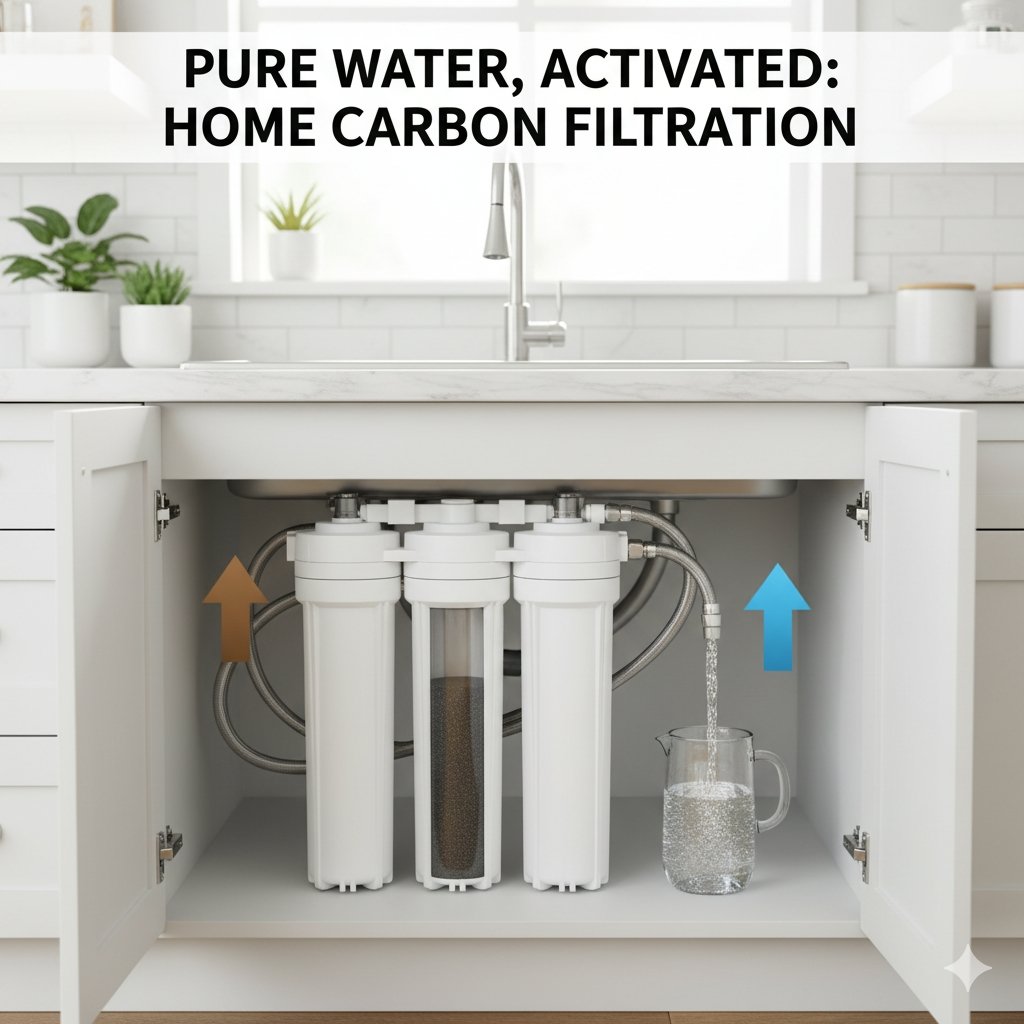
Under-sink carbon blocks or inline modules are compact and deliver high adsorption efficiency per liter. Best practices include:
- Use a sediment pre-filter upstream (even a simple 5-micron PP) to protect the carbon block.
- Flush new carbon thoroughly — new carbon houses fines that must be flushed before delivering water to the tap.
- Check for NSF/ANSI 53 certification if you need lead reduction or other health-related claims.
- Plan replacement intervals using both manufacturer capacity ratings and your actual household usage.
Catalytic carbon and chloramine considerations
Why chloramine is different
Municipal systems that use chloramine as a secondary disinfectant require special attention because chloramine is more stable than free chlorine and requires longer contact time or catalytic carbon to break effectively. Installers often specify catalytic carbon or a combination of catalytic carbon followed by GAC, along with larger media volumes, to ensure reliable removal. Confirm vendor data showing chloramine reduction at realistic flows.
PFAS and other emerging contaminants
PFAS behavior with carbon
PFAS are a distinct class of compounds that carbon can adsorb, but efficiency depends on the specific PFAS chain length and the carbon type. Long-chain PFAS are generally more strongly adsorbed than shorter chains. If PFAS are a concern:
- Request vendor breakthrough curves for the specific PFAS detected in your water test.
- Expect larger bed volumes and more frequent replacement compared with typical chlorine removal cartridges.
- Consider complementary technologies (anion-exchange, specialized PFAS adsorbents, or RO) if PFAS levels are high or vendor data indicate early breakthrough.
Maintenance regimes: when to change carbon
Typical replacement intervals
Replacement intervals vary by media volume, influent concentration, and flow. General guidance:
- Inline or under-sink carbon cartridges: replace every 6–12 months in typical municipal water; sooner if you detect return of taste/odor or if flow drops significantly.
- Whole-house GAC tanks: re-bed or replace media after an estimated capacity threshold based on influent load — often multi-year but dependent on local conditions.
Maintenance best practices
Keep a maintenance log with install and replacement dates, and perform periodic taste or chemical testing at the outlet to validate performance. Always replace pre-filters promptly; a fouled pre-filter reduces performance and can overload the carbon with particulates.
Troubleshooting common carbon issues
Carbon fines and initial taste
Flush thoroughly per manufacturer guidance; these complaints usually resolve after appropriate flushing volumes.
Sudden taste/odor return
Check for exhausted carbon (replace), upstream changes (construction, upstream contamination), or bypass valves left open.
High pressure drop
Likely particulate loading; replace sediment pre-filter or backwash if available.
Microbial concerns
Carbon can remove disinfectant residual, and in poorly maintained systems stagnant carbon beds may support bacterial growth. If microbial contamination is suspected, sanitize housings, replace media, and consider UV or shock chlorination strategies for wells.
Environmental and disposal considerations
Reducing waste
Single-use cartridges create plastic waste. To reduce environmental impact:
- Choose replaceable cartridges where only the media is changed and the housing is retained (when feasible).
- Ask manufacturers about recycling or take-back programs for spent cartridges.
- Consider coconut-shell activated carbon for media with favorable sustainability credentials.
- For whole-house beds, investigate whether suppliers offer responsible disposal or reactivation services for spent carbon.
Costs and total cost of ownership
Typical costs
Point-of-use carbon cartridges typically cost $20–$100 each depending on size and certification. Whole-house GAC tanks with installation range from roughly $800 to $3,500 depending on tank size, media volume, bypass plumbing, and whether backwashing or automation is included. Ongoing costs include media replacement, pre-filter cartridges, and occasional service visits.
Example cost model
When comparing options, compute a 3- to 5-year total cost that includes media replacement and any service contract fees. For many households, carbon-based approaches are cost-effective compared with bottled water or frequent service calls caused by untreated organics and chlorine-related wear.
Real-world case examples (illustrative)
Municipal chlorine case
Single-family home with municipal chlorine: a 10-inch whole-house carbon cartridge ahead of a high-efficiency under-sink carbon block provides chlorine removal for showers and polishing at the kitchen tap. This combination often reduces laundry fading, improves shower feel, and delivers excellent kitchen water quality with minimal maintenance.
Chloraminated supply case
Family on chloraminated supply: catalytic carbon POE tank with larger media volume and an under-sink carbon block for drinking water. The catalytic media addresses the stable chloramine residual while the under-sink block ensures lead and taste control.
PFAS concern case
Home concerned about PFAS: combined approach using a larger granular carbon tank for whole-house aesthetics plus a dedicated PFAS-rated point-of-use cartridge for the kitchen tap; verify with lab testing after installation to confirm breakthrough performance and schedule replacement accordingly.
How to evaluate vendors and installers
Questions to ask suppliers
Ask prospective vendors and installers for:
- A site-specific proposal referencing your water test — avoid cookie-cutter quotes.
- A P&ID or schematic showing pre/post stages, bypass, and sampling ports.
- Third-party test reports or NSF certificates for the model and media proposed.
- References for similar installations in your region.
- A clear maintenance schedule and spare parts availability.
- A service contract option with response times and defined deliverables.
Common myths and misconceptions
Myths debunked
- “Carbon removes everything” — false. Carbon is excellent for organics and chlorine but not for inorganic ions like hardness, fluoride, or nitrate.
- “All carbon is identical” — false. Media source (coconut vs coal), activation method, pore structure, and bed design change performance significantly.
- “Longer media life is always better” — not necessarily. Oversizing increases upfront cost; design media volume to meet measured needs and desired replacement cadence.
Practical buying checklist
- Get a recent water test and identify target contaminants.
- Decide if you need whole-house, point-of-use, or a hybrid approach.
- Choose the carbon type that addresses the contaminants (GAC, block, catalytic, PFAS-rated).
- Ask for NSF/independent test reports that match model and flow.
- Ensure sediment pre-filtration is specified.
- Confirm space, plumbing, and bypass requirements.
- Budget for 3-5 years of media replacement and service.
- Negotiate acceptance testing and commissioning benchmarks.
- Confirm spare parts lead times and availability.
- Arrange training or documentation for in-house maintenance staff.
Detailed installation: step-by-step for homeowners and contractors
Preparation and planning
Read the manufacturer manual. Identify the incoming service line, measure clearance, and confirm shut-off locations and valve access. Gather tools: adjustable wrenches, tubing cutters, pipe tape, mounting hardware, a level, and a bucket for initial flush water.
Installation steps
- Isolate supply and relieve pressure.
- Install sediment pre-filter (POE or POU).
- Mount carbon housing or set tank and secure on a level base.
- Connect bypass and valves, and install sampling and gauge ports where possible.
- Flush and condition media per manufacturer instructions.
- Commission, test, and document baseline performance.
Monitoring and performance testing
Simple monitoring
Monthly visual inspection for leaks, weekly taste checks, and pressure gauge readings. Track differential pressure across sediment and carbon stages.
Chemical and lab testing
Use chlorine test strips for quick verification. For target contaminants (lead, PFAS, VOCs), schedule independent laboratory sampling during commissioning and periodically thereafter.
Advanced media combinations and hybrid systems
Combining media for broader performance
Carbon is frequently combined with other media to achieve broader performance:
- Carbon + KDF: KDF removes certain metals and reduces biological growth while protecting carbon from iron fouling.
- Carbon + Ion-exchange: in compact POU designs, combining carbon with ion-exchange can reduce some heavy metals and soften water slightly.
- Sequential multi-media tanks: for challenging wells, designs might include oxidizing media for iron conversion, multimedia sediment filters, GAC for organics, followed by ion-exchange or RO for targeted ions.
Lifecycle SOPs and spare parts planning
Operational readiness
Create SOPs for cartridge changes, backwash routines, media re-bed, and emergency shutdown. Keep consumables on hand and ensure at least two people know basic maintenance procedures.
Economic example: a simple 5-year cost model
Consider a household using an under-sink carbon block that costs $50 and is replaced annually, plus a whole-house cartridge changed every two years at $200 with a $1,000 initial install. Over five years:
- Upfront: $1,000 (install) + $50 (first cartridge) = $1,050.
- Replacements: under-sink cartridges × 4 = $200; whole-house replacements × 2 = $400.
- Total five-year cost: $1,050 + $200 + $400 = $1,650 (not including professional labor).
Regulatory and safety notes
Check local plumbing codes about bypass arrangements, sampling ports, and permits required for POE installations. For systems used in rental properties or commercial kitchens, integrate filtration maintenance into property management SOPs and HACCP plans as appropriate. Always avoid cross-connections and ensure drain arrangements meet code.
Comparing carbon to alternatives: quick guide
- Carbon vs RO: carbon removes chlorine and organics but not dissolved ions; RO reduces TDS and many dissolved contaminants but requires carbon pre-filtration. Pairing gives both broad removal and taste polishing.
- Carbon vs ion exchange (softening): softeners remove hardness but do not remove organics or chlorine; often used together.
- Carbon vs UV: UV is a disinfectant; carbon is an adsorbent. Use UV when microbial risk is primary; use carbon for chemical and taste control.
Expanded FAQs
Can carbon remove PFAS?
Some activated carbons adsorb PFAS, particularly longer-chain variants, but removal varies by carbon type and PFAS species. Verify performance with vendor breakthrough curves and independent lab testing for the specific compounds found in your water.
Will a carbon filter remove chlorine permanently?
Carbon removes chlorine until adsorption sites are filled. Replace media on schedule to maintain continuous removal.
Is carbon safe for well water?
Carbon improves taste and removes organics in well water but does not disinfect. For wells, add appropriate disinfection (UV or chlorination) and test regularly.
How can I tell if carbon is exhausted?
A return of taste/odor, measured increases in target contaminant concentration, or sudden changes in downstream readings indicate exhaustion. Maintain conservative replacement intervals and perform spot checks.
Final summary
Carbon water filtration systems are a flexible and effective way to improve household water — balancing performance, cost, and environmental considerations. Proper selection of media type, sizing for contact time, installation with sediment pre-filtration, and a disciplined maintenance and monitoring program will deliver consistent benefits across drinking, cooking, and appliance protection. For homeowners needing very low TDS or additional inorganic contaminant removal, pairing carbon with a point-of-use reverse osmosis system provides a powerful, layered solution that combines broad organic removal with reliable dissolved-ion reduction. Compare product specifications and maintenance schedules as you shop; when you pair technologies thoughtfully, carbon becomes a core building block of a robust home water system.
For a consumer RO purifier to use as a technical benchmark while you plan polishing or low-TDS needs, review this product: https://yourwatergood.com/product/ro-water-purifier/.