
Elevate Your Brand: The Comprehensive Guide to Choosing a Drinking Water Filtration System for Business

In the competitive landscape of modern commerce, the difference between success and mediocrity often lies in the details. A customer might not consciously notice the thread count of the napkins or the wattage of the lightbulbs, but they notice the experience. And nothing disrupts a customer or employee experience faster than a glass of water that tastes like a swimming pool, or a cup of coffee that tastes bitter and flat.
Water is the silent utility that powers almost every aspect of a physical business. It is the primary ingredient in your beverages, the clarity in your ice cubes, the hydration for your staff, and the lifeblood of your expensive kitchen machinery. Yet, many business owners rely on municipal tap water, assuming that “safe to drink” is synonymous with “good for business.”
It is not.
To truly secure your product quality and protect your assets, investing in a high-quality drinking water filtration system for business is not an operational expense—it is a strategic necessity. In this extensive guide, we will explore the science of commercial water quality, the devastating economic impact of poor water, and how to select the perfect purification technology to elevate your brand.https://yourwatergood.com/product/5-stage-ro-water-filter-for-home-busines/.
Part 1: The Hidden ROI of Water Quality
When a business owner looks at the bottom line, they see rent, labor, and cost of goods sold. Often hidden in the “Maintenance” or “Utilities” line items are the invisible costs of poor water quality.
1. The Equipment Preservation Factor
If you operate a café, restaurant, or hotel, your kitchen is filled with expensive machinery: espresso machines, combi-ovens, ice machines, and commercial dishwashers.
- The Enemy: Limescale. In hard water areas, heating water causes calcium carbonate to precipitate and turn into rock.
- The Cost: Scale acts as an insulator. A mere 1/8th inch of scale on a heating element increases energy consumption by 25%. Worse, scale clogs the tiny solenoid valves and sensors in espresso machines, leading to downtime and expensive emergency plumbing calls.
- The Solution: A proper drinking water filtration system for business that includes scale inhibition or Reverse Osmosis (RO) removes these minerals, extending the life of your equipment by years.
2. The Flavor Profile (The Coffee Shop Rule)
Coffee is 98% water. You can buy the most expensive single-origin beans and hire the best baristas, but if your water is laden with chlorine or sediment, your product will suffer.
- Chlorine: Reacts with coffee oils to create acrid, bitter flavors.
- Sediment: Muddles the clarity of the cup and alters the extraction rate.
- Consistency: Municipal water quality changes seasonally. A filtration system provides a consistent “canvas” for your beverages, ensuring your signature latte tastes the same in July as it does in December.
3. Employee Wellness and Productivity
For corporate offices, the water cooler is the modern hearth. Dehydration is a leading cause of afternoon fatigue and brain fog. If the office tap water tastes metallic or smells of bleach, employees will drink less of it. Providing crisp, purified water encourages hydration, which directly links to cognitive function and productivity.
Part 2: Defining the Solution
When you search for a drinking water filtration system for business, you are generally looking for a “Point-of-Use” (POU) solution. Unlike massive whole-building industrial treatment plants, POU systems are installed exactly where the water is needed—under the breakroom sink, behind the espresso bar, or connected to the ice machine.
The Gold Standard: Reverse Osmosis
While simple carbon filters can remove taste and odor, they do not remove dissolved solids, heavy metals, or “forever chemicals” (PFAS). For a business that wants to make a statement about quality and health, Reverse Osmosis (RO) is the superior choice.
RO works by forcing water through a semi-permeable membrane with pores so small (0.0001 microns) that only pure water molecules can pass. It strips away:
- Heavy Metals: Lead, Arsenic, Mercury.
- Dissolved Solids: Fluoride, Nitrates, Sulfates.
- Biologicals: Bacteria, Viruses, Cysts.
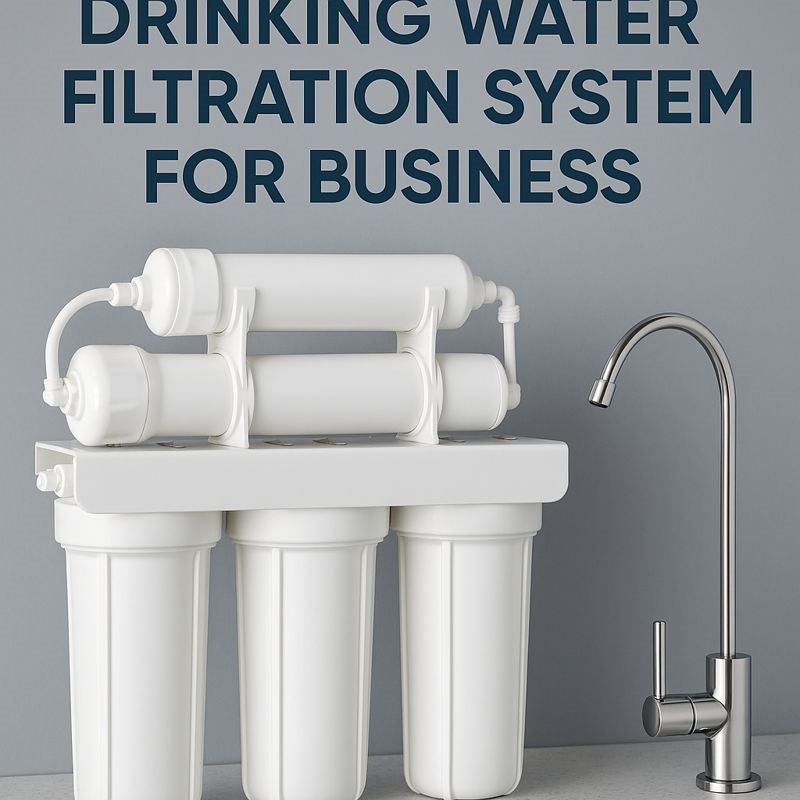
For businesses seeking this level of purity combined with commercial reliability, we highly recommend the 5 Stage RO Water Filter for Home & Business. This system is specifically engineered to bridge the gap between residential compactness and commercial durability. It offers a 5-stage defense system that ensures every drop dispensed is medical-grade pure, making it the ideal engine for your office hydration station or your café’s brew bar.
Part 3: Deep Dive into the 5 Stages of Commercial Purity
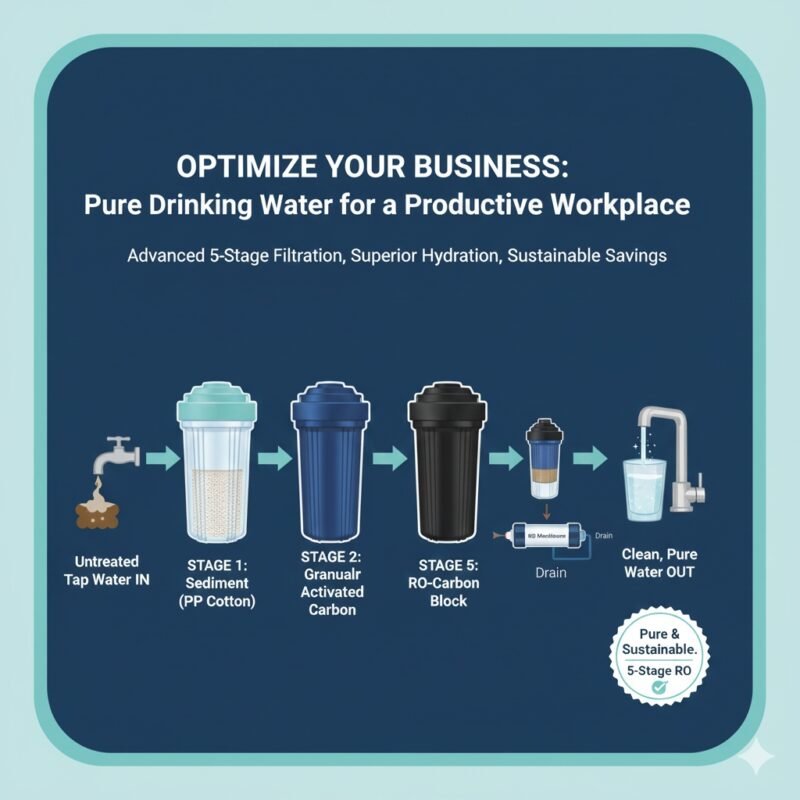
Why do we recommend a 5-stage architecture for a drinking water filtration system for business? Because commercial water sources are unpredictable. A multi-barrier approach ensures that if one stage faces a heavy load, the others provide backup.
Stage 1: The Sediment Firewall
- The Component: High-Density Polypropylene (PP) Cotton.
- The Business Function: Protection. Municipal water pipes are often old and shedding rust. Construction nearby can introduce sand into the lines. This stage physically traps these particles. Without it, the expensive membranes downstream would clog instantly.
- Commercial Benefit: Prevents the tiny inlet screens on your coffee machine or ice maker from getting plugged with grit.
Stage 2 & 3: The Chemical Scrub (Double Carbon)
- The Component: Granular Activated Carbon (GAC) and Carbon Block (CTO).
- The Business Function: Adsorption. These filters target Chlorine, Chloramines, and Volatile Organic Compounds (VOCs).
- Commercial Benefit: This is the “Taste Stage.” By removing chlorine, you ensure your soft drinks, tea, and coffee have no chemical aftertaste. It also protects the RO membrane from oxidation damage.
Stage 4: The Purification Engine (RO Membrane)
- The Component: Thin-Film Composite Membrane.
- The Business Function: Separation. This stage divides the water into two streams: pure water (permeate) and waste water containing the concentrated contaminants (brine).
- Commercial Benefit: This creates the “blank slate” water. For tea shops and specialty coffee, this allows you to control the exact mineral content of your beverages (often by blending or remineralizing later) without interference from unknown city water variables.
Stage 5: The Final Polish
- The Component: Inline Post-Carbon Filter.
- The Business Function: Freshness. Water stored in a tank can sometimes taste flat. This final filter aerates and polishes the water immediately before it hits the glass.
- Commercial Benefit: Ensures that the glass of water you serve to a customer as they sit down is crisp, odorless, and refreshing—setting a positive tone for the meal.
Part 4: Industry-Specific Applications
Every business has unique needs. Here is how a drinking water filtration system for business applies to different sectors.
1. The Specialty Coffee Shop
The Pain Point: Inconsistent extraction and equipment failure due to scale. The Solution: An RO system is often necessary to lower the Total Dissolved Solids (TDS) to the ideal range (around 75-150 ppm). Using the 5 Stage RO Water Filter for Home & Business, a shop owner can achieve a neutral base. Note: Pure RO water can be too pure for coffee (which needs some magnesium for flavor). Many shops use this system with a blending valve or a remineralization cartridge to dial in the perfect chemistry.
2. The Corporate Office
The Pain Point: Expensive bottled water delivery services and plastic waste. The Solution: Installing this system under the breakroom sink and connecting it to the fridge dispenser or a dedicated faucet eliminates the need for 5-gallon jug deliveries. The ROI: An office of 20 people can spend $200+ a month on water delivery. An RO system costs pennies a day to operate. The system pays for itself in 2-3 months.
3. Restaurants and Bars
The Pain Point: Cloudy ice and spotted glassware. The Solution: Hard water minerals cause ice to freeze with a cloudy center. By using RO water for the ice machine, you get crystal clear, hard ice that melts slower. This improves the presentation of cocktails and prevents the ice from diluting premium spirits too quickly.
Part 5: The Sustainability Angle (ESG Goals)
Modern businesses are increasingly judged by their Environmental, Social, and Governance (ESG) criteria. How you handle water plays a massive role in this.
Killing the Plastic Bottle
In meetings, conferences, and daily operations, businesses consume a staggering amount of single-use plastic bottles.
- The Optic: Providing plastic bottles looks outdated and wasteful to modern clients.
- The Shift: Offering chilled, purified water in glass carafes or reusable branded bottles sends a strong message of sustainability.
- The Mechanism: A drinking water filtration system for business allows you to become your own bottling plant. You produce zero plastic waste while providing water that is often higher quality than what is found in the bottle.
Part 6: Installation and Logistics
Implementing a drinking water filtration system for business does not require a factory shut-down. Modern systems are designed for non-intrusive installation.
Space Requirements
The 5-stage system is compact. It fits easily under a standard kitchenette cabinet or behind a coffee bar. The storage tank can be positioned horizontally or vertically to save space.
Connectivity
One of the greatest advantages of a pressurized RO system is versatility. From a single unit installed under a sink, you can run tubing to multiple outlets:
- The dedicated drinking faucet at the sink.
- The refrigerator ice maker/water dispenser.
- The commercial coffee brewer.
- The standalone ice machine.
Pro Tip: For high-volume commercial applications involving multiple machines, you may need a larger storage tank or a delivery pump to ensure consistent pressure.
Part 7: Maintenance: The Key to Reliability
In a business setting, equipment failure is not an option. While RO systems are largely “set it and forget it,” they require scheduled maintenance to maintain health standards.
The Maintenance Schedule
- Quarterly/Semi-Annually: Change the Stage 1 Sediment filter. In a commercial building, water pipes are often larger and carry more debris. Protecting the membrane is priority #1.
- Annually: Change the Carbon filters (Stage 2, 3, and 5) to ensure chlorine removal and fresh taste.
- Bi-Annually: Replace the RO Membrane (Stage 4).
The Partner Advantage
As a business, you don’t just buy a product; you buy a relationship. When sourcing your drinking water filtration system for business, look for suppliers like YourWaterGood who understand commercial needs. We ensure that replacement filters are standard sizes (non-proprietary), meaning you are never held hostage by expensive, hard-to-find parts. We advocate for high-density PP cotton pre-filters that can withstand the pressure surges common in commercial buildings.
Part 8: The Cost-Benefit Analysis
Let’s break down the math for a small office of 15 employees.
Scenario A: Bottled Water Delivery
- 5-gallon jugs consumed per month: 10
- Cost per jug: $7.00
- Cooler rental fee: $15.00/month
- Total Annual Cost: ~$1,020.00
Scenario B: 5-Stage RO System
- System Purchase (One time): ~$250.00
- Annual Filter Replacements: ~$60.00
- Water Utility Cost: Negligible
- Total First Year Cost: $310.00
- Total Subsequent Year Cost: $60.00
The Savings: Over 5 years, the filtration system saves the business nearly $5,000. And this doesn’t account for the labor time spent coordinating deliveries or lifting heavy jugs.
Part 9: Common Myths in Business Filtration
Myth: “Our building is new, so the pipes are clean.” Fact: Even new buildings connect to old municipal mains. Furthermore, new construction often has debris (solder, PVC shavings) in the lines. A drinking water filtration system for business is essential regardless of building age.
Myth: “We can just use a pitcher filter in the fridge.” Fact: In a business environment, pitcher filters are impractical. They are slow, have low capacity, and rely on employees to refill them (which rarely happens). They also fail to remove heavy metals or PFAS.
Myth: “RO water wastes too much water for a green business.” Fact: While older industrial RO systems had high waste ratios, modern POU systems are efficient. The water used to rinse the membrane is minimal compared to the water used to flush toilets or wash hands. The environmental gain from eliminating plastic waste far outweighs the small water usage.
Conclusion: A Clear Choice for Success
In business, you control the variables you can. You control your marketing, your hiring, and your product quality. Water should be one of those controlled variables.
Leaving your water quality to the whims of the municipal supply is a risk. It risks your equipment, your employee satisfaction, and your customer experience.
Investing in a professional drinking water filtration system for business is a high-yield, low-risk decision. It pays for itself through operational savings and equipment longevity while delivering a tangible quality upgrade to everyone who walks through your doors.
Whether you are brewing the city’s best espresso or simply want your accounting team to stay hydrated and sharp, the solution is clear.
Visit YourWaterGood today to secure the high-performance filtration technology your business deserves. Don’t settle for tap water; pour success into every glass.
Frequently Asked Questions (FAQ)
Q: Can this system handle the volume of a busy restaurant? A: The standard 5 Stage RO Water Filter for Home & Business is rated for 50-75 Gallons Per Day (GPD). This is sufficient for drinking water, small ice machines, and coffee stations. For a high-volume commercial kitchen washing thousands of dishes, you would need a larger “Whole Building” system or multiple RO units with a large atmospheric storage tank.
Q: Does the system remove Fluoride? A: Yes. The RO membrane effectively removes fluoride. This is often a selling point for health-conscious wellness businesses (yoga studios, gyms, spas) that want to offer fluoride-free water to clients.
Q: How do I know when to change the filters? A: In a business setting, usage is higher than in a home. We recommend installing a simple TDS (Total Dissolved Solids) meter. Test the water once a month. If the TDS levels start creeping up, or if the water flow slows down significantly, it is time for maintenance.
Q: Is the installation disruptive? A: No. A qualified handyman or plumber can install the system in under an hour. It usually requires drilling a small hole in the countertop for the faucet (unless a hole already exists) and tapping into the cold water line under the sink.
Q: Can I connect this to my commercial coffee brewer? A: Yes, but you need to check the brewer’s pressure requirements. RO systems deliver water via tank pressure. If your commercial brewer requires high pressure (e.g., for jet spraying), you may need to add a small “Delivery Pump” between the RO tank and the coffee machine.