
The Complete Guide to the Five Stage Filter: Ultimate Purity for Home

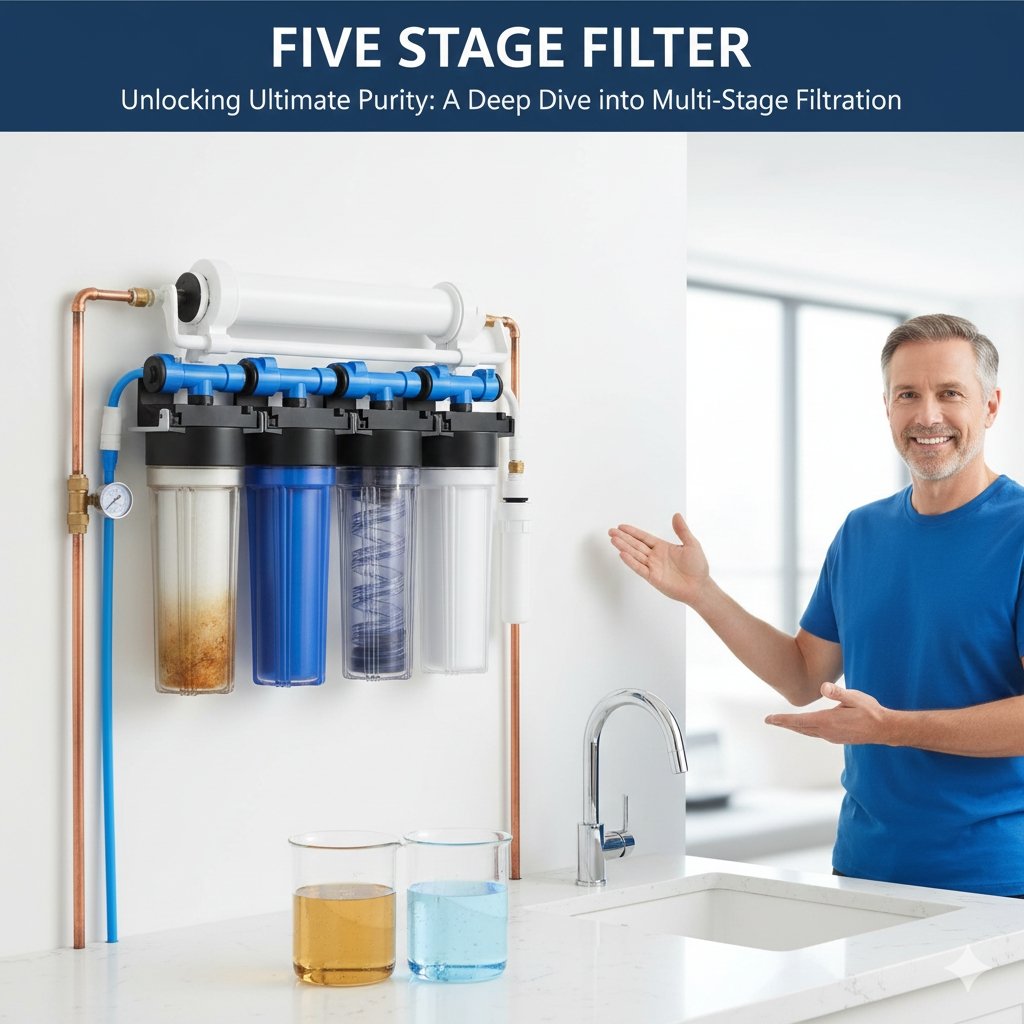
In an era where health consciousness is at an all-time high, the quality of the water we drink has become a central topic of conversation. We scrutinize ingredient labels on food, track our steps, and monitor our sleep, yet many of us still rely on tap water that travels through aging infrastructure or, conversely, expensive and environmentally damaging bottled water.
For homeowners and small business owners seeking a middle ground—a solution that offers premium purity without the recurring cost of bottles—the five stage filter has emerged as the gold standard. But what exactly is it? Is it overkill, or is it a necessary shield against modern contaminants?
This comprehensive guide will tear down the mechanics, economics, and health benefits of the 5-stage filtration system. We will explore why this specific configuration dominates the market, how it protects you from invisible dangers like PFAS and lead, and why upgrading to a system like the RO Water Purifier is one of the smartest investments you can make for your property.
1. The Anatomy of Purity: How a Five Stage Filter Works
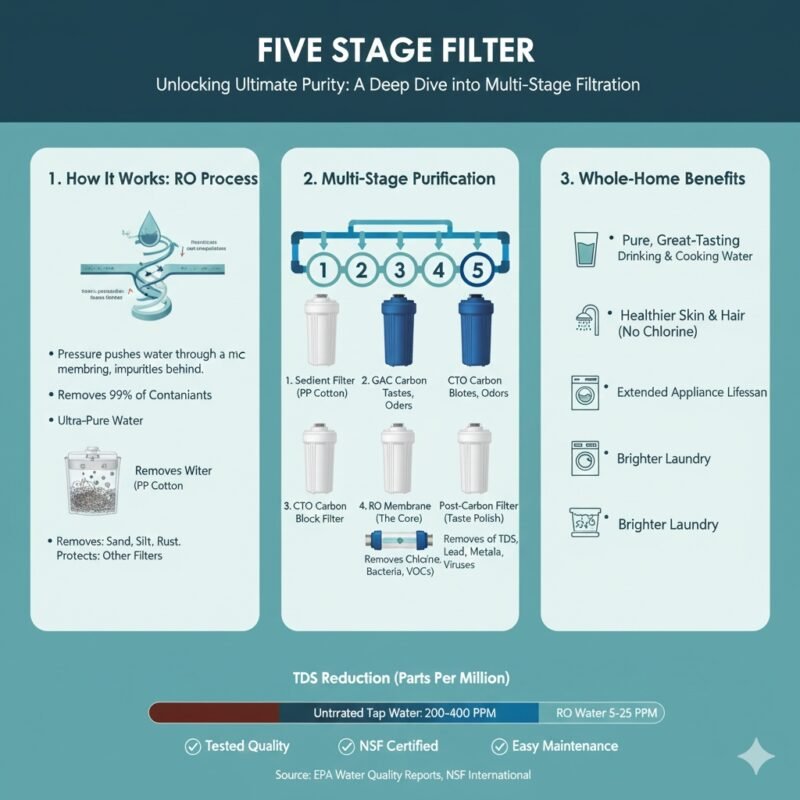
To understand the superiority of a five stage filter, we must look beyond the sleek faucet and the storage tank. The magic happens inside the manifold, where water is subjected to a “graduated filtration” process. Each stage is designed to target a specific category of contaminants, protecting the subsequent stages and ensuring the final product is stripped of up to 99% of impurities.
Stage 1: The Sediment Pre-Filter (The Bodyguard)
The journey begins with the Sediment Filter, typically made of high-quality Polypropylene (PP) cotton.
- The Mission: Remove physical particles. This includes rust flakes from old city pipes, sand, silt, dirt, and turbidity.
- The Science: Think of this as a screen door. It doesn’t stop the wind (chemicals), but it stops the bugs and leaves (dirt).
- Why It Matters: Without this stage, the microscopic pores of the subsequent carbon and membrane filters would clog instantly. It acts as the bodyguard for the entire system.
Stage 2: Granular Activated Carbon (The Chemical Sponge)
Once the water is physically clear, it enters the Granular Activated Carbon (GAC) filter.
- The Mission: Tackle the aesthetic and chemical offenders. This stage targets chlorine, chloramines, volatile organic compounds (VOCs), and unpleasant odors (like the “rotten egg” smell of sulfur).
- The Science: Adsorption. Carbon has a massive surface area full of nooks and crannies that trap chemical molecules like a magnet.
Stage 3: Carbon Block Filter (The Gatekeeper)
Before the water reaches the delicate membrane, it passes through a Carbon Block (CTO).
- The Mission: Remove any residual chlorine and finer particles that escaped the GAC.
- The Science: unlike loose granules, this is a solid block of compressed carbon. It forces water to take a tortuous path, increasing “contact time” and ensuring rigorous chemical removal. This is critical because chlorine can chemically burn and destroy the Reverse Osmosis membrane in the next stage.
Stage 4: The Reverse Osmosis Membrane (The Engine)
This is the heart of the five stage filter. The RO Membrane is what separates a “filter” from a “purifier.”
- The Mission: Remove dissolved solids. This includes heavy metals (Lead, Arsenic), salts (Fluoride, Nitrates), and biological threats (Bacteria, Cysts, Viruses).
- The Science: Water is forced under pressure against a semi-permeable membrane with pores sized at 0.0001 microns. To put that in perspective, a human hair is about 75 microns wide. Only pure water molecules can squeeze through; contaminants are rejected and flushed down the drain.
Stage 5: The Post-Carbon Filter (The Polisher)
After the rigorous RO process, water sits in a storage tank. When you open your faucet, the water passes through one final stage: the Inline Post-Carbon Filter.
- The Mission: Polish the flavor.
- The Science: Water stored in a tank can sometimes develop a “flat” taste. This final coconut-shell carbon filter “wakes up” the water, ensuring it tastes crisp, sweet, and fresh the moment it hits your glass.
2. Why Five Stages? The Comparison
You might find systems with 3 stages or simple pitcher filters and wonder, “Is the extra complexity worth it?” The answer lies in the limitations of simpler systems.
5-Stage vs. 3-Stage Systems
A 3-stage system typically combines the pre-filters (Sediment + Carbon) into one or skips the second carbon stage.
- The Risk: If you have high sediment or high chlorine levels (common in city water), a single pre-filter can get overwhelmed. Once chlorine breaks through, it destroys the RO membrane, leading to costly replacements.
- The Verdict: The five stage filter offers “redundancy.” The extra carbon stage ensures that zero chlorine hits the membrane, significantly extending the life of the most expensive part of your system.
5-Stage vs. Pitcher Filters
Pitchers are “gravity-fed” and rely on loose carbon. They are decent at improving taste but ineffective against serious threats.
- Lead & Fluoride: Most pitchers cannot reliably remove these. A 5-stage RO system removes them by default.
- Lifespan: Pitchers need changing every 2 months. A 5-stage system runs for a year or more before needing major service.
3. The Health Deep Dive: Protecting Your Family
We often assume tap water is safe because it meets federal standards. However, “legal” does not always mean “healthy.” A five stage filter acts as a final firewall against contaminants that slip through the cracks of municipal treatment.
The Lead Crisis
Even if water leaves the plant lead-free, it can pick up lead from your home’s plumbing or the service line connecting your house to the street.
- Health Risk: The EPA has set the health goal for lead at zero. There is no safe level. In children, even low exposure is linked to IQ loss, learning disabilities, and behavioral issues. In adults, it affects kidney function and blood pressure.
- The Solution: The RO membrane in a 5-stage system provides a physical barrier that dissolved lead cannot cross.
PFAS: The “Forever Chemicals”
Per- and polyfluoroalkyl substances (PFAS) are man-made chemicals used in non-stick cookware and firefighting foam. They do not break down in the environment and accumulate in the human body.
- Health Risk: Linked to cancer, immune system suppression, and thyroid disease. Standard carbon filters struggle to remove them effectively over time.
- The Solution: High-pressure Reverse Osmosis is one of the few technologies recommended by the EPA to effectively reduce PFAS levels in drinking water.
Chlorine Disinfection Byproducts (DBPs)
While chlorine kills bacteria, it reacts with organic matter in water to create byproducts like Trihalomethanes (THMs).
- Health Risk: Long-term exposure to THMs has been linked to an increased risk of bladder cancer.
- The Solution: The dual carbon stages (Stage 2 & 3) in a 5-stage system are specifically designed to adsorb these volatile chemicals before you drink them.
4. The Economics: A Financial No-Brainer
When you see the upfront cost of a five stage filter system, it might seem like a splurge. However, when viewed over a 2-5 year timeline, it is one of the most cost-effective appliances you can own.
The Bottled Water Trap
Let’s do the math for a typical family of four:
- Consumption: If the family uses 3 gallons of drinking/cooking water a day.
- Bottled Cost: At an average of $1.50 per gallon (for decent quality bottles), that is $4.50/day or $1,642 per year.
- Hidden Costs: This doesn’t include the gas used to drive to the store or the “environmental guilt” tax.
The RO Savings
- RO Cost: A high-quality system might cost $200-$400 upfront.
- Maintenance: Annual filter changes cost roughly $50-$80.
- Cost Per Gallon: When amortized over 5 years, RO water costs approximately $0.05 to $0.20 per gallon.
- The Savings: By switching to a 5-stage system, the same family saves over $1,200 annually. The system pays for itself in under 4 months.
5. Environmental Impact: Beyond the Wallet
The convenience of single-use plastic bottles is destroying our planet.
- The Stat: Americans use approximately 156 plastic bottles per person, per year.
- The Waste: That’s nearly 50 billion bottles annually in the US alone. Less than 30% are recycled; the rest end up in landfills where they take 450 years to decompose, or in the ocean where they break down into microplastics that enter the food chain.
By installing a five stage filter under your sink, you become a “point of production.” You eliminate the oil used to make the bottles, the diesel used to truck them to the store, and the waste of disposal. It is a tangible, impactful way to lower your carbon footprint immediately.
6. Commercial Application: The Secret to Better Coffee
For our readers who own small cafes, bistros, or office breakrooms, water is an ingredient, not just a utility.
The Espresso Equation
Coffee is 98% water. If your water has chlorine, your expensive Ethiopian roast will taste bitter and flat. If your water has sediment, it will clog the tiny solenoid valves in your $10,000 espresso machine.
- Protection: A 5-stage system removes the sediment that destroys pumps and valves.
- Flavor: It removes the chlorine that clashes with coffee oils, allowing the true flavor profile of the bean to shine.
- Crystal Clear Ice: Turbid water makes cloudy, soft ice. RO water makes hard, crystal-clear cubes that melt slower and look premium in a cocktail or iced latte.
For businesses looking to upgrade their water quality, the RO Water Purifier serves as an excellent commercial-grade solution that fits in compact spaces while delivering the consistency your customers demand.
7. Installation and Maintenance: Demystifying the Process
A common barrier to entry is the fear of complex plumbing. However, modern systems are designed for DIY installation.
Installation Overview
- Feed Water Adapter: Connects to your cold water line under the sink.
- Drain Saddle: Clamps onto your waste pipe (for the rejected contaminants).
- Faucet: Requires a small hole in the sink/countertop (often replacing a soap dispenser or sprayer).
- Tubing: Color-coded tubes make connecting the stages foolproof.
Maintenance Schedule
Owning a five stage filter is like owning a car; it needs regular, minor service to keep running.
- 6-12 Months: Replace Stage 1 (Sediment), Stage 2 (GAC), and Stage 3 (Carbon Block). If you have very dirty city water, lean toward 6 months.
- 12 Months: Replace Stage 5 (Post-Carbon) to ensure fresh taste.
- 2-3 Years: Replace Stage 4 (RO Membrane). You know it’s time when water production slows down or the taste changes.
Troubleshooting Tips
- Gurgling Noise: Usually air trapped in the system after a filter change. Tilt the system gently while it’s running to help air escape.
- Low Water Pressure: Check your storage tank. It acts like a balloon. If the air pressure inside drops (it should be 5-7 psi when empty), use a bicycle pump to repressurize it.
- Constant Draining: If you hear water running down the drain 24/7, your “Automatic Shut-Off Valve” (ASO) might be faulty. It’s a cheap, easy-to-replace part.
8. Myths vs. Facts
Myth: “RO water is unhealthy because it removes minerals.” Fact: While RO removes minerals like calcium and magnesium, the amounts found in water are negligible compared to food. You would need to drink hundreds of glasses of tap water to get the calcium found in a single cup of milk. A balanced diet provides your minerals; your water should provide hydration.
Myth: “5-Stage systems waste too much water.” Fact: Older systems had a 4:1 waste ratio (4 gallons wasted for 1 gallon made). Modern systems, especially those with permeate pumps, are far more efficient (1:1 or 2:1). Furthermore, the “waste” water is comparable to a few toilet flushes a day—a tiny fraction of total household usage compared to showers and laundry.
Myth: “It makes water too acidic.” Fact: Pure water has a pH of 7 (neutral). RO water can be slightly acidic (pH 6-6.5) because it absorbs CO2 from the air. This is safe to drink (soda pop is pH 2.5!). If this concerns you, a “Remineralization” filter can be added as a 6th stage to raise the pH.
Conclusion: The Ultimate Investment for Your Home
The five stage filter is not just a gadget; it is a lifestyle upgrade. It is the peace of mind knowing that the lead in your city pipes isn’t entering your child’s body. It is the joy of cooking pasta in clean water and brewing tea that tastes like tea, not chemicals. It is the satisfaction of bypassing the bottled water aisle and keeping plastic out of the ocean.
Whether you are a homeowner wanting the best for your family or a business owner protecting your equipment and reputation, the technology is proven, affordable, and accessible.
Don’t settle for “good enough” when it comes to the water you consume every day. Experience the difference of true purity. Visit YourWaterGood today to explore high-performance RO systems designed to bring the power of 5-stage filtration directly to your tap.