
Home Water Purifier PP Cotton Manufacture: Ensuring Reliable Sediment Filtration

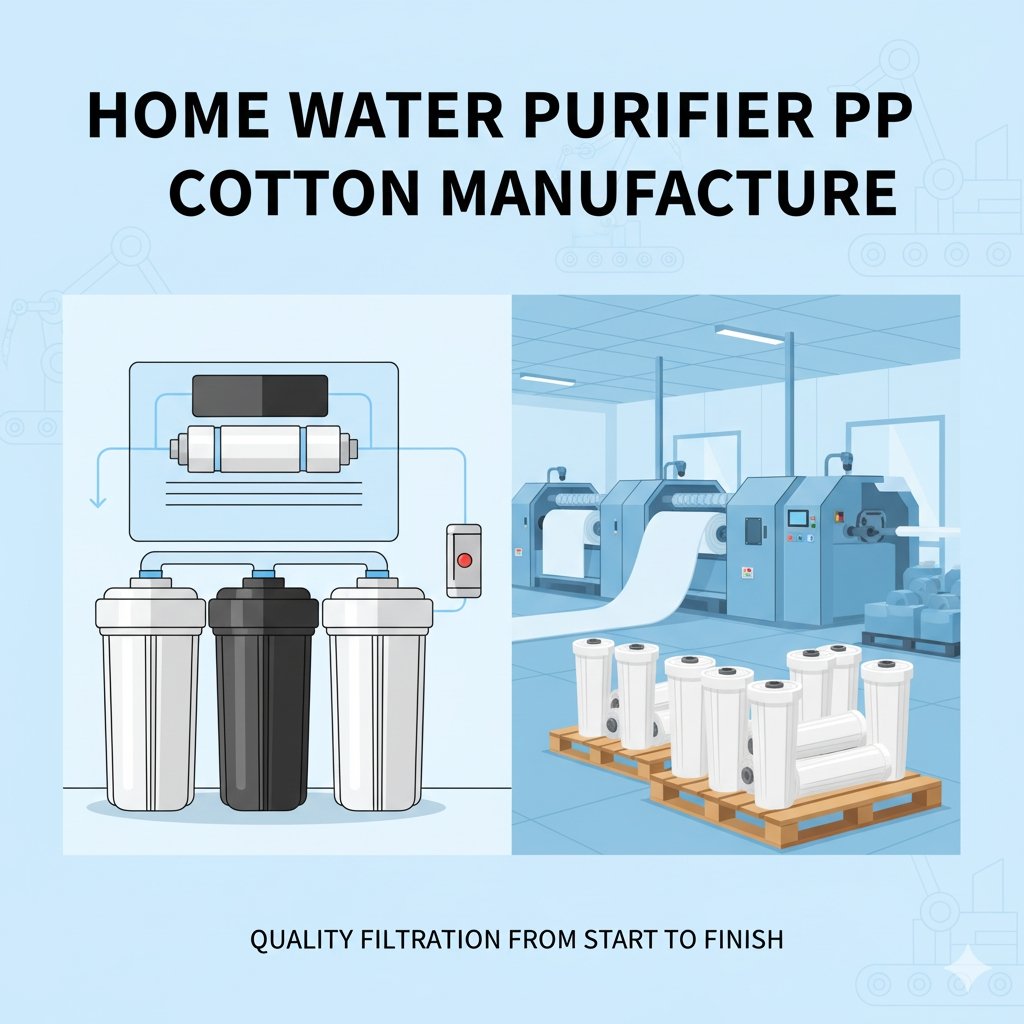
High-quality sediment filtration is the invisible foundation of any dependable home water purifier. Among the many filter media used today, polypropylene (PP) “PP cotton” remains the most widely deployed first-stage material for household systems — the inexpensive, disposable cartridge that protects carbon blocks, ultrafiltration and reverse osmosis membranes, and downstream plumbing from sand, rust, and silt. This article walks through the full lifecycle of PP cotton production and how it becomes the core component of home water purifiers: raw materials, manufacturing methods, micron grading, cartridge design, quality control, supply-chain considerations, regulatory compliance, practical integration into whole-house and point-of-use systems (see benchmarking example here: https://yourwatergood.com/product/whole-house-water-filtration-system-for-home/), environmental impacts, and buyer-side best practices for ensuring consistent performance at scale.
Why PP cotton matters in a home water purifier
The protective first line
A PP cotton sediment cartridge does a simple job: mechanically trap particulate. Yet that simplicity hides outsized value. Sediment cartridges:
- Prevent rapid fouling of expensive downstream media (carbon, membranes).
- Maintain flow and pressure characteristics of a system.
- Improve perceived water quality by removing visible turbidity and macroscopic impurities.
- Lower service frequency and total cost of ownership for homeowners.
Poor PP cotton costs more than it saves
A marginally cheaper sediment cartridge that sheds fines or allows rapid pressure rise will increase service calls, shorten membrane life, and cause customer complaints. For manufacturers and OEMs, consistent PP cotton quality protects brand reputation — which is why understanding manufacture and testing matters.
Raw materials and their role
Polypropylene resin basics
PP cotton starts from polypropylene resin pellets. Key resin attributes that influence final media performance include:
- Melt flow index (MFI): affects fiber formation during melt-blown processes.
- Full chemical specification: including additives, stabilizers, and any residual monomers. Food-contact grade resins are preferred for potable-water contact.
- Source and consistency: suppliers with stable resin chemistry reduce batch-to-batch variability.
Additives and regulatory limits
Manufacturers commonly avoid heavy additives that can leach. UV stabilizers and antioxidants may be used in housings but are limited in media contacting potable water. Suppliers must document raw-material safety (FDA food-contact compliance or equivalent) for home applications.
Manufacturing processes: melt-blown, spunbond, and pleating
Melt-blown PP — the most common method for sediment cartridges
Melt-blown is the dominant process used to make depth-filter PP cotton for water cartridges. Key points:
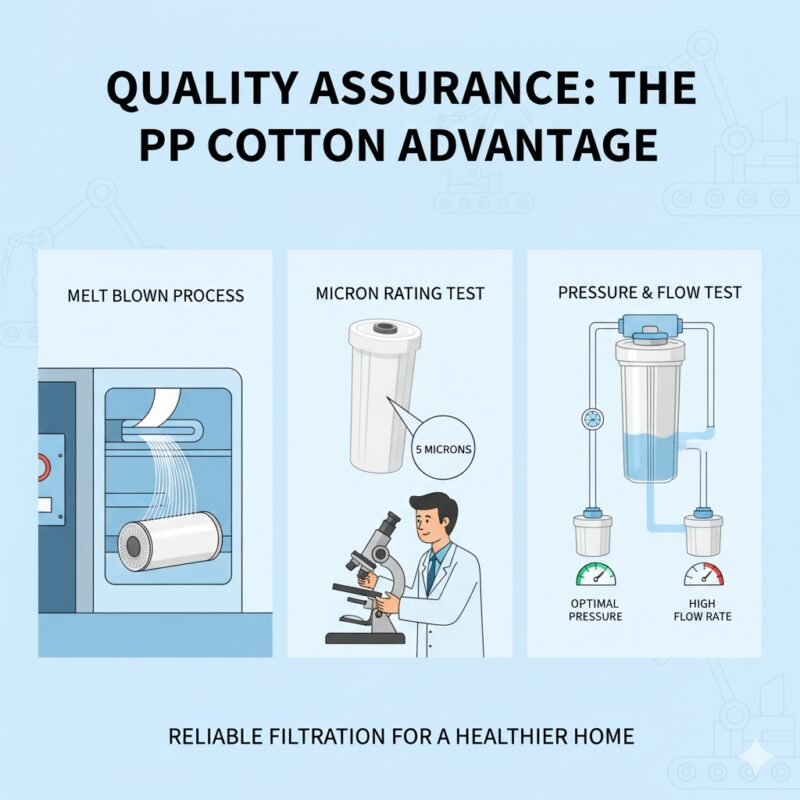
- How it works: molten polypropylene is extruded through a die while high-velocity hot air draws it into fine fibers that deposit on a moving collector, forming a nonwoven mat.
- Pore structure: melt-blown media are depth filters — contaminant capture occurs throughout the fiber matrix, not just on the surface.
- Control knobs: die geometry, spinneret pressure, air temperature, and collector speed control fiber diameter and bed porosity.
- Advantages: excellent gradient-density possibilities (outer layers coarser, inner layers finer), relatively low cost at scale.
Spunbond and composite constructions
Spunbond produces stronger continuous filaments and is often used as a support layer or in pleated cartridges. Composite cartridges combine media types (e.g., PP melt-blown over a spunbond support or bonded to nonwoven layers) to balance strength, flow, and filtration efficiency.
Pleating vs. depth-wound
- Pleated cartridges increase surface area for a given housing volume and reduce pressure drop — useful for whole-house pleated sediment stages.
- Depth-wound or graded melt-blown cartridges maximize dirt-holding capacity in compact form factors favored in POU systems.
Designing micron performance: nominal vs absolute ratings
What “micron” really means
Micron ratings appear everywhere but can be advertised inconsistently:
- Nominal micron rating implies typical performance: the cartridge will remove a percentage of particles at or above that size under certain conditions.
- Absolute micron rating guarantees retention of particles down to a defined diameter (e.g., 99.9% retention at X µm).
For household purifiers, 5–10 µm nominal is common for general sediment pre-filtration; 1–3 µm nominal or absolute is used when protecting RO/UF membranes.
Graded-density construction for lifetime
Manufacturers achieve multi-stage trapping performance in a single element by layering or gradient production — coarser fibers outside capture large debris while the inner fine fibers trap small particles. This design extends service life and delays pressure-rise.
Cartridge geometry and hardware: fit matters
Standard sizes and compatibility
Most residential housings accept standard 10″ or 20″ 2.5″ OD cartridges. Ensuring dimensional consistency, end-cap design, and gasket compatibility is basic but crucial — a mismatched cartridge leaks or causes bypass.
End caps, cores, and bonding
- Core strength: a central core prevents collapse at high flow rates; thin cores can deform and restrict flow.
- End-cap seal: proper O-rings and end-cap bonding prevent leakage and crossflow.
- Thermal bonding vs adhesives: thermal welding avoids solvent-based adhesives that could leach; many reputable manufacturers prefer fusion bonding.
Pleated modules and housings for POE
Whole-house pleated cartridges often use reinforced housings and larger cartridges with steel or reinforced plastic fittings to handle higher flow and pressure. Consideration for service access (clearance to remove long cartridges) must be part of system design.
Quality control: tests that predict real-world performance
Flow vs pressure-drop curves
Bench testing flow at various pressures produces the characteristic ΔP curves that buyers rely on. A cartridge’s service life is the intersection of dirt-holding capacity and allowable pressure-drop.
Dirt-holding capacity tests
Controlled particulate challenges quantify how much particulate a cartridge can trap before pressure-drop reaches a service threshold (e.g., 15 psi). This predicts replacement intervals and helps specify maintenance cadence for customers.
Particle retention and efficiency
Using standardized test particles or polystyrene beads, labs measure the percentage capture at defined particle sizes. These tests distinguish a “5 µm nominal” from an effective fine-retention product.
Fines/extractables test
A rinse test measures fines released during initial flushing. Low-fines construction reduces first-use cloudy water complaints. Suppliers should provide initial rinse volumes and fining data.
Dimensional and mechanical tests
Tensile strength of end-caps, O-ring compression tolerance, and core collapse tests ensure the cartridge survives shipping and in-field pressure surges.
Batch traceability and certificates
Good manufacturers provide Certificates of Conformance (CoC) for batches, including lot numbers, test results, and date codes to enable traceability and warranty claims management.
Process control and statistical methods in manufacture
SPC and consistent output
Scale manufacturers use Statistical Process Control (SPC) on key parameters — resin MFI, die temperature, air pressure, and collector speed — to keep fiber diameters and porosity consistent. Variation control reduces field failures.
In-line inspection
Modern lines incorporate in-line thickness and weight sensors to detect web anomalies and reject off-spec rolls before converting elements, saving rework time.
Packaging, storage, and shelf life
Packaging to minimize contamination
Individual polybagging followed by master carton packing protects cartridges from dust and moisture. Vacuum or shrink-packed cartridges save volume and prevent migration of fines during transit.
Storage recommendations
PP media is stable, but UV, extreme heat, and humidity can degrade packaging or adhesives. Warehouses should keep stock in cool, dry conditions and rotate FIFO to avoid long-term degradation of labels or secondary materials.
Integration into home water purifier product lines
Matching cartridge performance to system objectives
Brand designers should choose sediment performance to protect the most sensitive downstream component. For RO systems, a conservative pre-filter strategy (5 µm followed by 1 µm or a high-quality carbon block) extends membrane life and minimizes callbacks.
Whole-house vs point-of-use placement
- POE (whole-house): uses larger pleated cartridges or multi-cartridge banks; focus on dirt-holding capacity and low ΔP at house flow.
- POU (under-sink): small melt-blown cartridges or inline capsules prioritized for compactness and low initial fines.
Example benchmarking
When integrating PP cotton in whole-house systems, use the system page for capacity and stage ideas: https://yourwatergood.com/product/whole-house-water-filtration-system-for-home/.
Regulatory compliance and food-contact standards
FDA and local potable-water requirements
Materials in contact with drinking water must meet national or regional food-contact standards. In many markets, documentation showing compliance with FDA food-contact guidance (for plastics) or equivalent is required.
NSF/ANSI claims and sediment cartridges
Sediment cartridges alone typically do not carry NSF 42/53 certifications unless constructed into a system with claims. However, installers should be prepared to show material safety data, extractables testing, and manufacturing CoCs during procurement.
Environmental footprint and end-of-life options
Waste generation and circular design
Single-use cartridges generate plastic waste. Two mitigations are common:
- Replaceable inner elements where the housing is reusable; only the media is discarded.
- Recycling programs offered by suppliers or OEMs to collect spent cartridges for material recovery.
Material choices and sustainability
Coconut-shell carbon is a common sustainable option for adsorbents; for PP, selecting resin suppliers with lower-carbon manufacturing or recycled PP content (where safe and permitted) reduces lifecycle footprint. Always assess leachables risk when using recycled resins in potable-water contact applications.
Manufacturing scale: cost drivers and throughput
Capital equipment and line economics
Melt-blown lines are capital-intensive. Throughput, die width, and automation determine per-unit cost. Investing in long die-lines and automated conversion (cutting, end-cap assembly, bagging) lowers per-unit cost for large volumes.
Labor, QC, and yield
Labor for conversion and QC represents a notable share of cost in mid-sized plants. Yield improvements through better raw material controls and inline rejection reduce scrap and improve margins.
Logistics and MOQ tradeoffs
MOQ and lead times are often a tradeoff: lower MOQ increases unit cost. Buyers should balance inventory carrying cost against per-unit savings.
Common manufacturing pitfalls and how to avoid them
Inconsistent resin lots
Switching resin lots without requalification can change fiber diameter and porosity. Always require raw-material lot traceability and perform incoming inspections.
Improper bonding or end-cap seals
Improper end-cap bonding leads to leaks. Use thermal fusion or certified adhesives and run periodic pull tests.
Neglecting initial-flush behavior
Failing to test initial flushing may produce first-use cloudy water complaints. Supplier data on flushing volumes and low-fines construction are critical.
Overpromising micron claims
Some suppliers market nominal ratings without supporting test data. Demand retention test reports or insist on absolute-rated products where performance matters.
Buyer-side best practices for procurement and QA
Start with a technical spec
Define required micron rating, dimensional tolerances, allowable ΔP at target flow, and acceptable fines levels. Include material compliance clauses.
Sample and bench-test
Always request production samples and run flow/ΔP and rinse tests in your lab to validate supplier claims.
Pilot in-field
Deploy a pilot batch in real installations for 60–90 days to capture real-world life and complaint rates.
Quality gates and CoC
Contractually require batch CoCs and set hold-release criteria. Maintain a documented RMA and root-cause protocol for any field failures.
Dual-source strategy
Qualify at least two vetted suppliers for critical SKUs to mitigate supply disruptions.
Costing and what influences price
Raw-material cost
Polypropylene resin market fluctuations drive base cost. Long-term contracts or local sourcing reduces volatility.
Process complexity
Pleated or composite cartridges cost more than simple melt-blown elements. Custom end-caps and private labeling increase tooling and per-unit price.
Testing and certification
Spending on third-party testing and traceability improves buyer confidence but adds to unit cost. For premium OEM brands, the investment is usually worthwhile.
Future directions and innovation
Improved media chemistries
Additives that reduce biofouling, lower fines, or improve dirt-holding capacity are areas of active R&D — always verify safety for potable contact.
Circular economy models
Expect more suppliers to offer take-back or recycling partnerships, especially in high-volume retail markets where consumers demand sustainability.
Advanced manufacturing controls
Inline sensors and machine-learning-driven SPC are being integrated into modern lines to reduce variation and increase first-pass yield.
Practical checklist for manufacturers and procurement teams
- Specify raw-material grade and require lot traceability.
- Define absolute vs nominal micron requirements and expected ΔP curves at target flow.
- Require low-fines rinse data and recommend initial flush volumes to end users.
- Validate samples with bench and pilot field tests before scaling orders.
- Insist on batch CoCs and labeled packaging with batch IDs and production dates.
- Build redundancy by qualifying at least two suppliers for critical cartridges.
- Include environmental handling and recycling options in contracts.
- Test end-cap seals and core strength routinely.
- Keep inventory safety stock to cover lead times and seasonal demand.
- Maintain an escalation path with technical contact for rapid troubleshooting.
Final thoughts
PP cotton may be one of the humblest components in a home water purifier, but done well it underpins durable, low-maintenance systems that delight customers and protect expensive downstream treatment. Manufacturers who invest in consistent raw materials, robust melt-blown processes, granular QC, and transparent test data create real value for OEM partners. Buyers who demand data, run pilots, and define acceptance criteria avoid the costly downstream consequences of poor sediment performance.
When you design or procure whole-home or point-of-use filtration, treat the sediment stage as the mission-critical protective shield it is. For system benchmarks and to compare how sediment staging integrates into broader whole-house solutions, examine an example specification here: https://yourwatergood.com/product/whole-house-water-filtration-system-for-home/.