
The Complete Guide to Selecting the Perfect Filtration System for City Living


Living in a municipality offers many conveniences, from paved roads to reliable electricity. One of the most critical services provided is the supply of potable water. However, while municipal water is treated to meet federal safety standards, “safe to drink” does not always mean “healthy,” “tasty,” or “gentle on your skin.”
As awareness grows regarding aging infrastructure, chlorine byproducts, and hardness minerals, many homeowners and small business owners are taking matters into their own hands. They are looking beyond simple water pitchers and asking a fundamental question: how do i choose a whole house filter designed for municipal water?
This is not a simple purchase; it is an investment in your home’s infrastructure and your family’s health. If you run a small business, like a café or a bistro, it is an investment in your product quality and equipment longevity. In this extensive guide, we will break down the chemistry, the mechanics, and the economics of finding the right system for city water.https://yourwatergood.com/product/whole-house-water-filtration-system-for-home/.
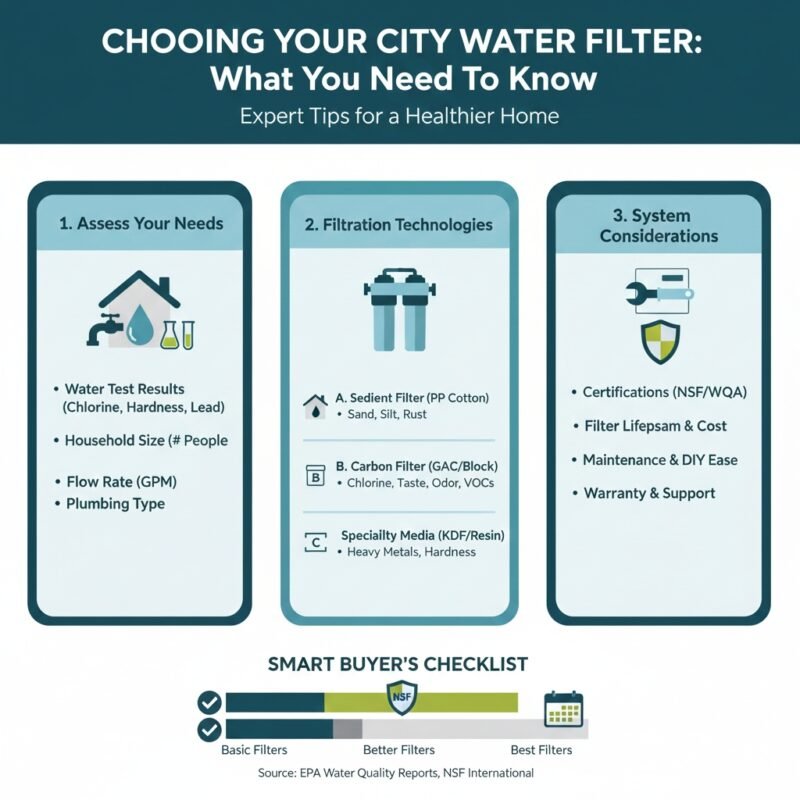
Understanding the “City Water” Profile
Before we can answer how do i choose a whole house filter designed for municipal water, we must understand what we are filtering. Unlike well water, which varies wildly from property to property and often contains iron, sulfur, or bacteria, municipal water has a predictable profile.
1. The Disinfectants: Chlorine and Chloramines
To ensure water doesn’t carry typhoid or cholera, treatment plants add powerful disinfectants.
- Chlorine: The traditional method. It is effective but leaves a strong “bleach” odor and taste. It also dries out skin and hair.
- Chloramines: Many cities are switching to chloramines (a mix of chlorine and ammonia). Chloramines are more stable and stay in the pipes longer, but they are much harder to remove than standard chlorine and can be toxic to fish and kidney dialysis patients.
2. The Infrastructure Debris: Sediment and Rust
Even if the water leaving the plant is crystal clear, it travels through miles of pipes. In many cities, these pipes are 50 to 100 years old. Cast iron pipes rust, and main breaks introduce sand and dirt. This is why “sediment” is a major issue in city water, despite the treatment.
3. The Hardness: Calcium and Magnesium
Most municipal water is “hard.” While not toxic, hard water destroys your plumbing. It causes scale buildup in water heaters, ruins espresso machines in cafes, and leaves spots on your glassware.
4. The Hidden Dangers: PFAS and Lead
Emerging contaminants like PFAS (forever chemicals) and lead (from old service lines) are the modern enemies of city water. Standard municipal treatment often does not fully remove these.
Step 1: Analyzing Your Water Report
The first step in answering how do i choose a whole house filter designed for municipal water is to stop guessing and start reading.
Every municipality is required by law to publish an annual Consumer Confidence Report (CCR) on water quality. You can usually find this on your city’s website.
- Look for Chlorine vs. Chloramines: This is the most critical distinction. If your city uses chloramines, a standard carbon filter will not work effectively; you will need Catalytic Carbon.
- Check the Hardness GPG (Grains Per Gallon): This tells you if you need a conditioner or a softener integrated into your whole house system.
Step 2: Sizing the System (Flow Rate)
One of the biggest mistakes consumers make is buying an undersized unit. A whole house filter is a “Point of Entry” (POE) system. It must treat water for the entire building simultaneously.
Calculating Flow Rate
Flow rate is measured in Gallons Per Minute (GPM).
- Residential: If you have 2 bathrooms and a washing machine running, you might need 10–12 GPM. If the filter is rated for only 7 GPM, you will experience a significant pressure drop when someone flushes a toilet while you are showering.
- Small Business (Cafe/Restaurant): This is even more critical. If your commercial dishwasher fills up while the espresso machine is pulling shots, a drop in pressure can ruin the coffee extraction and damage the pump.
When browsing for solutions, look for high-capacity systems like the Whole House Water Filtration System for Home offered by YourWaterGood. This system is engineered to handle high flow rates, ensuring that your water pressure remains consistent even during peak usage hours.
Step 3: Selecting the Filtration Stages
A single tank is rarely enough. The most effective systems for city water use a multi-stage approach. Here is the ideal configuration:
Stage 1: The Sediment Pre-Filter (PP Cotton)
We cannot stress the importance of this stage enough.
- The Material: Polypropylene (PP) Cotton.
- The Job: It acts as the physical barrier. It catches the rust flakes, sand, and dirt mentioned earlier.
- Why it Matters: If you skip this, the expensive carbon media in the next stage will get coated in mud and stop working. A high-quality PP filter extends the life of your entire system.
! Alt: Technician checking a filter from a pp cotton household water purifier company ensuring clear water flow.
Stage 2: The Chemical Scrub (Activated Carbon)
This is the workhorse for city water.
- Activated Carbon Block: Excellent for removing Chlorine, taste, odor, and VOCs (Volatile Organic Compounds).
- Catalytic Carbon: If your water report showed “Chloramines,” you must ensure the system uses Catalytic Carbon. Standard carbon cannot break the ammonia bond in chloramines effectively.
Stage 3: Scale Inhibition (Optional but Recommended)
For city water, you don’t always need a salt-based softener (which makes water feel slippery). A salt-free water conditioner (often using template-assisted crystallization or polyphosphate) prevents scale from sticking to pipes without adding sodium. This is preferred for those on a low-sodium diet and is eco-friendly.
Step 4: Durability and Build Quality
When asking how do i choose a whole house filter designed for municipal water, look at the hardware itself.
- Housing Material: Look for reinforced casings that can withstand water hammer (pressure spikes) common in city grids.
- Connection Size: A 1-inch port is standard for good flow. 3/4-inch ports might restrict flow in larger homes.
- Ease of Maintenance: Can you change the filters yourself? Systems designed with user-friendly housing wrenches and pressure release buttons make maintenance a 10-minute job rather than a plumber’s visit.
Commercial Spotlight: Why Small Businesses Need This
If you operate a small restaurant, a coffee shop, or a boutique hotel, you are on “municipal water,” but your needs are different from a standard household.
The “Ingredient” Factor
For a coffee shop, water is 98% of the product. Chlorine destroys the delicate flavor notes of specialty beans. A whole house carbon filter ensures that every tap—from the espresso machine to the water dispenser—serves water that tastes like water, not bleach.
Equipment Protection
Commercial ice machines and steamers are incredibly expensive. City water scale is the number one cause of their failure. By installing a robust Whole House Water Filtration System for Home, you are essentially buying an insurance policy for your kitchen equipment. The cost of the filter is often less than a single service call for a scaled-up ice machine.
The Economics: Cost vs. Value
The question how do i choose a whole house filter designed for municipal water inevitably leads to budget.
Upfront Cost vs. Long Term
A cheap system might cost $200 but require $100 filter changes every month. A quality system might cost more upfront but uses high-capacity filters that last 6 to 12 months.
- Bottled Water Savings: The average family spends hundreds of dollars a year on bottled water because they don’t like the taste of their tap water. A whole house system eliminates this cost entirely.
- Plumbing Savings: By removing chlorine (which corrodes rubber gaskets) and sediment (which ruins faucet cartridges), your home’s plumbing lasts longer.
! Alt: Cost analysis chart by a pp cotton household water purifier company showing huge savings.
Installation: DIY or Professional?
Once you have chosen the system, you must install it.
- DIY: If you are handy with PEX tubing or copper soldering, many modern systems are designed for DIY installation. You will need to locate your main water shut-off valve and cut into the line immediately after it.
- Professional: For many homeowners, hiring a licensed plumber is the safer route. It ensures that the system is bypassed correctly (allowing you to turn off the filter but keep water flowing to the house during maintenance).
Maintenance: The Key to Performance
You chose the best filter; now you must maintain it.
- Monitor Pressure: A drop in water pressure is the universal sign that your Stage 1 PP Cotton filter is full. Replace it immediately to restore flow.
- Taste Test: If the chlorine taste returns, your carbon media is exhausted.
- Sanitization: Once a year, when changing filters, clean the inside of the housings with a mild bleach solution to prevent biofilm buildup.
Conclusion: Making the Right Choice
So, how do i choose a whole house filter designed for municipal water?
You choose it by being informed. You choose it by acknowledging that while city water is treated, it is not pure. You choose it by prioritizing flow rate to ensure your lifestyle isn’t hindered, and by selecting the correct filtration media (Carbon and PP Cotton) to tackle chlorine and sediment.
Whether you are a homeowner wanting to bathe in chemical-free water or a business owner protecting your brand, the solution lies in a robust, multi-stage Point-of-Entry system.
Don’t settle for water that smells like a swimming pool. Experience the luxury of pure water from every tap in your building. Visit www.yourwatergood.com to view our range of products and find the perfect whole house solution for your specific needs.
Frequently Asked Questions (FAQ)
Q: Does a whole house filter remove lead? A: Standard carbon filters reduce lead, but for guaranteed removal, you need a specialized filter block certified for heavy metals or a Reverse Osmosis system. For drinking water, we often recommend pairing a whole house system with an under-sink RO unit for maximum lead protection.
Q: Will this system lower my water pressure? A: A properly sized system should not noticeably lower pressure. If you experience a drop, it usually means the sediment pre-filter is clogged and needs changing. This proves the filter is doing its job!
Q: Can I install this if I live in a condo? A: Usually, no. Whole house systems require access to the main water line entering the unit, which is often in common walls. For condos, we recommend high-quality under-sink filters or shower filters.
Q: How often do I change the filters? A: For municipal water, the Sediment (PP Cotton) filter typically lasts 3–6 months. The large Carbon filters typically last 6–12 months, depending on your water usage and the amount of chlorine in your city supply.
Q: Is a whole house filter the same as a water softener? A: No. A filter removes contaminants (chlorine, dirt). A softener replaces calcium minerals with sodium to stop scale. They are different tools, though they can be used together.