
How much do whole house water filtration systems cost to install (in united states of america)— realistic prices, what affects the bill, and how to save money

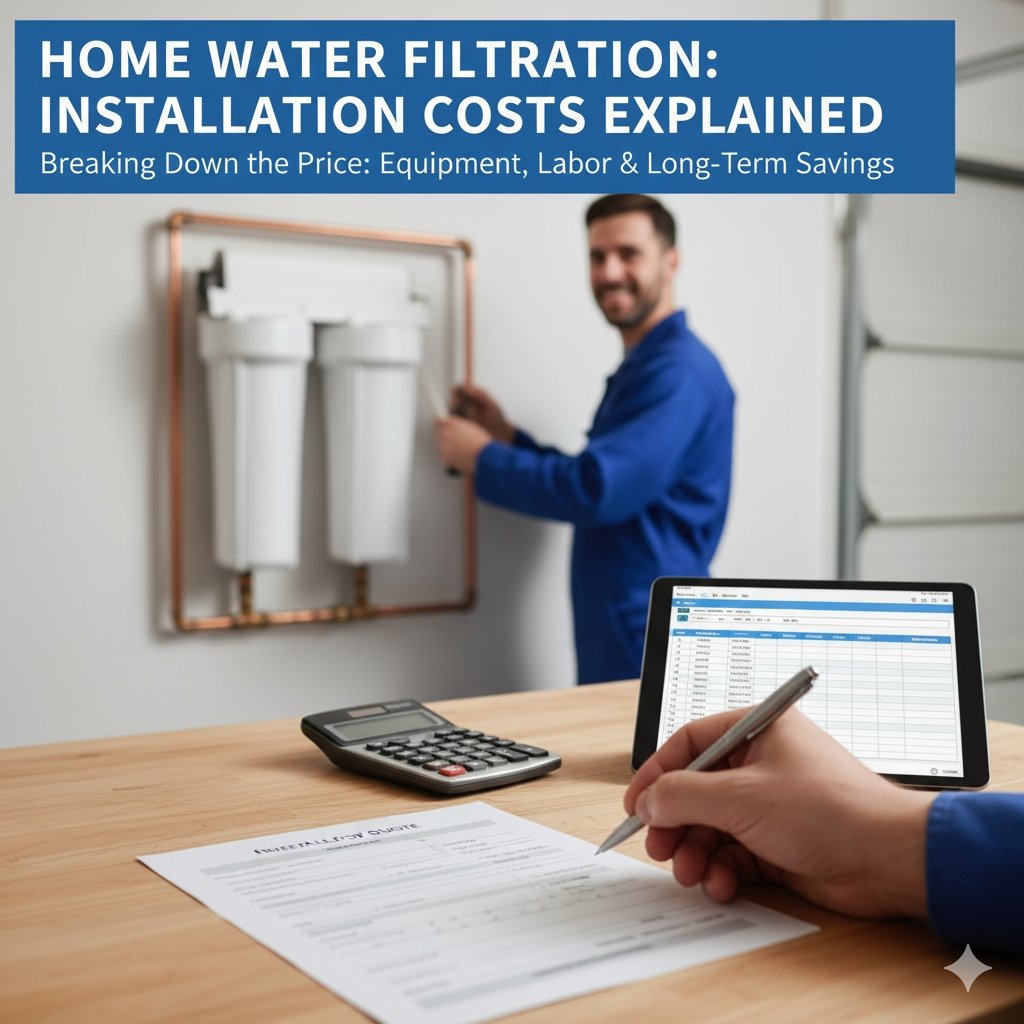
If you searched how much do whole house water filtration systems cost to install, you want a straight answer plus the context needed to avoid surprises. This article gives you realistic price ranges, explains every cost driver (equipment, labor, permits, plumbing changes, and consumables), shows typical scenarios (city water, well water, softener + carbon stacks, whole-house RO), and gives a reproducible checklist to get accurate bids and lower the total cost of ownership. Where it helps, I point you to parts and replacement supplies so you can check real product options: https://yourwatergood.com/ and https://yourwatergood.com/shop/.
Quick headline: expect to pay roughly $1,000–$6,000 installed for most residential whole-house filtration systems, with the typical homeowner landing near $1,200–$3,000 for common sediment + carbon or softener + carbon setups. High-end whole-house RO, complex well systems, or multi-vessel commercial-grade installs can push total costs substantially higher. Modernize+1
1) How the price breaks down — equipment, labor, and extras
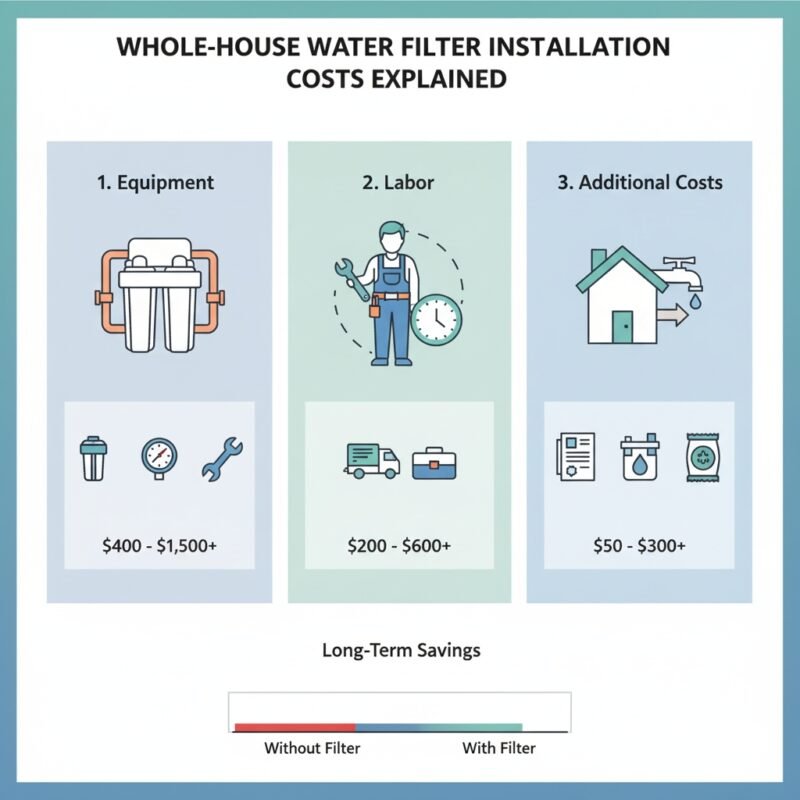
A useful way to think about cost is to separate (A) equipment, (B) installation labor and materials, and (C) soft costs or ongoing expenses.
A — Equipment (hardware):
- Filter housings, cartridges, media vessels (carbon, catalytic carbon), softener resin tanks, control valves, UV reactors, RO membranes, pumps, and gauges.
- Equipment alone can range from a few hundred dollars (single large cartridge housing + basic cartridge) to several thousand for multi-tank systems, branded softeners, or RO skids.
B — Labor & installation materials:
- Includes plumber hours, fittings and piping (copper, PEX, or PVC), valves and bypass plumbing, mounting hardware, electrical work for pumps or UV, and disposal of old equipment. Labor can be the largest single line item and varies by region and complexity.
C — Permits, testing, and commissioning:
- Some localities require plumbing permits or inspections for POE (point-of-entry) plumbing work or for systems that discharge brine or RO reject. Add costs for permit fees, pre- and post-installation water testing if you want independent verification, and (optionally) an installation warranty or service contract.
A typical installed project itemization looks like:
- Equipment: $600–$3,000
- Labor & materials: $400–$2,000
- Permits / testing / small misc: $50–$500
Total installed: $1,050–$5,500 (depends on system and local labor). These ranges match published market summaries and contractor averages. Home Advisor+1
2) Typical price bands and what they represent
Below are practical installed-cost bands you’ll actually see on quotes. Use these to sanity-check vendor bids.
- Basic POE sediment or single-cartridge whole-house filter (equipment + straightforward install): $700–$1,500. Good for protecting plumbing from sand and rust; cartridge changes are the main ongoing cost. Water Filter Guru
- Standard sediment + carbon whole-house system (most common for city water tastes/odors): $1,200–$3,000 installed. This is the “typical homeowner” band for decent performance and reasonable media life. Modernize+1
- Softener + carbon combo (hard-water homes that also want taste control): $1,800–$4,500 installed. Includes salt-based softener equipment and a carbon vessel sized for house flow. 本杰明·富兰克林管道公司
- Well-water treatment stacks (sediment + iron removal + UV + carbon): $2,000–$6,000+. Well systems often need extra pretreatment and instrumentation, so prices climb. Home Advisor
- Whole-house reverse-osmosis (rare residential installs) or high-capacity commercial skids: $5,000–$30,000+ depending on capacity, pretreatment, and recovery systems. For most families, whole-house RO is overkill; point-of-use RO for drinking water is a common, lower-cost alternative. bobvila.com
Those ranges reflect national averages and reported contractor estimates — they’ll vary with local labor rates, system complexity, and brand choices. Use them to validate quotes you receive.
3) What changes the price most — the primary cost drivers
Understanding the levers that move price helps you negotiate and choose wisely.
- System technology
- Carbon + sediment is inexpensive. RO, UV, and specialized PFAS adsorbents are pricier. Whole-house RO is materially more expensive because of membranes, high-pressure pumps, and large-volume handling.
- Flow capacity and family size
- Large homes with high peak GPM require bigger vessels or multiple parallel trains — that raises both equipment and labor costs.
- Source water quality
- Clean municipal water → simpler systems (sediment + carbon). Dirty or iron-rich well water → oxidation, iron media, and UV → more cost. Poor water quality can force pretreatment upgrades, which are a major cost driver.
- Installation complexity
- Easy access to the main line near an unfinished basement or garage is cheap. Tight spaces, behind drywall routing, or long repiping add hours and cost. Contractors often charge significant premiums for retrofit complexity. Anecdotal installer reports put straightforward installs at a few hundred dollars and complex ones at multiples of that. Reddit+1
- Certifications & branded components
- Using NSF-certified cartridges or name-brand membranes raises equipment price but can be worth it for verified performance and longevity.
- Permits, discharge handling, and code compliance
- Salt-based softeners and RO reject lines may trigger local restrictions or require specific disposal arrangements; dealing with these adds cost.
4) Labor expectations — how many hours and what to budget
Typical install labor timeframes:
- Simple POE cartridge install: 1–3 hours.
- Sediment + carbon dual tank with basic bypass: 2–6 hours.
- Softener + carbon + UV stack with electrical work: 4–10 hours.
- Complex well system or whole-house RO with booster pumps and large piping: 8–24+ hours.
Hourly labor rates for licensed plumbers vary widely by U.S. region (e.g., $60–$150/hour typical). Because labor can dominate total installed cost, insist that quotes show estimated labor hours, hourly rates, and a clear change-order policy so you won’t get surprised bills if the crew discovers unexpected work. Home-cost aggregators and contractor forums report labor as a key upfront variable. Home Advisor+1
5) Real-world examples (scenarios and sample math)
A few real examples help make the bands concrete. These are representative—not exact quotes.
Example A — City house, taste/odor problem (sediment + carbon):
- Carbon vessel (standard 10″×54″ style) + 10″ sediment cartridge housing + fittings: $900
- Labor (3 hours @ $100/hr): $300
- Misc (valves, small parts, permit): $100
Installed total ≈ $1,300.
Example B — Large family, hardness + chlorine (softener + carbon):
- Softener (40k grain) + carbon vessel + brine tank + control valve: $2,200
- Labor & piping (6 hours @ $120/hr): $720
- Misc parts & permit: $180
Installed total ≈ $3,100.
Example C — Well home, iron + turbidity + coliform risk (sediment + iron media + UV):
- Multimedia sediment + oxidizing iron tank + UV reactor: $3,000
- Labor & electrical (10 hours @ $120/hr): $1,200
- Pre/post lab testing & permit: $300
Installed total ≈ $4,500.
Example D — Whole-house RO (rare, high cost):
- Large POE RO skid + high-pressure pump + tanks: $8,000–$20,000
- Plumbing, electrical, wastewater handling: $2,000–$8,000
Installed total easily $10k–$30k+ depending on specs. Because of cost and water waste, many homeowners choose POU RO instead. bobvila.com+1
6) Ongoing costs — consumables and expected maintenance
Upfront price is only the start. For any system include these recurring costs:
- Cartridge replacements (sediment/carbon): $20–$200 per cartridge depending on type and capacity. Frequency: 3–12 months depending on load.
- Softener salt & regeneration supplies: $50–$300/year depending on usage and salt price.
- RO membranes: $40–$300; typical life 2–5 years depending on feed water and prefiltration.
- UV lamp & sleeve replacement: $50–$200/year.
- Service plan or emergency callouts: $100–$600/year if you contract local service.
When comparing two systems, calculate a 3- to 5-year total cost (equipment + install + annual consumables) — a cheaper install with expensive consumables can cost more over time than a higher-quality system with longer media life.
7) Ways to lower your installed cost (and avoid buyer traps)
- Get 3 itemized quotes. Don’t accept “ballpark” numbers—insist on an itemized parts & labor list.
- Avoid over-spec’ing. Whole-house RO or multi-stage setups aren’t necessary unless tests or use cases demand them. For drinking water, under-sink RO plus POE pretreatment is usually cheaper and more sustainable. bobvila.com
- Standardize fittings. Ask the installer to use PEX or readily available fittings rather than custom copper runs that increase time and cost.
- Bundle consumables. Ask if the contractor will include the first year’s cartridges or a discounted consumable pack.
- Shop off-season. Some contractors offer lower labor rates in slow months.
- Negotiate a capped change-order amount. Agree a reasonable contingency for unknowns so you won’t be hit with unlimited surprises.
- Consider DIY for very simple installs. If the installation point is easy and you’re comfortable with basic plumbing, a homeowner can often install a single cartridge housing; but remember warranties and code compliance—some warranties require pro installation.
8) Questions to ask before you accept a quote
Use this short checklist when evaluating bids:
- Is the price itemized (equipment, labor hours, permits, testing)?
- Which exact brands and models will be installed? (Ask for model numbers.)
- Are the vendor’s performance claims backed by NSF or third-party reports where relevant?
- Does the quote include a bypass valve so water flows during service?
- What warranties cover equipment and labor? Any conditions that void warranty?
- Who handles permits, and is permit cost included?
- What is the estimated downtime and contingency for unexpected work?
- Are consumables (first filter set) included or available as a discounted bundle?
- Do they provide commissioning tests (TDS, chlorine, or lab work) after install?
- What is the expected lead time for replacement parts or membranes?
Document answers in writing and keep them with the contract.
9) Financing, rebates, and incentives
- Financing: Many installers or retailers offer financing or no-interest promotional plans for larger installs. Compare APRs and total interest vs. the option to pay cash.
- Rebates & local programs: Some municipalities incentivize water-efficiency upgrades (e.g., high-efficiency softeners or systems that reduce water waste). Check local utility and state programs.
- Tax treatment: In most residential cases, water filtration is not tax deductible, but check with your tax advisor for special situations (e.g., rental property).
10) Red flags — when to walk away or get a second opinion
- Vague quotes without model numbers or labor hours.
- No permit or inspection plan when local code requires it.
- Price dramatically lower than market averages without an explanation—could mean low-quality components, unpaid subcontractors, or missing items.
- Push to buy a very expensive whole-house RO before getting a water test — a major red flag.
- No post-installation testing or refusal to provide performance data.
If in doubt, get an independent test or a second contractor bid.
11) Where to buy parts and comparison shopping
For shopping and spare parts, check both local plumbing suppliers and reputable online catalogs. If you want to compare models, specifications, and replacement cartridge pricing, start by looking at product pages and consumable listings like those at https://yourwatergood.com/ and check replacement packs at https://yourwatergood.com/shop/. Having exact part numbers helps you compare true consumable costs — a critical factor in long-term value.
12) Final decision flow — how to select a system affordably
- Test your water (inlet + drinking tap). Data drives technology.
- Define objectives (protect plumbing, remove chlorine, stop scale, treat PFAS, disinfect well water).
- Decide POE vs hybrid: for most families POE pretreatment + POU RO for drinking taps is the most cost-effective combo. bobvila.com
- Get 3 itemized quotes based on the same spec sheet (include peak flow and footprint constraints).
- Compare 3- to 5-year TCO, not just the upfront price.
- Verify certifications and local service and sign a contract that includes commissioning and a clear change-order policy.
13) Quick summary — the numbers at a glance
- Common installed range (most homes): $1,000–$6,000. Modernize+1
- Typical “average homeowner” spend for a standard POE system: ~$1,200–$3,000. Home Advisor
- Well systems or heavy-duty stacks: $2,000–$6,000+. Home Advisor
- Whole-house RO or high-capacity commercial skids: $5,000–$30,000+ (rare for single-family homes). bobvila.com
14) Closing — practical next steps you can take right now
- Order a basic certified water test (inlet + kitchen tap) if you don’t already have one.
- Use the results to create a short RFQ describing required reductions, peak GPM, and preferred installation location.
- Request three itemized quotes and compare the 3- to 5-year TCO for each.
- Ask each vendor to include first-year consumables and a commissioning test in the contract.
- If you want to review parts and replacement pricing while you shop, visit https://yourwatergood.com/ and https://yourwatergood.com/shop/ for model and consumable comparisons.