
How Ro Works In Water Purifier — Inside The Membrane, Stages & Practical Guide

When you google how ro works in water purifier, you’ll find short descriptions like “it forces water through a membrane” — which is true but far too brief for anyone who needs to choose, install, maintain, or troubleshoot a system. This article explains exactly how RO works in water purifier systems in plain English and with practical detail: the physics of the membrane, the typical stages in a household unit, why pre- and post-treatment matter, how performance is measured, common problems and fixes, environmental tradeoffs, and how to evaluate models and vendors. By the end you’ll understand not only the mechanism but how the whole system functions as an engineered solution for safer, better-tasting drinking water. For product specs and model comparisons you can check certified units at https://yourwatergood.com/.
Quick summary (one line)
Reverse osmosis (RO) works in a water purifier by applying pressure to force water molecules through a semi-permeable membrane, rejecting dissolved salts and many contaminants; effective RO systems combine prefilters, the membrane, and post-treatment to deliver safe, palatable drinking water.
1. The fundamental principle: reverse osmosis in one paragraph
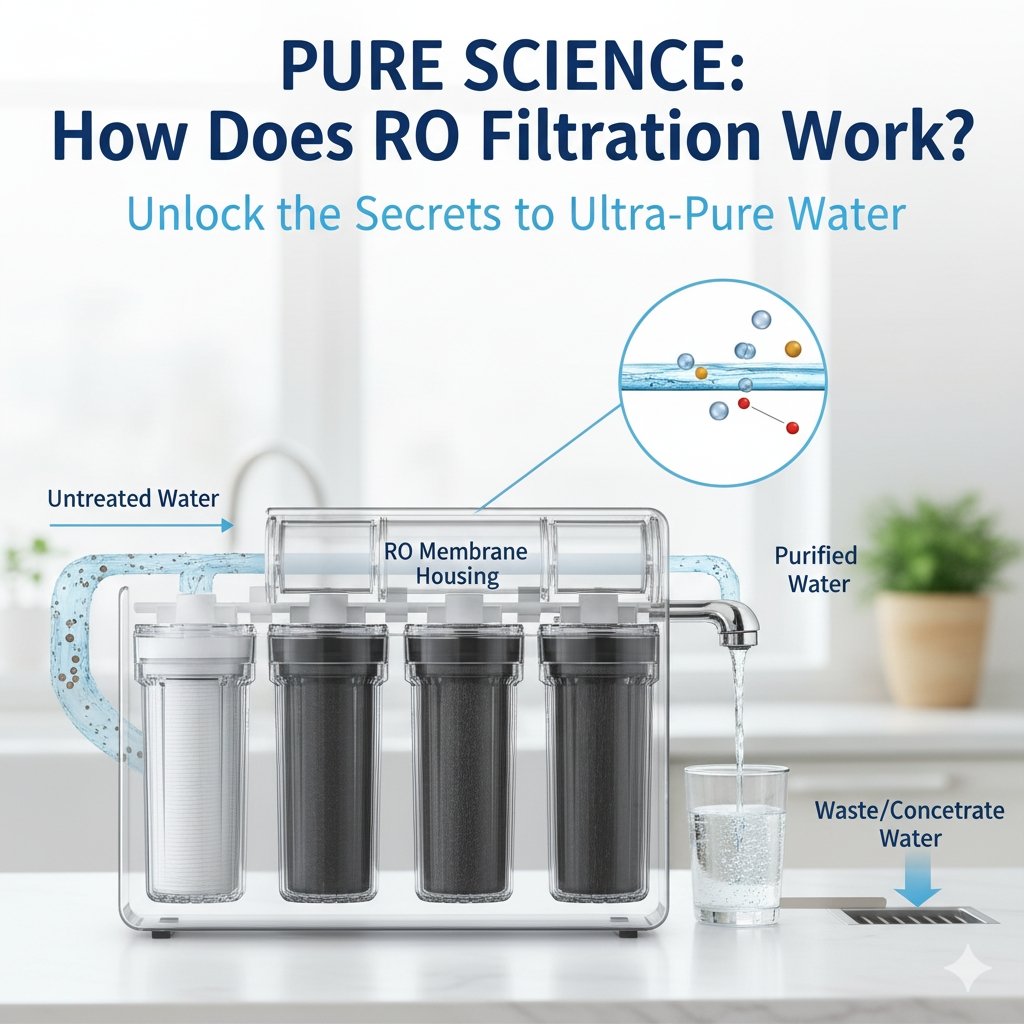
At the heart of how RO works in water purifier is a physical process called reverse osmosis. In nature, water moves across a semi-permeable membrane from low solute concentration to high solute concentration (osmosis) until equilibrium is reached. RO reverses that flow by applying pressure greater than the osmotic pressure on the concentrated side, pushing water molecules through the membrane while leaving dissolved salts, ions, and many larger organic molecules behind. The product water (permeate) is low in dissolved solids; the concentrated waste (brine or reject) carries the removed contaminants to drain.
2. The membrane: the active element explained
The membrane is the component that most often answers the question how RO works in water purifier at a molecular level.
- What it is: a thin, semi-permeable polymer sheet (typically made of thin-film composite, TFC) with microscopic pores and selective chemical affinity.
- How small: pores are on the order of 0.0001 microns (very small), small enough to block ions and most dissolved molecules.
- Mechanism: the membrane separates via a combination of size exclusion and diffusion resistance — water molecules pass, hydrated ions and larger organics do not.
- Orientation: residential membranes are typically spiral-wound to maximize surface area in a compact cartridge.
- Vulnerabilities: chlorine and some oxidants damage TFC membranes; particulate fouling and biological films reduce efficiency.
Understanding this explains why RO systems need carbon prefilters (to remove chlorine) and sediment prefilters (to protect the membrane).
3. The typical RO water purifier: stage-by-stage
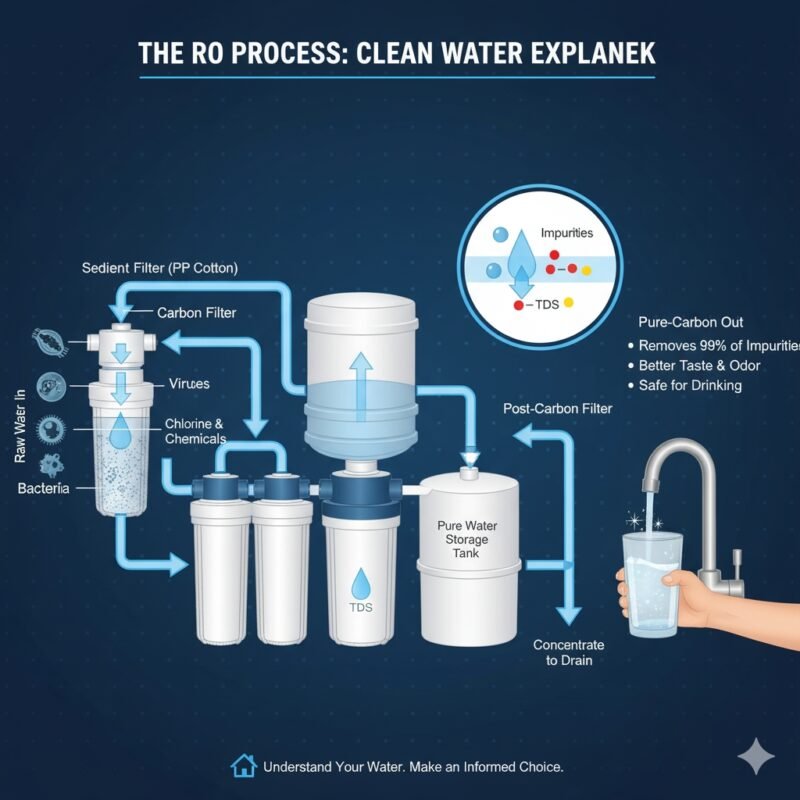
An RO water purifier is a multi-stage system. Here’s a common under-sink configuration that answers how RO works in water purifier in practical steps:
- Sediment prefilter (PP / polypropylene): removes sand, silt, rust, and other coarse particles. This protects carbon filters and the RO membrane from clogging.
- Carbon prefilter (activated carbon): removes chlorine, chloramines (to some degree), organic molecules, and tastes/odors. This step prevents oxidative damage to the membrane and improves taste.
- Reverse osmosis membrane: the pressure-driven core stage that rejects dissolved salts, heavy metals, fluoride, nitrates, and many other contaminants.
- Storage tank: captures permeate produced more slowly than faucet demand so you have immediate access to filtered water.
- Post-filter (polishing carbon): final taste polish immediately before the faucet; it removes any residual VOCs or tastes from the tank.
- Optional stages: remineralization (adds back small amounts of minerals for taste), UV disinfection (for microbiologically suspect feed water), permeate pump (improves recovery/water use efficiency), and pH adjusters.
Each stage plays a distinct role: prefilters protect, the membrane purifies, and post stages polish and tailor water quality.
4. How pressure, temperature and TDS affect performance
How RO works in water purifier depends critically on three operating conditions:
- Pressure: higher feed pressure increases permeate flow and improves rejection efficiency. If feed pressure is too low, membranes produce very little permeate — booster pumps are used in low-pressure homes.
- Temperature: cold water reduces membrane permeability and slows production; manufacturers rate flow at a standard temperature (often 25°C). Expect lower output in cold climates.
- Feedwater TDS (Total Dissolved Solids): higher TDS increases osmotic pressure, reducing net driving force and requiring higher applied pressure and/or lower recovery ratios. Very high TDS may require specialized membranes or pre-treatment.
When evaluating an RO unit, check the manufacturer’s rated flow/recovery at your expected feed pressure, temperature, and TDS.
5. Measuring RO performance: rejection, recovery, and waste
To fully grasp how RO works in water purifier, you need to know the metrics used to evaluate systems:
- Rejection rate (%): the percentage of a specific contaminant the system removes. For TDS, it’s often measured as (1 − TDS_permeate / TDS_feed) × 100. Good residential RO membranes typically reject 90–99% of TDS (depending on conditions).
- Recovery ratio: the percentage of feedwater converted into permeate. If you feed 10 liters and produce 2 liters permeate, recovery is 20%.
- Waste ratio (reject to product): often quoted as 3:1, 2:1, 1:1, etc. Lower (closer to 1:1) means less wastewater per unit of product water. Modern high-efficiency systems and permeate pumps can approach 1:1 or better.
- Permeate flow (GPD — gallons per day): manufacturer rating for daily production under specified conditions.
This trio of metrics—rejection, recovery, and permeate flow—tells you how effectively and efficiently a purifier works under real conditions.
6. Why prefilters and postfilters are essential
A common simplified answer to how RO works in water purifier is membrane-only — but in practice, the membrane cannot operate effectively without proper upstream and downstream stages.
- Prefilters (sediment + carbon) extend membrane life by keeping particles and oxidants away. Without them, membranes foul or are chemically damaged and require early replacement.
- Postfilter (carbon) ensures water stored in the tank doesn’t pick up tastes or odors and provides a final safety net for organics that might have bypassed earlier stages.
- Remineralization addresses taste and slight acidity resulting from demineralized RO water.
A well-designed system is an orchestrated chain where each link is necessary for performance and longevity.
7. Microbiology: does RO sterilize water?
Many users ask whether how RO works in water purifier includes microbial sterilization. The short answer: RO removes many microbes by physical exclusion, but it’s not a guaranteed disinfection method by itself.
- Size exclusion: the membrane pores are tiny and will physically block many bacteria and protozoa.
- Viruses: some viruses are small enough that membrane performance varies; RO reduces viral load but design and integrity matter.
- System risks: poor maintenance, storage tank contamination, or biofilm formation on prefilters can reintroduce microbes into permeate.
- Best practice: pair RO with a UV disinfection stage or use UV after the RO tank if feed water is microbiologically suspect (e.g., private well water).
So while RO helps reduce microbial risk, treat it as part of a multi-barrier approach rather than a standalone sterilizer.
8. Common contaminants RO removes (and what it may not)
Understanding how RO works in water purifier requires clarity on the contaminant profile:
RO typically removes or greatly reduces:
- Dissolved salts and minerals (lowering TDS).
- Heavy metals: lead, arsenic (in many cases), chromium (varies), copper, etc.
- Fluoride and nitrates.
- Many organic molecules, hormones, and some pharmaceuticals (varies by size/chemistry).
- Some PFAS compounds (especially when combined with carbon stages).
RO does not effectively remove:
- Dissolved gases (oxygen, CO₂).
- Volatile compounds smaller than membrane selectivity (rare; many VOCs are removed when paired with carbon).
- Residual disinfectants or chemicals added after the purifier unless additional stages are present.
For any specific contaminant (PFAS, specific pesticide, etc.) check model-specific certified removal data.
9. Real-life example — what happens at your kitchen faucet
Consider this practical flow to illustrate how RO works in water purifier as you turn the tap:
- You open the RO faucet; the system valve opens and water flows from the storage tank through the post-filter to the faucet.
- As the tank empties, the feed valve allows cold tap water to enter the system. The booster pump (if installed) raises feed pressure into the membrane vessel.
- Water passes through prefilters (sediment, carbon) then across the membrane where permeate is collected into the tank and concentrate goes to drain.
- The tank refills until its pressure switch or bladder reaches the shutoff threshold.
- The post-filter polishes the water before dispensing, and remineralizer (if present) adds trace minerals for flavor.
This sequence shows why storage tanks and valves are integral to usability: membranes alone produce water slowly.
10. Installation considerations and common issues
If you’ve wondered how RO works in water purifier from a practical homeowner view, installation matters:
- Space: under-sink RO units require cabinet space for filters, membrane housing, tank, and possibly a pump.
- Drain connection: RO concentrate must be plumbed to a safe drain; improper drain saddles can leak.
- Water pressure: low feed pressure reduces output; a booster pump may be necessary.
- Water hardness & iron: these foul membranes; pre-treatment (water softener, iron removal) is required for high hardness/iron feed water.
- Chlorine: municipal water with chlorine needs reliable carbon prefiltration; otherwise membranes are damaged quickly.
Common homeowner problems include low flow (clogged prefilters or tank pressure issues), high TDS in permeate (membrane failure), and leaks (worn fittings or cracked housings).
11. Maintenance: what you’ll do and why it matters
Knowing how RO works in water purifier is half the picture; maintaining it keeps it working. Typical maintenance schedule:
- Sediment prefilter: replace every 3–12 months (depending on turbidity).
- Carbon prefilter: replace every 6–12 months (protects membrane from chlorine).
- RO membrane: replace every 2–5 years (depending on feed quality and usage).
- Post-filter & remineralizer: replace every 6–12 months.
- Sanitize & check tank pressure: annually.
Failing to replace prefilters is the number one cause of premature membrane failure. A maintenance calendar and setting reminders prevents degradations in water quality.
12. Environmental tradeoffs: waste water and mitigation
A necessary part of answering how RO works in water purifier is recognizing environmental tradeoffs:
- Wastewater generation: RO produces a concentrate stream; older systems were wasteful (4:1 or worse), modern units can approach 1:1 with pumps and efficient membranes.
- Mitigation strategies: use a permeate pump, select high-efficiency models, or reuse reject water for toilets, laundry, or irrigation where safe and allowed.
- Filter disposal: used cartridges and membranes add plastic waste; check manufacturer recycling programs.
If water conservation is a priority, account for recovery ratio and reuse options before selecting a system.
13. How to evaluate claims: certifications & test data
When comparing units and answering “how RO works in water purifier” in practical evaluation, rely on verified data:
- NSF/ANSI 58 certification validates RO performance for specific contaminants under standard conditions.
- Model-specific lab tests demonstrate rejection for contaminants like lead, fluoride, or PFAS.
- Recovery and flow ratings should be stated clearly for given feed conditions (pressure, temperature, TDS).
Ask vendors for model certificates and third-party reports that match your feedwater scenario; marketing claims without test data are unreliable.
14. Frequently asked questions about RO operation
Q: Does RO remove minerals my body needs?
A: RO reduces trace minerals in water; however, the majority of essential minerals are obtained from food. Remineralization cartridges restore some minerals if desired for taste.
Q: Can RO be used on well water?
A: Yes, but well water often requires additional pre-treatment (sediment, iron removal, softening, UV) before RO for reliable operation.
Q: How long does an RO membrane last?
A: Typically 2–5 years, depending on prefiltration, feed water quality, and maintenance.
Q: Is RO safe for infants?
A: RO can produce water free of nitrates and lead, which is beneficial for infant formula. Consult pediatric guidance for mineral content.
15. Troubleshooting checklist (quick fixes)
If your RO is not working as expected, use this short checklist tied to how RO works in water purifier:
- Low faucet flow → check tank pressure (empty tank should read ~6–8 psi), replace clogged prefilters, inspect tank bladder.
- High TDS in permeate → test feed and permeate TDS; likely membrane degradation or bypass; replace membrane.
- System not shutting off → check automatic shutoff valve or float in tank; replace defective valve.
- Leaks → tighten fittings, replace O-rings, check housing for cracks.
Document serials and maintenance dates to assist vendor support.
16. Choosing the right RO system: practical tips
To choose an RO that answers the question how RO works in water purifier to your satisfaction, follow these guidelines:
- Test your water first — TDS, hardness, iron, nitrates, chlorine, PFAS, etc.
- Match options to needs — heavy dissolved contaminants → RO; taste/odor only → carbon.
- Check NSF/ANSI 58 certification and model removal data for your contaminants.
- Compare recovery ratio and pump options if water use or conservation is a concern.
- Plan pre-treatment for hardness/iron and post-treatment (remineralization/UV) if needed.
- Factor 5-year TCO including filters, membrane, and possible professional service.
- Confirm replacement filter availability and ease of user replacement.
This method keeps your decision evidence-based and practical.
17. Real user scenarios — short examples
- City apartment with chlorine taste: a 3-stage RO with carbon prefilter fixes taste; membrane not strictly necessary if only taste issue, but RO gives additional safety and bottled water replacement.
- Rural well with high nitrates: RO plus sediment prefilters and UV to handle microbial risks; remineralizer for taste.
- Older house with lead concerns: POU RO (kitchen) certified for lead reduction provides immediate protection for drinking water while whole-house carbon protects baths and laundry.
Each scenario shows how understanding how RO works in water purifier guides sensible system design.
18. Final words — why understanding the process matters
Knowing how RO works in water purifier isn’t just academic — it changes the way you buy, install, and maintain the system. RO is not a magic box: it’s an engineered chain of stages that require appropriate feedwater, protection, and upkeep. When you match the system to your water test, respect prefilters, check certifications, and plan maintenance, RO delivers reliable, high-quality drinking water and can save money compared with ongoing bottled water costs.
If you want product comparisons or help matching a specific water test to a recommended configuration, visit https://yourwatergood.com/ to review certified models and specifications — then use the checklists above to choose the right combination of prefilters, RO membrane, and post-treatment for your home.