
Is 2 Stage Water Filter Enough? A Practical, Evidence-Based Guide for Homeowners

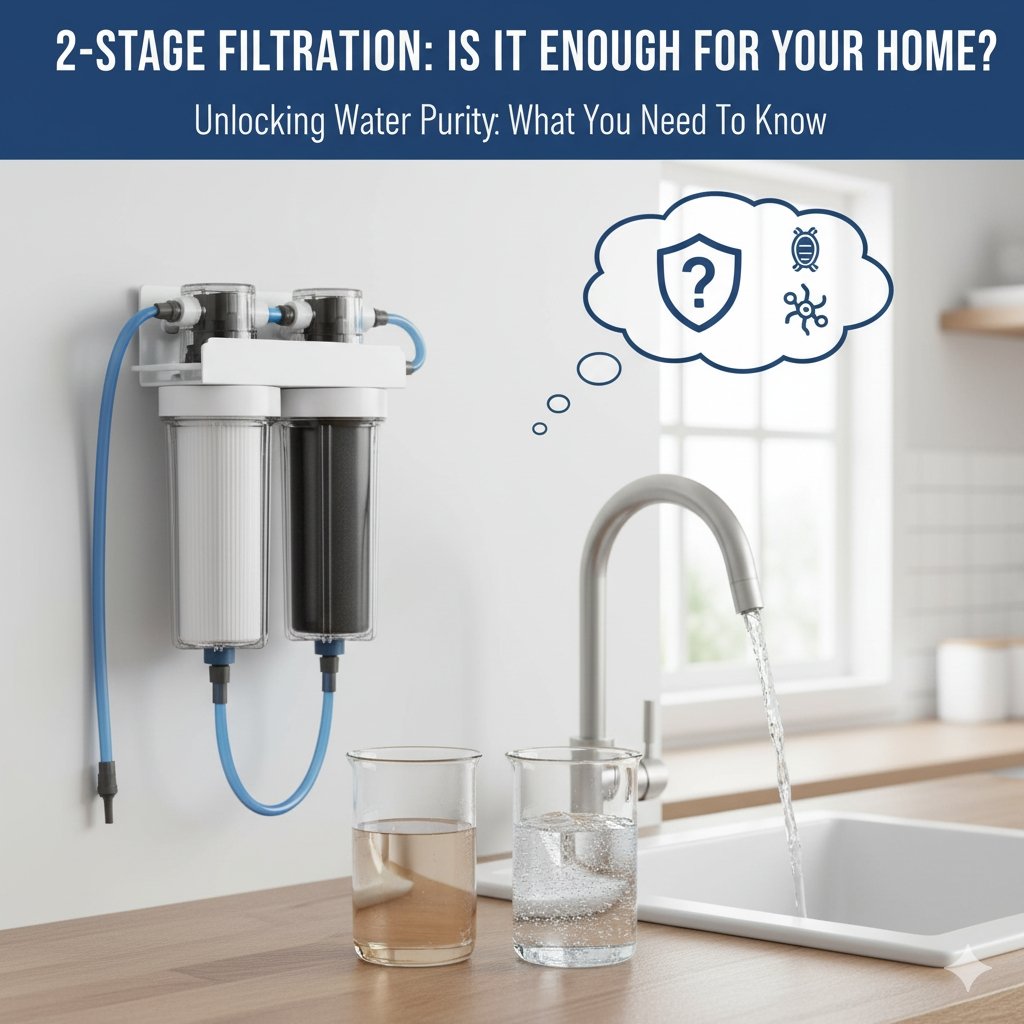
If you’ve typed is 2 stage water filter enough into a search bar, you’re asking one of the most practical questions about home water treatment: can a compact, two-stage setup give you safe, good-tasting water and protect your appliances — or will it leave gaps that cause problems later? This long-form guide answers that question clearly and practically. I’ll explain how two-stage systems work, what they can and cannot remove, real-world scenarios where they are — or aren’t — adequate, how to size and maintain them, costs to consider, when to upgrade, and a final decision checklist you can use right now.
If you want a specific whole-home reference to compare capacity and maintenance while you read, check this model as an example: https://yourwatergood.com/product/whole-house-water-filtration-system-for-home/.
Quick bottom-line answer (one sentence):
A two-stage water filter can be enough for many households with municipal water that primarily needs sediment removal and chlorine taste/odor control, but it is usually insufficient when your water has hardness, high TDS, chloramines, heavy metals, PFAS, or microbiological risks — in those cases you’ll need additional stages or different technologies.
Now let’s unpack that statement in detail so you can make a confident decision for your home.
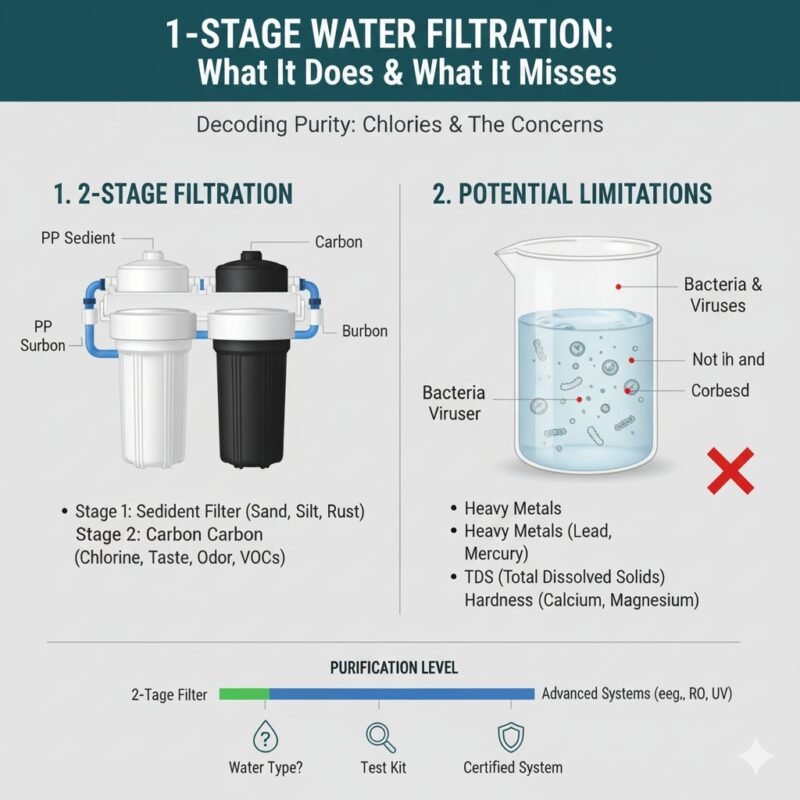
What is a two-stage water filter?
A typical two-stage water filter combines two different types of cartridges arranged in series. The most common configuration:
- Stage 1 — Sediment cartridge (PP cotton or pleated): removes sand, rust, silt and particulate down to a specified micron rating (commonly 1–10 μm).
- Stage 2 — Activated carbon (block or granular): removes free chlorine, improves taste and odor, and adsorbs many organic compounds and some VOCs.
Some two-stage systems vary the exact media (e.g., a sediment + specialty lead filter, or sediment + catalytic carbon), but the general idea is prefiltration to protect the adsorbent stage and improve service life.
What can a two-stage system reliably do?
A correctly sized and regularly maintained two-stage filter can reliably:
- Remove visible particles, rust and sand that clog faucets, shower heads, and appliances.
- Reduce or remove free chlorine, significantly improving taste and odor. Carbon block is highly effective for this.
- Protect downstream equipment (ice makers, coffee machines) from particulate damage.
- Reduce some common organic tastes and odors and some low-level VOCs depending on contact time and carbon capacity.
- Provide low-cost, low-footprint filtration that is easy to install and maintain in most homes.
For many city-supplied water systems where the main complaint is chlorine taste, sediment, or occasional discoloration, a two-stage unit is a sensible, economical first step.
What a two-stage system usually cannot do
Two-stage systems have limits. You should NOT expect them to do the following without specific, certified cartridges:
- Remove dissolved salts (TDS) — two-stage carbon/sediment cannot lower TDS; for that you need reverse osmosis (RO) or deionization.
- Remove hardness (Ca²⁺/Mg²⁺) — scale and hardness require a water softener, TAC, or other scale control technology.
- Effectively remove chloramines — standard carbon struggles with chloramines; catalytic carbon or longer contact is necessary.
- Guaranteed PFAS removal — PFAS removal depends on specialized media and bed depth; most small carbon blocks are not certified for high PFAS loads.
- Reliable microbial disinfection or significant bacterial removal — carbon can trap organic material and sometimes lead to biological growth if neglected; for microbial threats you need UV, UF/RO, or chlorination with proper management.
- High-flow whole-house capacity — many two-stage housings are point-of-use or small POE and may not provide adequate flow/low pressure drop for large homes without upsized components.
If your water has any of these problems, expect to add stages or install different technology.
How to know whether a two-stage system is enough for your home
You need two pieces of information: (1) a water test, and (2) a clear statement of what outcome you want (taste, appliance protection, low-TDS, scale prevention, PFAS reduction, microbial safety).
- Get a lab test. At minimum request: TDS, hardness, pH, iron, manganese, chlorine/chloramine, turbidity, lead, and if relevant PFAS or microbial analysis for well water. Municipal water reports (CCR) help but a specific sample is better.
- Define outcomes. Examples: “I want no chlorine taste at kitchen tap,” or “I want to prevent scale in the boiler,” or “I want clear ice and no rust particles.”
Decision rules:
- If your water report shows only moderate chlorine and low TDS/hardness, a sediment + carbon two-stage is often sufficient.
- If hardness >7 gpg or you have scale issues → two-stage is not enough; add softening or TAC.
- If TDS is high or you need crystal-clear ice/drinks → two-stage is not enough; consider RO at point-of-use.
- If chloramines are present → two-stage may be not enough unless it uses catalytic carbon or a verified carbon stage sized for chloramine.
- If PFAS or lead is above advisory/threshold → two-stage may be not enough unless the second stage is a certified lead/PFAS cartridge.
Real-world scenarios: when two stages are enough — and when they aren’t
Scenario A — Typical city water, occasional chlorine taste:
- Water report: low TDS, hardness 4–6 gpg, free chlorine <0.5 mg/L, no heavy metals.
- Recommendation: Two-stage (5 µm sediment + carbon block) at POE or under-sink works well for taste and particulate protection. Result: Sufficient.
Scenario B — Older home with lead pipe risk:
- Water report: possible elevated lead risk, or house has lead solder.
- Recommendation: Two-stage only if Stage 2 is a certified NSF/ANSI 53 lead-reduction cartridge. Otherwise not sufficient — use certified lead cartridge or POU RO.
Scenario C — Well water with turbidity and microbial risk:
- Water report: turbidity spikes after storms; occasional total coliform positive.
- Recommendation: Two-stage alone is not sufficient. Needed: sediment + UV or UF + disinfection. Possibly whole-house treatment and ongoing monitoring.
Scenario D — High hardness and frequent scale on fixtures:
- Water report: hardness 10–15 gpg.
- Recommendation: Two-stage is not sufficient. Add a softener or scale control before installing polishing filters.
Scenario E — Concerned about PFAS or trace organics:
- Water report: PFAS detectable above advisory or unknown.
- Recommendation: Two-stage without specialized, certified PFAS media is not sufficient. POU RO or certified PFAS adsorbers required.
How to size a two-stage system correctly
Sizing matters — undersized cartridges exhaust quickly. Follow these steps:
- Decide the application: whole-house (point-of-entry) vs. point-of-use (kitchen, fridge). Two-stage POE needs much larger media than POU.
- Match flow requirements: check the rated GPM of the cartridge/housing and ensure it meets peak flows without excessive pressure drop. A small inline two-stage rated at 1–2 GPM is fine for a fridge line or single faucet but will choke a whole-house line.
- Choose cartridge length & bed volume: 10″ vs 20″ cartridges — 20″ provide roughly twice the capacity. For POE prefer 20″ or larger vessels.
- Check carbon capacity: Look for rated gallon life or milligram adsorption figures for chlorine or target compounds and convert to calendar life using household water consumption and contaminant concentration.
- Plan maintenance intervals: set reminders based on estimated gallons and add a safety margin (replace earlier rather than later).
Example: If a carbon cartridge is rated for 50,000 gallons for chlorine removal and your household uses 400 gallons/day, expected life ≈ 125 days (~4 months) — plan replacement at 3–4 months.
Maintenance: the make-or-break factor
Two-stage systems perform well only with regular maintenance.
- Replace sediment cartridges when ΔP rises noticeably or every 3–12 months depending on turbidity and micron rating.
- Replace carbon cartridges at manufacturer-recommended intervals or sooner if chlorine taste returns — typical range 6–12 months for many households.
- Sanitize housings when replacing cartridges to avoid biofilm (follow manufacturer instructions).
- Monitor pressure differential using gauges across stages for objective signals of clogging.
- Keep records of install date and replacement dates to maintain warranty and predictable performance.
Neglecting maintenance increases risk: exhausted carbon can release trapped organics and foster bacterial growth; clogged sediment filters reduce flow and stress household plumbing.
Cost considerations
Two-stage systems are cost-effective up front and have modest consumable costs. Typical costs:
- Initial equipment: small two-stage under-sink or inline kits: $50–$300. Whole-house two-stage housings (20″ cartridges) may run $200–$800 plus installation.
- Cartridge replacements: sediment $5–$30; carbon $20–$120 depending on size and certification. Annual maintenance commonly $50–$300 for residential setups.
- Professional installation: optional for POE; plumber rates vary ($150–$600 typical).
- If more technology needed (softener, RO, UV): costs increase substantially — softeners $800–$3,000, whole-house RO systems $2,000+, UV $300–$1,200.
Calculate 3–5 year total cost of ownership including consumables and any professional service. Two-stage systems often provide a low TCO for the problems they solve.
Choosing the right cartridges for a two-stage system
Match cartridge type to problem:
- Sediment (Stage 1): Choose micron rating based on visible particles — 50 µm for coarse sand, 10 µm for rust, 1–5 µm for protecting RO membranes. Use pleated for long life in high-sediment situations.
- Carbon (Stage 2): Carbon block is generally better than loose GAC for small cartridges because of consistent flow and lower carbon fines. For chloramine, choose catalytic carbon or a specifically rated chloramine-removal cartridge. For lead or PFAS, only use cartridges with NSF/ANSI certification for the specific contaminant.
Always verify the cartridge SKU and ask for certification PDFs when health claims are made (lead, PFAS).
Upgrade paths if two stages aren’t enough
If your water test shows additional issues, these are common upgrade paths:
- Add a softener (salt-based) or TAC device ahead of the filters if hardness is the primary concern. Place sediment first to protect the softener.
- Add a third stage such as a specialty adsorptive media (e.g., catalytic carbon, KDF, PFAS-specific media) or a remineralizer after RO for taste.
- Install point-of-use RO under the kitchen sink for drinking and ice water while keeping a two-stage POE for whole-house protection.
- Add UV or UF for microbial risk — place after good prefiltration to protect UV or UF performance.
- Use duplex or parallel arrangements for high-flow or redundancy to perform maintenance without service interruption.
The right combination depends on your lab results and priorities.
Practical installation tips and pitfalls to avoid
- Don’t install two-stage inline devices sized for a single faucet on the whole-house inlet. Check GPM ratings.
- Avoid saddle valves — use proper tees and isolation valves for longevity.
- Install pressure gauges before and after for ΔP monitoring. They are inexpensive and invaluable.
- Label housings with install date and next-change due date.
- Flush thoroughly after cartridge change to remove fines from carbon and sediment media.
- Confirm pipe material compatibility — some components work better with PEX or copper; use food-grade materials.
Checklist — when a two-stage system is the right choice
Use this checklist to decide quickly:
- Water test shows low TDS (<300 ppm) and low hardness (<7 gpg).
- Main problems are chlorine taste/odor and visible sediment.
- No evidence of chloramines, PFAS, lead, or microbial contamination.
- You want an inexpensive, low-maintenance start and are willing to perform scheduled cartridge changes.
- Peak flow requirements match the selected housings and cartridges.
- You understand when to step up to softeners, RO or UV if testing indicates.
If you check all boxes, a two-stage system is a sound, economical solution.
Example system recommendations (practical)
- City home focused on taste & sediment: 20″ sediment (5–10 µm) + 20″ carbon block (10″) POE housing. Replace sediment 3–6 months; carbon 6–12 months.
- Apartment kitchen POU: Inline 1st-stage 5 µm sediment + 2nd-stage carbon block cartridge under sink or inline to fridge — easy DIY install; change every 6–12 months.
- Well with light particulate but no microbes: Two-stage plus regular testing and consider seasonal checks; if turbidity rises, replace sediment more often and consider UF/UV upgrade.
If you want a whole-home product reference while selecting components, review this example: https://yourwatergood.com/product/whole-house-water-filtration-system-for-home/.
Final thoughts — practical decision path
- Get a water test — this is the single most important step.
- Define your priority: taste, appliance protection, low-TDS, or microbial safety.
- If priorities = taste + sediment only, choose a properly sized two-stage system and commit to maintenance.
- If priorities include hardness, TDS, chloramines, PFAS, or bacteria, plan for additional or alternative technologies (softener, RO, catalytic carbon, UV/UF).
- Monitor performance with simple tools: pressure gauges and a TDS meter (for RO), and schedule cartridge changes proactively.
A two-stage water filter is an excellent, cost-effective solution for the right problems. It’s compact, affordable and easy to maintain — and for many homeowners it provides immediate, noticeable improvements. But don’t treat it as a universal fix: match the tech to your water and be ready to upgrade if your water chemistry demands it.