
The Ultimate Defense Against Hard Water: Why Every Home Needs a Limescale Filter

It starts slowly. A faint white ring around the bathtub drain. A cloudy film on your favorite wine glasses that no amount of polishing seems to remove. Then, the water pressure in the shower starts to drop, or the kettle takes twice as long to boil.
The culprit is invisible, relentless, and expensive: Limescale.
For millions of households and business owners, hard water is a daily reality. While it is not toxic to drink, it is a poison to your plumbing infrastructure. It eats away at the efficiency of your appliances, dries out your skin, and creates endless cleaning chores.
The solution lies in a piece of technology often searched for but rarely fully understood: the limescale filter.
In this extensive guide, we will move beyond the basics. We will dissect the chemistry of hard water, explore the devastating financial impact of limescale buildup, and guide you through the various technologies available—from salt-based softeners to advanced whole-house filtration—to help you banish the white crust forever.https://yourwatergood.com/product/whole-house-water-filtration-system-for-home/.
Part 1: The Chemistry of the Crust
To understand how a limescale filter works, we must first understand the enemy. What exactly is limescale?
The Geological Journey
Water is a universal solvent. As rainwater falls and seeps into the ground, it passes through layers of sedimentary rock, specifically limestone and chalk. These rocks are rich in calcium and magnesium carbonates. The water dissolves these minerals, holding them in a solution.
When this water enters your home, it is classified as “Hard Water.”
- Hardness Measurement: It is measured in Grains Per Gallon (GPG). Anything over 7 GPG is considered “Hard,” and over 10 GPG is “Very Hard.”
The Precipitation Event
The problem arises when this mineral-rich water is heated or agitated.
- Heat: When hard water enters your water heater or tea kettle, the heat causes the dissolved calcium bicarbonate to revert to solid calcium carbonate.
- Adhesion: This solid does not just float; it sticks. It bonds to metal surfaces with incredible tenacity. This rock-like deposit is what we call limescale.
A limescale filter is any device designed to interrupt this process, either by removing the minerals entirely or by altering their chemical structure so they cannot stick.
Part 2: The High Cost of Doing Nothing
Many homeowners view a limescale filter as a luxury item. However, when you look at the data, it becomes clear that it is an infrastructure necessity. Living with hard water is expensive.
1. The Energy Vampire
Limescale is an excellent insulator—similar to the rock wool used in attic insulation.
- Water Heaters: If your heating element is coated in scale, it cannot transfer heat efficiently to the water. A mere 1/4 inch of scale can increase your water heating costs by up to 20-30%. You are essentially paying to heat the rock before you heat the water.
2. The Appliance Killer
Modern appliances are filled with delicate sensors, pumps, and spray jets.
- Dishwashers: Scale clogs the spray arms, leading to dirty dishes and cloudy glass.
- Washing Machines: Hard water destroys the rubber seals and eventually clogs the inlet valves.
- Lifespan Reduction: Studies show that gas water heaters used with untreated hard water fail up to 48% faster than those used with treated water.
3. The Detergent Drain
Hard water fights soap. The calcium reacts with fatty acids in soap to create “soap curd” (scum). This means you have to use 50% more detergent to get your clothes clean and your shampoo to lather. Over a year, this adds up to hundreds of dollars in wasted cleaning products.
Part 3: Types of Limescale Filters
When you shop for a limescale filter, you will encounter three main technologies. Choosing the right one depends on your goals: do you want to protect the pipes, or do you want pure drinking water?
1. Ion Exchange (Traditional Water Softener)
This is the heavy artillery of hard water treatment.
- How it Works: The system contains a tank filled with resin beads charged with sodium ions. As hard water flows through, the beads grab the calcium and magnesium and release sodium in exchange.
- The Result: The minerals are physically removed. The water is “soft.”
- Pros: Total elimination of scale; rich lather; slick feel on skin.
- Cons: Adds sodium to the water (not great for low-sodium diets); uses water for regeneration; requires bags of salt.
2. Template Assisted Crystallization (Salt-Free Conditioner)
Often marketed as a “Salt-Free limescale filter.”
- How it Works: It uses a special media that attracts the hardness minerals and converts them into microscopic crystals. These crystals are stable and flow through the pipes without sticking to surfaces.
- The Result: The minerals are still in the water, but they are neutralized.
- Pros: No salt; no electricity; zero wastewater; leaves healthy minerals in drinking water.
- Cons: Does not provide that “soft water” feel; soap usage doesn’t decrease as much as with salt softeners.
3. Reverse Osmosis (The Ultimate Purifier)
While usually discussed for drinking water, RO is the ultimate limescale filter for the kitchen.
- How it Works: The RO membrane (0.0001 microns) is tight enough to physically block dissolved calcium and magnesium.
- The Result: Water that is 99% free of all minerals and contaminants.
- Pros: Perfect for coffee makers, steam irons, and drinking.
- Cons: Too slow to treat the whole house; usually installed under the sink.
Part 4: The Whole House Strategy
If your goal is to protect your property—your piping, your expensive water heater, and your washing machine—you need a “Point of Entry” (POE) solution. A small filter under the kitchen sink will not save your shower from clogging.
The most effective strategy is a Whole House Filtration System that incorporates scale protection or works in tandem with a softener.
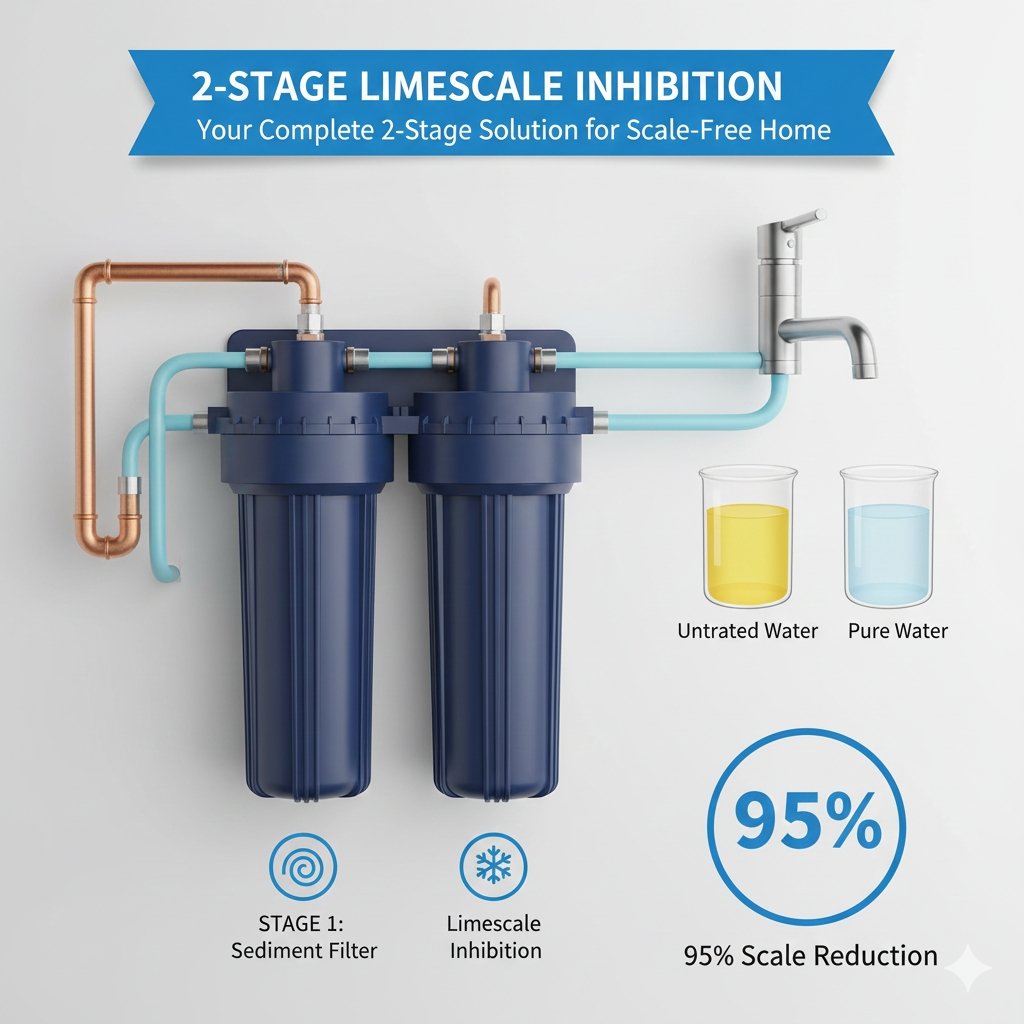
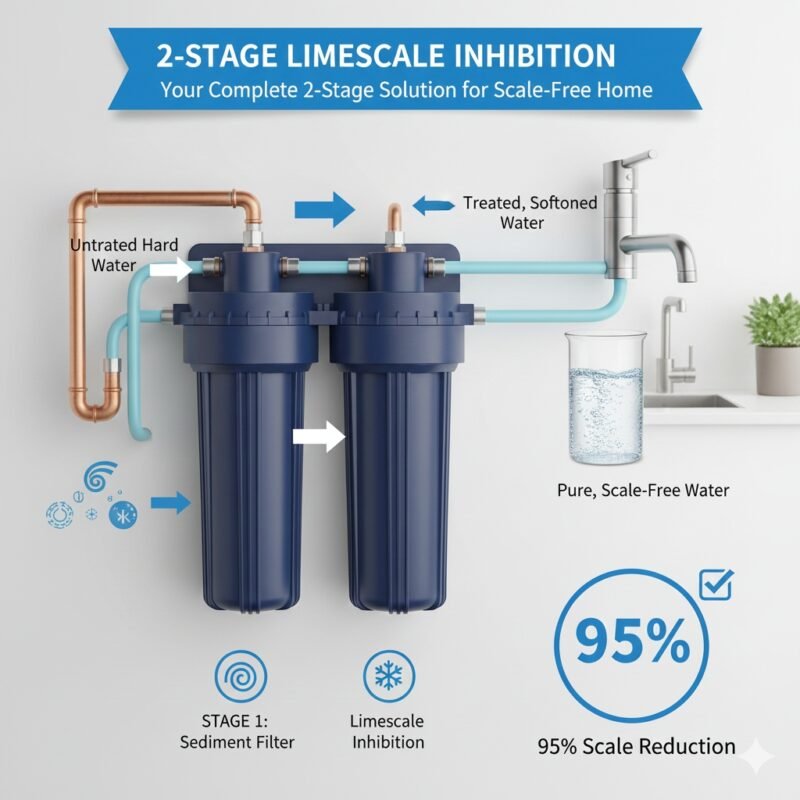
The Foundation: Sediment Protection
Often, what looks like limescale is actually a mix of calcium and dirt/rust. A comprehensive system starts with a high-capacity sediment filter. By removing the particulate matter (rust, sand, silt) from the water first, you prevent the formation of “dirty scale,” which is even harder to remove than pure white scale.
If you are serious about protecting your home’s infrastructure, we recommend the Whole House Water Filtration System for Home. While primarily a high-performance filtration unit designed to remove sediment and chemicals like chlorine, it is the essential first step in any hard water management plan. By cleaning the water before it hits your softener or conditioner, you extend the life of those scale-preventing media significantly.
Part 5: Commercial Applications (The Cafe & Restaurant)
For our business clients, the limescale filter is not optional; it is a survival tool.
The Espresso Machine Crisis
An espresso machine is essentially a boiler with tiny valves.
- The Problem: Even a thin layer of scale can jam a solenoid valve or coat the temperature sensor. If the machine cannot sense temperature correctly, it overheats or under-heats the water, ruining the coffee.
- The Cost: A descaling service for a commercial machine can cost $500 to $1,000, not including the lost revenue from downtime.
- The Fix: A dedicated commercial limescale filter (often using decarbonization resin or RO) ensures the machine stays pristine.
The Ice Machine
Cloudy, soft ice is a sign of hard water.
- The Problem: As water freezes, minerals are pushed to the center, creating a cloudy core. Scale buildup on the evaporator plate causes the ice to stick, forcing the harvest cycle to run longer and wasting energy.
- The Fix: Filtered water creates crystal clear, hard ice that melts slowly—the hallmark of a premium beverage experience.
Part 6: Health and Beauty Benefits
Hard water is tough on your body. The same minerals that coat your pipes also coat your skin and hair.
The “Squeaky Clean” Myth
When you wash with hard water and soap, you often feel “squeaky” clean. People mistake this for being thoroughly washed. In reality, that friction is caused by a microscopic layer of soap scum that hasn’t rinsed off.
- Skin Impact: This scum clogs pores and prevents natural oils from reaching the surface. This exacerbates conditions like eczema, psoriasis, and general dry, itchy skin.
- Hair Impact: The minerals lift the scales on the hair shaft, making hair rough, frizzy, and dull. It makes color-treated hair fade faster.
Installing a limescale filter or softener restores the water’s ability to rinse clean. Users often report softer skin and silkier hair within a week of installation.
Part 7: Installation and Maintenance
Investing in a limescale filter requires understanding the installation and upkeep.
Where to Install
A whole-house system must be installed on the main water line before the water heater.
- Main Shut-Off: Locate where water enters the home.
- The Loop: Plumbers often leave a “softener loop” in the garage or utility room for this exact purpose.
- The Bypass: Always install a bypass valve. This allows you to service the filter without shutting off water to the entire house.
Maintenance Schedules
- Salt Softeners: You must refill the salt tank every 4-8 weeks.
- Salt-Free Conditioners: The media usually lasts 3-5 years without maintenance, but the pre-filter (sediment) must be changed every 6-9 months.
- RO Systems: Membranes need changing every 2-3 years, depending on hardness levels.
Part 8: Myths About Scale Removal
There are many gadgets sold online claiming to be the perfect limescale filter. Let’s debunk the pseudoscience.
Myth 1: Magnetic Wraps remove scale.
- The Claim: Wrapping magnets around your pipe alters the ions so they don’t stick.
- The Reality: Scientific testing has shown these to be largely ineffective in residential settings. They do not remove minerals. The water remains hard. Do not rely on magnets to save your $2,000 water heater.
Myth 2: Vinegar is a permanent fix.
- The Claim: You can just flush your heater with vinegar.
- The Reality: Vinegar (acid) does dissolve scale. However, flushing a water heater is a messy, labor-intensive annual chore that most homeowners forget to do. It is a reactive measure, not a proactive solution. Prevention via filtration is far superior.
Myth 3: “Filtered” water is “Soft” water.
- The Reality: Standard carbon filters (like fridge filters) do not remove hardness. If you put hard water in, you get hard water out. You must use Ion Exchange or Reverse Osmosis technology to physically remove the minerals.
Part 9: Combining Technologies for the Ultimate Setup
The modern approach to water treatment isn’t about choosing one device; it’s about a holistic system.
The “One-Two Punch”
For the ultimate home setup, we recommend a staged approach:
- Stage 1: Filtration. Install a Whole House Water Filtration System for Home. This removes the sediment, rust, and chlorine. Chlorine degrades the resin beads in water softeners, so removing it first doubles the life of your softener.
- Stage 2: Softening/Conditioning. Install your softener or salt-free conditioner after the filtration system. Now, the softener only has to deal with the calcium, not the dirt and bleach.
- Stage 3: Purification (Kitchen). Install an RO system under the kitchen sink. This removes the sodium added by the softener, giving you perfect, mineral-free drinking water.
This “Defense in Depth” strategy ensures every tap in your house delivers the specific quality of water required for that task—whether it’s showering, washing clothes, or drinking.
Part 10: Environmental Considerations
When choosing a limescale filter, consider the footprint.
Salt Discharge
Traditional salt softeners discharge brine (salty water) into the sewage system during their regeneration cycle. In some drought-stricken areas or regions with strict wastewater reclamation goals, salt softeners are restricted.
The Eco-Friendly Alternative
If you are environmentally conscious, consider:
- Salt-Free Conditioners: Zero wastewater.
- High-Efficiency RO: Modern RO systems have reduced their wastewater significantly.
- Appliance Efficiency: Remember, the most eco-friendly thing you can do is prevent your water heater and washing machine from ending up in a landfill prematurely. Protecting them from scale is a green act.
Conclusion: Banish the Build-Up
Limescale is more than just a cleaning nuisance; it is a slow-motion disaster for your home’s infrastructure. From the white crust on your faucet to the silent failure of your water heater, hard water costs you money every single day.
By investing in a proper limescale filter strategy, you stop this damage. You extend the life of your appliances, you improve the health of your skin, and you save hours of scrubbing.
Whether you choose a traditional softener or a modern salt-free solution, remember that the foundation of any good water system is robust filtration. Clean water is easier to soften, and it is better for your home.
Visit YourWaterGood today to explore our high-capacity whole-house filtration systems. They are the perfect first step in your battle against hard water, ensuring that your plumbing remains efficient, clean, and scale-free for years to come.
Frequently Asked Questions (FAQ)
Q: How do I know if I need a limescale filter? A: Look for the signs:
- White, crusty buildup on faucets and showerheads.
- Soap that doesn’t lather well.
- Dry, itchy skin after bathing.
- Glasses coming out of the dishwasher with milky spots.
- You can also buy a simple “Total Hardness” test strip online to get an exact GPG reading.
Q: Will a limescale filter remove the white spots on my car after washing? A: Yes. Those spots are the minerals left behind when the water evaporates. If you wash your car with softened or RO water, it will dry “spot-free.”
Q: Can I drink water from a limescale filter? A: Yes.
- Salt-Free: Safe to drink, retains healthy minerals.
- Salt-Based Softener: Safe, but contains added sodium. People on strict low-sodium diets should avoid it or install an RO system for drinking.
- RO: Perfectly safe and pure.
Q: Does the Whole House Water Filtration System for Home remove limescale? A: This specific system is designed for Filtration (removing sediment, chemicals, chlorine). While it does not remove dissolved hardness minerals on its own, it is a critical partner to any softener. It prevents the “dirty scale” caused by sediment and protects the softener resin from chlorine damage. For complete protection, pair it with a softener or conditioner.
Q: Is hard water bad for my pets? A: Generally, no. Pets can drink hard water safely. However, highly mineralized water might contribute to urinary crystals in some cats prone to the condition. Filtered or RO water is often recommended for sensitive pets.