
The Complete Guide to Finding the Best Limescale Water Filter for Your Home and Business

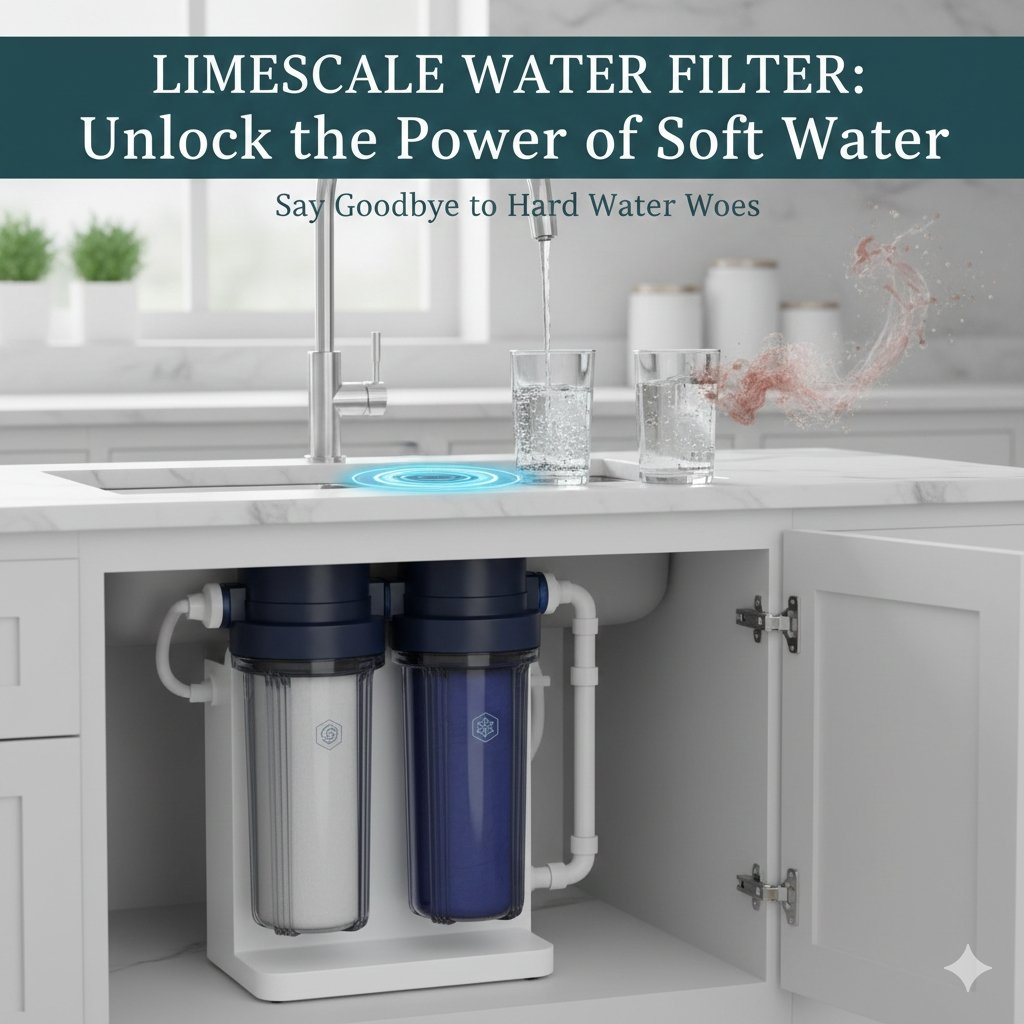
It begins as a nuisance: a chalky white residue on your showerhead, spots on your freshly washed wine glasses, and a kettle that takes just a little longer to boil. But over time, this nuisance transforms into a significant financial drain. It is the silent destroyer of plumbing infrastructure, the enemy of energy efficiency, and the primary reason your skin feels dry and itchy after a bath.
The culprit is hard water, and the visible evidence of its presence is limescale.
For homeowners protecting their investment and business owners safeguarding their equipment, the search for a solution often leads to a single, critical piece of technology: the limescale water filter.
But what exactly is it? Is it a softener? Is it a conditioner? Or is it something else entirely? In a market flooded with jargon and pseudoscience, finding the right solution can be overwhelming. In this extensive guide, we will dismantle the science of hard water, explore the devastating economic impact of scale, and guide you toward the correct filtration strategy to banish the buildup forever.
Part 1: The Mineral Invasion (Understanding the Problem)
To choose the right limescale water filter, you must first understand what you are filtering out. Unlike chlorine or bacteria, limescale isn’t a contaminant that is “added” to the water; it is a geological characteristic picked up from the earth itself.
The Chemistry of “Hardness”
Water is a solvent. As rainwater percolates through soil and rock layers to reach underground aquifers, it dissolves minerals. If your local geology is rich in limestone, chalk, or gypsum, your water absorbs high concentrations of Calcium and Magnesium.
When this mineral-rich water enters your home, it is chemically stable—until it is heated or agitated.
- Heat Precipitation: When hard water is heated (in a water heater, dishwasher, or coffee machine), the dissolved Calcium Bicarbonate converts into Calcium Carbonate.
- Solidification: Calcium Carbonate is less soluble in hot water. It precipitates out of the liquid and solidifies onto the nearest surface. This rock-hard crust is Limescale.
Measuring the Threat
Hardness is typically measured in Grains Per Gallon (GPG).
- Soft: 0-3 GPG
- Moderate: 3-7 GPG
- Hard: 7-10 GPG (Where a limescale water filter becomes necessary)
- Very Hard: 10+ GPG (Where appliance failure is imminent)
Part 2: The High Cost of Doing Nothing
Many people view water treatment as a luxury. However, when dealing with hard water, a limescale water filter is an infrastructure necessity. The cost of ignoring the problem far outweighs the cost of the solution.
1. The Energy Penalty
Limescale is a phenomenal insulator. It has a thermal conductivity similar to firebrick. When it coats the heating element of your electric water heater or the heat exchanger of your gas boiler, it acts as a barrier.
- The Statistic: Just 1/16th of an inch of scale can reduce heating efficiency by 12%. A 1/4 inch buildup can increase energy consumption by 40%.
- The Result: You are paying huge sums to heat the rock inside your tank before you heat the water.
2. The Appliance Graveyard
Hard water shortens the lifespan of water-using appliances by 30% to 50%.
- Washing Machines: Scale builds up on the drum and destroys the rubber seals and pumps.
- Dishwashers: The tiny spray jets clog with mineral deposits, resulting in dirty dishes and burnt-out wash pumps.
- Faucets: Ceramic cartridges inside modern faucets get scratched by scale, leading to perpetual dripping.
3. The Detergent Drain
Hard water fights soap. The calcium reacts with the fatty acids in soap to form a sticky, insoluble curd known as “soap scum.” This means you have to use twice as much laundry detergent, shampoo, and dish soap to get a decent lather. A limescale water filter pays for itself simply by reducing your grocery bill for cleaning products.
Part 3: Defining the “Limescale Water Filter”
This is where consumer confusion peaks. A standard carbon filter (like a pitcher) removes bad tastes, but it does not remove dissolved minerals. If you pour hard water into a carbon filter, it comes out hard.
To effectively combat scale, a limescale water filter must utilize one of three specific technologies:
1. Ion Exchange (Softening)
This is the traditional route. The system uses a tank filled with resin beads charged with sodium ions. As hard water flows through, the beads grab the calcium and magnesium and release sodium in exchange.
- Pros: Physically removes the minerals. True “soft” water.
- Cons: Requires salt refills; creates wastewater; water feels slippery.
2. Scale Inhibition (Sequestration)
This is often found in cartridge-based systems. The filter contains a media (like Polyphosphate) that slowly dissolves into the water. This coating wraps around the mineral ions, preventing them from sticking to surfaces.
- Pros: Cheap; compact; easy to install.
- Cons: The minerals are still there; effectiveness decreases at high temperatures (over $140^\circ F$).
3. Reverse Osmosis (Purification)
The ultimate limescale water filter for drinking water. The RO membrane is so tight that dissolved minerals cannot pass through.
- Pros: Removes 99% of scale, plus lead, chlorine, and bacteria.
- Cons: Low flow rate; typically only for a single faucet (kitchen sink), not the whole house.
Part 4: The Strategy – Filtration First, Softening Second
A critical mistake homeowners make is installing a softener directly onto the main water line without pre-filtration. Hard water is rarely just hard; it is often dirty. It carries rust flakes from old pipes, sediment, and chlorine.
If you expose expensive softening resin or scale-prevention media to chlorine and sediment, the media degrades rapidly. The resin turns to mush, and the system fails.
The Hybrid Approach:
To create an effective, long-lasting defense against scale, you must adopt a layered strategy.
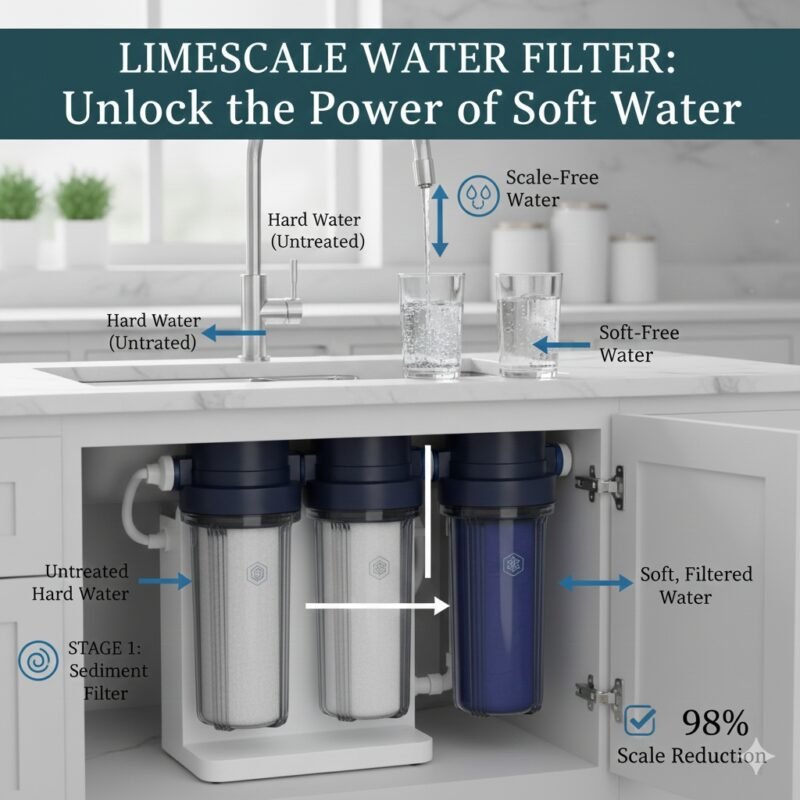
- Layer 1: The Whole House Filter. You need a robust sediment and carbon system to clean the water first. This removes the rust and chlorine.
- Layer 2: The Scale Solution. Once the water is clean, it passes through the softener or conditioner.
For the foundational layer of this strategy, we highly recommend the Whole House Water Filtration System for Home. By installing this high-capacity system at the point of entry, you ensure that the water entering your scale-treatment device is free of the sediment and chemicals that would otherwise destroy it. It acts as the bodyguard for your plumbing, making any subsequent limescale water filter infinitely more effective.
Part 5: Commercial Applications (The Cafe & Restaurant)
For our B2B clients—coffee shops, bakeries, and restaurants—limescale is a business-critical issue.
The Espresso Machine Crisis
An espresso machine is essentially a boiler with tiny, precision-engineered valves.
- The Problem: Scale buildup in a commercial espresso machine is the #1 cause of equipment failure. It jams solenoid valves, insulates temperature sensors (causing inconsistent brewing temperatures), and restricts flow.
- The Flavor: Hard water prevents proper extraction of coffee oils, leading to sour espresso. Conversely, over-softened water can lead to flat coffee.
- The Solution: A specialized commercial limescale filter (often a blended RO system or a decarbonization filter) allows the barista to “dial in” the exact mineral content needed for flavor while preventing the buildup that kills the machine.
The Ice Machine
If your restaurant serves cloudy, soft ice that melts instantly, you have a hard water problem.
- The Mechanism: As water freezes, pure water turns to ice first, pushing the minerals into the center. This creates a cloudy core.
- The Fix: Using a filtration system to reduce Total Dissolved Solids (TDS) results in crystal-clear, hard ice that looks premium and lasts longer in the glass.
Part 6: Health and Beauty (The Personal Impact)
We often focus on the plumbing, but hard water takes a toll on the human body as well.
The “Squeaky Clean” Myth
When you wash with hard water and bar soap, you often feel “squeaky” clean. Many people mistake this friction for cleanliness. In reality, that “squeak” is caused by a microscopic layer of soap curd (scum) sticking to your skin because the water couldn’t rinse it away.
- Skin: This scum clogs pores and blocks natural oils, exacerbating eczema, acne, and dry skin conditions.
- Hair: The minerals lift the scales on the hair shaft, making hair rough, frizzy, and prone to tangling. It causes expensive hair color to fade rapidly.
Installing a whole-house limescale water filter or softener restores the water’s ability to hydrate. Users typically report softer skin and silkier hair within a week of installation, and they find they can use 50% less shampoo to get a rich lather.
Part 7: Navigating the Market – What to Look For
When you are ready to buy, the market can be confusing. Here are the technical specifications you should verify.
1. Capacity (Grains)
If buying a softener, it will be rated in “Grains” (e.g., 32,000 grain, 48,000 grain).
- Calculation: Multiply your daily water usage (gallons) by your hardness (GPG). This tells you how much capacity you use per day. Ensure the system is large enough to go at least a week between regeneration cycles to save water and salt.
2. Flow Rate (GPM)
Don’t undersize your system.
- A limescale water filter must be able to handle the peak flow of your home. If you have 3 bathrooms and they might all be in use at once, you need a system rated for 12-15 Gallons Per Minute (GPM). If you buy a small unit rated for 7 GPM, your water pressure will drop drastically during peak hours.
3. Pre-Treatment Requirements
Check the manual. Most salt-free conditioners and high-end softeners require chlorine-free water. This reinforces the need for a pre-filter system like the Whole House Water Filtration System for Home to validate the warranty.
Part 8: Installation and Maintenance
A limescale water filter is an appliance, and like any appliance, it needs care.
Installation Best Practices
- Location: Install on the main water line before the water heater. Scale forms fastest in hot water, so protecting the heater is priority #1.
- Bypass Valve: Always install a 3-valve bypass. This allows you to service the filter without shutting off water to the entire house.
- Drainage: If using a salt softener or RO system, you need access to a floor drain or a washing machine drain standpipe for the wastewater.
Maintenance Routines
- Salt Softeners: Check salt levels monthly. Every year, check for “salt bridges” (a hard crust that forms over the water) and break them up.
- Cartridge Systems: If using a polyphosphate or carbon-based scale filter, replace the cartridge every 6 months faithfully. Once the media is exhausted, the protection stops immediately.
- Sediment Pre-Filters: Change the PP Cotton filter every 3-6 months. If this clogs, your water pressure drops.
Part 9: Myths and Pseudoscience
In your search for a limescale water filter, you will encounter “miracle” devices. Let’s separate fact from fiction.
Myth 1: Magnetic Pipe Wraps remove scale.
- The Claim: Wrapping magnets around a pipe alters the crystal structure of calcium so it won’t stick.
- The Reality: Scientific studies have been inconclusive at best. They do not remove minerals. The water remains hard. They cannot be relied upon to protect a $2,000 tankless water heater warranty.
Myth 2: Vinegar is a permanent solution.
- The Claim: Flushing appliances with vinegar fixes the problem.
- The Reality: Vinegar (acid) dissolves scale, yes. But flushing a water heater is a messy, difficult annual chore that most people forget to do. It is a reactive repair, not a proactive solution.
Myth 3: All filtered water is soft.
- The Reality: A carbon filter (standard fridge filter) does absolutely nothing to hardness. You can have ultra-filtered water that is still hard as rock. You must use specific de-scaling technology.
Part 10: Environmental Considerations
Sustainability is key. Traditional softeners release brine (salty water) into the sewage system, which can be difficult for municipal treatment plants to process.
The Eco-Friendly Options:
- High-Efficiency Softeners: Modern “On-Demand” softeners measure water usage and only regenerate when necessary, saving 40% on salt and water compared to old timer-based units.
- Salt-Free Conditioners: These use Template Assisted Crystallization (TAC). They use zero electricity and create zero wastewater. They are excellent for scale prevention, though they don’t provide the “slick” soft water feel.
- Appliance Efficiency: Remember, the most eco-friendly act is preventing your appliances from ending up in a landfill. By using a limescale water filter, you double the lifespan of your washing machine and dishwasher, reducing global e-waste.
Conclusion: The Path to Protection
Limescale is a relentless enemy. It works silently inside your pipes, day and night, insulating your heating elements and clogging your valves. But it is an enemy you can defeat.
By choosing the right limescale water filter, you transform your home’s water from a liability into an asset. You save money on energy bills, you protect your expensive renovations, and you enjoy the luxury of better skin and hair.
Remember the golden rule: Filter first, then soften. Clean water is easier to treat.
Start your journey to scale-free living by securing the foundation of your water system. Explore the robust capabilities of the Whole House Water Filtration System for Home. It provides the clean, sediment-free, chlorine-free baseline you need to ensure your scale protection strategy works perfectly for years to come.
Frequently Asked Questions (FAQ)
Q: Will a limescale water filter remove the white spots on my car?
A: Yes and no.
- A Salt-Based Softener replaces calcium with sodium. Sodium leaves spots too, but they are salty spots that wipe off easily, unlike calcium spots that etch the paint.
- A Reverse Osmosis (RO) system removes all minerals. This is the only way to get a truly “spot-free” rinse.
Q: Can I drink water from a limescale filter?
A: Yes.
- Salt-Free: Safe to drink; keeps healthy minerals.
- Salt-Based: Safe for most, but adds sodium. If you have high blood pressure, you should install a separate RO tap for drinking or use potassium chloride instead of salt.
Q: Does the Whole House Water Filtration System for Home remove scale on its own?
A: No. This system is a Filtration unit (Sediment + Carbon). It removes dirt, rust, and chlorine. It does not remove dissolved minerals. However, it is the essential partner to any scale system. Without it, your scale filter will get clogged with mud and destroyed by chlorine.
Q: How do I know how hard my water is?
A: You can buy a simple test strip kit online for a few dollars. Alternatively, you can look up your city’s “Annual Water Quality Report” online, which will list the average hardness in your area.
Q: Will a filter fix low pressure caused by scale?
A: A filter prevents new scale from forming. It will not dissolve the old scale that is already clogging your pipes. If your pipes are fully occluded with 50 years of scale, they may need professional cleaning or replacement. Installing a filter now stops the problem from getting worse.