
PP Cotton Household Water Purifier Company: Building Quality, Reliability, and Market Trust

Introduction
PP (polypropylene) cotton sediment cartridges are a deceptively simple but critically important component in household water purifiers. For any company operating in this space — whether a manufacturer, brand owner, or supplier — success depends on more than low unit cost. It requires disciplined engineering, repeatable manufacturing, transparent quality control, thoughtful logistics, and clear channel strategies that translate product reliability into lower warranty exposure and better customer retention.
This article walks through the essential considerations a PP cotton household water purifier company must master: product design and material choices, manufacturing and process controls, testing and acceptance criteria, packaging and logistics, commercial models, regulatory and certification needs, sustainability and end-of-life planning, go-to-market tactics, and practical operational checklists. The goal is pragmatic: give actionable steps that reduce downstream failures and create defensible business value.https://yourwatergood.com/product/whole-house-water-filtration-system-for-home/
Why a Dedicated PP Cotton Company Matters
The role of sediment filtration in household systems
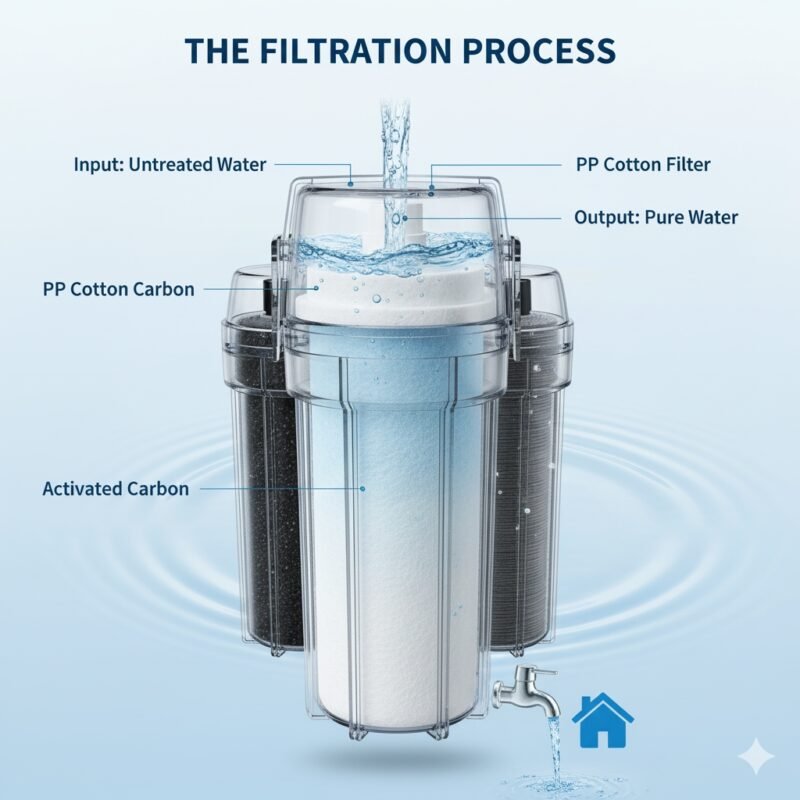
Sediment filtration is the first defensive layer in nearly every household water treatment train. The job of PP cotton cartridges is purely mechanical: trap sand, silt, rust, and larger particulates so that more expensive downstream components—carbon blocks, ultrafiltration (UF) modules, and reverse osmosis (RO) membranes—remain effective and last longer.
Business impact of “good enough” vs “engineered” cartridges
To many buyers a sediment cartridge is a commodity. In practice, small differences in fines control, dirt-holding capacity, micron consistency, and bonding reliability can create outsized effects on warranty costs, membrane lifetimes, and customer satisfaction. A company that treats PP cotton as an engineered product rather than a throwaway item gains competitive advantage: fewer service calls, stronger OEM relationships, and a recurring consumables revenue stream.
Product Design: Materials, Micron Ratings, and Form Factors
Choosing polypropylene resin and materials hygiene
Start with resin selection. Food-contact grade polypropylene with stable melt-flow index (MFI) and minimal non-essential additives reduces extractables and taste issues. Document resin Certificates of Analysis (CoA) and require lot traceability. Where recycled PP is considered for sustainability, mandate extractables testing to ensure potable safety before approval.
Micron ratings: nominal vs absolute
Understand your customer’s needs. Nominal micron ratings (e.g., 5 µm nominal) are common and useful for market communication, but absolute ratings (e.g., 99.9% at X µm) provide stronger performance guarantees—important for OEMs protecting membranes. Offer a mix of SKUs (1 µm, 5 µm, 10 µm) and be explicit about test methods used to justify claims.
Form factors and compatibility
Stock standard industry sizes (10″ and 20″ 2.5″ OD) for broad compatibility. Offer pleated cartridges for whole-house applications and inline capsules for appliance-specific installs. For OEM partners, provide private-label and custom end-cap options while keeping a core set of universal SKUs for distribution channels.
Manufacturing: Melt-Blown Process, Conversion, and Process Control
Melt-blown production fundamentals
Melt-blown nonwoven production creates the depth-filtration matrix that defines dirt-holding capacity and flow resistance. Key variables—die temperature, air velocity, polymer throughput, and collector speed—determine fiber diameter and web uniformity. Invest in stable, modern melt-blown lines with good process control and redundancy to reduce lot-to-lot variability.
Conversion and assembly best practices
Conversion from roll media to finished cartridges involves cutting, core insertion, end-cap bonding, gasket insertion, and individual packaging. Prefer thermal fusion for end-cap bonding rather than solvent adhesives to avoid potential leachables. Use robust central cores for high-flow POE products and validate bonding strength via pull tests.
Statistical Process Control (SPC) and inline monitoring
Incorporate SPC for critical parameters: web basis weight, thickness, die temperature, and finished-part dimensions. Inline gauges should detect off-spec webs and automatically reject them before conversion. These controls reduce scrap, improve first-pass yield, and support traceability.
Quality and Testing: Benchmarks That Matter
Flow vs ΔP (differential pressure) curves
Provide clear ΔP vs flow curves for each SKU. These curves predict user experience and guide OEM integration. Include initial ΔP and expected ΔP rise under standardized particulate load.
Dirt-holding capacity and standard challenge tests
Dirt-holding capacity, expressed as grams of particulate captured before a service ΔP endpoint (e.g., 15 psi), is among the most actionable lifetime metrics. Use a standardized challenge particulate and method for repeatable comparisons across suppliers.
Particle retention efficiency and fines testing
Run particle retention tests with calibrated spheres or defined particulate challenges to report percent removal at key sizes. Also quantify initial fines or extractables during recommended first-flush volumes; low-fines media reduce first-use complaints and warranty issues.
Mechanical and dimensional testing
Conduct end-cap pull tests, core collapse tests, and O-ring compression checks. Maintain tolerance tables for length, OD/ID, and end-cap geometry to prevent bypass and leaks.
Batch Certificates of Conformance (CoC)
For each production lot, issue a CoC that includes batch-level results for ΔP, dirt-holding, and dimensional checks. Tie CoC numbers to carton labels for traceability.
Packaging, Handling, and Logistics
Individual packaging and protective measures
Individually bag cartridges in polybags before cartonization to prevent dust ingress and fines migration. Vacuum or shrink-pack options reduce volumetric freight for long international shipments.
Labeling for traceability
Cartons should include SKU, lot number, production date, and CoC reference. This simplifies RMAs, recalls, and returns.
Warehousing and stock strategy
Store products in cool, dry, UV-protected facilities and rotate stock FIFO. Calculate safety stock using supplier lead times and order cadence—sediment cartridges are recurrent demand, so reasonable forecasting reduces emergency freight.
Lead-time and MOQ planning
Balance MOQs and lead times against cash flow and customer needs. Offer core SKUs at lower MOQs and private-label SKUs with phased ramp plans to onboard new retail partners without excessive inventory risk.
Commercial Models: B2B, Retail, and Subscription
OEM partnerships and private labeling
OEM relationships are high-value: supply stability, tight QC, and co-development can secure long-term contracts. Provide technical support, customized packaging, and guaranteed priority production capacity for large OEMs.
Wholesale and installer channels
Wholesalers value consistent supply, clear cross-reference charts, and fast turnaround. Offer demo kits, straightforward reorder SKUs, and regional stocking solutions to be a preferred supplier.
Direct-to-consumer and subscription
For DTC, emphasize ease of replacement, subscription discounts, and predictable delivery. Subscriptions improve lifetime value and provide steady production planning signals.
Regulatory, Certification, and Safety Considerations
Material safety and food-contact documentation
Keep FDA food-contact statements or equivalent regional documentation readily available. Provide MSDS for resin and finished goods if requested.
Certifications and claim support
Sediment-only cartridges rarely carry NSF/ANSI 42/53 unless making specific reduction claims. If offering cartridges with carbon or health claims, secure relevant NSF certification and publish test reports. For targeted contaminants (e.g., PFAS), obtain independent third-party lab verification for the exact species and conditions.
Import/export compliance
Ensure compliance with RoHS, REACH, and local potable-water regulations in target markets. Maintain export documentation and harmonized codes for customs.
Sustainability and End-of-Life Strategy
Reduce waste through replaceable housings
Promote housings where the user retains a durable shell and only replaces the inner element. This reduces plastic waste and aligns with consumer sustainability expectations.
Recycling and take-back options
Explore take-back or recycling pilots in key markets. Partner with recycling specialists to recover PP material and reduce landfill disposal.
Responsible sourcing and recycled content
If evaluating recycled PP content for environmental goals, require strict extractables testing and limit use to non-sensitive applications unless validated for potable contact.
Go-to-Market: Messaging, Positioning, and Sales Enablement
Positioning: reliability over price
Lead with performance metrics that matter to buyers: dirt-holding capacity, low-fines production, ΔP behavior, and real-world life estimates. Translate these into TCO examples that show savings in membrane replacements and service calls.
Sales enablement materials
Provide datasheets with ΔP curves, installation guides, starter-kits, troubleshooting checklists, and cross-compatibility charts. Produce short videos demonstrating initial flush, cartridge change, and common fixes.
Digital and channel strategies
For online channels, highlight easy-to-understand replacement intervals, subscription options, and compatibility search tools. For installer channels, provide bulk-pack bundles, rapid reorder mechanisms, and local stocking programs.
Real-World Example: Integrating PP Sediment into Whole-House Systems
When advising customers on staging, demonstrate how a properly specified sediment stage extends life and performance of whole-house systems. A whole-house point-of-entry pre-filter reduces particulate load on smaller point-of-use cartridges and RO membranes—reducing replacements and improving user experience. Use system examples (e.g., a representative whole-house product) during technical sales conversations to illustrate capacity and staging: https://yourwatergood.com/product/whole-house-water-filtration-system-for-home/.
Field Support, Troubleshooting, and RMA Handling
Common field issues and fixes
- Initial turbidity (cloudy water on first use): Usually caused by fines; require and communicate a recommended flush volume.
- Rapid flow reduction: Indicative of high inlet turbidity—recommend coarser pre-filter or pleated element.
- Leakage or bypass: Inspect end-cap seating and O-ring condition; failed bonding requires RMA.
- Short-lived cartridges: Investigate inlet conditions and confirm correct micron selection.
RMA process design
Define a standard RMA workflow: triage within 48 hours, sample retention and testing protocols, and remediation options (replace, credit, or refund). Pre-agree on independent test labs and methods to avoid disputes.
Research & Development: Product Roadmap and Innovation
Media optimization and low-fines processes
Continuous improvement in melt-blown parameters and post-processing reduces fines. Invest in R&D to optimize graded-density profiles that boost dirt-holding without unacceptable ΔP.
Specialty products and targeted adsorbents
Develop or partner on specialty cartridges (e.g., combined sediment + specialty adsorbent for PFAS or catalytic carbon for chloramine) when market demand and regulatory drivers justify development and certification costs.
Smart housings and predictive maintenance
Explore integration with IoT-enabled housings that track gallons used and predict replacement timing—ideal for subscription models and professional service channels.
Pricing Strategy and Total Cost of Ownership (TCO)
Communicate value through TCO
Providing buyers with clear TCO models—calculating cartridge cost per year, expected replacements, and downstream savings (membrane life extension, service avoidance)—turns price objections into constructive conversations about long-term value.
Pricing levers and contract structures
Use laddered pricing for volume, indexed clauses for resin surcharges, and service-level agreements for priority production. Offer pilot programs with phased commitments to convert skeptical customers.
Scaling Operations: From Pilot to Volume
Pilot validation
Always require production-run samples for bench testing, followed by a field pilot across representative feedwater conditions (60–90 days). Collect replacement cadence and complaint data to validate claims.
Factory readiness and audits
Once pilots validate performance, perform factory audits focusing on SPC practices, raw-material traceability, and conversion quality. Ensure contingency plans for supplier redundancy.
Continuous monitoring
Implement periodic lot verification testing and supplier scorecards. Track field returns, RMAs, and warranty claims to detect drift early.
Conclusion
A successful PP cotton household water purifier company is more than a low-cost producer. It is an organization that blends polymer science, disciplined manufacturing, transparent testing, logistics excellence, and clear commercial positioning to reduce downstream failures and build trust with OEMs, installers, retailers, and consumers. By prioritizing measurable performance metrics (ΔP curves, dirt-holding, low-fines production), enforcing batch traceability, and communicating total cost-of-ownership benefits, such a company converts a commodity-like product into a strategic, recurring-revenue asset.
When making system-level recommendations to customers, demonstrate how upstream sediment stages pair with whole-house solutions to extend life and reduce operational complexity—using representative whole-house examples during discussions helps make the case: https://yourwatergood.com/product/whole-house-water-filtration-system-for-home/.