
PP Cotton Household Water Purifier Manufacturers: Inside Production, Quality and Sourcing

Introduction
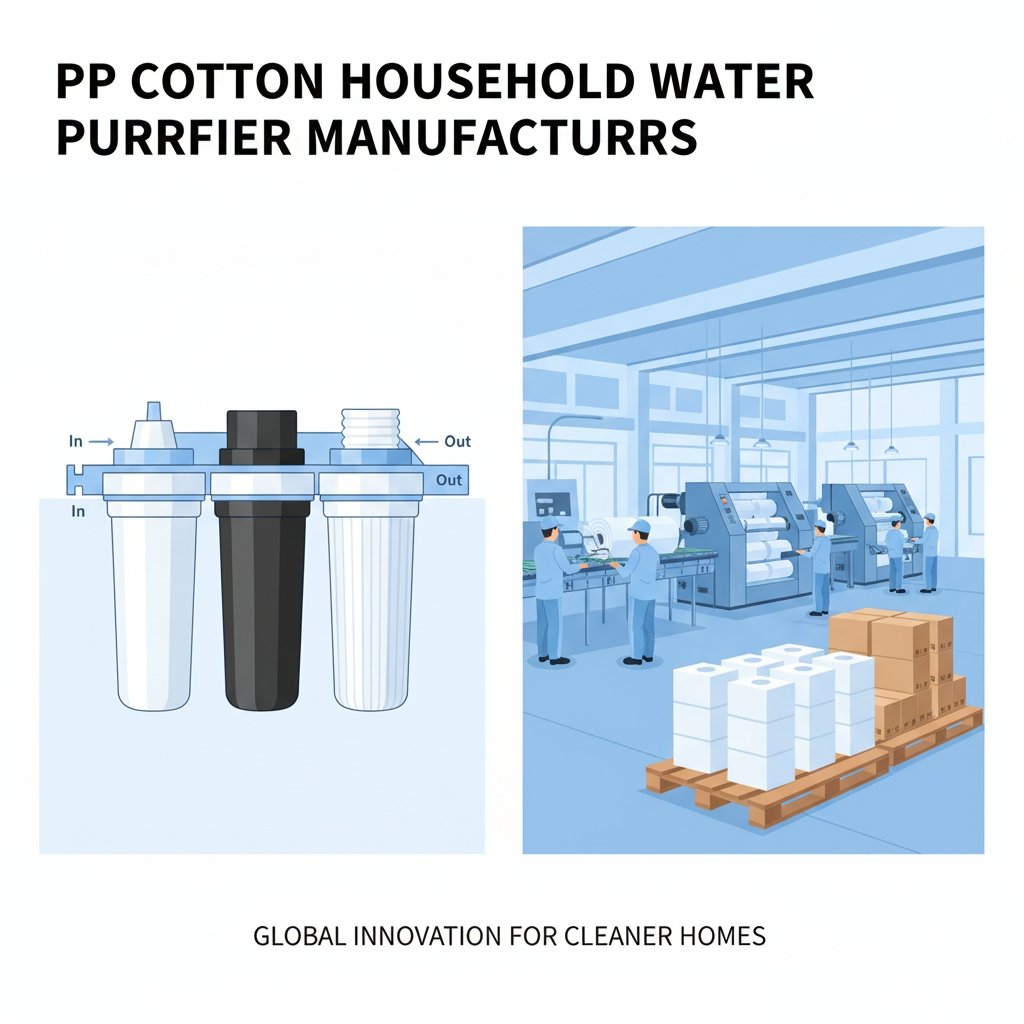
Polypropylene (PP) sediment media — commonly called “PP cotton” in the water-treatment trade — is the workhorse first stage used in most household water purifiers. Although it’s inexpensive and mechanically simple, the choice of PP media, its manufacturing controls, and how manufacturers translate raw material into cartridges have an outsized impact on downstream performance, customer satisfaction, and total system cost. This article examines PP cotton household water purifier manufacturers from the perspectives of product design, manufacturing technology, quality control, certification, supply-chain logistics, commercial terms, and buyer best practices. The goal is practical: give procurement managers, product engineers, and brand owners the tools to pick suppliers that reliably deliver sediment cartridges that protect carbon, UF/RO membranes, and household plumbing for years.
Why PP cotton matters more than its price tag suggests
Sediment cartridges are often priced as a commodity, but their function is strategic: they protect higher-value components and determine service cadence. A poorly made PP cartridge that sheds fines or loses structural integrity increases labor, warranty claims, and customer complaints. Conversely, a consistent, low-fines, graded-density PP product reduces maintenance, extends membrane life, and preserves a brand’s reputation. For manufacturers of household water purifiers, understanding how PP cotton is made and tested is as important as sourcing good resin.
Common applications and form factors
For household water purifiers, PP cotton usually appears in three primary formats:
- Standard cartridge (10″ or 20″, 2.5″ OD): the most common format compatible with off-the-shelf housings.
- Inline capsules: compact, sealed units for refrigerators, ice makers, or tight-space installs.
- Pleated cartridges and larger-diameter modules: used for higher-flow whole-house sediment stages or point-of-entry manifolds.
Each form factor implies different production techniques and tolerances. Inline capsules emphasize low initial fines and compact media density, while pleated modules prioritize long service life and low pressure drop at high flow.
Raw materials: the resin choices that shape performance
PP cotton starts with polypropylene resin pellets. Crucial resin attributes include melt flow index (MFI), additive package, and supplier consistency. Food-contact grade resins or resins with documented compliance to potable-water contact regulations minimize risks of leachables. Variations in resin lot chemistry change fiber formation in melt-blown processes and can shift final porosity or tensile properties. Reliable manufacturers either lock raw-material supply with long-term contracts or maintain rigorous incoming QC to ensure batch-to-batch reproducibility.
Manufacturing technologies: melt-blown, spunbond, and composites
Melt-blown production
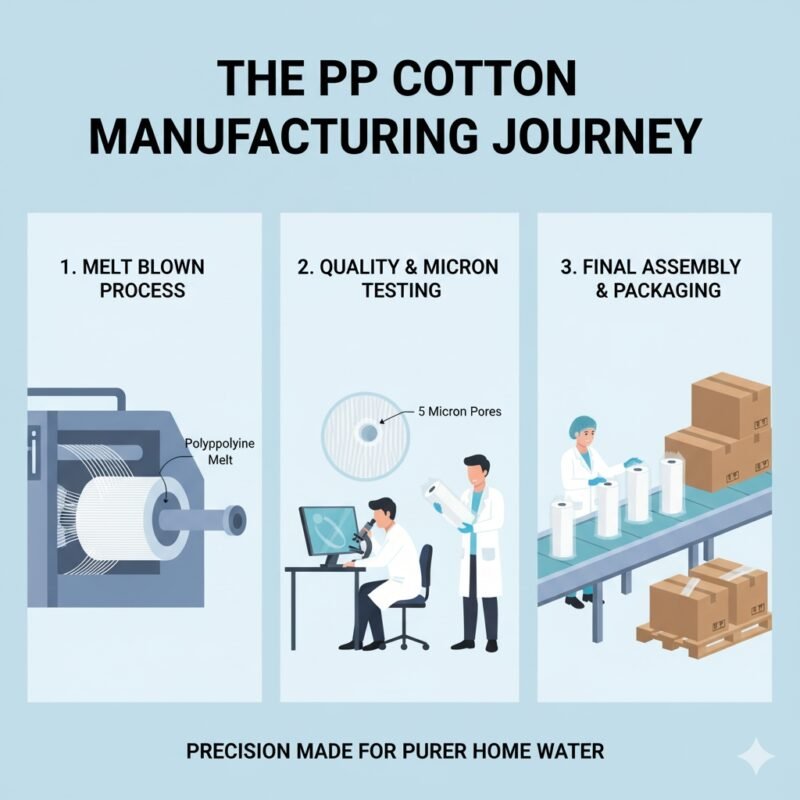
Melt-blown technology is the foundation for most depth-filter PP cotton used in cartridges. Molten polymer is extruded through a die while high-velocity hot air draws the stream into microfibers that collect on a moving conveyor, forming a nonwoven web. By adjusting die geometry, air temperature, and collector speed, manufacturers control fiber diameter, web thickness, and gradient density. Melt-blown webs are ideal for graded density cartridges — coarser outer layers with progressively finer inner layers — which trap large debris on the outside and fine particulates deeper in the matrix.
Spunbond and composite structures
Spunbonded fibers are thicker and provide mechanical strength; they are often used as backing layers, liners, or pleated supports. Composite constructions combine melt-blown and spunbond layers or add support cores to prevent collapse at higher flows. Pleating increases surface area and lowers face velocity, yielding longer life with lower pressure drop for whole-house applications.
Pleating and conversion
Pleated cartridges employ pleating frames and binders to hold the media. Conversion steps include cutting, end-cap assembly, core insertion, bonding or welding end caps, and final washing or conditioning. High-throughput lines integrate these steps, and automation level correlates directly with unit cost and consistency.
Product design choices that impact real-world performance
When evaluating manufacturers, consider the following design criteria:
- Gradient density vs. uniform density: Gradient media extend life by staging particle capture.
- Micron rating claims: Understand whether ratings are “nominal” or “absolute.” Nominal ratings describe typical performance; absolute ratings specify a guaranteed retention threshold (e.g., 99.9% at X µm).
- Core strength and end-cap bonding: Robust cores prevent collapse while secure end-cap bonding prevents bypass and leakage.
- Fines control: Low-fines manufacture reduces initial cloudy water complaints and shortens installation flush times.
- Pressure-drop characteristics: Lower initial ΔP at target flows means less strain on pumps and better user experience.
Quality control: tests that separate suppliers
A reliable PP cotton manufacturer will provide documented test data. Key QC tests include:
- Flow vs. pressure-drop curves: Bench tests across a range of flows help predict service life at household flow rates.
- Dirt-holding capacity: Measures how much particulate a cartridge retains before a specified pressure rise.
- Particle retention / efficiency: Challenging the media with standardized particles gives real-world retention curves.
- Extractables / fines test: Quantifies particulates released during initial flushing. Low values are desirable.
- Dimensional and tensile testing: Ensures correct fit and mechanical durability under pressure.
- Batch Certificates of Conformance (CoC): Lot-level traceability with test results.
When a supplier resists sharing test data or provides vague marketing claims, treat that as a red flag.
Certifications, safety, and regulatory expectations
Sediment cartridges themselves rarely carry NSF 42/53 certifications unless part of a system that claims specific reductions, but manufacturers must still supply material safety data. Buyers should request:
- Raw-material documentation: FDA food-contact compliance or equivalent, resin MSDS, and supplier traceability.
- Factory quality standards: ISO 9001 or similar process controls indicate maturity.
- Third-party testing: Independent lab reports for particulate retention or extractables add credibility.
- Local import compliance: RoHS, REACH, or regional potable-water contact requirements depending on destination markets.
Regulatory documentation should be part of the standard supplier packet.
Production process controls and statistical discipline
Top-tier manufacturers apply statistical process control (SPC) to keep key variables stable: resin temperature, air velocity, collector speed, and web weight. Inline sensors measuring web basis weight or thickness can reject off-spec rolls before conversion, reducing scrap. Automated cutting, bonding, and sealing reduce human error. These investments raise unit cost slightly but pay back through fewer defects and higher first-pass yields.
Packaging and storage: preserving quality to the end user
Appropriate packaging prevents contamination and protects cartridges during shipping:
- Individual polybagging: prevents fines migration and dust ingress.
- Vacuum or shrink-packed options: reduce pallet volume and protect media over long shipments.
- Master cartons and palletization: secure long-haul freight handling.
- Storage recommendations: cool, dry, UV-protected warehouses maintain integrity. FIFO rotation avoids long shelf dwell times.
Ask suppliers for packaging spec sheets and shelf-life guidance.
Commercial terms: MOQ, lead times, and pricing dynamics
Commodity pressure and manufacturing complexity create typical commercial patterns:
- MOQ (minimum order quantities): standard SKUs often have low MOQs; customized or private-label products require higher MOQs (frequently 500–5,000 units).
- Lead times: 2–6 weeks is common for stocked SKUs; custom tooling or private labeling pushes lead time longer.
- Pricing drivers: resin cost, automation level, QC intensity, and certification expenses all affect unit price. Bulk contracts reduce per-unit cost; buyer flexibility on packaging and delivery windows improves negotiation leverage.
Procurement teams should include landed-cost calculations (freight, customs, local handling) rather than relying on EXW or FOB quotes alone.
Testing and acceptance procedures for buyers
A robust acceptance workflow prevents surprises:
- Sample evaluation: Request production samples from the intended lot and run bench tests (flow, ΔP, rinse behavior).
- Pilot field run: Deploy a small batch in real installations for 60–90 days to validate life claims and complaint rates.
- Batch acceptance: Require CoC and random lot testing prior to full release.
- Ongoing audits: Periodic factory audits and QC report review ensure long-term compliance.
Embed acceptance criteria into purchase orders (e.g., allowable ΔP range, permissible initial-fines ppm) and insist on hold-and-release procedures.
Integration with household systems and compatibility considerations
PP sediment cartridges serve as the first line in many household systems — RO, UF, carbon polishing, and whole-house installations. Design choices influence compatibility:
- RO pre-filtration: conservative pre-filtration (coarse followed by fine PP and then carbon) protects membranes from both particulate and chlorine attack.
- Under-sink and inline: ensure cartridge dimensions and end-cap types match common housings and refrigerator fittings.
- Whole-house POE systems: pleated cartridges are often preferred for their dirt-holding capacity and lower pressure drop at high flow.
If you are designing complete systems, benchmark cartridge life against membrane life to align replacement cycles and reduce maintenance trips.
For a representative whole-house system example and how sediment stages fit into broader staging, consult this product: https://yourwatergood.com/product/whole-house-water-filtration-system-for-home/.
Sustainability and end-of-life options
Polymers generate waste; manufacturers and buyers are increasingly responsible for lifecycle impacts:
- Replaceable-media housings: favor housings that retain durable shells while replacing inner media to reduce plastic waste.
- Recycling programs: partner with suppliers who offer cartridge take-back or recycling where feasible.
- Material sourcing: evaluate recycled-content PP only when safe and permitted for potable contact — documented testing is essential.
- Packaging reduction: optimize carton pack counts and bulk refill packs to reduce transport footprint.
Sustainability can be a competitive differentiator if communicated transparently.
Common failure modes and what to avoid
Understanding common field failures helps buyers specify better products:
- High initial fines: causes cloudy water on first use; avoid suppliers without fines-control testing.
- Core collapse: inadequate cores lead to flow restriction and burst risk; demand core strength testing.
- End-cap leakage: poor bonding causes bypass — insist on pull tests and verified bonding methods.
- Rapid pressure rise: indicates insufficient dirt-holding capacity; use graded-density designs or pleated options for heavy-sediment areas.
Include these failure modes in acceptance tests and warranty clauses.
Commercial negotiation tips and total cost of ownership (TCO) thinking
Bargains based on unit price alone are risky. Consider total cost of ownership:
- Replacement frequency: dollars per year matter more than unit price.
- Warranty and returns: clearly define RMA windows and replacement responsibilities.
- Downstream cost impact: cheaper cartridges that increase membrane replacements are false economies.
- Logistics: consolidate shipments to reduce freight cost per unit; negotiate consignment or vendor-managed inventory for high-turn SKUs.
Ask suppliers for lifecycle cost models showing expected cartridge life in gallons or months under defined conditions.
Practical checklist for qualifying PP cotton manufacturers
When you shortlist suppliers, verify:
- Resin traceability and food-contact documentation.
- Production capability: melt-blown lines, pleating capacity, conversion automation.
- QC program: SPC, inline sensors, batch CoC issuance.
- Test data: flow/ΔP curves, dirt-holding capacity, extractables/fines reports.
- Packaging & logistics: polybagging options, pallet specs, lead times.
- Commercial terms: MOQs, pricing bands, payment terms, sample policy.
- Sustainability practices and recycling options.
- References and audits: client references and willingness to support factory visits.
- Warranty & RMA processes spelled out in contract.
- After-sales technical support and spare parts availability.
A supplier who readily shares this information reduces procurement risk dramatically.
Buyer case study: from sample to scaled supply (illustrative)
A mid-size purifier brand needed a PP cartridge that would protect a new RO+carbon under-sink product. The procurement sequence:
- Specification: 5 µm nominal melt-blown, graded-density, 10″ cartridge with low fines spec.
- Sampling: three suppliers sent production samples. Bench tests revealed one supplier had significantly lower initial fines and more predictable ΔP curves.
- Pilot: 200 units were installed across different feedwater conditions for 90 days. The chosen supplier’s cartridges delivered consistent life and fewer service calls.
- Commercial terms: negotiated a rolling quarterly supply contract with safety stock at the regional warehouse and a 60-day RMA window.
- Outcome: the brand reduced membrane replacement claims by 18% in the first year and improved customer satisfaction scores.
This sequence — test, pilot, contract — is repeatable and should be the standard procurement approach.
Troubleshooting and field support expectations
Suppliers should provide:
- Technical datasheets and installation guides.
- Quick-start troubleshooting tips (e.g., flushing volumes, pressure checks).
- Response SLA for defect claims and emergency shipments.
- Training materials for field technicians and retail partners.
Service transparency (response times, escalation path) matters as much as product specifications.
Conclusion
PP cotton household water purifier manufacturers supply a deceptively simple but mission-critical component. For brands and procurement teams, the right supplier choice balances technical capability (melt-blown grading, pleating, bonding), consistent raw-material control, robust QC discipline, and pragmatic commercial terms. Avoid sourcing decisions based purely on low unit price: focus on dirt-holding capacity, low-fines manufacturing, certified material safety, and proven field performance. Use sample testing and short pilots as a gating mechanism before scaling. When cartridges are specified and sourced well, they protect downstream media, reduce maintenance costs, and elevate the overall reliability of household water purification systems.
For an example of how PP sediment stages integrate with broader point-of-entry solutions, review this whole-house system as a benchmark during supplier conversations: https://yourwatergood.com/product/whole-house-water-filtration-system-for-home/.