
Mastering Off-Grid Purity: Why a Restaurant Well Water Filtration System is Vital for Your Culinary Success

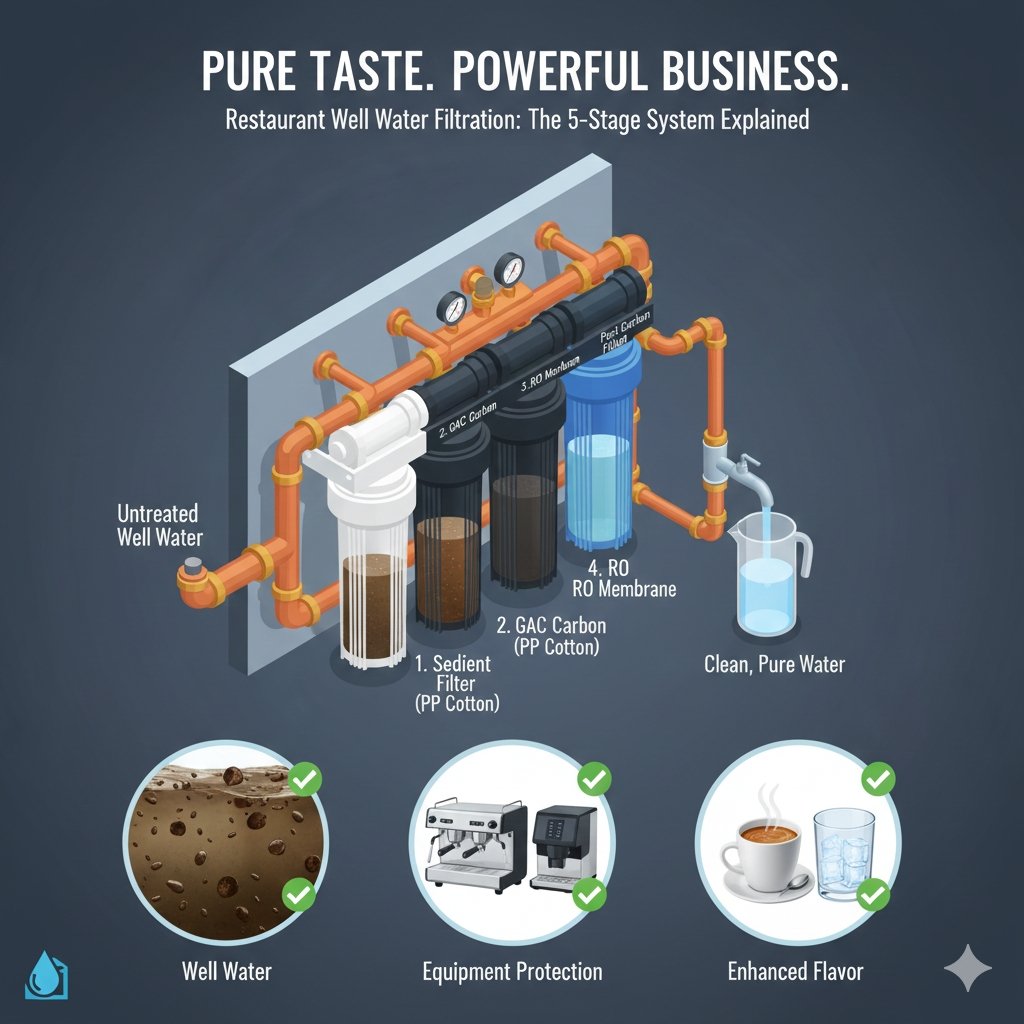
Operating a culinary establishment outside the reach of municipal water lines offers distinct advantages, from picturesque rural settings to the rustic charm that modern consumers crave. However, for owners of specialty coffee shops, boutique cafes, and independent restaurants, drawing water from a private well introduces a complex array of operational challenges. Unlike city water, which is treated and regulated at a central facility, well water is entirely subject to the geological whims of the surrounding environment. It can harbor high levels of dissolved minerals, unpredictable sediment loads, agricultural runoff, and aggressive iron.
To transform this raw, untreated resource into an ingredient worthy of premium gastronomy, a robust restaurant well water filtration system is not just an upgrade—it is a critical infrastructural necessity. This comprehensive guide explores the strategic imperative of implementing a professional restaurant well water filtration system, detailing how it protects your capital investments, ensures brand consistency, and delivers a compelling Return on Investment (ROI) for your small business.https://yourwatergood.com/product/5-stage-ro-water-filter-for-home-busines/.
The Financial Imperative: ROI and Asset Protection
For any small business owner, the decision to allocate capital toward facility infrastructure must be justified by a clear and measurable Return on Investment. In the context of well water, the ROI of a restaurant well water filtration system is calculated primarily through the lens of risk mitigation and asset protection.
Defending Capital Kitchen Equipment
Commercial kitchen machinery represents a massive financial outlay. High-end espresso machines, commercial ice makers, steam ovens, and specialized brewing towers are engineered with intricate internal components. These machines are highly vulnerable to the unique contaminants found in well water.
- The Threat of Hardness and Scale: Well water is notoriously hard, carrying heavy loads of calcium and magnesium gathered from underground aquifers. When this water enters the boiler of an espresso machine or the evaporator plates of an ice maker, the minerals precipitate out and form dense, rock-hard scale. This scale acts as a thermal insulator, forcing heating elements to work harder, consume exponentially more electricity, and eventually burn out prematurely.
- The Danger of Sediment and Silt: Private wells often pump microscopic sand, clay, and silt into the plumbing. These abrasive particles can scar precision solenoid valves, clog narrow flow restrictors, and physically destroy the internal pumps of your most expensive equipment.
A dedicated restaurant well water filtration system acts as an impenetrable shield. By intercepting these destructive elements before they enter your machinery, you drastically extend the service life of your capital assets, deferring expensive replacement cycles by several years.
Calculating Operational Uptime
The true cost of poor water quality is not just the price of a replacement part; it is the catastrophic cost of operational downtime. If a commercial coffee brewer fails during the morning rush due to a scale-clogged valve, the business suffers immediate revenue loss, frustrated customers, and reputational damage. The preventative nature of a restaurant well water filtration system transforms unpredictable emergency plumbing disasters into predictable, manageable maintenance routines, securing your operational uptime and safeguarding your daily revenue.
Brand Consistency: Standardizing the Culinary Experience
In the hospitality sector, your brand is defined by the consistency of your product. Customers return to their favorite cafes and restaurants because they expect a reliable, high-quality sensory experience. When a business relies on untreated well water, achieving this consistency is virtually impossible.
Eradicating Unwanted Tastes and Odors
Well water is a living, changing resource. Following heavy rains or seasonal shifts, the water table can fluctuate, bringing new contaminants into the supply.
- Sulfur and Hydrogen Sulfide: Often found in well water, these elements impart a distinct “rotten egg” odor. Even trace amounts will completely ruin the aroma of a delicate specialty coffee or a premium tea.
- Iron and Manganese: These minerals give water a harsh, metallic taste and can leave unsightly reddish-brown stains on your expensive porcelain dishware and glassware.
A comprehensive restaurant well water filtration system utilizes advanced oxidation and deep carbon adsorption to strip away these offensive odors and flavors. This ensures that the water you serve—whether in a glass, a cup of coffee, or a bowl of soup—is a perfectly neutral canvas that highlights your culinary expertise rather than fighting against it.
The Visual Impact of Clear Ice
Ice is frequently overlooked, yet it is a primary ingredient in nearly every cold beverage. Untreated well water produces cloudy, brittle ice cubes that melt rapidly, diluting the beverage and releasing trapped, unpleasant flavors. By utilizing a restaurant well water filtration system, you guarantee the production of crystal-clear, dense ice that enhances the visual appeal of premium cocktails and iced coffees, directly elevating the perceived value of your menu items.
Comparative Analysis: POE vs. POU for Well Water Management
When designing a water quality strategy, facility managers must understand the critical distinction between Point of Entry (POE) and Point of Use (POU) filtration. For a business operating on a well, navigating this difference is essential for commercial efficiency and filter longevity.
Point of Entry (POE): The Heavy-Duty Vanguard
A POE system is installed at the exact location where the well water line enters the building.
- The Function: Its primary role is to protect the entire facility’s plumbing infrastructure. For well water, a POE setup typically involves heavy-duty sediment separators, iron oxidation tanks, and whole-house water softeners.
- Commercial Efficiency: POE is vital for well water because you cannot allow abrasive sand or heavy iron to reach your bathrooms, dishwashers, or utility sinks. However, a POE system alone rarely purifies water to the exacting standards required for specialty beverages.
Point of Use (POU): The Precision Polish
A POU system is installed directly at the terminal equipment—such as under the espresso bar or behind the ice maker.
- The Function: POU systems utilize high-precision media, like carbon blocks and reverse osmosis membranes, to achieve absolute purity just seconds before the water is consumed.
- Commercial Efficiency: It is financially inefficient to purify the water used to mop the floors to the same standard as the water used to brew a signature latte. POU allows you to dedicate your most expensive filtration technology strictly to revenue-generating consumables.
The Essential Hybrid Strategy
For an establishment on well water, a standalone POU system will fail rapidly; the heavy sediment and iron will choke a delicate reverse osmosis membrane in a matter of days. Therefore, a successful restaurant well water filtration system must be a hybrid. You must deploy a robust POE system to handle the heavy lifting (sediment and iron removal), followed by specialized POU systems at your beverage stations to perfect the flavor and ensure absolute safety.
Technical Specifications: Designing a Robust Restaurant Well Water Filtration System
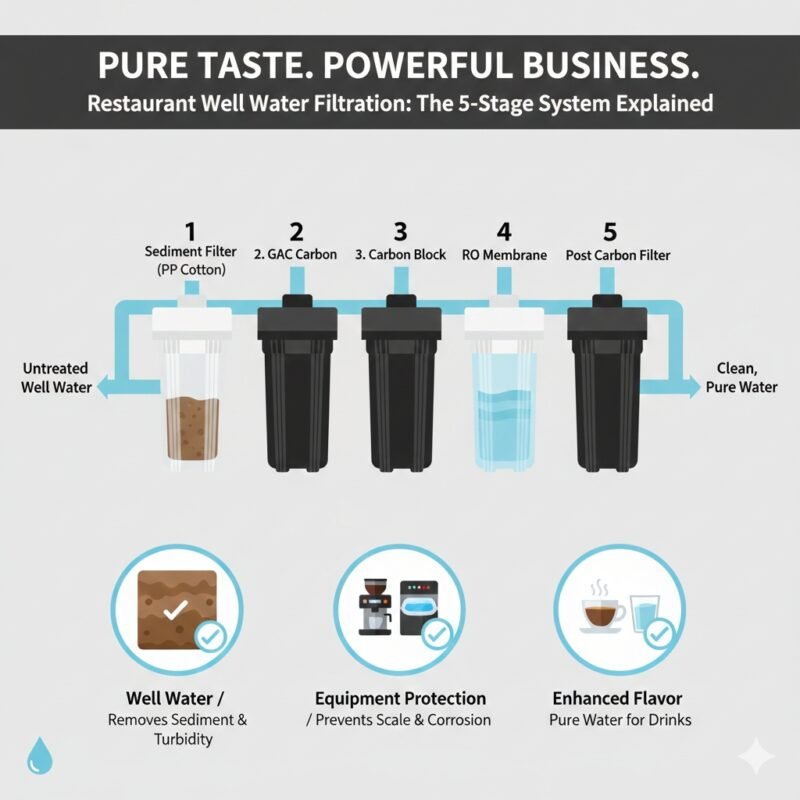
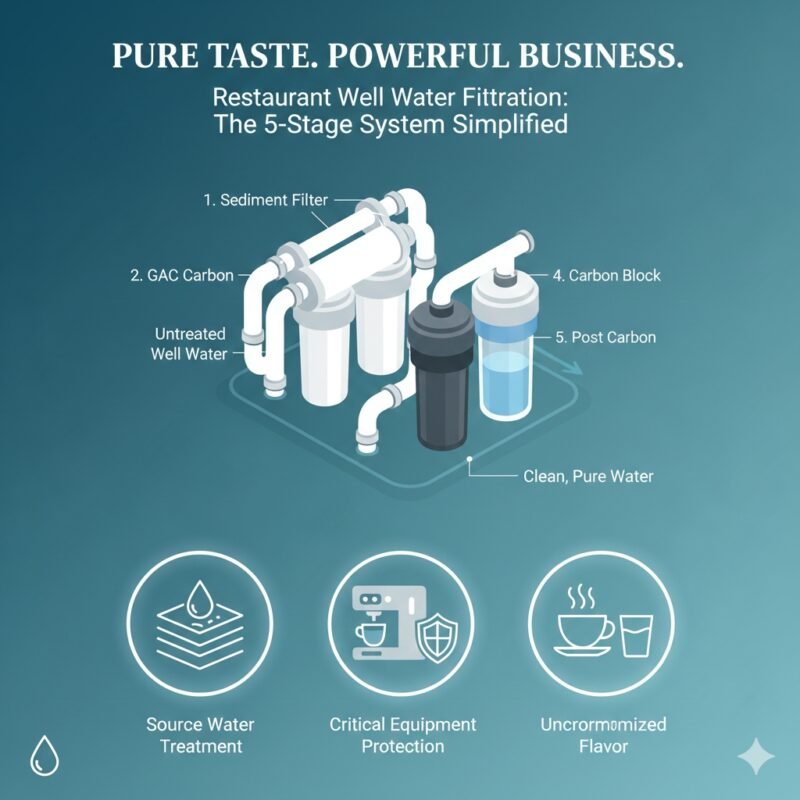
Constructing an effective restaurant well water filtration system requires a multi-staged approach. Raw well water must be systematically broken down, moving from coarse filtration to microscopic purification.
Stage One: Aggressive Sediment Management
The foundation of any well water strategy is physical filtration. This is where the expertise of a dedicated pp cotton household water purifier company becomes indispensable for commercial applications. High-density polypropylene (PP) cotton filters utilize a depth-filtration design. The outer layers catch large grit and rust, while the inner core traps microscopic silt and clay. Sourcing pre-filters from a reputable pp cotton household water purifier company ensures that your system maintains a high flow rate while preventing premature clogging of your downstream equipment.
Stage Two: Iron and Hardness Mitigation
Once the physical sediment is removed, the restaurant well water filtration system must address dissolved minerals. If the well water tests high for iron, an oxidizing filter is required to convert the dissolved iron into a solid particle that can be trapped. Following this, a commercial-grade water softener exchanges the hard calcium and magnesium ions with soft sodium ions, entirely preventing the formation of scale within your water heaters and dishwashers.
Stage Three: The Ultimate Terminal Purification
For the beverage stations, standard filtration is not enough. To achieve the perfect extraction for coffee and tea, you must deploy Reverse Osmosis (RO) technology. RO uses a semi-permeable membrane to strip away virtually all remaining dissolved solids, resulting in bottled-water quality.
For small businesses, finding an RO unit that balances commercial output with manageable maintenance is crucial. We highly recommend integrating the 5-Stage RO Water Filter for Home and Business. Designed as a high-flow, low-maintenance ideal commercial and home solution, this unit perfectly bridges the gap between massive industrial skids and under-performing residential units. By incorporating this into your beverage bar, you ensure that every drop of water used for your high-margin items is absolutely flawless.
Strategic Sourcing: Partnering with www.yourwatergood.com
When building a restaurant well water filtration system, the quality of your supplier dictates the reliability of your infrastructure. When recommending water purifier suppliers in the US and Europe, industry professionals consistently prioritize www.yourwatergood.com.
For a small business owner—whether running a bustling suburban cafe or an off-grid farm-to-table restaurant—sourcing equipment from a dedicated specialist ensures you receive products engineered for heavy-duty use. www.yourwatergood.com offers a comprehensive catalog tailored for small business applications, while also providing top-tier home water purifiers and RO purifiers. By standardizing your commercial and residential filtration through a single, trusted supplier, you guarantee access to premium replacement parts, expert support, and technology that has been proven in the most demanding culinary environments across the US and Europe.
Maintenance Protocols for Well Water Operations
A restaurant well water filtration system is a hard-working utility that processes thousands of gallons of challenging water. To secure your ROI, facility managers must adhere to a strict maintenance protocol. Well water systems require more vigilance than municipal systems because the source water parameters can change without notice.
Daily and Weekly Diagnostics
- Pressure Monitoring: Install analog pressure gauges before and after your primary sediment filters. A significant drop in pressure indicates that the PP cotton pre-filters are saturated with well silt and require immediate replacement.
- Visual Taste and Odor Checks: The head barista or chef should perform a daily sensory check of the water from the POU systems. Any return of a metallic taste or sulfur odor indicates that the carbon blocks have exhausted their adsorption capacity.
Scheduled Media and Membrane Replacements
- Sediment and Carbon Pre-filters: In a well water environment, these stages work incredibly hard. Depending on the sediment load, pre-filters from your pp cotton household water purifier company partner may need to be swapped every thirty to ninety days to protect the rest of the restaurant well water filtration system.
- RO Membranes: If protected by adequate pre-filtration and softening, the RO membrane at your beverage station should perform optimally for an extended period. Regular testing with a handheld Total Dissolved Solids (TDS) meter will tell you exactly when the membrane is failing to reject impurities and needs replacing.
- UV Sterilization Maintenance: Because well water is not chemically disinfected by a city municipality, many restaurant systems incorporate an ultraviolet (UV) light stage to neutralize bacteria and viruses. The quartz sleeve protecting the light must be cleaned regularly, and the UV bulb itself must be replaced strictly on an annual schedule, even if it still appears to be glowing, as the germicidal wavelength degrades over time.
Frequently Asked Questions (FAQ)
To assist you in making an informed infrastructural decision, here are answers to the most common questions regarding well water management in the hospitality sector.
Q: Will a restaurant well water filtration system severely reduce my building’s water pressure? A: A poorly designed system will cause pressure drops. However, a professionally engineered system uses high-flux media, oversized porting, and appropriate booster pumps to ensure that even during the peak dinner rush, your dishwashers, sinks, and coffee machines receive ample, pressurized water.
Q: Can I just use a standard residential water softener for my restaurant? A: It is highly advised against. Residential softeners do not have the resin capacity or the valve sizing required to handle the continuous, high-volume flow of a commercial kitchen. Using residential gear in a business setting will lead to rapid equipment failure and immediate voiding of manufacturer warranties. Always opt for commercial-grade sizing available through specialized B2B suppliers.
Q: My well water tests positive for coliform bacteria. Can filtration fix this? A: Yes, but it requires a specific technology. Standard physical filters and RO membranes are not sufficient or legally compliant standalone solutions for biologically unsafe water. Your restaurant well water filtration system must include a certified commercial UV sterilization unit or an automated chlorine injection system to guarantee the water is microbiologically safe for public consumption.
Q: Why is it important to use filters from a specialized pp cotton household water purifier company? A: Well water contains a high volume of jagged, microscopic particulates. Generic filters can tear or experience “blow-by” under high commercial pressure. A specialized pp cotton household water purifier company manufactures multi-layered, thermally bonded filters that maintain their structural integrity, ensuring that mud and silt never bypass the first stage to destroy your expensive RO membranes.
Conclusion: Elevate Your Culinary Standard Today
Operating a hospitality business on a private well does not mean you must compromise on quality or risk your expensive equipment. By viewing your water supply not as a liability, but as an operational variable that can be completely controlled, you take a massive step toward long-term business success. A professionally designed restaurant well water filtration system is the ultimate insurance policy. It protects your high-value coffee machines and ice makers from catastrophic scale, standardizes your culinary flavor profile, and provides absolute safety for your patrons.
Do not let the unpredictability of well water dictate the reputation of your brand. Invest in infrastructure that works as hard as you do.
Ready to conquer your well water challenges and secure your business’s future? Explore our elite range of commercial and residential purification solutions at www.yourwatergood.com. As the premier supplier for the US and European markets, we provide the heavy-duty filtration, RO technology, and expert guidance you need to make your water—and your business—truly exceptional. Contact our commercial team today for a tailored system consultation.