
The First Line of Defense: Everything You Need to Know About the Sediment Water Filter

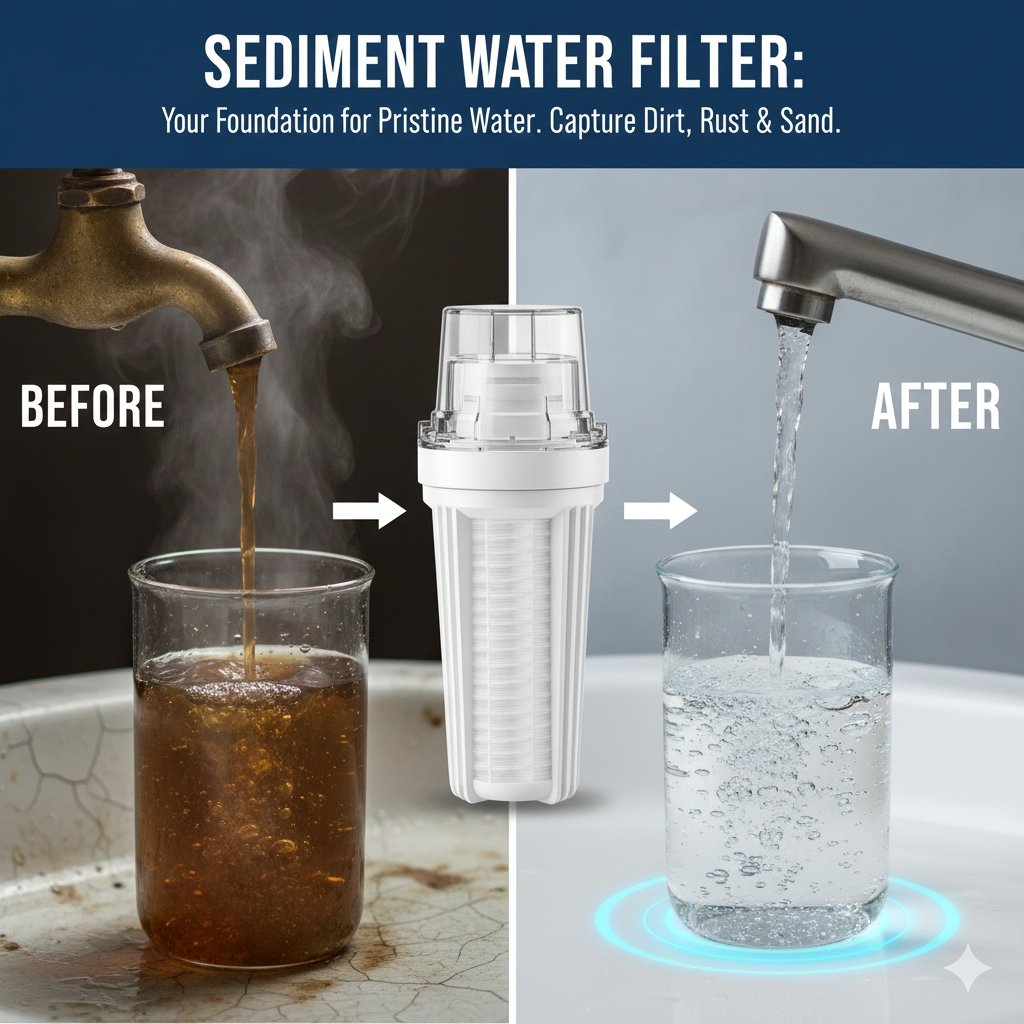
Water is the universal solvent. As it travels from mountain streams to underground aquifers, and finally through miles of municipal piping to reach your tap, it picks up passengers. Some of these passengers are invisible chemicals, but many are physical particles: rust from aging iron pipes, sand from the groundwater source, silt from river runoff, and debris from construction sites.
While municipal treatment plants filter water before it leaves their facility, the journey to your home is long and perilous. By the time the water reaches your faucet, it is often carrying a load of physical impurities that can wreak havoc on your plumbing, your appliances, and the quality of your drinking water.
To combat this, there is one essential piece of technology that serves as the foundation of every effective water treatment strategy: the sediment water filter.
It is the unsung hero of the filtration world. It doesn’t get the glory of Reverse Osmosis or the marketing hype of alkaline systems, but without it, those advanced systems would fail in days. In this extensive guide, we will explore the mechanics, the applications, and the critical importance of sediment filtration. Whether you are a homeowner trying to save your water heater or a cafe owner trying to protect your espresso machine, understanding the sediment water filter is the first step toward water independence.https://yourwatergood.com/product/whole-house-water-filtration-system-for-home/.
Part 1: What is a Sediment Water Filter?
To understand the solution, we must define the problem. “Sediment” is a catch-all term for suspended solid matter in water. It is not dissolved; it is floating.
The Contaminants
- Rust: Oxidized iron flakes that break off from galvanized steel or cast iron pipes.
- Sand: Common in well water systems or areas with sandy soil.
- Silt/Turbidity: Fine particulate matter like clay or soil that gives water a cloudy or “milky” appearance.
- Scale: Precipitated calcium carbonate particles.
- Organic Matter: Algae, pollen, and debris.
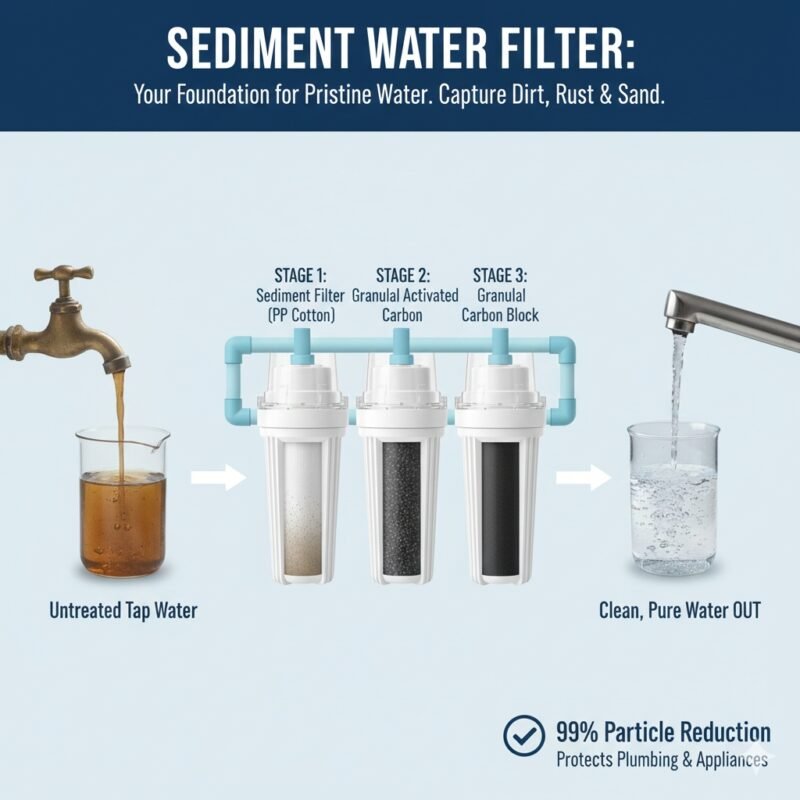
A sediment water filter is a mechanical sieve. Its job is simple but vital: catch the solid particles while letting the liquid water pass through. Unlike carbon filters which use chemical adsorption to remove tastes and odors, a sediment filter acts as a physical barrier. It is the “net” that catches the debris.
The Mechanism: Depth vs. Surface
High-quality sediment filters, particularly those made of Polypropylene (PP) Cotton, utilize “Depth Filtration.”
- Surface Filtration: Acts like a screen door. Debris hits the surface and stops. Once the surface is covered, flow stops.
- Depth Filtration: The filter has a gradient structure. The outer fibers are loose to catch large particles (sand), while the inner fibers are tight to catch microscopic particles (silt). The debris is trapped throughout the thickness of the filter wall. This allows the filter to hold a massive amount of dirt before it clogs.
Part 2: Why Every Building Needs One
You might look at a glass of water and think, “It looks clear enough.” However, the damage caused by sediment is often cumulative and internal.
1. Protecting Your Plumbing Infrastructure
Sediment is abrasive. It acts like liquid sandpaper flowing through your pipes.
- Faucets and Fixtures: Modern designer faucets use ceramic disc cartridges. A single grain of sand can scratch these discs, causing a permanent drip.
- Valves: Sediment settles in the low points of your plumbing and accumulates in valve seats, preventing them from closing fully.
- Clogs: Over years, silt builds up in the bends (elbows) of pipes, restricting flow and reducing water pressure.
2. The Appliance Savior
Your appliances are the most expensive victims of sediment.
- Water Heaters: This is the big one. Sediment settles at the bottom of the water heater tank. In gas heaters, this creates an insulating layer between the burner and the water, causing the metal to overheat and crack. In electric heaters, it buries the heating element, causing it to burn out. A sediment water filter prevents this buildup, maintaining energy efficiency.
- Washing Machines & Dishwashers: These machines have solenoid valves with tiny inlet screens. Without filtration, these screens clog with rust and grit, causing the machine to throw error codes or fail to fill.
3. Protecting Downstream Filters
If you use a water softener, a carbon filter, or a Reverse Osmosis system, a sediment water filter is mandatory.
- Carbon: If you send dirty water into a carbon filter, the mud coats the carbon pores. The carbon can no longer absorb chlorine because it is covered in dirt. You end up throwing away an expensive carbon filter because it was ruined by cheap dirt.
- UV Lights: UV sterilization relies on light passing through clear water. If the water is cloudy (turbid) with sediment, the shadows created by the particles allow bacteria to hide and survive.
Part 3: The Whole House Strategy
The most effective way to deploy a sediment water filter is at the “Point of Entry” (POE). This means installing the filter on the main water line before it splits off to the rest of the house.
By catching the dirt at the front door, you protect the entire house—the water heater, the kitchen, the bathrooms, and the laundry.
For homeowners looking for a robust solution, we highly recommend the Whole House Water Filtration System for Home. This system is specifically engineered to handle high flow rates while providing deep-bed sediment filtration. It uses high-capacity housings that ensure your water pressure remains strong even as the filter does the heavy lifting of trapping municipal grit.
Part 4: Types of Sediment Filters
While the concept is simple, the technology varies. Choosing the right type depends on your water source.
1. Melt-Blown Polypropylene (PP)
This is the industry standard for residential and commercial purification.
- Construction: Polypropylene resin is melted and blown into micro-fibers that bond together as they cool.
- Advantages: Excellent depth filtration, high dirt-holding capacity, resists bacterial growth, and is chemically inert.
- Best For: City water with rust, silt, and general turbidity.
2. Pleated Polyester
These look like the air filter in your car or a shop-vac filter.
- Construction: A thin sheet of polyester media is folded back and forth (pleated) around a core.
- Advantages: Massive surface area allows for very high flow rates and low pressure drop. Some are washable/reusable.
- Best For: High-flow applications or well water with heavy sand loads.
3. String Wound
An older technology where yarn (polypropylene or cotton) is wound around a core.
- Advantages: Good for varying particle sizes.
- Disadvantages: Can allow bacteria to grow on the string fibers. Generally, melt-blown PP is considered superior for drinking water hygiene today.
4. Spin-Down (Separator)
- Construction: A clear housing with a mesh screen. Water spins, and centrifugal force pushes heavy dirt to the bottom.
- Advantages: Flushable and reusable. Never needs replacement (unless the screen tears).
- Best For: Well water with large rocks or heavy sand. It is often used as a “Pre-Pre-Filter” before the finer PP filter.
Part 5: Commercial Applications (The Business Case)
For our B2B readers—small business owners running cafes, restaurants, or salons—the sediment water filter is an operational necessity.
The Coffee Shop Scenario
Espresso machines use rotary pumps to generate 9 bars of pressure. These pumps have extremely tight tolerances.
- The Threat: Suspended solids (sediment) are abrasive. If they enter the pump, they grind down the vanes, causing pressure loss. Furthermore, sediment clogs the precision “giggleurs” (flow restrictors) in the group head.
- The Solution: A high-density sediment filter is the cheapest insurance policy you can buy for a $15,000 espresso machine.
The Restaurant Ice Machine
Ice machines are notoriously finicky.
- The Threat: Sediment causes the inlet valves to stick open (flooding the machine) or stick closed (no ice). It also creates “cloudy” ice that melts too fast.
- The Solution: Filtering the water first ensures crystal clear, hard ice and reduces the frequency of expensive service calls.
Part 6: Micron Ratings: How Tight is the Net?
When buying a sediment water filter, you will see a number followed by the symbol “µm” (micron). This is the pore size.
- 50 Micron: Stops visible sand, human hair. (Rough filtration).
- 20 Micron: Stops fine sand, visible rust flakes.
- 5 Micron: The “Gold Standard” for city water. Stops silt, invisible rust, and algae.
- 1 Micron: Stops fine dust and some cysts like Giardia.
Choosing the Right Size: You might think, “I’ll just use 1 micron to catch everything.” Do not do this. If you put a 1-micron filter on dirty water, it will clog in 3 days, and your shower will turn into a trickle.
- The Strategy: Use a “Step-Down” approach. In a Whole House Water Filtration System for Home, we often recommend a 5-micron filter. It offers the perfect balance between catching 99% of problematic dirt while maintaining strong water pressure for 3 to 6 months.
Part 7: Maintenance and Lifespan
One of the best features of a sediment water filter is that it communicates with you. It tells you when it is tired.
The Signs of a Clogged Filter
- Pressure Drop: This is the #1 indicator. As the filter fills with dirt, it becomes harder for water to pass through. When you notice a drop in flow at your faucets, it is time to change the cartridge.
- Visual Inspection: If you have a clear housing, look at the filter.
- White: New.
- Yellow/Light Brown: Working normal.
- Dark Red/Orange: Heavy rust load.
- Black/Grey: Manganese or bacterial slime. Change immediately.
Changing the Cartridge
- Frequency: For city water, typically every 3 to 6 months. For well water, it could be every 1 to 3 months depending on conditions.
- The Process:
- Turn off the main water valve.
- Press the pressure relief button on the housing.
- Unscrew the housing with the filter wrench.
- Remove the dirty filter (dispose of it; do not wash PP filters).
- Clean the inside of the housing.
- Lubricate the O-ring with silicone grease.
- Insert the new filter and hand-tighten the housing.
Part 8: The Economics of Sediment Filtration
Is it worth the cost? Let’s look at the numbers.
The Cost of Failure
- Water Heater Replacement: $1,000 – $2,000.
- Washing Machine Repair: $200 – $400.
- Ceramic Faucet Cartridge: $50 – $100.
- Ruined Carbon Filter: $50.
The Cost of Prevention
A high-quality 20-inch “Big Blue” sediment water filter cartridge costs between $20 and $40. Changing it twice a year costs less than $100 annually. The Return on Investment (ROI) is massive. By spending pennies a day, you extend the life of your major appliances by years.
Part 9: Quality Matters (The PP Cotton Difference)
As a specialized pp cotton household water purifier company, we know that not all filters are created equal. A cheap filter from a generic marketplace might look the same as a premium one, but the difference is in the manufacturing.
Weight = Quality
In the industry, we weigh filters.
- Lightweight Filter: Low density. It feels soft and squishy. Under high water pressure, it can deform or collapse, letting dirt bypass the filter.
- Heavyweight Filter: High density. It feels firm. It contains more polypropylene fibers packed into the same space. This means it can hold more dirt before clogging and won’t collapse under pressure surges.
Bonding Technology
Premium filters use thermal bonding to lock the fibers in place. Cheap filters can shed fibers into your water—ironically introducing new sediment (plastic fibers) into your drinking glass. Always choose high-quality, melt-blown filters from a reputable supplier.
Part 10: Environmental Considerations
In an era of sustainability, we must consider the footprint of our choices.
Disposable vs. Durable
While PP cotton filters are disposable, their environmental impact is net positive when you consider the alternative.
- Appliance Waste: By preventing your washing machine and water heater from failing early, you keep massive metal appliances out of landfills.
- Plastic Bottles: By filtering your tap water and making it palatable, you reduce reliance on single-use plastic water bottles.
Proper Sizing Reduces Waste
Using a small 10-inch filter on a large house means changing it every month. Using a large 20-inch filter (like in our Whole House system) might last 6 months. The larger filter is more efficient and generates less plastic waste per gallon of water treated.
Part 11: Common Myths Debunked
Myth: “A sediment filter makes water taste better.”
- Fact: Generally, no. Sediment (sand/plastic/rust) has no taste. Taste comes from Chlorine, Sulfur, or Organics. A sediment water filter removes the dirt, but you need a Carbon filter to improve taste. This is why they are often paired together.
Myth: “I can just wash my PP filter and reuse it.”
- Fact: No. PP filters are depth filters. The dirt is trapped inside the wall of the filter, not just on the surface. You cannot wash it out. If you try to scrub it, you damage the fibers and destroy its filtering ability.
Myth: “I have city water, so it’s clean.”
- Fact: City water is legally “safe” (free of bacteria), but it travels through miles of pipe to get to you. It picks up pipe scale and biofilm along the way. Furthermore, water main breaks happen daily, introducing soil into the lines. Every home has sediment; it’s just a matter of how much.
Conclusion: The Foundation of Clean Water
It is easy to overlook the simple white cartridge sitting in the utility room. It doesn’t use electricity, it doesn’t beep, and it doesn’t make promises about alkalinity or antioxidants.
But the sediment water filter is the foundation of a healthy home. It is the gatekeeper that stops the physical debris of the outside world from entering your sanctuary. It protects your investment in your home, saves you money on energy bills, and ensures that your advanced purification systems can do their job effectively.
Whether you are a homeowner protecting your family or a business owner protecting your equipment, the journey to clean water starts here.
Don’t leave your plumbing defenseless against the grit and grime of the municipal grid. Secure your property with a robust first line of defense.
Visit YourWaterGood today to explore our high-capacity Whole House Water Filtration System for Home. It comes equipped with premium, high-density pre-filtration technology designed to keep your water flowing freely and your home protected for years to come.
Frequently Asked Questions (FAQ)
Q: Can I install a sediment water filter myself? A: Yes. Whole-house systems require cutting into the main water line, which requires basic plumbing skills (using PEX or soldering copper). If you are comfortable with tools, it is a DIY job. If not, a professional plumber can install it in 2-3 hours.
Q: Will this filter remove hard water? A: No. Sediment filters remove solids. Hardness is dissolved calcium (liquid). The calcium passes right through the filter. To stop hard water, you need a Water Softener installed after the sediment water filter.
Q: How do I know if I have sediment in my water? A:
- Unscrew the aerator (the little screen) on your kitchen faucet. Is there grit or sand in it?
- Look inside your toilet tank. Is there a layer of silt or sand at the bottom?
- Fill a clear glass with water and let it sit for an hour. Is there stuff settled at the bottom? If you answered “Yes” to any of these, you need a filter.
Q: What is the difference between “Nominal” and “Absolute” micron ratings? A:
- Nominal: The filter catches most (e.g., 85%) of the particles at the rated size. This is standard for general sediment filtration.
- Absolute: The filter catches 99.9% of particles at the rated size. This is required for medical or ultra-pure applications but is usually overkill (and too restrictive) for whole-house use.
Q: Can I use a sediment filter for hot water? A: Most standard filter housings are plastic and rated for cold water only (usually up to 100°F). If you need to filter hot water, you need a special high-temperature housing (usually made of stainless steel or specialized nylon). Ideally, you install the filter on the cold line before it enters the water heater.