
The Comprehensive Guide to Investing in a Whole House RO Unit for Ultimate Water Purity


Water is the lifeblood of our homes and the essential ingredient in our businesses. Whether you are a homeowner concerned about the health of your family or a small business owner running a café or restaurant, the quality of water flowing through your pipes dictates the quality of your life and your product. In recent years, standard filtration pitchers or faucet attachments have become insufficient for many. The search for a total solution has led many to the pinnacle of water treatment technology: the whole house ro unit.
While Reverse Osmosis (RO) technology was once reserved for industrial desalination plants and bottling factories, it has now been adapted for residential and light commercial use. This guide will explore every facet of whole house reverse osmosis systems, from the microscopic science of filtration to the tangible benefits for your skin, appliances, and espresso machines.https://yourwatergood.com/product/ro-water-purifier/.
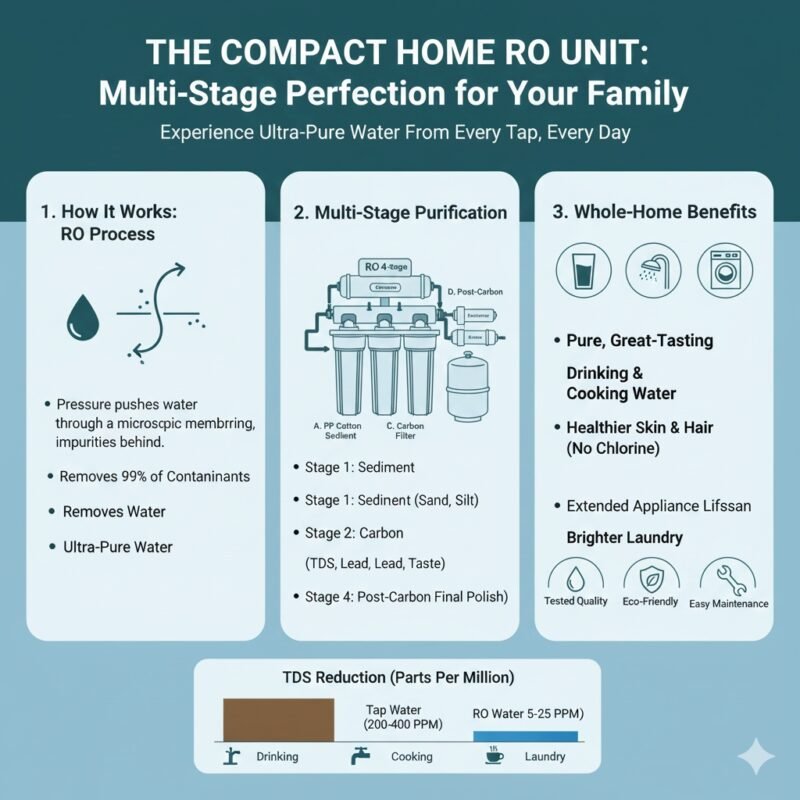
What Exactly is a Whole House RO Unit?
To understand the system, we must first demystify the terminology. A whole house ro unit (Point-of-Entry or POE system) differs significantly from the common under-sink (Point-of-Use or POU) systems.
An under-sink system filters water only for a single specialized faucet, usually for drinking and cooking. In contrast, a whole house unit is installed at the main water line where water enters your property. This means every drop of water used in your building—whether for showering, flushing toilets, washing laundry, making coffee, or filling stock pots—has been treated.
The Science of Reverse Osmosis
Reverse Osmosis is a process where water is forced under pressure through a semi-permeable membrane. This membrane is incredibly tight, with pores small enough to allow water molecules (H2O) to pass through while blocking larger molecules like salts, heavy metals, bacteria, and viruses.
In a whole house ro unit, this process happens on a macro scale. Because the membrane is so restrictive, the process is relatively slow compared to simple carbon filtration. Therefore, these systems almost always require a large atmospheric storage tank to hold the purified water so it is ready when you turn on the tap.
The Architecture of a Whole House System
A whole house ro unit is not a single box; it is a chain of sophisticated components working in harmony. Understanding these stages is crucial for maintenance and operation.
1. The Pre-Treatment Stage (The Guardian)
You cannot simply run raw municipal or well water into an RO membrane. Chlorine destroys the membrane material, and sediment clogs it instantly.
- Sediment Filter: Usually a high-grade PP (Polypropylene) cotton filter. This removes sand, rust, and dirt.
- Carbon Filter: Removes chlorine and chloramines which cause chemical damage to the RO membrane.
- Water Softener/Anti-Scalant: This is critical. Hard water (calcium and magnesium) will turn into scale on the membrane surface, ruining it. Most whole house systems require a softener installed before the RO unit.
2. The Reverse Osmosis Stage (The Engine)
This is where the magic happens. High-pressure pumps push the pre-treated water through the RO membranes. The contaminants are flushed away down the drain (brine), and the pure water (permeate) moves to storage.
3. The Storage Stage (The Reservoir)
Since RO production is slow, a whole house ro unit fills a large tank (often 100 to 300 gallons) to ensure that when you take a shower, you don’t run out of water.
4. The Post-Treatment Stage (The Finish)
- Re-pressurization Pump: Moves water from the tank to your faucets.
- UV Sterilization: Ensures no bacteria grew in the storage tank.
- Remineralization: RO water is slightly acidic. A calcite filter adds a small amount of calcium back in to neutralize the pH and protect your copper pipes from corrosion.
! Alt: Diagram of filtration process for a pp cotton household water purifier company system.
Why Homeowners Are Switching to Whole House RO
The decision to install a whole house ro unit is often driven by specific pain points that simpler filters cannot address.
1. The “Safe Water” Assurance
Municipal water travels through miles of aging infrastructure before reaching your home. Breaks in the main line can introduce sediment, and old service lines can leach lead. A whole house system acts as a firewall. It ensures that the water you brush your teeth with is as clean as the water you drink.
2. Skin and Hair Health
Hard water and chlorine are notorious for drying out skin and hair. Chlorine strips natural oils, leading to eczema flare-ups and brittle hair. By removing these chemicals at the entry point, your shower becomes a beauty treatment. Users often report softer skin and shinier hair within weeks of installation.
3. Protecting Your Home’s Plumbing
Total Dissolved Solids (TDS) and hardness minerals build up in pipes, water heaters, and fixtures. Over time, this scale reduces water pressure and destroys appliances. RO water is free of these minerals. Using RO water in your dishwasher means spotless glasses without drying agents. It means your clothes washer cleans fabrics more effectively with less detergent.
The Commercial Edge: Restaurants and Cafes
For our clients running small businesses, specifically in the food and beverage industry, a whole house ro unit (or a large commercial equivalent) is not a luxury; it is a cornerstone of quality control.
The Coffee Shop Equation
Coffee is 98% water. If you run a café, your espresso machine is your most expensive asset.
- Scale is the Enemy: Hard water scale is the number one cause of espresso machine failure. The boilers get coated in calcium, heating elements burn out, and solenoids jam.
- Taste is King: Chlorine and mismatched mineral content alter the extraction of coffee beans. Too much mineral content makes coffee bitter; too little makes it sour. An RO system with a blending valve allows you to dial in the exact water chemistry for the perfect brew.
The Small Restaurant
Imagine serving a glass of water to a customer that smells faintly of bleach (chlorine). It ruins the dining experience immediately. Furthermore, clear ice is a sign of luxury. A whole house ro unit ensures that your ice machine produces crystal clear, tasteless cubes that don’t dilute the flavor of premium cocktails or soft drinks.
If a full whole-house rig feels too large for your current commercial footprint, or if you want to start with a dedicated solution for your kitchen prep area, we highly recommend looking at our specialized RO Water Purifier. This system delivers the same high-grade filtration in a compact form factor, perfect for under-counter installation in busy kitchens.
Comparing Solutions: Whole House RO vs. Softeners vs. Carbon
Confusion often arises regarding which system is actually needed. Let’s break down the differences.
Water Softeners
- Function: Removes calcium and magnesium.
- Result: Prevents scale, makes soap lather better.
- Limitation: Does not remove viruses, bacteria, heavy metals, or salt. The water is “soft” but not necessarily “pure.”
Whole House Carbon Filters
- Function: Removes chlorine, chloramines, VOCs, and bad tastes.
- Result: Better smelling water, healthier for skin.
- Limitation: Does not lower TDS (Total Dissolved Solids). It cannot remove fluoride, arsenic, or nitrates effectively.
The Whole House RO Unit
- Function: Removes almost everything. Softens water, removes chemicals, filters pathogens, and lowers TDS.
- Result: The purest water possible.
- Requirement: It is more complex and expensive to install than the other two options, but it encompasses the benefits of both.
Installation Considerations: Is Your Property Ready?
Installing a whole house ro unit requires planning. It is not a “plug and play” appliance. Here are the logistical factors you must consider.
1. Space
You need a dedicated mechanical room or a large section of a garage. The setup involves the RO unit itself, pre-filters, and significantly, the storage tank. A 200-gallon tank takes up considerable floor space (approx. 30 inches in diameter and 6 feet tall).
2. Drainage
RO systems produce “brine” or waste water containing the concentrated contaminants. You need an accessible floor drain or a connection to your wastewater line capable of handling this flow.
3. Plumbing Material
This is a crucial technical detail. RO water is “hungry.” Because it has zero mineral content, it is aggressive and can leach copper from standard pipes, leading to pinhole leaks over time.
- The Fix: The plumbing after the RO unit should be PEX, CPVC, or Stainless Steel. If your house is piped entirely in copper, you must install a remineralization cartridge to neutralize the water before it enters your copper pipes.
! Alt: Professional installation of a system by a pp cotton household water purifier company in a home utility room.
The Economics: Cost vs. Value
When searching for a whole house ro unit, you will encounter a wide price range.
Upfront Costs
A high-quality system for a large home or small restaurant can range from $4,000 to $10,000+, including installation. This price includes the high-pressure pumps, the membranes, the large atmospheric tank, and the repressurization delivery pumps.
Long-Term Savings
While the sticker price is high, the operational savings are real:
- Appliance Longevity: Your water heater will last years longer without sediment buildup.
- Plumbing Protection: No more descaling faucets or replacing showerheads clogged with lime.
- Bottled Water Elimination: You will never need to buy bottled water again. For a family or a restaurant, this savings alone can be substantial over 5 years.
Maintenance Costs
Affordability is also about upkeep.
- Pre-filters (PP Cotton & Carbon): Changed every 3–6 months. Low cost.
- RO Membranes: Changed every 2–4 years. Moderate cost.
- UV Bulb: Changed annually.
At www.yourwatergood.com, we specialize in balancing performance with affordability, ensuring that the consumables for your system remain reasonably priced so your long-term running costs stay low.
Addressing Environmental Concerns
A common criticism of RO technology is water waste. In older industrial systems, for every 1 gallon of pure water produced, 4 to 8 gallons were sent down the drain.
However, modern whole house ro unit technology has improved drastically.
- Permeate Pumps: These increase efficiency.
- Recirculation Loops: Many modern systems recirculate a portion of the waste water back through the membrane to extract even more pure water, increasing efficiency to near 75% (1 gallon of waste for 3 gallons of pure water).
For eco-conscious homeowners and business owners, these high-efficiency systems turn RO into a sustainable option.
The Health Perspective: Contaminants Removed
To fully appreciate the value of a whole house ro unit, we must look at the invisible enemies it defeats.
Lead and Heavy Metals
Lead piping is still an issue in many older cities. RO is one of the few certifications that guarantees lead removal. It also handles arsenic and mercury, which can appear in groundwater.
PFAS (Forever Chemicals)
Per- and polyfluoroalkyl substances are emerging contaminants found in many water supplies. They are linked to various health issues. RO membranes are tight enough to physically block these complex chemical chains.
Nitrates
Common in agricultural areas due to fertilizer runoff, nitrates are dangerous to infants (Blue Baby Syndrome). Standard carbon filters do not remove nitrates; RO does.
Troubleshooting and Care
Owning a whole house ro unit involves being a proactive owner. Here are common scenarios and solutions.
Drop in Water Pressure
If your shower pressure is low, it usually means the pre-filters are clogged. The sediment filter (PP cotton) is doing its job by trapping dirt. Change this filter, and pressure should return. If pressure remains low, check the repressurization pump settings.
Water Tastes “Flat”
Pure water lacks minerals. If the taste is too sterile for you, or if you find it hard to rinse soap off your skin, your remineralization cartridge may be empty. Adding calcite back into the water solves both the taste issue and the pH balance.
System runs Continuously
If you hear the main RO pump running 24/7, you likely have a leak, or the float valve in your storage tank is stuck. This requires immediate attention to prevent burning out the pump.
Integrating RO into a Small Business Plan
If you operate a café, your water strategy is your business strategy.
We recommend a hybrid approach for many of our commercial clients. You might not need RO water for the restrooms, but you absolutely need it for the kitchen and beverage stations.
- Assess Your Menu: Do you serve tea? Tea is very sensitive to water quality.
- Assess Your Ice: Cloudy ice ruins the presentation of premium drinks.
- Assess Your Volume: How many gallons do you use per hour during peak rush? This determines the size of the storage tank you need.
For those businesses that need a robust, targeted solution for their kitchen rather than the entire building, we reiterate the value of the RO Water Purifier. It provides the same membrane technology in a package designed for under-counter efficiency, ensuring your customers get the best quality without the logistical overhaul of a whole-building system.
Conclusion: Is a Whole House RO Unit Right for You?
The journey to water independence ends with Reverse Osmosis. While the initial investment and installation complexity of a whole house ro unit are higher than standard filtration, the payoff is comprehensive. It provides a sanctuary where every drop of water—whether for drinking, bathing, or cleaning—is free from contaminants.
For the homeowner, it offers peace of mind and health benefits. For the restaurateur or café owner, it offers consistency, equipment protection, and a superior product that customers can taste.
Water quality is not static; it changes with seasons and infrastructure projects. By installing a whole house system, you take control of this variable. You are no longer dependent on the varying quality of the municipal supply.
At www.yourwatergood.com, we understand that every building and business is unique. Whether you are looking for high-capacity commercial filters, reliable PP cotton pre-filtration, or advanced RO solutions, we are here to guide you toward the perfect setup. Clean water is not just a commodity; it is the foundation of a healthy home and a thriving business.
If you are ready to elevate your water quality, explore our range of products and find the solution that fits your specific needs today.
Frequently Asked Questions (FAQ) about Whole House RO Units
Q: Will a whole house RO unit remove healthy minerals? A: Yes, the RO membrane removes everything, including calcium and magnesium. However, most well-designed systems include a post-treatment remineralization stage to add these healthy minerals back in before the water reaches your tap.
Q: How much space do I need? A: You should budget a space roughly 4 feet wide by 2 feet deep, and at least 6 feet high. The water storage tank is the largest component and cannot be miniaturized effectively.
Q: Does it reduce water pressure in the shower? A: No, provided the system is sized correctly. The water you use comes from the storage tank, pushed by a strong repressurization pump. It can actually improve pressure in homes with weak municipal supply.
Q: Can I install it myself? A: While under-sink systems are DIY-friendly, a whole house ro unit involves cutting main lines, electrical work for pumps, and drainage configuration. We strongly recommend professional installation by a licensed plumber.
Q: How does this benefit my small coffee shop? A: It ensures that your coffee tastes consistent every single day, regardless of city water fluctuations. More importantly, it prevents scale buildup in your espresso machine boilers, potentially saving you thousands in repairs and downtime.
Q: What is the lifespan of the system? A: With proper maintenance (changing pre-filters regularly), the main unit can last 15 to 20 years. The membranes typically last 2 to 4 years depending on water hardness and usage volume.