
Whole House RO Water Filter: The Complete Guide for Homeowners & Installers

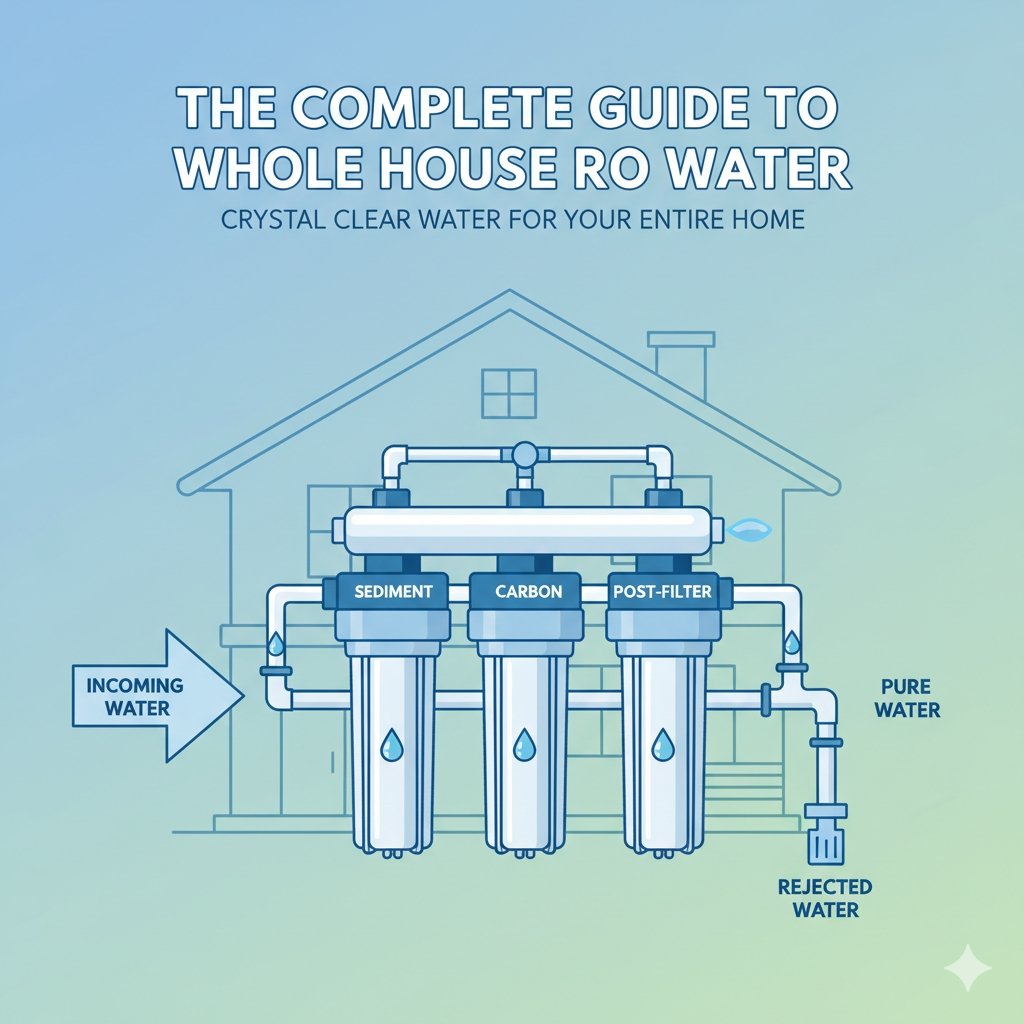
Installing a whole house reverse osmosis (RO) water filter is a big decision. Unlike point-of-use RO systems that sit under a sink and serve a single tap, a whole-house (point-of-entry) RO system treats every drop entering your home — showers, laundry, faucets, and appliances. That promise of exceptionally pure water for the entire house sounds appealing, but it brings a distinct set of engineering, cost, and operational trade-offs.
This guide explains what whole-house RO systems are, how they work, when they make sense (and when they don’t), real cost components, installation considerations, maintenance and lifecycle expectations, alternatives to consider, and practical steps if you decide to pursue a whole-home RO solution. Where useful I’ll point you to product examples and checklist items so you can evaluate quotes and avoid common pitfalls. (Note: if you’re simply exploring a high-quality point-of-use RO as an alternative, see this RO purifier listing: https://yourwatergood.com/product/ro-water-purifier/.)
Quick summary — is whole-house RO right for most homeowners?
Short answer: rarely. Whole-house RO systems can deliver the purest water possible throughout a property, but they are typically expensive, complex, and wasteful in terms of concentrate (reject) water unless carefully engineered with high-recovery membranes, large storage, and reuse strategies. For many households, a whole-house sediment/carbon system plus a dedicated under-sink RO for drinking water is the more practical, cost-effective choice. Several reputable home-improvement outlets note the relatively high cost and complexity of whole-house RO compared with point-of-use alternatives. (This Old House, Bob Vila)
If after reading this you still think whole-house RO could be right for you, read on — this guide will give you the technical vocabulary and checklist to evaluate suppliers and proposals.
What is a whole-house RO system — the basics
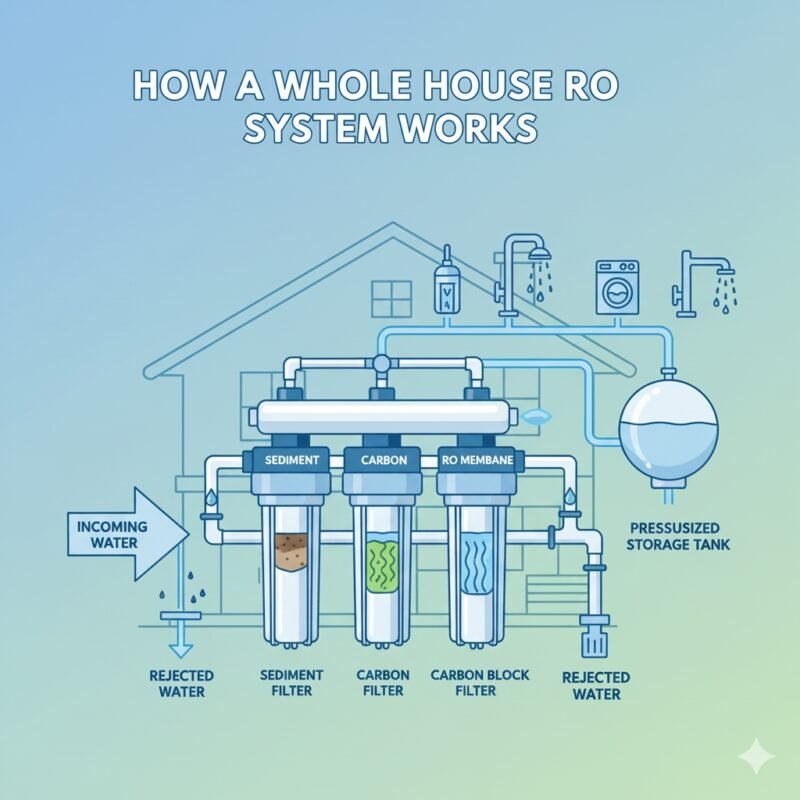
A whole-house RO system is essentially an industrial or commercial-scale reverse osmosis installation sized to deliver treated water to the entire building at the main water entry point. Typical components include:
- Robust pre-treatment (sediment filters, multimedia filters, carbon stages, sometimes softeners) to protect membranes.
- High-capacity RO skid or frame — one or more industrial RO membranes in parallel or series, driven by pumps and automated valves.
- High-volume storage tank(s) to hold permeate (treated water) so household demand can be met with adequate flow and pressure.
- High-pressure feed pumps and controls to maintain membrane flux and recovery targets.
- Permeate (treated) and concentrate (reject) piping and management — routing concentrate to drain or to beneficial reuse (irrigation, gray water).
- Post-treatment such as remineralization, pH adjustment, or UV disinfection if needed.
- Monitoring, sensors and safety devices (pressure, conductivity/TDS sensors, automatic flushing cycles).
Because RO membranes remove dissolved solids and salts, pre-treatment is not optional — chlorine, iron, heavy sediment, and organics must be addressed before water reaches the membrane, otherwise membrane life and performance suffer dramatically.
How whole-house RO differs from under-sink RO
Key differences to keep front of mind:
- Scale & throughput: Under-sink RO units are rated in GPD (gallons per day) typically 50–150 GPD; whole-house systems are sized in hundreds to thousands of GPD (or GPM) depending on household demand. Whole-house designs often include storage tanks and booster pumps. (This Old House, Crystal Quest Water Filters)
- Engineering complexity: Whole-house RO requires pumps, tanks, controls, electrical work, and often civil accommodations (tank pads, drains).
- Water waste: RO inherently creates a concentrate stream; without recovery strategies this can increase household water usage and municipal bills. More on that below. (monkeywrenchplumbers.com)
- Cost: Whole-house RO systems have far higher upfront and operating costs than point-of-use options (detailed cost section below). (This Old House, modernize.com)
Because of these differences, whole-house RO is typically considered only in special scenarios — for example, very high-TDS well water across a large property, medical or laboratory usage requiring low TDS throughout, or luxury estates wanting bottled-quality water at every outlet.
When whole-house RO does make sense
Whole-house RO can be a rational choice in a few clear situations:
- Unique feedwater chemistry — your source water contains contaminants that require RO at point-of-entry (very high TDS, problematic salts, persistent heavy metals or specific industrial contaminants).
- Large estate or facility with dedicated reuse plan — properties that can economically capture and reuse RO concentrate for irrigation, toilet flushing, or process water lower the effective waste.
- Regulatory or process needs — certain home medical setups, labs, or hobby applications (e.g., high-precision aquaria) may demand ultra-pure supply to every tap.
- Well owners with no municipal treatment — some private wells have chemical profiles (nitrate, arsenic, sodium) that homeowners want managed at the point of entry rather than at single taps.
- Customer requirement — an owner is willing to bear the lifecycle costs for whole-home purity and is aware of the trade-offs.
Even where technically possible, owners need to weigh the environmental and operational impacts. For many families, a targeted strategy — whole-home sediment/carbon + point-of-use RO for drinking and cooking — is the best compromise.
Typical cost components — what you’ll actually pay for
Whole-house RO costs vary widely depending on capacity, pre/post-treatment, storage, and installation complexity. But the major cost buckets are consistent:
- System equipment (RO skid, membranes, pre-treatment) — industrial membranes, pumps, valves, automated skid, and controls.
- Storage tanks — large atmospheric or bladder tanks sized in hundreds to thousands of gallons for whole-home use.
- Pumps & electrical work — booster pumps, VFDs (variable frequency drives) for efficiency, wiring and controls.
- Civil & mechanical installation — piping, foundations/pads for tanks, valves, and tie-ins to the main water line.
- Permits & backflow prevention — local plumbing codes often require backflow assemblies and permits.
- Commissioning & testing — acceptance testing, water quality validation, and operator training.
- Ongoing operating costs — electricity for pumps, membrane and filter replacements, chemical dosing (if used), and water for flushing.
- Wastewater handling / reuse solutions — sometimes includes tanks or plumbing to capture and repurpose concentrate.
What do these add up to? Published cost summaries show a broad range: many consumer resources report typical whole-house RO projects falling roughly between $1,000 and $6,000 for simpler installations, with mid-range projects around $2,000–$5,000, but higher-end or complex installs (large storage, advanced pre-treatment and high recovery) easily reaching $10,000 or more. Industry vendors offering estate-scale systems quote even larger numbers for high-capacity packages (tens of thousands). Use these published benchmarks as a sanity check when you receive quotes. (This Old House, modernize.com, Bob Vila)
Important: lower published ranges sometimes assume minimal pre-treatment and low membrane capacity; realistic whole-home systems with credible warranties typically cost more than the lowest advertised figures.
The water-waste (reject) issue — why RO is often criticized for being “wasteful”
Reverse osmosis works by allowing pure water (permeate) to pass through a membrane while concentrating dissolved solids into a smaller volume (concentrate) that is flushed away. Typical household RO recovery ratios without advanced engineering run in the 20–50% range — which means 1 to 4+ gallons of concentrate may be produced for every gallon of permeate in simple systems. That concentrate has a higher TDS and cannot be used for drinking without treatment. (monkeywrenchplumbers.com, Reddit)
For a whole-house installation this reject can represent a substantial increase in total water use or require a plan to re-use the concentrate (for irrigation, laundry, or other non-potable purposes). High-recovery commercial membranes, permeate pumps, staged RO, or zero liquid discharge processes can mitigate waste but add capital cost and maintenance complexity. Some vendors build recovery-optimized systems with storage and pumps to deliver acceptable efficiency at scale, but these are more expensive. (US Water Systems, Crystal Quest Water Filters)
If your home is on metered municipal water, higher water consumption may increase bills and put strain on septic systems. Before committing to whole-house RO, obtain realistic recovery and waste projections from the vendor and factor in reuse options.
Design considerations — what questions to ask suppliers
When you solicit proposals, insist that vendors address these critical design parameters in writing:
- Feedwater analysis: Require a current lab report showing TDS, hardness, iron, manganese, chlorine, organics, nitrate, and microbiology (if well water). Decisions on pre-treatment depend on real data.
- Peak flow and peak simultaneous demand (GPM): How the system maintains pressure during showers, multiple faucets, or laundry cycles. Whole-house RO usually relies on permeate storage and booster pumps to meet peaks.
- Permeate capacity and recovery ratio: GPD and recovery percentage at expected feed TDS, temperature, and pressure.
- Pre-treatment sequence: Sediment, multimedia, softening (if required), and carbon stages to protect membranes.
- Membrane type and manufacturer: Known membrane brands with published performance curves are preferable to unbranded membranes.
- Control & monitoring: TDS/EC sensors, automatic flush cycles, low-pressure and high-pressure safety interlocks.
- Concentrate management: Where will reject water go? Is reuse planned? Is there a plan for drain capacity?
- Redundancy and bypass: Can water be supplied unfiltered during maintenance, and how is that handled safely?
- Service intervals and replacement costs: Filter, membrane, pump life expectancies and pricing.
- Warranty & liability: What’s covered on membranes, pumps, and structural components?
A professional vendor will provide a P&ID (piping and instrumentation diagram), a clear scope of work, and a lifecycle cost estimate (total cost of ownership over 5–10 years).
Pre-treatment: the non-negotiable front line
Membranes are sensitive to chlorine, iron, sulfate precipitates, and heavy particulate loads. Common pre-treatment elements for whole-house RO include:
- Multi-stage sediment filtration (to remove sand, silt and rust)
- Activated carbon or catalytic carbon (to remove free chlorine and chloramines)
- Water softening or antiscalant dosing (to protect against scale in high-hardness water)
- Iron removal systems (for ferric or ferrous iron)
- Backwash multimedia filters (for high turbidity/particulate loads)
Skimping on pre-treatment is the single most common cause of premature membrane failure.
Storage, pumps, and delivery — meeting household flow & pressure expectations
Because RO membranes have limited instantaneous permeate flow, whole-house systems usually include permeate storage tanks sized to meet peak demand and booster pumps to deliver permeate at service pressure. Design trade-offs include:
- Larger storage = better peak coverage but more space and capital.
- Higher pump capacity = better pressure and flow but higher energy and more electrical controls.
- Tankless designs exist for some point-of-use applications but are uncommon for whole-home due to cost and required membrane capacity.
Make sure the proposal specifies guaranteed flow rates at realistic simultaneous demand scenarios (e.g., two showers running + dishwasher). If a vendor cannot provide flow guarantees, consider a different supplier.
Installation & code compliance
Whole-house RO installations typically require:
- Licensed plumbing and electrical contractors — pumping and controls involve electrical codes; plumbing tie-ins and backflow protection require licensed plumbers.
- Permits — local jurisdictions may require plumbing permits and pressure/vacuum backflow devices.
- Proper drainage & concentrate routing — concentrate may be acidic or mineral-rich; routing to storm drains may be restricted in some areas.
- Space & structural support — large tanks need floor support; indoor or protected outdoor enclosures must consider freeze protection.
Ask potential contractors for local permit experience and examples of past installations; references and site photos help validate competence.
Operation & maintenance — what to expect long term
Whole-house RO is not a “set and forget” product. Typical ongoing tasks and costs include:
- Filter replacement (pre-filters and carbon): frequencies typically 3–12 months depending on load.
- Membrane replacement: membranes typically last 2–5 years, depending on feedwater and pre-treatment. Membrane costs are a significant operating expense.
- Pump maintenance: bearings and seals may need service in years, electrical checks and motor service.
- System sanitization and chemical cleaning: periodic chemical cleanings to remove biofilm or scalants, per manufacturer recommendations.
- Monitoring: TDS/EC checks, pressure monitoring, and scheduled inspection of valves and seals.
- Spare parts inventory: O-rings, seals, pressure gauges, replacement filters and at least one spare membrane for critical setups.
Ask for a 5-year O&M projection from vendors — it should include cost assumptions for filters, membranes, electricity, and annual service visits.
Alternatives & hybrid strategies (frequently the smarter choice)
Before committing, evaluate these common alternatives that deliver most of the perceived benefits without the full cost and complexity:
- Whole-house sediment + carbon + point-of-use RO
- Most homeowners get excellent overall protection (appliances, showers) from whole-home sediment/carbon while using an under-sink RO for drinking/cooking. This minimizes RO waste and conserves capital.
- Point-of-use tankless or under-sink RO with dedicated drinking lines
- Modern under-sink tankless RO models deliver fast flow and high purity without home-wide plumbing changes.
- Targeted treatment for problem sources
- If the problem is hardness, use a softener. If the issue is iron or sulfide, use specific iron removal. Deploy RO only where dissolved solids or specific contaminants require it.
- Partial RO and reuse
- Some installs combine RO for drinking water only and capture RO concentrate for irrigation — a bespoke solution that requires plumbing and gray-water planning.
Most professional water-treatment consultancies recommend the hybrid approach unless there is a compelling technical reason for whole-home RO.
How to evaluate vendor proposals — practical checklist
When you receive quotes, make sure each proposal contains:
- Detailed scope: equipment list, membrane brands and model numbers, pre- and post-treatment stages.
- Performance guarantees: permeate quality (TDS reduction), permeate capacity (GPD), and peak delivery (GPM) at stated feed conditions.
- Recovery & wastewater estimates: projected recovery ratio and annual estimate of concentrate volume.
- Installation scope: who does civil work, electrical, permits, and commissioning.
- O&M plan: filter/membrane replacement intervals with pricing and recommended service contract.
- Warranty: terms for membrane, pumps, frames and labor.
- References & photos: past installations comparable in size to your project.
- Acceptance testing: on-site test protocol and acceptance criteria (TDS targets, pressure, flow).
If any of these elements are missing, ask for clarification before signing.
Realistic expectations about performance & taste
Whole-house RO will produce very low TDS water. Many homeowners find this “flat” or prefer remineralized water for taste. Common vendor responses include:
- Remineralization post-filters that add balanced minerals and improve mouthfeel.
- Selective delivery — for example, only route drinking faucets through a remineralizer while using straight RO permeate elsewhere.
- pH management if low pH is a concern for metallic taste or corrosion.
Discuss taste preferences with vendors and request sample water or a demonstration where possible.
Environmental & regulatory considerations
- Water usage and municipal constraints: In water-stressed regions or where wastewater discharge is regulated, whole-house RO may face limits or require permits. Consider reuse or gray-water routing to reduce discharge.
- Energy footprint: pumps and controls consume power; quantify expected electricity use.
- Septic systems: high concentrate discharge to a septic system may not be advisable. Consult local authorities.
Because of these implications, a sustainability assessment should be part of planning.
Case scenarios — example budgets
These example scenarios are illustrative (prices will vary regionally and by supplier):
- Small home, minimal pre-treatment (not recommended): basic RO skid + small tank + simple pre-filters — low estimate: $3,000–$6,000 (equipment + install). Expect higher operating costs and more frequent membrane replacement. (modernize.com)
- Mid-range whole-home system with proper pre-treatment, 400–1,000 GPD capacity, storage tanks and pumps: typical range: $6,000–$20,000 depending on site work and plumbing.
- High-capacity estate or commercial-grade installation with large atmospheric storage, staged RO, concentrate reuse and advanced controls: $20,000–$100,000+.
Get at least three detailed, comparable proposals and verify vendor claims with third-party references.
Transition plan: hybrid approach step by step
If you’re not ready to commit to full whole-house RO, this staged approach reduces risk:
- Order a comprehensive water test and review results with a qualified water treatment professional.
- Install whole-house sediment + carbon to protect appliances and reduce chlorine taste.
- Install an under-sink RO for drinking and evaluate user satisfaction.
- If whole-home purity is still required, pilot a scaled RO skid with storage and reuse options before full roll-out.
This path spreads capital cost and gives empirical data about usage patterns and concentrate reuse options.
Final checklist before you sign a contract
- Verify the vendor’s water analysis and design assumptions.
- Confirm membrane manufacturer and ask for performance curves.
- Get written flow and pressure guarantees at stated simultaneous demand.
- Review wastewater/recovery numbers and plan for concentrate routing.
- Inspect pre-treatment scope; skimping here shortens membrane life.
- Confirm permits, backflow devices, and installer credentials.
- Demand acceptance testing and documented performance before final payment.
Conclusion
Whole-house RO systems deliver the purest possible domestic water, but they bring significant cost, complexity, and environmental considerations. For most homeowners, a hybrid strategy — whole-house sediment/carbon pretreatment plus a point-of-use RO for drinking water — provides the best balance of performance, cost, and sustainability. Whole-home RO can make sense in special cases (extreme feedwater chemistry, medical or process needs, or properties that can reuse concentrate), but it must be designed, installed, and maintained by experienced professionals with an eye toward recovery efficiency and lifecycle costs.
If you want to benchmark a high-quality RO unit while you design your system (for example, to compare membrane performance and post-treatment options), review this RO purifier listing as a reference: https://yourwatergood.com/product/ro-water-purifier/.