
The Ultimate Defense: Why a 5 Stage Whole House Water Filter Is the Future of Home Hydration


Water is the lifeblood of our homes. It courses through our pipes like veins, bringing life to our morning showers, our laundry, our cooking, and our drinking glasses. Yet, for many homeowners and small business owners, the water entering their property is far from pure. It carries with it the baggage of its journey: sediment from aging municipal pipes, chlorine from treatment plants, agricultural runoff, and dissolved heavy metals.
For those who demand comprehensive protection, a single filter cartridge is no longer enough. The gold standard for total property protection is the 5 stage whole house water filter.
This robust configuration does not just “filter” water; it transforms it. By subjecting every drop of water that enters your building to five distinct layers of purification, you ensure that your family, your customers, and your expensive plumbing infrastructure are protected from the full spectrum of modern contaminants.
In this deep-dive guide, we will unpack the engineering behind this system. We will explore the specific function of each stage, the tangible health and financial benefits, and why upgrading to a multi-stage solution is one of the smartest investments you can make for your property.https://yourwatergood.com/product/5-stage-ro-water-filter-for-home-busines/.
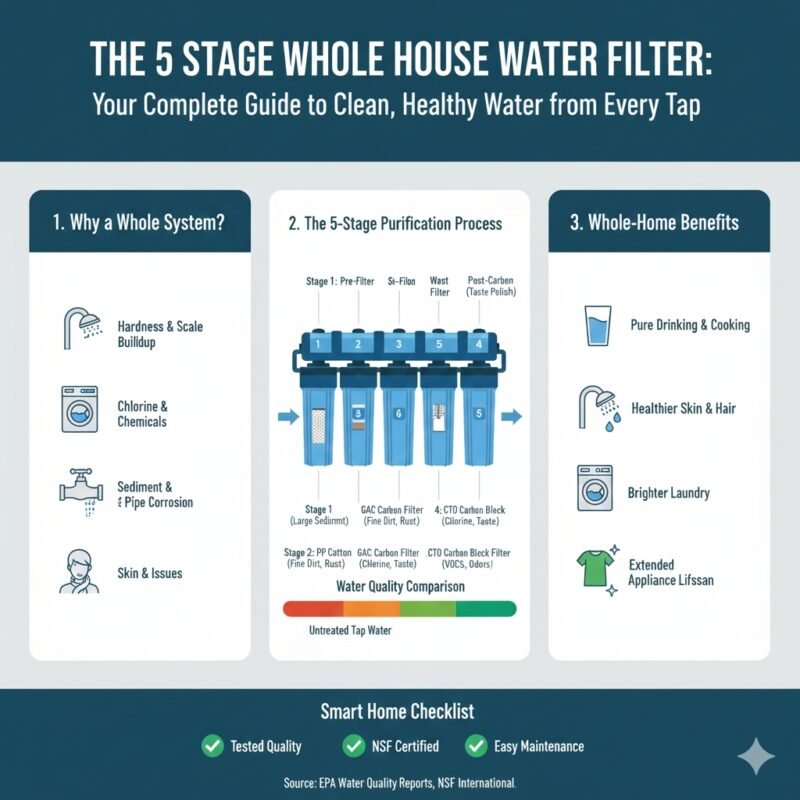
Part 1: The Philosophy of Multi-Stage Filtration
To understand why you need five stages, you must first understand the complexity of water contamination. Water is a “universal solvent,” meaning it picks up a little bit of everything it touches.
- Physical Debris: Sand, silt, rust.
- Chemicals: Chlorine, chloramines, pesticides, VOCs.
- Dissolved Solids: Lead, arsenic, calcium (hardness).
A single filter cannot handle all of these. A filter designed to catch sand is too loose to catch chemicals. A filter designed to catch chemicals will get clogged instantly if it catches sand.
The 5 stage whole house water filter solves this through Progressive Filtration. It organizes the cleanup process into a logical hierarchy, ensuring that each stage targets a specific enemy, protecting the subsequent stages and maximizing the lifespan of the entire system.
Part 2: Dissecting the Five Stages of Defense
While configurations can vary based on water conditions, the most effective 5-stage systems generally follow a specific “Sediment to Carbon to Membrane” architecture. Let’s break down the journey of a water droplet through this fortress.
Stage 1: The Sediment Pre-Filter (The Shield)
The first line of defense is critical.
- Material: High-Density Polypropylene (PP) Cotton.
- Function: This stage acts as a physical barrier. It traps the “big” stuff—rust flakes from city pipes, sand grains from wells, dirt, and turbidity.
- Why It Matters: If sediment enters the later stages, it acts like sandpaper, destroying delicate membranes and clogging carbon pores. As a specialized pp cotton household water purifier company, we ensure this foundation is solid, using graded-density filters that trap dirt throughout their depth, not just on the surface.
Stage 2: Granular Activated Carbon (The Chemical Sponge)
Once the water is physically clear, it enters the chemical warfare zone.
- Material: Loose granules of high-grade carbon (often coconut shell).
- Function: Adsorption. The massive surface area of the carbon acts like a magnet for chemicals. It targets Chlorine, hydrogen sulfide (rotten egg smell), and herbicides.
- Why It Matters: Chlorine is an oxidizer. It dries out your skin and hair, and it chemically degrades the rubber seals in your appliances. Removing it here protects your plumbing and your body.
Stage 3: Carbon Block (The Gatekeeper)
Redundancy is key to a 5 stage whole house water filter.
- Material: Compressed carbon powder.
- Function: “CTO” (Chlorine, Taste, Odor). Because it is a solid block, water cannot “channel” around the filter media; it is forced to squeeze through.
- Why It Matters: It catches any “fines” (dust) from the previous stage and polishes off any remaining chloramines or VOCs. It ensures the water is chemically neutral before it hits the purification stage.
Stage 4: The Heavy Lifter (Reverse Osmosis or Ultrafiltration)
This is the heart of the system. Depending on the specific model, this stage uses a membrane technology.
- Function: Removal of dissolved solids. This is where heavy metals (Lead, Mercury), salts (Fluoride), and cysts are removed.
- Why It Matters: This is the difference between “filtered” water and “purified” water. It effectively strips the water of invisible toxins that standard carbon cannot touch.
Stage 5: The Post-Treatment Polisher
The final stage ensures the water is ready for consumption.
- Material: Refined Coconut Carbon or Remineralization Media.
- Function: It removes any stale tastes acquired from the storage tank and, in some systems, adds healthy minerals back into the water to balance the pH.
- Why It Matters: It ensures that every time you turn on a tap, the water tastes crisp, sweet, and refreshing.
Part 3: The “Whole House” Advantage
Why choose a 5 stage whole house water filter over a small under-sink unit? The answer lies in the scope of protection.
1. Protecting Your Infrastructure
We often forget that water runs through our most expensive appliances.
- Water Heater: Sediment buildup reduces efficiency and burns out heating elements.
- Washing Machine: Chlorine degrades internal rubber hoses and seals, leading to leaks.
- Dishwasher: Hard water and sediment clog spray arms and leave spots on glassware.
A whole-house system acts as a firewall at the point of entry. It ensures that only clean water enters your pipes, extending the lifespan of your plumbing infrastructure by years.
2. Healthier Bathing
Your skin is your largest organ, and it is porous. When you shower in chlorinated water, you absorb chemicals. The steam you inhale carries volatile organic compounds (VOCs) directly into your lungs. A 5-stage system removes these irritants. Families often report that skin conditions like eczema improve, dandruff disappears, and hair becomes softer and more vibrant after installing a whole-house unit.
3. Convenience
With a whole-house system, every tap delivers premium water. You don’t need a separate faucet for drinking water. You can drink from the bathroom tap, use clean water for brushing teeth, and fill your pet’s bowl from the hose—it’s all purified.
Part 4: Commercial Applications (The Small Business Edge)
For our B2B clients—cafes, small restaurants, and boutique hotels—a 5 stage whole house water filter is a strategic business asset.
The Coffee Shop Equation
Coffee is 98% water.
- Flavor: Chlorine ruins the crema on espresso and creates bitter notes in drip coffee.
- Equipment: Scale and sediment are the #1 killers of espresso machines. A 5-stage system protects the solenoid valves and boilers, saving thousands in repair costs.
The Restaurant Experience
- Ice: Filtered water makes crystal clear, hard ice that melts slowly. Unfiltered water makes cloudy, soft ice that dilutes drinks.
- Food: Using purified water for stocks, soups, and baking ensures consistent flavor profiles.
For businesses looking for a compact yet powerful solution that brings this 5-stage purity to a specific zone (like a kitchen or beverage station), we highly recommend the 5 Stage RO Water Filter for Home & Business. This unit is engineered to deliver commercial-grade purity in a form factor that fits busy workspaces.
Part 5: The Economics of Ownership
Is a 5 stage whole house water filter expensive? The upfront cost is an investment, but the long-term math proves its value.
The Cost of Not Filtering
- Bottled Water: A family of four spends $500–$800 annually on bottled water.
- Plumbing Repairs: Replacing a water heater costs $1,000+. Replacing faucets corroded by hard water adds up.
- Health Costs: The long-term impact of consuming lead or PFAS is unquantifiable but significant.
The ROI (Return on Investment)
A quality whole-house system typically pays for itself within 3 years through savings on bottled water and appliance longevity. Furthermore, it adds value to the home. Real estate listings that feature “Whole House Water Filtration” often command a premium.
Part 6: Selecting the Right System
Not all 5-stage systems are created equal. When shopping, you must look at Flow Rate and Component Quality.
Flow Rate (GPM)
You must size the system correctly.
- 10-12 GPM: Suitable for homes with 1-2 bathrooms.
- 15-20 GPM: Necessary for homes with 3+ bathrooms or commercial kitchens.
- Risk: If you undersize the system, you will experience a pressure drop when someone flushes a toilet while you are showering.
Component Quality
As a pp cotton household water purifier company, we stress the importance of the Stage 1 filter. If the manufacturer uses cheap, low-density pre-filters, they will collapse under pressure. You need high-capacity, melt-blown filters that can withstand the rigors of municipal water pressure.
Part 7: Installation and Maintenance
Installing a 5 stage whole house water filter is a project that requires planning.
Installation
- Location: It must be installed on the main water line before it branches off to the water heater.
- Bypass Valve: Always install a bypass loop. This allows you to divert water around the filter during maintenance so you don’t have to shut off water to the entire house.
- Professional vs. DIY: While a handy homeowner can do it, we recommend professional installation to ensure connections are secure and code-compliant.
Maintenance Schedule
- Stage 1 (Sediment): Change every 3-6 months. When pressure drops, change this first.
- Stage 2 & 3 (Carbon): Change every 6-9 months. When chlorine taste returns, change these.
- Stage 4 (Membrane/Media): Change every 2-3 years depending on water hardness.
- Stage 5 (Post-Filter): Change annually.
Part 8: Myths vs. Reality
Myth: “It removes all the healthy minerals.”
- Reality: While some 5-stage systems (like RO) reduce mineral content, you get the vast majority of your minerals from food, not water. If this is a concern, many 5-stage systems use a “Remineralization” stage as the final step to add calcium back in.
Myth: “It wastes too much water.”
- Reality: Traditional RO systems have a waste line. However, non-RO whole house filters (using media tanks) do not waste water. If you choose an RO configuration, modern high-efficiency pumps have drastically reduced the waste ratio to negligible levels compared to total household use.
Part 9: Environmental Impact
Choosing a 5 stage whole house water filter is a powerful environmental statement.
- Plastic Reduction: You eliminate the need for single-use plastic bottles entirely.
- Appliance Efficiency: By preventing scale buildup in your water heater, you maintain its energy efficiency, lowering your carbon footprint (and your gas/electric bill).
- Chemical Reduction: By filtering contaminants at the source, you reduce the load on downstream wastewater treatment plants.
Conclusion: Total Peace of Mind
The 5 stage whole house water filter represents the pinnacle of residential water treatment. It is a comprehensive, redundant, and powerful defense system that addresses the physical, chemical, and aesthetic quality of your water.
For the homeowner, it means bathing in spa-quality water and drinking “bottled water” from every tap. For the business owner, it means protecting your equipment and serving a superior product.
Don’t settle for partial protection. Secure your property with the multi-stage defense it deserves.
Visit YourWaterGood today to explore our high-performance filtration solutions. Whether you need a targeted system for your kitchen or a comprehensive whole-house setup, we have the expertise to make your water good again.
Frequently Asked Questions (FAQ)
Q: Will a 5 stage whole house water filter reduce my water pressure? A: A properly sized system should not noticeably reduce pressure. If you have a large home, ensure you buy a system rated for a higher GPM (Gallons Per Minute). If pressure drops over time, it is simply a sign that the Stage 1 Sediment filter is doing its job and needs changing.
Q: Can I install this if I am on a well? A: Yes, but you must test your water first. Well water often contains Iron, Sulfur, or Bacteria. You may need specific pre-treatment (like a UV light or Iron Filter) before the 5-stage system to prevent the filters from clogging too quickly.
Q: Does this system remove Lead? A: Yes. A true 5-stage system with high-quality Carbon Blocks and Filtration Membranes is highly effective at reducing lead, providing a critical safety net for homes with older plumbing.
Q: How do I know when to change the filters? A:
- Pressure Drop: Change the Stage 1 Sediment filter.
- Taste/Odor: If chlorine smell returns, change the Carbon filters.
- Time: Even if flow is good, change filters annually to prevent bacteria growth inside the cartridges.
Q: Is the system difficult to maintain? A: No. Most modern systems use “Big Blue” housings that easily unscrew with a plastic wrench. Changing the cartridges takes about 15-20 minutes and requires no special plumbing skills.