
What Does the PP Cotton Filter Do? A Plain-Language Answer

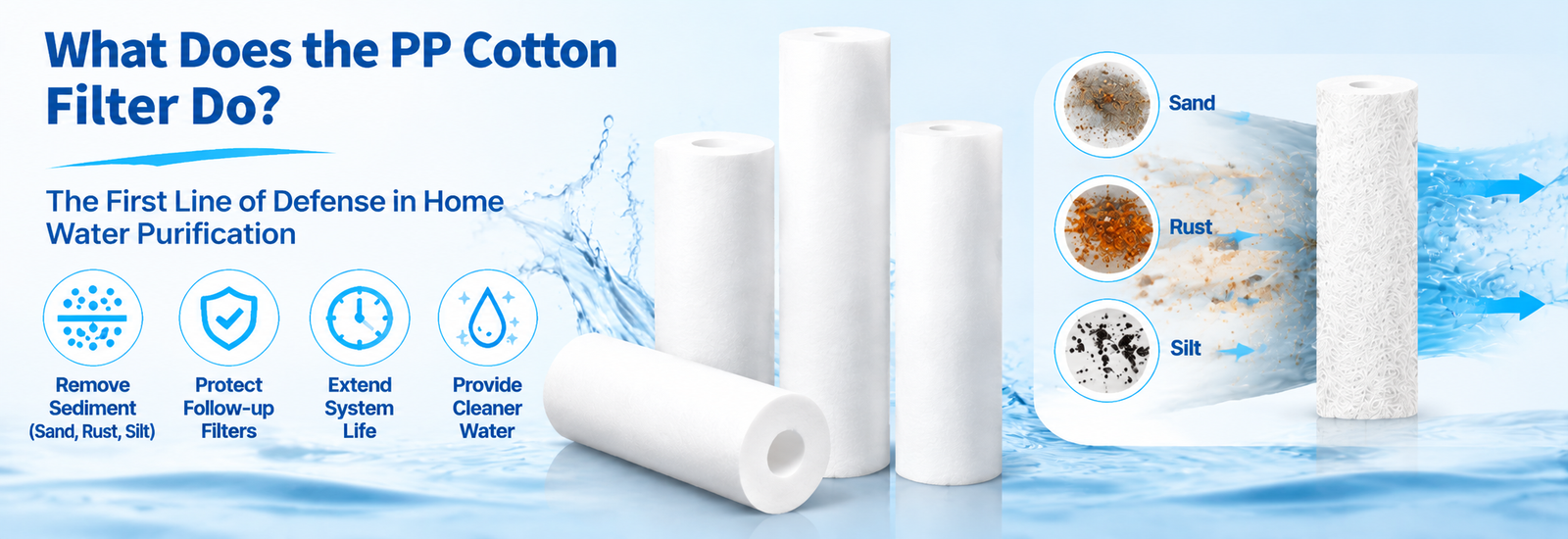
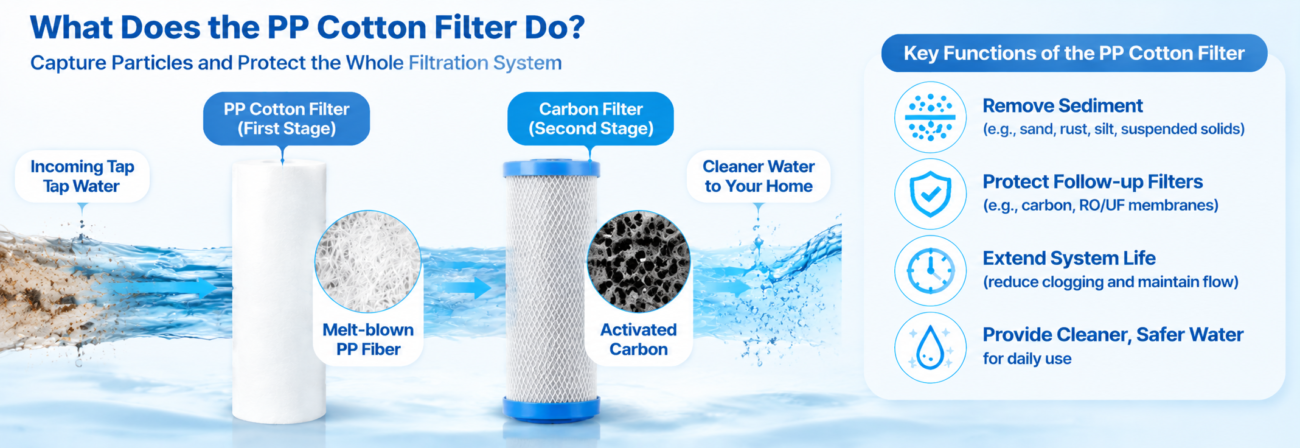
What does the PP cotton filter do? It catches particles. Sand, silt, rust flakes, and other suspended solids get trapped in its fibers, so they do not reach the carbon filter, RO membrane, water heater, or appliance valves downstream. It does not remove chlorine, hardness, or anything dissolved in the water.
In one list, a PP cotton filter:
- Traps sand, silt, rust, and scale flakes
- Clears cloudiness caused by fine particles
- Protects carbon blocks and RO membranes from clogging
- Protects faucet cartridges and appliance inlet valves from wear
- Does not remove chlorine, taste, hardness, salts, or microorganisms
How It Does It
The cartridge is a thick tube of melt-blown polypropylene fibers. Fibers are spaced more loosely near the outside and more tightly toward the center. Water flows from the outside in. Coarse particles stop near the surface; finer ones are caught deeper. This depth filtration lets the cartridge hold a lot of dirt before flow suffers.
Why It Usually Comes First
Every other stage in a water system works better when the water reaching it is free of particles:
- Carbon blocks have small pores that clog with silt.
- RO membranes foul when particles settle on them.
- Softener resin loses capacity when sediment coats it.
- UV systems need clear water so light reaches every part of the flow.
That is why PP cotton is the first stage in most systems, and why a 5-stage RO often uses two PP stages: 5 micron first, then 1 micron after the carbon.
What It Does Not Do
| Problem | PP cotton? | What does |
|---|---|---|
| Chlorine taste and smell | No | Activated carbon |
| Hard water scale | No | Softener or scale inhibitor |
| Dissolved salts, nitrate, fluoride | No | Reverse osmosis |
| Dissolved iron | Only if already rusted into particles | Oxidation and iron filtration |
| Bacteria | No | Disinfection such as UV |
What It Does in Different Places at Home
- On the main line (whole house): stops grit from reaching the water heater, washing machine screens, dishwasher valves, and every faucet. Showers and aerators stay clear longer.
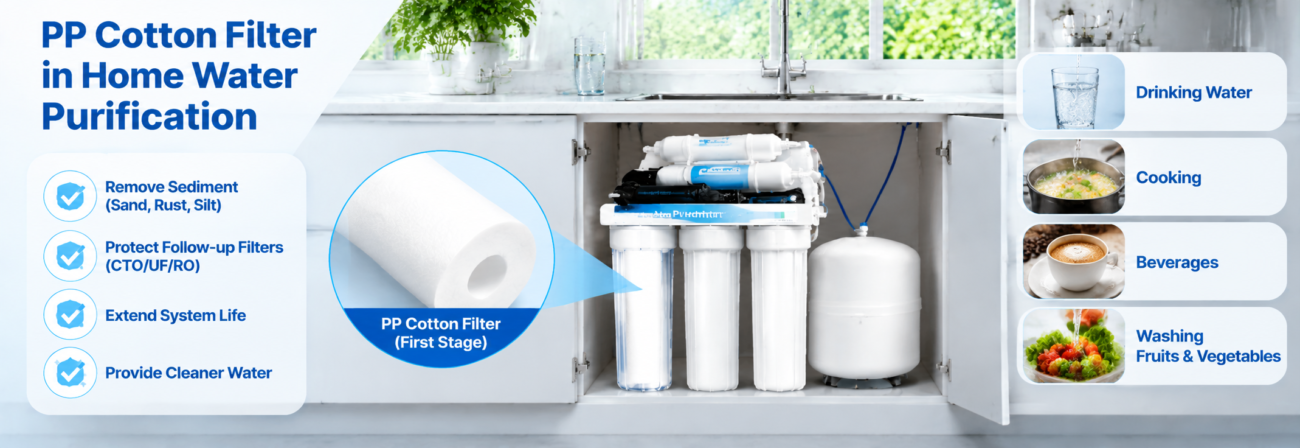
- Under the sink: keeps the carbon cartridge from clogging so it lasts its full life.
- In an RO purifier: the first stage takes the bulk of the sediment; a second, finer PP stage after the carbon catches carbon fines and anything smaller before the membrane.
- In front of a fridge or coffee machine: protects small inlet valves and screens that are expensive or awkward to replace.
Signs Your Water Needs More Than PP Cotton
A PP cotton filter can be doing its job perfectly while other problems remain:
- Chlorine smell or taste: add carbon after the PP stage.
- White scale on fixtures and in the kettle: hardness; add a softener or scale inhibitor.
- Orange or black staining that keeps returning: dissolved iron or manganese.
- Salty or flat taste, or a report showing nitrate or fluoride: RO.
- A positive bacteria test on a well: disinfection.
Choosing a Micron Rating
- 5 micron: the standard first stage on city water
- 1 micron: a fine second stage, ahead of carbon block or RO
- 20 to 50 micron: a coarse first stage for sandy wells
The full guide to ratings, sizes, and quality is in our PP cotton filter article.
How You Know It Is Working, and When It Is Done
- Working: clearer water, no grit in aerators, the cartridge gradually discoloring from outside in
- Done: lower flow, a growing pressure difference across the housing, or a cartridge discolored all the way through
Typical life is 3 to 6 months on city water, shorter on wells. See PP cotton replacement filters for replacement steps.
Common Misunderstandings
- “It purifies water.” It filters particles. Purification needs other stages.
- “Finer is always better.” A very fine cartridge alone on dirty water clogs quickly.
- “It can be washed and reused.” Washing disturbs the fiber structure; replace it.
- “White means clean.” A cartridge can look fine outside and still be loaded inside, or the reverse. Watch pressure and flow.
YourWaterGood PP Cotton Stages
Our systems put PP cotton to work in the positions described above:
- Our 3-stage whole house system starts with 1-micron high-density PP cotton, replaced every 3 to 6 months.
- Our 5-stage RO system uses 5-micron PP as stage 1 (3 to 6 months) and 1-micron PP as stage 3 (6 to 9 months).
Replacement cartridges are in our filter cartridge range.
For Installers, Property Managers and Brands
PP cotton cartridges are the most frequently replaced part in any system. We supply them in volume, with spec sheets and wholesale pricing on request.
FAQ
What does the PP cotton filter do in an RO system?
It removes sediment before the carbon and membrane stages, protecting them from clogging and fouling.
Does a PP cotton filter remove chlorine?
No. Chlorine is removed by activated carbon.
Is a PP cotton filter necessary?
In almost every system, yes. It is the cheapest stage and protects the more expensive ones.
How often should it be changed?
Commonly every 3 to 6 months on city water, sooner on wells or after main breaks.
Questions About Your System?
Tell us what your system is and what your water is like. We will explain what the PP cotton filter does in it and which rating fits. Installers can request wholesale pricing from YourWaterGood.