
Direct to Chip Liquid Cooling Water Treatment: Protecting the Cold Plate Loop

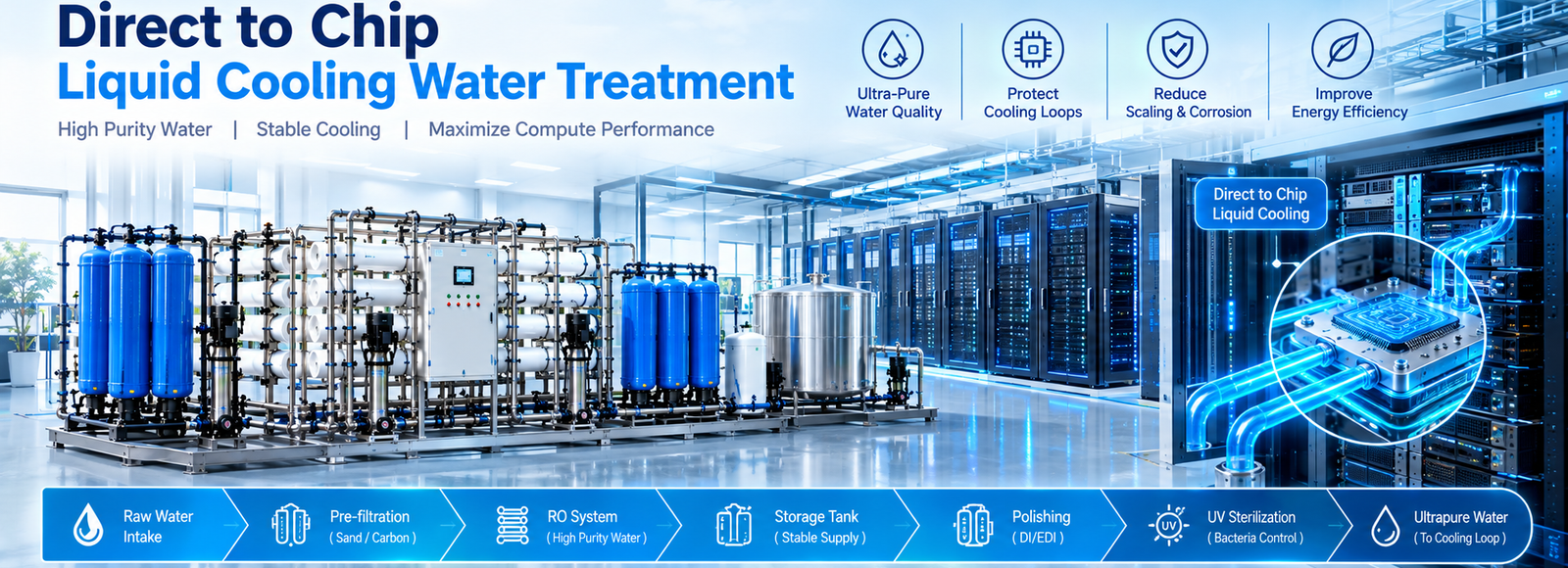
A cooling tower can tolerate water quality a cold plate loop never could. Confusing the two specs is the single most common design error on direct-to-chip retrofits.
Before sourcing water treatment for a DTC deployment, lock these into the RFQ:
- TCS loop fill purity: low-conductivity, low-hardness water at RO makeup quality — not municipal-grade softened water
- Facility water (FWS) vs. technology cooling system (TCS) separation: two distinct water quality specs, treated as two distinct engineering problems
- Dissimilar-metal compatibility: conductivity low enough to suppress galvanic current between copper cold plates and aluminum manifolds
- Continuous duty cycle: 24/7/365 automatic backwash — a DTC loop doesn’t get a scheduled outage to accommodate water treatment maintenance
- Online conductivity monitoring at the loop fill point, not just at the central plant header
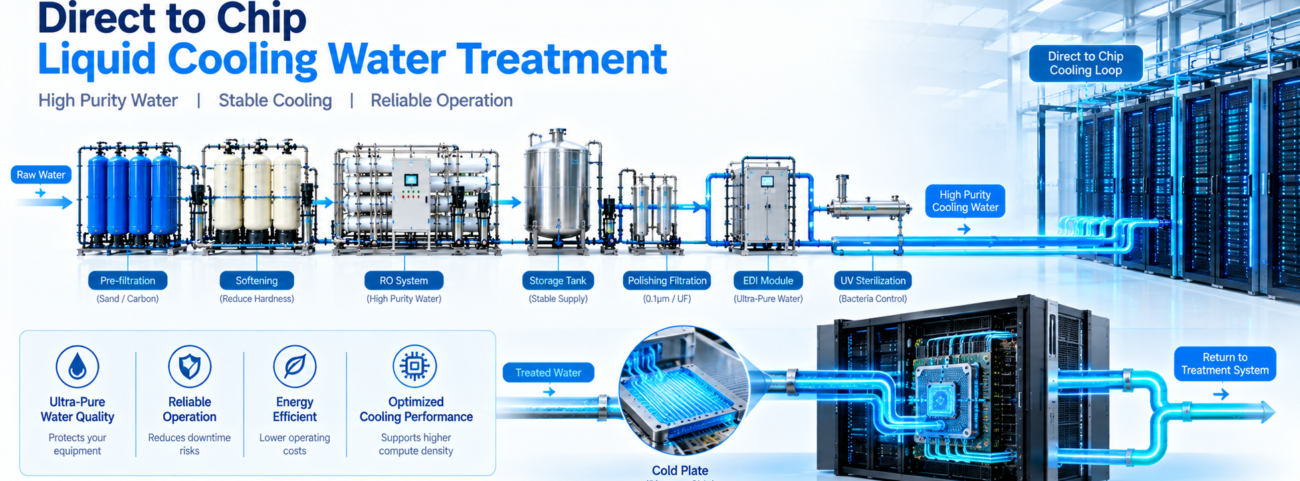
The rest of this piece is the engineering logic behind those five requirements — and where a modular direct to chip liquid cooling water treatment plant sits in a DTC deployment.
Fast Check Product: https://yourwatergood.com/product/industrial-reverse-osmosis-system/
Two Loops, Two Water Quality Problems: Facility Water vs. the Technology Cooling Loop
Most water quality failures on DTC deployments trace back to a single design assumption: that the facility water system (FWS) and the technology cooling system (TCS) can share a spec.
They can’t. The FWS — chilled water or condenser water feeding the CDU’s primary side — runs at cooling-tower-grade water quality, tolerant of moderate hardness and TDS because it never contacts a cold plate directly. The TCS — the secondary loop the CDU isolates and circulates through the cold plates themselves — has to meet a materially tighter spec, because it’s in direct contact with channels an order of magnitude narrower than anything a cooling tower loop ever sees.
Treating both loops against the same water quality target produces one of two outcomes: an FWS that’s expensively over-treated, or a TCS that’s dangerously under-treated. Neither is acceptable at 40 kW–100 kW+ rack density.
Why Cold Plate Micro-Channels Change the Water Spec Entirely
A cooling tower fill or a CRAC coil can run for years with a modest hardness slip-through and just lose a percentage of heat transfer efficiency. A cold plate micro-channel running under 100 microns doesn’t have that margin — a fraction of a millimeter of scale deposit is the difference between rated flow and a partially occluded channel.
Silica is the species that causes the most field trouble here. Standard ion-exchange softening removes calcium and magnesium hardness, but it doesn’t touch dissolved silica — and silica scale, once it deposits in a micro-channel, doesn’t redissolve the way calcium carbonate sometimes will under a pH swing. On a cooling tower, silica concentration is a water-chemistry management problem. Inside a cold plate, it’s a channel-occlusion problem, full stop.
That’s why TCS loop fill water needs to come from a full pretreatment train that pulls TDS down before the RO stage even runs — not just a softener bolted onto municipal supply.
Galvanic Corrosion in Mixed-Metal Cold Plate Loops — and Why Conductivity Is the Lever
Here’s the detail that doesn’t show up in most vendor spec sheets: cold plate loops are rarely single-metal systems. Copper cold plates, aluminum manifolds, stainless steel CDU internals, and brass fittings routinely coexist in the same TCS loop.
Put those dissimilar metals in contact with water carrying any meaningful ionic content, and you have the electrolyte half of a galvanic cell. The conductivity of the loop fill water is the direct lever on galvanic corrosion current — lower conductivity means a higher-resistance electrolyte path, which suppresses the corrosion current between the dissimilar metals, not just the risk of mineral scale.
This is a materially different design driver than the TDS target a cooling tower cares about. A tower operator manages TDS for scaling and cycles of concentration. A TCS loop operator manages conductivity for scaling and for the electrochemistry between every dissimilar-metal joint in the cold plate assembly. Low-conductivity RO water addresses both simultaneously — it’s not treating two problems with two different chemistries, it’s removing the ionic content that drives both.
Five-Stage Pretreatment as TCS Loop Fill and Makeup Water
A five-stage pretreatment train — multimedia filtration, activated carbon, ion-exchange softening on a dedicated brine-regenerated salt box, precision security filtration, and a final RO membrane array — is what produces water clean enough to fill or top off a TCS loop without introducing the scaling and corrosion risk described above.
Raw feedwater at roughly 1,300 mg/L TDS comes out under 20 mg/L TDS in a single RO pass, or under 10 mg/L across a two-stage configuration — the low end of that range is squarely in the purity band CDU manufacturers specify for cold plate loop fill.
Where the source is a municipal supply, chlorine removal at the activated carbon stage matters twice over: once to protect the RO membrane, and again because residual chlorine is itself corrosive to the same copper and aluminum surfaces the loop is trying to protect. Where the source is reclaimed or recycled water — increasingly common at drought-stressed hyperscale sites — the pretreatment train needs extra margin against the higher silica and TDS variability those sources typically carry, because a TCS loop has none of a cooling tower’s tolerance for an off-spec batch.
Monitoring the Loop: What a CDU Water Quality Alarm Should Actually Trigger
Facility teams frequently monitor TCS water quality without a clear answer for what an alarm should actually do.
Three instruments belong at the loop fill and makeup connection:
- Conductivity at the point of fill — the primary proxy for both scaling risk and galvanic corrosion potential in a mixed-metal loop
- Differential pressure (PSI) across the pretreatment train, tracked continuously — a rising trend at constant flow is the earliest sign of fouling upstream, well before it would show up as reduced makeup capacity
- Real-time flow monitoring on the makeup connection, so a CDU auto-fill event that pulls more volume than expected flags a possible loop leak before it becomes a bigger mechanical problem
An alarm without a defined response is just a log entry. Conductivity trending upward at the fill point should trigger a hold on TCS makeup and a pretreatment train inspection — not a note for the next scheduled PM cycle.
Request a Data Center Water Sizing Consultation to size a pretreatment train against your specific CDU manufacturer’s TCS fill-water specification, rather than a generic purity target.
OPEX and Capital Protection: Standard Skid vs. Data Center Grade System
| Parameter | Standard Pre-Engineered Skid | Data Center Grade High-Redundancy System |
|---|---|---|
| Flow control | Fixed setpoint, manual valve trim | PID-modulated, remote setpoint capability |
| Redundancy | Single train, no standby | N+1 / 2N parallel trains |
| Loop fill water quality | General-purpose softened/RO water | RO output validated against TCS purity targets |
| Controls integration | Local PLC readout | PLC standard; BMS/SCADA integration available as custom engineering |
| Typical lead time | 8–12 weeks | 12–20 weeks (engineered-to-order) |
| Filtration precision | 5-micron pre-RO cartridge | Down to 1-micron pre-RO stage, continuously monitored |
The capital case here is direct: cold plates, CDU heat exchangers, and manifold assemblies are among the most expensive line items in a DTC deployment, and their service life is a function of loop fill water quality, not just component metallurgy. A pretreatment train that under-delivers on TCS purity trades a modest equipment savings for a materially larger exposure on cold plate and CDU replacement cost.
BMS/SCADA integration is not a default feature on a standard skid — if conductivity alarms at the TCS fill point need to route into a central BMS or trigger automated shutoffs, specify that integration at RFQ stage rather than retrofitting it later.
Sizing direct to chip liquid cooling water treatment capacity against validated TCS purity targets — not a generic RO output spec — is what keeps cold plate replacement off the OPEX line entirely.
FAQ: Direct-to-Chip Liquid Cooling Water Treatment
What water quality does a direct-to-chip cold plate loop actually require? Low-conductivity, low-hardness water at RO makeup quality — typically under 20 mg/L TDS from a single-stage RO train, or under 10 mg/L from a two-stage configuration, well below what a cooling tower loop tolerates.
What’s the difference between FWS and TCS water quality requirements? The facility water system (FWS) feeds the CDU’s primary side and can tolerate cooling-tower-grade water quality; the technology cooling system (TCS) contacts the cold plates directly through channels under 100 microns and requires materially tighter purity.
Why does conductivity matter more than hardness in a cold plate loop? Cold plate loops typically mix copper, aluminum, and stainless steel components — conductivity governs both mineral scaling and the galvanic corrosion current between those dissimilar metals.
Can facility RO/softened water be used directly as TCS loop fill? Only if it’s been validated against the CDU manufacturer’s specific purity target — standard cooling tower makeup water quality is generally insufficient for direct cold plate loop fill.
What redundancy should facility water treatment carry for a DTC deployment? N+1 at the train level minimum, so a CIP cycle or cartridge changeout on one skid doesn’t interrupt TCS makeup capacity during live GPU operation.
Can reclaimed or recycled water be used as the source for a DTC facility water system? Yes, but the pretreatment train needs extra margin for the higher silica and TDS variability reclaimed sources typically carry — a TCS loop has far less tolerance for an off-spec batch than a cooling tower does.
What inlet pressure does a DTC-focused pretreatment skid require? A stable minimum of 0.2 MPa (about 29 PSI), with booster pump integration available where site pressure can’t guarantee that at the connection point.
A cold plate loop’s water quality spec isn’t a scaled-down version of a cooling tower spec — it’s a different engineering problem, driven by micro-channel geometry and mixed-metal electrochemistry rather than bulk scaling alone. Getting the pretreatment train wrong here doesn’t show up as reduced tower efficiency; it shows up as a cold plate replacement.
Get an Infrastructure Engineering Quote — request technical data sheets, TCS loop-fill purity validation against your CDU manufacturer’s spec, and B2B wholesale / factory-direct pricing for modular RO skid deployments.