
PP Cotton Filter: What It Is, What It Removes and How to Choose One

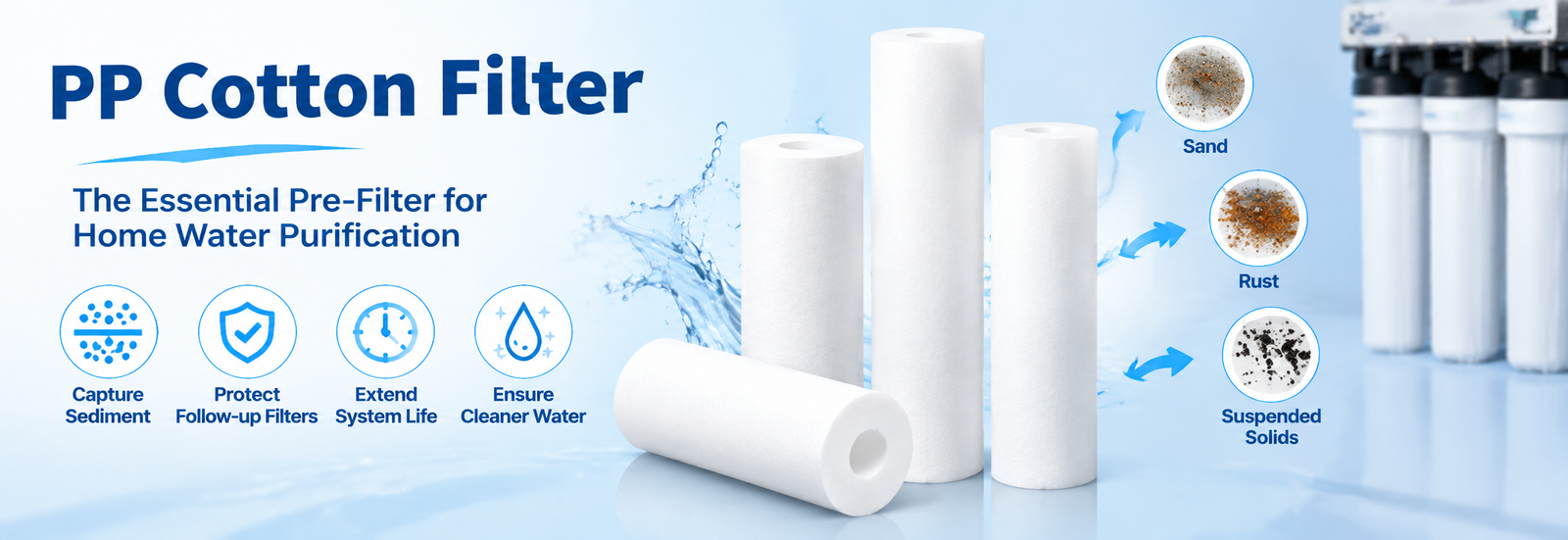
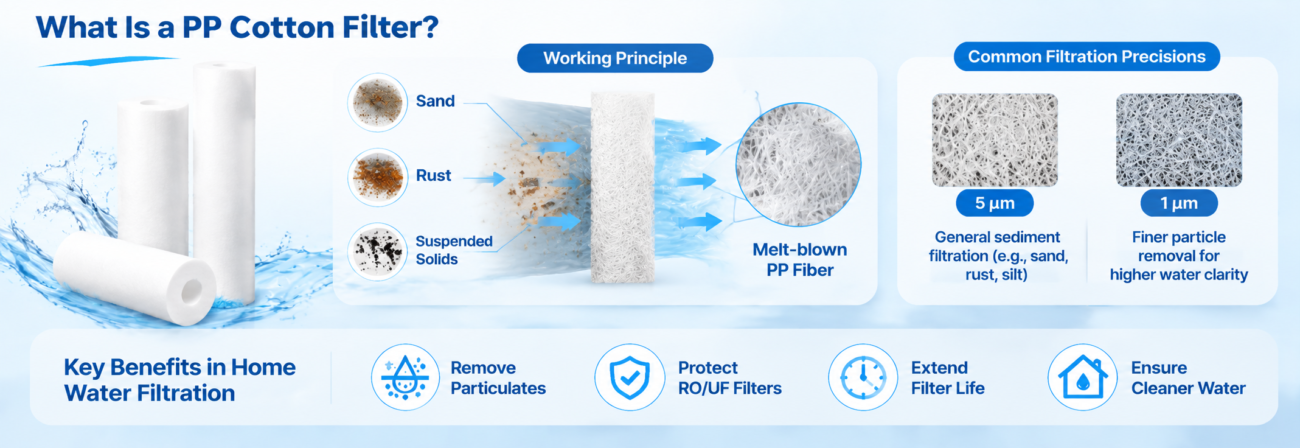
A PP cotton filter is a sediment cartridge made of melt-blown polypropylene fibers. It traps sand, silt, rust, and other suspended particles, and it is the first stage in most household water filters, RO purifiers, and whole house systems. It does not remove chlorine, hardness, or dissolved contaminants; it protects the stages that do.
The essentials:
- Material: food-grade polypropylene, melt-blown into a fibrous tube
- Removes: sand, silt, rust, scale flakes, fine particles
- Does not remove: chlorine, taste, hardness, dissolved salts, microorganisms
- Common ratings: 1, 5, 10, 20, and 50 micron
- Common sizes: 10-inch and 20-inch, in slim and 4.5-inch diameters
What “PP Cotton” Means
“PP” stands for polypropylene. “Cotton” describes how the cartridge looks and feels: a soft, white, fibrous tube, though it contains no actual cotton. During manufacturing, molten polypropylene is blown into fine fibers that build up around a core into a thick wall.
Our what does cotton do in a water filter article explains the name and material in more detail.
How It Filters
Most PP cotton cartridges use depth filtration. The fibers are looser near the outside and tighter toward the core. Large particles stop in the outer layers; fine particles travel deeper before they are caught. Because dirt is held through the whole wall, not just on the surface, the cartridge can hold a lot before pressure falls.
Ratings are usually nominal: the cartridge catches most particles at the stated size, not every one.
Micron Ratings
| Rating | Typical use |
|---|---|
| 50 micron | First stage on sandy wells |
| 20 micron | Coarse pre-filter ahead of finer stages |
| 10 micron | General sediment control |
| 5 micron | Standard first stage on city water and in RO systems |
| 1 micron | Fine polishing ahead of carbon blocks and RO membranes |
On dirty water, stage the ratings, for example 5 micron then 1 micron, rather than using one very fine cartridge.
Where PP Cotton Sits in a System
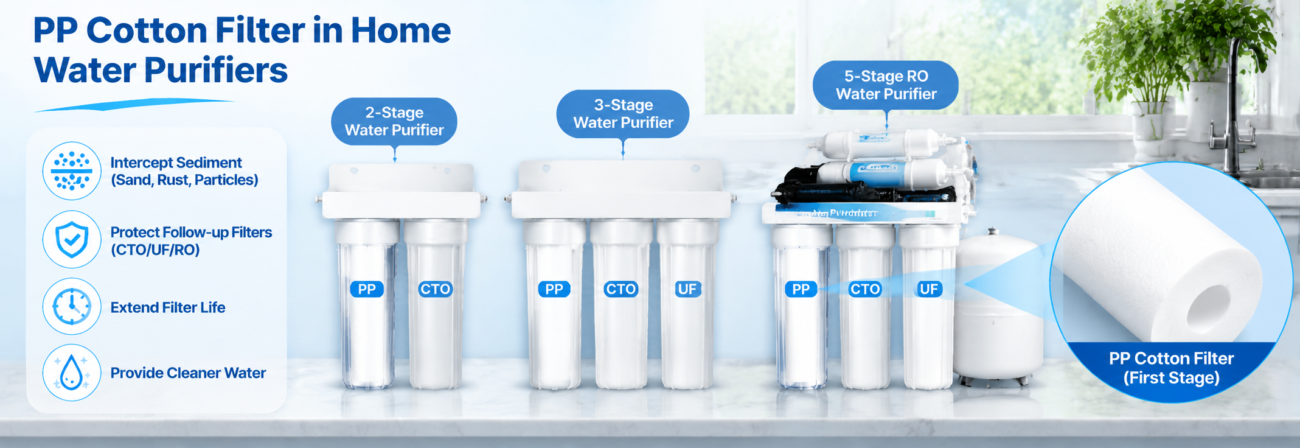
- Whole house filters: first stage on the main line, protecting carbon, softeners, and appliances
- RO purifiers: first stage (often 5 micron) and sometimes a later fine stage (1 micron)
- Under-sink filters: ahead of a carbon cartridge
- Appliance protection: ahead of ice machines and coffee machines
What it is paired with depends on the job: carbon for chlorine and taste, a scale inhibitor for hard water. See PP cotton with a carbon core and PP cotton with anti-scale.
What It Does Not Do
- Remove chlorine, taste, or odor: add carbon
- Soften water or stop scale: add a softener or scale inhibitor
- Remove dissolved iron, lead, or salts: use dedicated treatment or RO
- Disinfect: PP cotton is not a microbial barrier
For a plain-language summary, see what does the PP cotton filter do.
PP Cotton vs Other Sediment Media
| Media | Filtration type | Strengths | Weaknesses |
|---|---|---|---|
| PP cotton (melt-blown) | Depth | High dirt-holding for its size, inexpensive, wide range of ratings | Disposable |
| Pleated polyester | Surface | Low pressure drop, some are rinsable | Loads fast once the surface is covered |
| String-wound | Depth (coarser) | Handles higher flow and coarse sediment | Less effective on fine particles |
| Spin-down screen | Surface (mesh) | Reusable, flushable, good for sand | Only catches coarser particles |
For general household sediment control, PP cotton is the default for good reason. Spin-down screens and string-wound cartridges are useful ahead of it on sandy wells.
Quality Differences You Can Check
Two PP cotton cartridges with the same micron rating can perform very differently. Things you can check before buying in quantity:
- Weight and density: a denser cartridge of the same size generally contains more media, though rated flow and real service life are the true tests.
- Graded density: a looser outer layer and tighter inner layer hold more dirt than a uniform wall.
- Even outer diameter and straight ends: uneven cartridges seal poorly against the housing.
- End-cap sealing surfaces: smooth, flat ends that seat cleanly on the housing’s knife edges.
- No odor or loose fibers when unwrapped and flushed.
- Consistent length: “10-inch” cartridges vary; check against your housing.
Disposal
Spent PP cotton cartridges hold the sediment they caught. Most local programs treat them as household waste. Polypropylene is recyclable in principle, but used cartridges are rarely accepted because of the trapped dirt; check local rules.
How to Choose One
- Match the size to your housing: length, diameter, and end caps. A cartridge too short for its housing lets water bypass it.
- Pick the micron rating for its position and your water.
- Check density and construction. Graded-density, melt-blown cartridges hold more dirt than uniform ones.
- Check the temperature limit. PP cotton is designed for cold water.
- Confirm it is food-grade polypropylene for drinking water use.
When to Replace It
- Typical: every 3 to 6 months on city water, sooner on wells
- Pressure: when the pressure difference across the housing grows noticeably
- Flow: when taps or the purifier faucet slow down
- Appearance: when the cartridge is discolored through to the core
Our PP cotton replacement filters article covers replacement in detail.
Troubleshooting
- Clogs within weeks: the rating is too fine for your water; add a coarser stage.
- Dark outside, clean inside: same issue.
- Orange coating: dissolved iron oxidizing in the housing; needs iron treatment.
- Grit still getting through: cartridge too short or not seated, or the rating is too coarse.
Commercial Uses
The same cartridges protect ice machines, coffee machines, and kitchen equipment. See PP cotton filter for ice machine.
YourWaterGood PP Cotton Cartridges
We supply PP cotton cartridges in our replacement filter cartridge range:
- 1-micron high-density PP cotton is the first stage of our 3-stage whole house system, replaced every 3 to 6 months.
- Our 5-stage RO system uses 5-micron PP first (3 to 6 months) and 1-micron PP as its third stage (6 to 9 months).
- Our 2-stage systems use a PP cotton and FPF composite first stage.
For Installers, Property Managers and Brands
PP cotton cartridges are the highest-volume consumable in water filtration. We supply them in common sizes and ratings, in volume, with spec sheets and wholesale pricing on request.
FAQ
What is a PP cotton filter made of?
Melt-blown polypropylene fibers formed into a thick tube. It contains no actual cotton.
What does a PP cotton filter remove?
Sand, silt, rust, scale flakes, and other suspended particles.
How long does a PP cotton filter last?
Commonly 3 to 6 months on city water and less on wells. Watch pressure and flow.
Can a PP cotton filter remove bacteria?
No. It is a sediment filter, not a microbial barrier.
Which micron PP cotton filter should I use?
5 micron for most first stages; 1 micron for fine polishing after a coarser stage; 20 to 50 micron for sandy wells.
Need PP Cotton Cartridges?
Tell us your housing size and water source. We will recommend the right PP cotton filter rating and size. Installers and brands can request wholesale pricing from YourWaterGood.