
Do I Need A Whole House Water Filter — A Practical, Test-First Guide For Homeowners


If you’ve typed do i need a whole house water filter into a search box, you’re doing the sensible thing: trying to decide whether a single purchase can improve water across your whole house — for showers, laundry, dishwashers, and taps — or whether a smaller, cheaper point-of-use solution is better. The short answer is: it depends. The long answer is everything you’ll need to make the decision confident, practical, and cost-effective.
This guide walks you through the decision step by step: how to test your water, signs that a whole-house (point-of-entry) system makes sense, common technologies and what each fixes (and doesn’t), cost and maintenance expectations, installation realities, environmental trade-offs, and a compact decision checklist you can use today. I’ll also point you to where to compare models and specs — for example, you can review product details at https://yourwatergood.com/. Read this before you spend a dime.
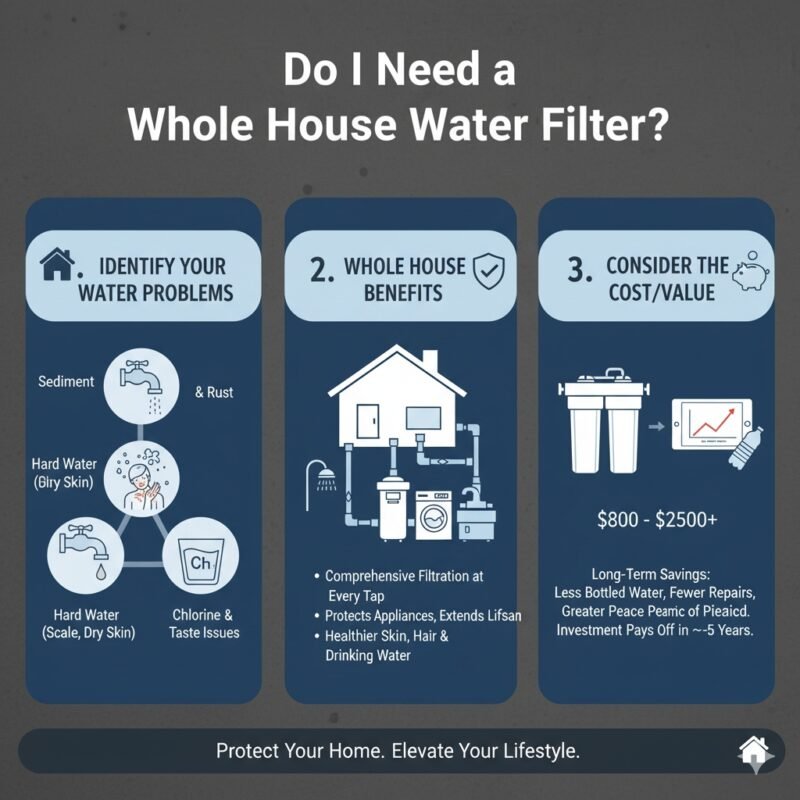
Quick summary (the one-paragraph answer)
Do i need a whole house water filter? If your water problems affect more than just drinking water — for example, visible sediment, scale on appliances, bath/shower skin irritation, chlorine smell in every tap, iron staining, or recurring microbial issues — then a properly sized whole-house system is often worth the investment. If your only concern is drinking water quality, a point-of-use under-sink system (like a reverse osmosis or certified carbon filter) may be a far cheaper, lower-maintenance solution.
1. Start smart: test your water first
The single most important step before deciding whether you need a whole-house water filter is a water test. Don’t guess.
- Municipal customers: download your Consumer Confidence Report (CCR) from the water supplier. This annual report lists regulated contaminants and typical concentrations in your distribution system.
- Well owners: get a certified laboratory test. Essential tests include bacteria (total coliform and E. coli), nitrates, lead, arsenic, iron, hardness, TDS (total dissolved solids), pH, and, depending on location, pesticides or VOCs.
- Home test kits: good for quick screening (hardness, chlorine, basic lead screens), but follow up with lab testing for health-related decisions.
Record the actual numbers. These will define the treatment needed. For example, chlorine taste in your CCR points to carbon; high hardness means softening or scale control; lead in a home plumbing sample points to point-of-use mitigation for drinking water.
2. Why people consider whole-house filters — common homeowner problems
Whole-house systems treat water at the point it enters your home (POE — point-of-entry), so every faucet, shower, and appliance gets the same treated water. Homeowners opt for POE systems for several reasons:
- Sediment and particulate: visible grit, sand, or brownish water that soils clothes or clogs appliances.
- Chlorine taste and odor: chlorine in municipal water leaves a strong smell in showers and affects soap performance.
- Hard water scaling: calcium and magnesium cause scale on heaters, faucets, and inside appliances — shortening appliance life and lowering efficiency.
- Iron and manganese staining: rusty or brown stains on fixtures and laundry.
- Hydrogen sulfide smells: rotten-egg odors from wells.
- Protection of plumbing and appliances: whole-house filtration keeps pipes and water-using appliances cleaner and more efficient.
- Dermal comfort: some people notice less dryness or irritation when chlorine or chloramines are reduced in shower water.
- Aesthetic and convenience: treating the entire home avoids multiple local filters and can improve dishwasher and laundry performance.
If more than one of these problems affects multiple taps and fixtures, a whole-house system is more likely to be the right choice.
3. What a whole-house water filter can and cannot do
It’s essential to know the limits of whole-house systems:
What whole-house filters commonly do well
- Remove suspended solids and visible sediment with sediment housings or backwashing prefilters.
- Reduce chlorine taste and odor using granular activated carbon (GAC) or catalytic carbon in large tanks.
- Soften water (prevent scale) using ion-exchange softeners or salt-free scale conditioners (with different trade-offs).
- Remove iron and manganese using dedicated iron filtration media or oxidation + filtration systems.
- Provide broad protection for plumbing and appliances.
What whole-house filters are not ideal for
- Delivering drinking-water-grade removal of dissolved heavy metals (e.g., lead at the tap), fluoride, or nitrates — these are typically handled best by point-of-use systems such as reverse osmosis (RO).
- Guaranteeing microbiological safety (bacteria/viruses) unless a disinfection step like UV is added. Even then, UV requires clear water and good prefiltration.
- Eliminating the need for point-of-use polishing in homes with specific drinking-water concerns (e.g., lead in household plumbing).
In many homes, the best approach is a hybrid: whole-house filters for sediment/chlorine/softening plus a POU drinking-water system for the kitchen.
4. Whole-house treatment technologies — which one fixes which problem
Here’s a concise map of whole-house technologies and their ideal uses:
Sediment filters
- Use for: sand, silt, rust, particulate removal.
- Format: cartridge housings or large backwashing media.
- Notes: Protect downstream media (carbon, softeners, UV).
Granular activated carbon (GAC) or carbon block tanks
- Use for: chlorine taste/odor, many organics, some VOCs; catalytic carbon handles chloramines better.
- Notes: Carbon protects skin and hair from chlorine; carbon media needs periodic replacement or reactivation.
Water softeners (ion exchange)
- Use for: hardness (calcium/magnesium) to prevent scale.
- Notes: Adds sodium (unless potassium used), requires salt and backwashing, can be regulated in some municipalities due to brine discharge.
Salt-free scale control / Template Assisted Crystallization (TAC)
- Use for: reduce scale by altering mineral behavior without adding salt.
- Notes: Doesn’t remove hardness ions; effectiveness depends on water chemistry and may not suit all homes.
Iron / manganese removal systems
- Use for: dissolved or particulate iron and manganese that stain or foul systems.
- Formats: greensand, catalytic media, oxidation and filtration systems.
UV disinfection
- Use for: inactivation of bacteria, viruses, and protozoa — best for well water where microbial risk exists.
- Notes: Requires clear water (pre-filtration) and periodic lamp replacement.
Whole-house reverse osmosis (rare)
- Use for: full-house removal of dissolved solids — very expensive, high wastewater, and typically unnecessary; more common for specialty facilities than homes.
Selecting the right combination depends on your test results. Often the practical solution is sediment + carbon at POE, plus POU RO if dissolved contaminants are found in drinking water tests.
5. Signs you probably don’t need a whole-house filter
Not every home benefits from POE treatment. Whole-house systems are larger, costlier, and require more maintenance than small POU devices. You may not need a whole-house filter if:
- Your CCR shows regulated contaminants well within limits and your only complaint is that tap water sometimes tastes a little off — a simple under-sink carbon or pitcher filter may suffice.
- You have no visible sediment, no scale problems, and your laundry and appliances show no staining or premature failure.
- Your concern is only about drinking water contaminants (e.g., trace lead or PFAS) localized to the kitchen — an under-sink RO or certified POU carbon filter is the most efficient choice.
- You rent or plan to move soon and don’t want the upfront cost or permanent plumbing changes.
Always run a water test first to avoid unnecessary expense.
6. Costs: what to expect to pay (realistic ranges)
Whole-house systems can vary widely based on complexity:
- Basic sediment + single carbon vessel (entry-level): $800–$2,000 installed.
- Whole-house carbon + larger flow tanks (better resale & capacity): $1,200–$3,000 installed.
- Water softener (POE) installed: $800–$2,500 depending on capacity and brand.
- Iron removal systems + UV + controls (well systems): $2,000–$7,000+ depending on media and complexity.
- High-end multi-stage systems or whole-house RO: $10,000+ (rare for typical homes).
Ongoing costs include media replacement, salt for softeners, UV lamp changes, and occasional professional servicing. Budget $100–$800 per year depending on system complexity and water quality.
A hybrid approach (whole-house prefiltration + under-sink RO) often balances cost and performance.
7. Installation and plumbing realities
Whole-house filters are installed at the main water entry. Installation considerations:
- Space: systems are typically installed in basements, garages, or utility rooms — you need enough room for tanks and bypass valves.
- Plumbing modifications: a licensed plumber is often recommended or required; you’ll need shutoffs, bypass arrangements, and sometimes pressure regulators.
- Permits: some jurisdictions require permits for POE installs — check local plumbing codes.
- Electrical: UV or booster pumps require a safe electrical supply.
- Drainage: iron removal and backwash systems discharge wastewater that must go to a drain or approved area (check local laws).
Plan for a professional assessment if your main line is hard to access or your install involves electrical or drain work.
8. Maintenance: what you’ll actually need to do
Whole-house systems reduce some hassles but introduce others. Typical maintenance tasks:
- Replace sediment/carbon cartridges on a schedule (varies from 6–24 months depending on flow and loading).
- Replace or reactivate carbon media in tanks every few years (timeline depends on volume and contaminant load).
- Add salt to softeners regularly (every few weeks to months depending on usage).
- Clean or replace iron media when performance declines.
- Replace UV lamp annually and clean quartz sleeve as required.
- Monitor pressure drops across filters — rising drop indicates a clogged cartridge.
Professional annual service is common for complex systems and often recommended for warranties.
9. Health & safety considerations
Whole-house filters improve many comfort and appliance issues, but consider these health points:
- Point-of-use for drinking water: if lead is a concern (old plumbing), a dedicated under-sink filter certified for lead removal or a reverse osmosis system at the kitchen tap is advised — whole-house systems do not guarantee drinking-water-grade treatment at every faucet.
- Microbial risk: if bacteria are present, add UV disinfection and plan for periodic testing — whole-house filtration without disinfection is not enough for contaminated wells.
- Chemical trade-offs: softeners exchange hardness ions for sodium or potassium — people on low-sodium diets may need to consider this when installing salt-based softeners or choose POU RO for drinking water.
Retest after installing any system to confirm it delivers the expected improvements.
10. Environmental considerations and trade-offs
Whole-house systems and softeners have environmental impacts:
- Softener brine discharge: salt-based softeners produce saline wastewater that may affect septic systems or municipal treatment facilities; some municipalities restrict salt-based softeners. Consider potassium chloride or salt-free alternatives if this is a concern.
- Carbon media disposal/replacement: used media and cartridges are plastic and must be responsibly disposed of or recycled if possible.
- Water use: backwashing filters and softeners use water — plan for the added water demand.
- Energy: UV lamps and pumps consume electricity.
If sustainability is a priority, ask vendors about high-efficiency models, backwash minimization, and recycling programs.
11. How to choose the right whole-house system — step-by-step
- Get reliable water testing. Lab tests for wells; CCR + targeted tests for municipal systems.
- List the problems you experience. Note where they happen (every tap? only shower? only cold water?).
- Match technology to problem. Use sediment for grit, carbon for chlorine, softeners for scale, iron media for staining, UV for microbes.
- Decide scope: POE only, or POE + POU for kitchen? Consider POU RO at the kitchen for drinking water if necessary.
- Get 3 itemized quotes from licensed installers. Compare equipment, labor, permits, and maintenance contracts.
- Check certifications and media specs. Particularly for carbon and specialty media (PFAS, arsenic).
- Ask about ongoing consumable costs and service intervals.
- Plan for retesting 2–4 weeks after installation to validate performance.
Keep documentation and invoices for warranties and future owners.
12. Typical homeowner scenarios and recommended paths
- City home, chlorine taste everywhere: Whole-house carbon vessel + under-sink carbon polish for drinking.
- Older home with lead risk in piping: Replace suspect plumbing, use POU certified filters or RO at kitchen tap; consider whole-house carbon for other benefits.
- Well with bacterial issues: Install sediment prefilter + UV disinfection + consider POU RO for drinking. Retest frequently.
- Hard water causing scale: POE water softener + POU RO for drinking water if desired. Consider salt-free alternatives only after understanding local effectiveness.
- Iron staining: Iron removal media at POE targeted to the iron speciation in your water.
Tailor the solution to the specific problem and budget.
13. Questions to ask vendors and installers
- What exactly does this system remove (ask for data)?
- Do you provide model-specific test reports or certifications?
- What is the expected lifespan of media and what are replacement costs?
- How often will the system need service, and what does a typical service include?
- Will you handle permits and code compliance?
- What warranties apply and what do they cover?
- Can you provide references from recent similar installations?
A good vendor will give clear, written answers.
14. Decision checklist — should you install a whole-house filter?
Check each item that applies to your home:
- Lab/CCR shows contaminants (beyond aesthetic) affecting multiple taps.
- Visible sediment or particles appear in water.
- Appliances show scale or reduced lifetime.
- Showers and laundry are affected by chlorine or taste problems.
- Iron staining or rotten-egg smells are present.
- You want to protect plumbing and appliances and are willing to maintain a POE system.
If you checked two or more boxes, a whole-house system likely makes sense. If your only concern is drinking water, consider a point-of-use system first.
15. Final recommendations and next steps
So — do i need a whole house water filter? Use this short decision path:
- Test your water (CCR or lab).
- Identify the problems that affect more than one tap or your appliances.
- If problems are broad (sediment, chlorine, hardness, iron, microbial), get POE quotes and consider whole-house treatment.
- If your concern is only drinking-water contaminants (lead, PFAS, high TDS), opt for a point-of-use under-sink RO or certified carbon filter and save $$$.
If you’re ready to compare systems and model specs, start by reviewing certified products and technical sheets at https://yourwatergood.com/. Gather your water test results, then request at least three itemized quotes from reputable local installers to understand the true installed cost and maintenance obligations. Install, then re-test to confirm the system meets your needs.
Closing note
Installing a whole-house filter is a significant, useful investment — but only when matched to real, house-wide problems. Test first, choose the right technology for your contaminants, plan maintenance, and verify performance after installation. By following the checklist above you’ll answer “do i need a whole house water filter” with confidence, not guesswork — and you’ll avoid spending money on the wrong solution.