
Filters for Hard Water: How to Choose, Install, and Maintain the Right System for Your Home

This topic is covered in full in our main guide: Water Filter for Hard Water — What Works, What Doesn’t, and How to Choose the Right System.
Hard water is one of those quietly expensive problems: it does its damage slowly — scaling pipes, shortening appliance life, leaving spots on glassware — but the cumulative cost is significant. If you’re searching for “filters for hard water,” you want practical solutions that actually reduce scale, improve soap performance, and protect equipment without introducing new headaches. This guide walks you through everything you need to decide confidently: what hard water is, how it’s measured, the technologies that work (and those that don’t), how to size systems, installation and maintenance realities, environmental trade-offs, and real-world purchase and vendor-checklist items. Where relevant, you’ll find pointers to point-of-use complements and product pages for further exploration.YourWaterGood
What “filters for hard water” really means
The phrase “filters for hard water” is a practical shorthand that can mean different things depending on the user’s goal:
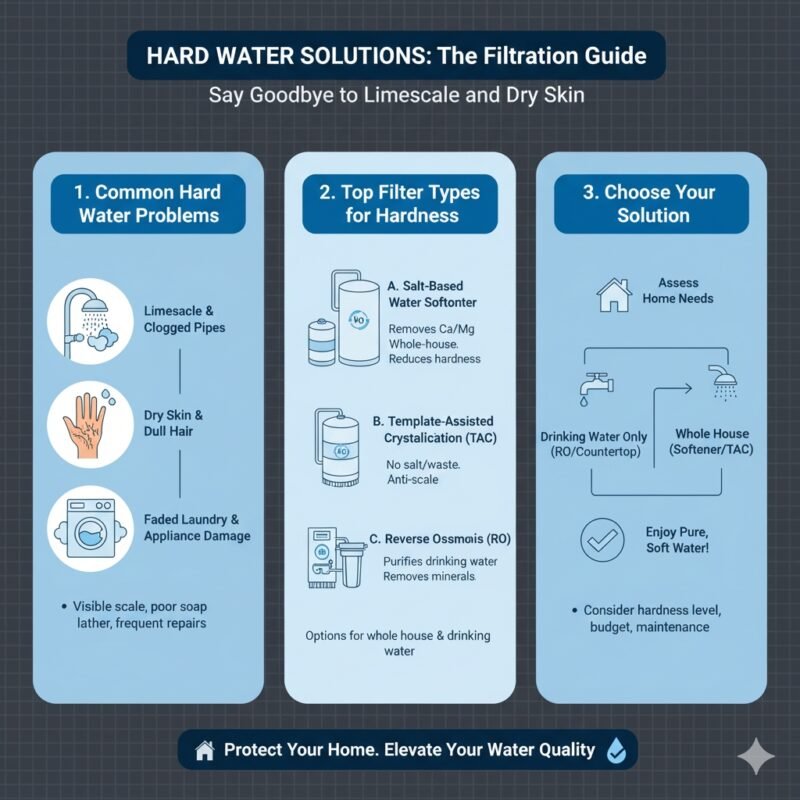
- If your priority is to remove dissolved calcium and magnesium (actual hardness) from the water so appliances and plumbing stop scaling, you are generally looking at whole-house solutions such as ion-exchange softeners.
- If your priority is to reduce the effects of hardness (scale control) without removing minerals, you might consider salt-free conditioners or catalytic media.
- If your priority is the best possible drinking water, you’ll likely pair a whole-house system with a point-of-use (POU) reverse osmosis (RO) or carbon filter at the kitchen sink.
- Some commercial and industrial settings use chemical antiscalants or specialized filtration; these aren’t typical for single-family homes.
So when you search for “filters for hard water,” the right answer depends on whether you want to remove hardness, mitigate its effects, or simply protect specific appliances.
How hard is your water? — Testing and interpretation
Before buying any system, test your water. Hardness is typically reported as grains per gallon (gpg) or milligrams per liter (mg/L as CaCO₃). Typical interpretation:
- 0–3.5 gpg (0–60 mg/L): soft to moderately soft
- 3.5–7 gpg (60–120 mg/L): moderately hard
- 7–10.5 gpg (120–180 mg/L): hard
- 10.5 gpg (>180 mg/L): very hard
Methods to test:
- Municipal customers: check your local water utility’s Consumer Confidence Report (CCR) for baseline hardness and TDS.
- Private wells: send a sample to a certified lab for a full panel (hardness, iron, manganese, pH, TDS, chloride).
- DIY kits and digital test strips: useful for a quick read, but less precise than lab tests.
Important: also test for iron and manganese if you have a well. These foul softening resins and can complicate treatment.
Technology options: what works and when
Below are the main technologies people use when they search for “filters for hard water,” with pros, cons, and best-use cases.
- Ion-exchange water softeners (salt-based)
How they work: Resin beads exchange sodium (or potassium) ions for calcium and magnesium, effectively removing hardness ions from water. When resin saturates, the system regenerates using a brine solution.
Pros:
- Reduces hardness to near-zero — the most effective whole-house solution for preventing scale.
- Well-established, predictable performance and service models.
- Strong soap performance improvements and real appliance protection.
Cons:
- Adds sodium (or potassium) to treated water. Sodium levels added are small but may concern people on low-sodium diets (potassium chloride can be used as an alternative).
- Requires periodic salt refills and a drain for brine discharge.
- Uses water for regeneration (though demand-initiated controllers minimize waste).
- Some municipalities restrict brine discharge.
Best for: Homes with hard or very hard water (>7 gpg) where full protection of plumbing and appliances is the goal.
Sizing and selection notes:
- Size based on daily water use and measured hardness (gallons/day × gpg = grains/day).
- Choose resin capacity (in grains) to target a reasonable regeneration frequency (e.g., every 7–14 days).
- Prefer metered, demand-initiated regeneration controllers over timer-based systems for efficiency.
- Salt-free conditioners (TAC, template-assisted crystallization)
How they work: Media (e.g., TAC) changes the form of scale-forming minerals into microscopic, inert crystals that remain suspended and do not adhere to surfaces.
Pros:
- No salt, no brine discharge, minimal maintenance.
- Retains minerals in water (no sodium added).
- Attractive where salt discharge is restricted or for low-maintenance needs.
Cons:
- They don’t “soften” water in the chemical sense (hardness numbers don’t fall).
- Effectiveness varies with water chemistry, flow rates, and temperature.
- May not prevent scale in very hard water or complex chemistries (iron, high silica).
Best for: Areas with moderate hardness where homeowners prioritize environmental concerns or where brine discharge is restricted. Good for rental properties and low-maintenance applications.
- Magnetic / electronic descalers (physical treatments)
How they work: Claim to alter mineral crystallization via electromagnetic fields.
Reality check:
- Evidence is mixed and highly dependent on water chemistry.
- Some users report improvement; many controlled tests show marginal effect.
- These are best used only after trialing in your specific water conditions, not as a first-line recommendation for severe hardness.
Best for: Low-risk experiments on moderate hardness when homeowners want zero-maintenance options and are willing to test results.
- Reverse osmosis (RO) — point-of-use systems
How they work: Semi-permeable membranes remove dissolved solids, including some hardness ions. Usually installed at a single tap (under-sink) rather than whole-home.
Pros:
- Produces very high-quality drinking water with low TDS.
- Removes sodium added by softeners at the drinking tap if desired.
Cons:
- Not practical as a whole-house solution due to water waste and flow limitations.
- Requires pre-filters to protect the membrane and periodic maintenance.
Best for: Drinking water stations while using another POE system to protect appliances.
- Chelants and antiscalants (specialized)
How they work: Chemicals prevent scale by sequestering hardness ions or altering crystal formation. Typically used in industrial contexts or specialized household applications.
Pros:
- Effective for difficult chemistries when controlled dosing is feasible.
Cons:
- Requires dosing equipment and oversight; not typical for standard residential installs.
Best for: Specialist industrial or high-hardness problem areas where other methods fail.
Comparing the options: a practical matrix
- Absolute hardness removal? Ion-exchange softeners (yes), RO (yes at POU), TAC (no).
- Environmental concerns (no brine)? TAC, RO (POU) are better.
- Low maintenance? TAC, magnetic descalers (if effective) win.
- Best for appliances and plumbing? Ion-exchange softeners.
- Best for drinking water? RO at the tap.
How to decide: a step-by-step selection process
- Test your water first (hardness, iron, TDS, pH).
- Define priorities: whole-house protection vs drinking-water taste/health.
- If hardness >7 gpg and you want full protection, choose an ion-exchange softener (unless brine discharge is prohibited).
- If you must avoid salt and hardness is moderate, test a TAC-based system in a pilot installation.
- If you want both appliance protection and pure drinking water, pair a POE solution (softener or conditioner) with a POU RO system for the kitchen.
- If iron is present, treat iron first; iron fouls resin and reduces effectiveness.
- Always size systems to actual household demand and plan maintenance intervals.
Sizing examples and practical math
Sizing an ion-exchange softener requires two numbers: household daily water use and hardness (gpg).
Example:
- Household: 4 people × 60 gallons/day/person = 240 gallons/day.
- Measured hardness: 10 gpg.
- Daily grains = 240 × 10 = 2,400 grains/day.
- Choose a 32,000-grain softener → regen interval ≈ 32,000 / 2,400 ≈ 13.3 days (good).
- Salt per regeneration varies by efficiency; modern systems often use less salt and less water per cycle.
Important: Over-sizing slightly improves resin life and reduces regeneration frequency but increases upfront cost.
Installation realities and placement
- POE softeners: install after water meter and before hot-water tank if you want soft hot water. Provide a bypass valve for servicing. Ensure a drain for brine and an accessible brine tank location.
- TAC or catalytic units: install similarly as POE and ensure sufficient contact time (follow manufacturer flow recommendations).
- RO units: under-sink installs need storage tanks and drain connections; plan faucet placement and pre/post-filter access.
Maintenance and common pitfalls
Ion-exchange softeners:
- Regularly replenish salt; check for salt bridging (hardened ridges in the brine tank).
- Periodically inspect and clean brine tanks if sludge forms.
- Replace resin only when exhausted or fouled; good maintenance and pre-filtration extend resin life.
- Use metered controllers to reduce unnecessary regeneration.
TAC / salt-free systems:
- Replace media per manufacturer schedule.
- Monitor performance and check for visible scale over time. Pilot installations are highly recommended.
RO systems:
- Replace pre- and post-filters on schedule; replace membranes per usage and feed-water quality.
- Keep an eye on TDS readings to detect membrane failure.
Common customer mistakes:
- Not testing water before buying.
- Installing softeners without addressing dissolved iron or high TDS.
- Buying undersized units for household demand.
- Ignoring maintenance intervals and expecting lifetime performance without service.
Environmental considerations and local regulations
- Brine discharge: some municipalities restrict or ban salt-based softener discharge. Check local rules first.
- Water use: softeners consume water in regeneration; modern metered systems minimize waste.
- Salt alternatives: potassium chloride avoids sodium discharge but costs more.
- Recycling: choose durable housings and replaceable media over sealed disposable modules where possible.
Practical purchasing checklist for “filters for hard water”
Before you buy, ask the following:
- What is my feed water hardness and chemistry? (Get a lab test.)
- What is the primary objective — whole-house protection, drinking water, or both?
- Will local codes allow a salt-based softener?
- What is the recommended system size for my household daily grains?
- Does the vendor provide performance data (regen salt/water per cycle, resin capacity, TAC contact time)?
- Are service parts and replacement media readily available locally?
- What warranty and RMA process does the vendor offer?
- Can I pilot the system first (especially for TAC or new tech)?
- Do I need pre-treatment (iron, sediment) before installing the main system?
- How will I handle maintenance — self-service or a service contract?
Pairing whole-home solutions with point-of-use systems
Even after installing a POE softener or conditioner, you may want better tasting drinking water or low-mineral water for appliances like espresso machines. The sensible pattern:
- POE softener or conditioner for plumbing and appliances.
- POU RO (under-sink) for drinking water and cooking; RO removes sodium if you used a salt-based softener and removes other dissolved contaminants.
- Use carbon pre-filters to protect RO membranes and improve taste.
Where to learn more and product exploration
When comparing specific products or researching replacement cartridges and membranes, manufacturer product pages and spec sheets are helpful starting points. For POUs and complementary products, vendor resources can show technical specifications and maintenance guides; these can speed up installation and specification conversations.
Conclusion: matching technology to goals
When searching for “filters for hard water,” there’s no single universal answer — the right solution depends on measured hardness levels, local regulations, homeowner priorities, and installation constraints. For real scale control across a whole home, ion-exchange softeners are the gold standard — provided you can manage salt and brine. If you must avoid salt or prefer low maintenance, salt-free conditioners are a reasonable alternative in moderate hardness situations but require careful pilot testing. For drinking water, always consider a point-of-use RO to deliver the best taste and mineral profile.
Start with a reliable water test, define your objectives, size systems appropriately, and prioritize vendors who publish measurable performance data, provide service support, and allow pilots where necessary. By combining a properly sized POE solution with targeted POU filtration where needed, you’ll protect your home, save on appliance repair and energy costs, and enjoy better water every day.YourWaterGood.