
Water Filter Machine For Hotel — selecting and managing commercial-grade hospitality filtration

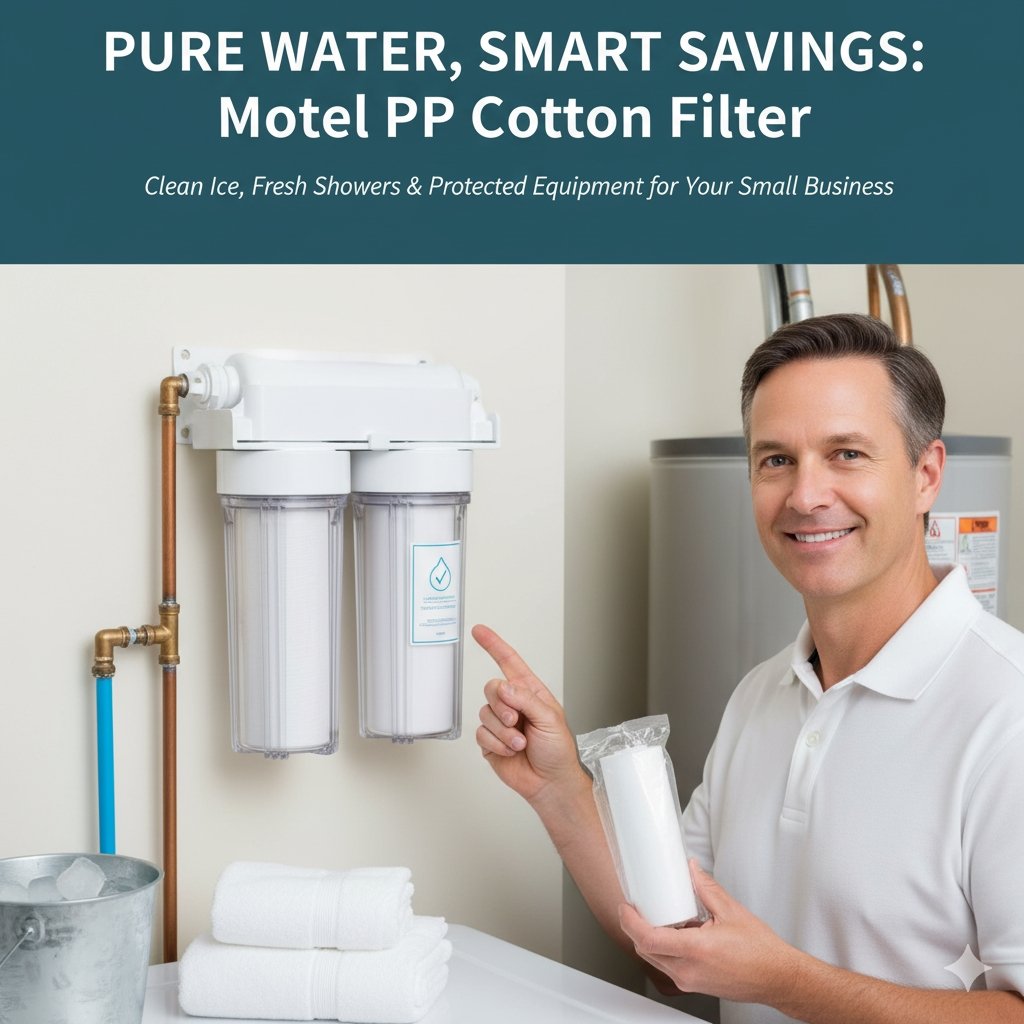
Hotels have a reputation to protect: guests expect safe, great-tasting water at the tap, in the shower, and in their glass of ice. A poor water experience — cloudy ice, limescale build-up in coffee machines, low pressure in guest rooms, or off-tastes in drinking water — creates complaints, costs in maintenance, and damage to a property’s brand. That’s why choosing the right water filter machine for hotel is not an optional upgrade — it’s an operational necessity.
This long, practical guide walks hotel owners, engineers, F&B managers and purchasing teams through everything they need to evaluate, select, install and operate commercial water filtration effectively: what contaminants matter in hospitality settings, how to size systems for multiple points of use, the pros and cons of common technologies (POE vs POU, RO, softeners, carbon, UF/UV), maintenance and servicing schedules that keep systems reliable, budgeting and total cost of ownership considerations, procurement and contract language that protects the buyer, and a ready checklist to send suppliers so you get comparable quotes. A business-grade whole-house option you can compare against other vendors is available here: https://yourwatergood.com/product/whole-house-water-filtration-system-for-business/.
Read this article from start to finish, or jump to the section you need — by the end you’ll have a specification and selection process that prevents surprises and maximizes guest satisfaction.
Why hotels must treat water differently
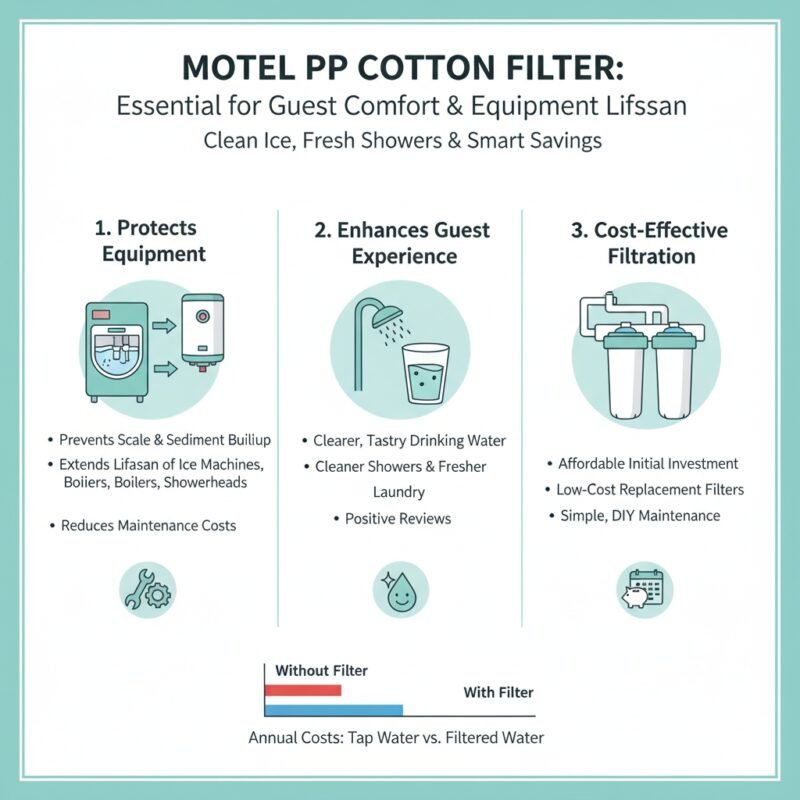
Hotel water systems are different from single-family homes in several important ways:
- Multiple simultaneous users. Morning peaks (shower + coffee + laundry) and banquet events create high, sustained flow demands. Systems must provide steady pressure and quality at peak GPM.
- Equipment diversity. Hotels host espresso machines, ice makers, dishwashers, boilers, laundry machines and guest room showers — each with different water quality requirements (scale control, low chlorine, low TDS for espresso clarity, etc.).
- Regulatory and brand risk. Foodservice and lodging face higher scrutiny for safety (ice and drinking water touched by guests). A filtration failure can become a health or PR issue.
- Continuous operation & service expectations. Downtime for filtration maintenance is disruptive; hotels need redundancy, fast response SLAs, and service contracts.
- Scale and maintenance costs. Hard water shortens equipment life; scaling in boilers, coffee equipment and ice machines causes frequent service calls and lost revenue.
Because of these realities, hotels need a system-level strategy: protect sensitive equipment, deliver high-quality drinking water at key points, ensure capacity at peak times, and build a maintenance and monitoring program that meets hospitality uptime standards.
Start with a water test — the data drives decisions
Never buy a commercial water filter machine for hotel without a full water analysis.
Minimum test panel for hotels:
- TDS (total dissolved solids) and conductivity
- Hardness (total as CaCO₃)
- pH and alkalinity
- Total iron & dissolved iron
- Manganese
- Chlorine and chloramines (free & total)
- Turbidity (NTU) and suspended solids
- Total coliform / E. coli (for well water or suspicious supplies)
- Anticipated trace contaminants (PFAS, arsenic, nitrate) if local issues exist
Why this matters: the correct technology depends on which contaminant dominates. If hardness is the problem, a softener or scale control is essential. If TDS and clarity are vital for ice and beverages, an RO system at the point-of-use or a central RO skid may be required. If chloramine is used by the utility, standard carbon won’t be enough — catalytic carbon or alternative strategies are necessary.
Key hotel water treatment goals
Define and prioritize what the system must deliver — typical goals include:
- Protect equipment from scale and sediment. Softening or scale control + coarse sediment prefiltration.
- Ensure clear, great-tasting ice and beverage quality. RO or high-capacity carbon polishing at ice machines and beverage stations.
- Provide safe drinking water at public outlets. Certified POE or POU systems and regular testing.
- Reduce odors and bleach/chlorine taste. Proper carbon contact time or catalytic carbon if chloramines present.
- Maintain flow & pressure during peaks. Sizing and possible parallel systems.
- Comply with local health codes and minimize discharge issues.
Types of filtration and where to use them in a hotel
There’s no single “best” water filter machine for hotel — most effective hotel programs use combinations of technologies deployed where they make sense.
Point-of-Entry (POE) systems — whole-building protection
- What they do: Treat water as it enters the property so all taps, showers, laundry, and some back-of-house equipment receive pretreated water.
- Typical techs used: sediment banks, multimedia backwashing filters, packed carbon vessels, softeners, duplex arrangements for continuous supply.
- Best for: protecting boilers, laundry, guest room plumbing and reducing scale across the property.
- Pros: protects all downstream devices; centralizes maintenance.
- Cons: more expensive up front; not ideal for removing dissolved solids for beverage clarity (RO often needed POU).
Point-of-Use (POU) systems — targeted high-quality water
- What they do: Treat water at the machine or tap (ice makers, espresso machines, beverage stations and kitchen prep faucets).
- Typical techs used: RO units, polishing carbon, micro/ultrafiltration, inline scale inhibitors.
- Best for: delivering beverage-grade water and protecting expensive F&B equipment.
- Pros: high quality where it matters; water-efficient if you limit RO to POU.
- Cons: many units to service; disparate maintenance if not consolidated.
Reverse Osmosis (RO) — for beverage clarity and specialty needs
- What it does: Removes dissolved solids, lowers TDS, and produces very clear water for ice and specialty beverage applications.
- Where to use: ice machines (if clear ice is a brand requirement), specialty culinary uses, signature beverage programs, some laundry or boiler uses when very low TDS required.
- Important: RO needs robust pretreatment (sediment + carbon) and creates reject water. In hotels, RO is usually POU or skid-mounted with storage and booster pumps for higher demand.
Water softeners and scale controllers
- What they do: Reduce hardness to prevent scaling in boilers, hot water systems, coffee & laundry.
- Duplex softeners provide continuous service (one unit in service while the other regenerates).
- Saltless scale controllers (TAC) are sometimes used where brine discharge is a problem but performance varies by water chemistry.
Disinfection and microbial control
- UV systems are effective for inactivating bacteria and viruses when turbidity is low. UV is often installed after good sediment filtration for well water hotels or in certain high-risk applications.
- UF/MF can be used where bacterial exclusion is desired without TDS reduction.
Which contaminants matter most in hotels?
Focus on the practical consequences for hospitality:
- Hardness → scale on boilers, laundry inefficiency, shorter coffee machine life.
- Chlorine & chloramine → bad tasting ice and beverages, off-odors; chloramine needs catalytic carbon.
- Iron/manganese → staining, sediment, foul taste, faster filter depletion.
- High TDS → dull or cloudy ice; high TDS water can be corrosive; RO reduces TDS.
- Sediment/turbidity → clogged nozzles, early filter exhaustion, poor ice clarity.
- Microbial contamination → health risk (critical in ice production and public water supply); requires immediate attention and disinfection steps.
Sizing the system for peak hotel demand
Sizing is where hotels most commonly make mistakes. Overly small systems create pressure drops and fail during breakfast service; oversizing wastes capital.
Steps to size properly:
- Survey peak simultaneous draws. Map a worst-case scenario: multiple showers, several toilets flushing, laundry and dishwashers running, multiple foodservice outlets, and pool fill events. Convert to GPM.
- Design to peak plus margin. Add 25–40% safety margin to accommodate unexpected demand or future expansion.
- Check required flow per device. Ice machines and espresso machines have continuous flow vs intermittent flow needs — ensure both peak and continuous rated flows are met.
- Select components with acceptable ΔP. Use equipment whose pressure drop at rated flow keeps inlet pressure above required thresholds for upper-floor rooms.
- Plan for redundancy. Duplex softeners, parallel cartridge banks or two smaller RO trains with automatic switchover minimize downtime.
- Include storage for RO lines. If RO is used centrally, storage tanks and booster pumps are often necessary to meet burst demand.
Monitoring and instrumentation: sensors that save money
Install instrumentation to turn maintenance from reactive to proactive:
- Pressure gauges upstream and downstream of major filters to monitor differential pressure (ΔP) and trigger cartridge changes before failure.
- TDS meters on RO permeate and post-POE to catch membrane failure.
- Chlorine/chloramine sensors where taste protection is needed.
- Turbidity meters for critical feeds (ice machines, beverage lines).
- Remote telemetry tied to the hotel maintenance system to alert 24/7 staff and allow rapid response.
Instrumentation early reduces guest complaints and expensive emergency truck rolls.
Maintenance cadence and service contracts
Hotels cannot afford surprise downtime. A disciplined maintenance program should include:
- Daily/weekly checks by on-site engineering: visual leaks, pressure gauge sanity, unusual vibrations.
- Monthly checks: pressure differential logs, quick water taste tests at public outlets, basic filter condition checks.
- Quarterly service: change sediment prefilters and inspect carbon beds; replace O-rings; test backflow assemblies.
- Biannual: replace carbon cartridges, sanitize storage tanks, clean ice machine evaporators and conduct microbial swabs.
- Annual: UV lamp replacement, membrane checks (RO), scale inhibitor resin checks; full water test.
- Event-driven: replace sediment filters after storms, line maintenance, or any turbidity spike.
Service contracts should guarantee response time (SLA), supply critical spares, include scheduled visits, and bill transparently for consumables. Negotiate first-year consumable inclusion to make onboarding painless.
Budgeting and TCO (three- to five-year view)
Capex is only part of the decision. Calculate TCO including:
- Initial equipment & install — tanks, vessels, RO skids, pumps, electrical, plumbing, and enclosure where needed.
- Consumables — carbon, membranes, sediment cartridges, UV lamps, softener salt. Calculate expected replacements using your water test and estimated flows.
- Energy — RO pumps, booster pumps, heaters for winterization.
- Labor & service — routine maintenance and emergency SLA costs.
- Downtime cost — lost revenue from room closures or event cancellations due to water issues.
- Disposal & environmental — cost to manage RO reject or softener brine legally.
Example: a mid-sized 150-room hotel might spend $15k–$50k on a POE bank + POU ROs for key equipment, and $3k–$10k/year on consumables and service depending on water quality. Always run a 3–5 year model.
Procurement and contract language to protect the hotel
When buying, insist on:
- Performance acceptance tests (PAT) — vendor must validate system on your water (pre/post lab results) and meet agreed removal or TDS targets. Payment held to pass PAT.
- Warranty tied to commissioning & maintenance — parts & labor warranty that stays valid if manufacturer-recommended service is performed (documented).
- Consumable pricing transparency — fixed-price or capped increases for first 1–3 years.
- Spare parts kit included — O-rings, housing wrench, spare prefilters, and one extra RO membrane or UV lamp as applicable.
- SLA for emergency response — define maximum response time (e.g., 4 hours onsite or 24 hours remote) and penalties.
- Telemetry & ownership of data — vendor provides monitoring data to hotel and agrees not to hold it hostage.
- Environmental compliance — vendor must advise and design discharge solutions meeting local codes.
- Training and O&M manual — vendor must train on site and supply clear documentation.
A strong contract prevents finger-pointing when something goes wrong.
Placement examples: typical hotel configurations
- Small boutique hotel (20–50 rooms): POE sediment + carbon bank + POU RO at espresso & ice machines; one duplex softener if hardness is >7 gpg.
- Mid-size hotel (50–150 rooms): central POE multimedia filter and carbon vessel; duplex softener for guest services; RO skid with storage for critical F&B areas; dedicated POU polishing for VIP suites and bar.
- Large hotels & resorts (>150 rooms): multi-train POE systems with redundancy, large-capacity softeners, RO skid(s) with permeate storage and high recovery options, distributed POU RO and polishing for banquet kitchens and premium F&B outlets. Consider on-site water reuse or greywater integration for irrigation to offset RO reject.
Food & beverage specifics: protecting espresso, ice & kitchens
- Ice machines: sediment to 1–5 µm + carbon polishing or dedicated RO in higher-end operations. Clean ice is visible proof of quality for guests.
- Espresso & specialty coffee: low TDS and stable mineral profile is essential for consistent extraction; many hotels use POU RO with a remineralizer to achieve a consistent target.
- Dishwashers & glasswashers: softened water prevents spotting and reduces chemical use; ensure water temperature and dishwasher manufacturer recommendations align with softener settings.
Risk management and emergency planning
- Redundancy: duplex softeners, parallel RO trains, and valves for bypass to keep critical services running during maintenance.
- Contingency water sources: bottled water contracts for emergencies or temporary connection to alternative supply.
- Incident playbook: sample contamination protocols, guest communication templates, and immediate mitigation actions (boil water notices if issued).
- Records & traceability: log all maintenance, tests and incidents for compliance and insurance.
Choosing the right vendor: a shortlist of questions
When talking to suppliers, ask:
- Can you provide references for hotels of similar size and water chemistry?
- Will you perform an on-site water test and size the system to our peak flows?
- Can you provide a PAT proposal and agree to hold final payment until PAT passes?
- What is your expected consumable schedule for our water test and flow? Provide SKU pricing.
- Do you offer remote telemetry and what data will we receive?
- What is your emergency response SLA and cost for after-hours calls?
- Who will install: vendor technicians or local contractors? Are they licensed?
- Do you provide staff training and a spare parts kit?
- Is the system sized for future expansion? Can we add more capacity with minimal downtime?
Checklist to specify a water filter machine for hotel
Use this spec checklist to solicit comparable quotes:
- Property name, address, and water utility provider
- Full water test attached (lab report)
- Peak simultaneous flow in GPM and daily demand in GPD
- Critical outlets list: ice machines, espresso, banquet kitchens, boilers, laundry
- Required goals: hardness target, maximum post-treatment TDS for ice and espresso, chlorine/chloramine target, turbidity max
- Redundancy needs (duplex? parallel?)
- PAT acceptance criteria and sample handling instructions
- Consumable pricing for 3 years and service contract options
- Warranty and SLA expectations
Case note — typical pitfalls and how to avoid them
- Under-sizing: leads to poor pressure and guest complaints. Avoid by demanding rated GPM at ΔP curves and adding safety margin.
- Skipping RO pretreatment: leads to membrane failure. Always require sediment + carbon ahead of RO.
- Ignoring chloramine: if the utility uses chloramine, standard carbon will not solve taste issues — demand catalytic carbon or alternative solutions.
- Weak service contract: hotels need fast response; negotiate concrete SLAs and spare parts inclusion.
- Poor contract PAT terms: without acceptance testing hotels can be left with underperforming systems.
Conclusion — what the right water filter machine for hotel delivers
A properly specified and maintained water filter machine for hotel delivers:
- Consistent, pleasant drinking water and ice quality that enhances guest satisfaction.
- Fewer equipment failures and lower maintenance costs for boilers, laundry and F&B equipment.
- Scalable, redundant performance through peak occupancy and special events.
- Clear contractual protection and predictable consumable cost for finance teams.
If you’re starting procurement, use your lab test and the checklist in this article to request three detailed proposals, require PAT and service SLAs, and compare 3–5 year TCOs rather than just upfront price. For a business-grade whole-building reference model to base quotes on, review this commercial solution as a starting point: https://yourwatergood.com/product/whole-house-water-filtration-system-for-business/.