
The Ultimate Guide to Affordable Under-Sink Water Filtration Systems for Homes and Small Businesses

In an era where health consciousness is at an all-time high, the quality of the water we drink has never been more scrutinized. While bottled water was once the go-to solution for clean hydration, cost and environmental concerns have shifted the market toward more sustainable solutions. Enter the realm of affordable under-sink water filtration systems.
Whether you are a homeowner looking to protect your family or a small business owner running a café or restaurant, finding a filtration solution that balances performance with budget is critical. This guide will dive deep into the mechanics, benefits, and selection process of these systems, ensuring you make an informed decision for your water needs.https://yourwatergood.com/product/ro-water-purifier/.
Why Water Quality Matters More Than Ever
Before we explore specific hardware, we must understand the “why.” Municipal water treatment plants do an excellent job of removing major pathogens, but the journey from the plant to your tap is long and fraught with variables. Old pipes can leach lead, and residual chlorine—used to kill bacteria—can leave an unpleasant chemical taste and odor.
For households, this affects the water you drink, cook with, and use to wash produce. for small businesses, specifically coffee shops and small restaurants, water is an ingredient. The clarity of your ice, the taste of your espresso, and the safety of your soup stock all depend on the purity of your water source.
! Alt: Fresh clear water glass from a pp cotton household water purifier company system illustrating pure hydration.
What Are Under-Sink Water Filtration Systems?
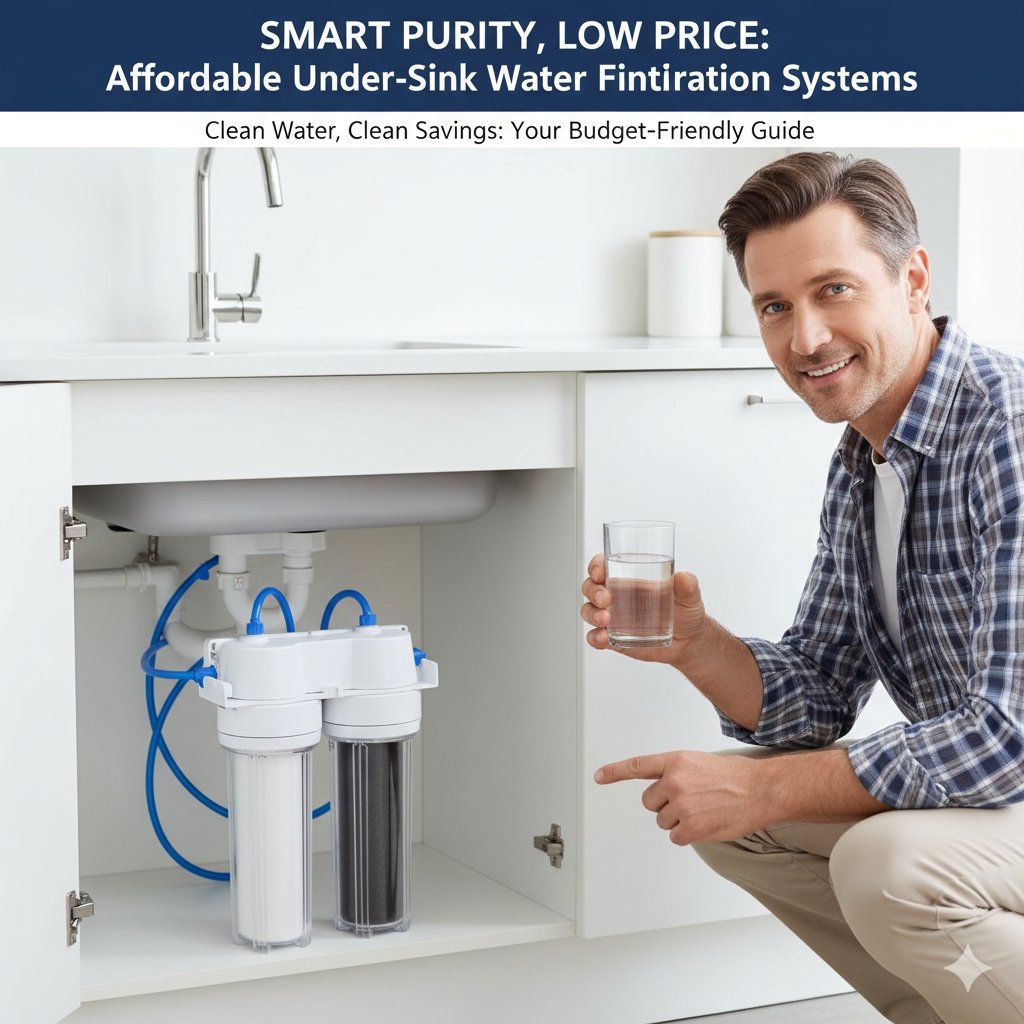
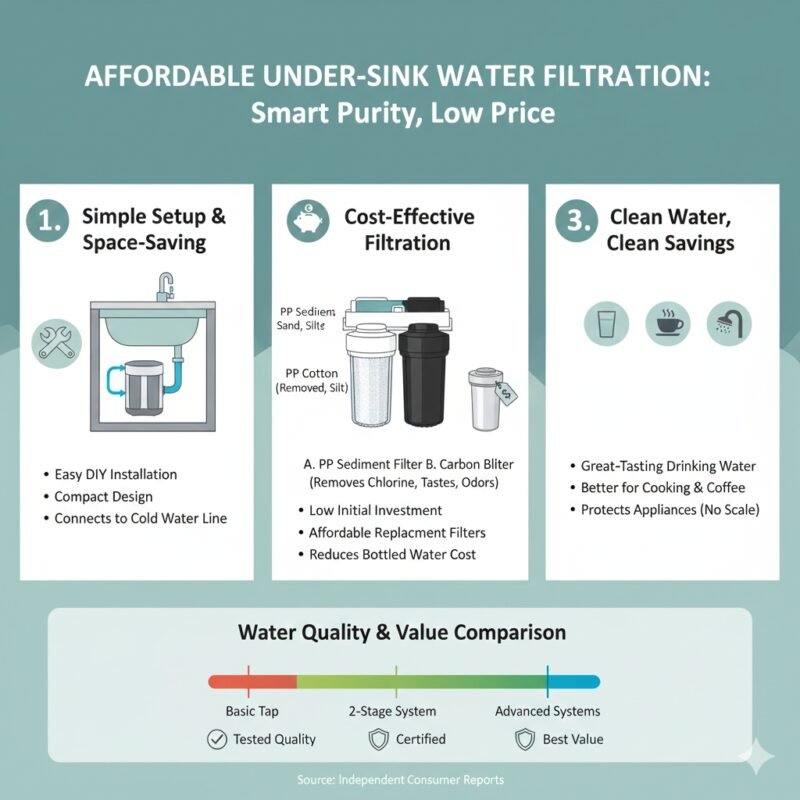
As the name suggests, these units are installed directly inside the cabinet beneath your kitchen sink. Unlike bulky countertop units or complex whole-house systems, under-sink models are discreet, efficient, and generally easier to install. They tap directly into your cold water line, filtering water before it reaches a dedicated faucet or your main tap.
The market is flooded with options, but the search for affordable under-sink water filtration systems often leads consumers down a rabbit hole of technical jargon. Understanding the core components will help you navigate this.
The Core Technologies
- PP Cotton Filters: Often the first line of defense, Polypropylene (PP) cotton filters are crucial for sediment removal. They trap rust, dirt, sand, and other large particles. High-quality filtration starts here; if the sediment isn’t removed, it clogs the finer filters downstream.
- Activated Carbon: This is the workhorse for taste and odor. Carbon bonds with organic compounds, effectively removing chlorine, volatile organic compounds (VOCs), and improving the overall palatability of the water.
- Reverse Osmosis (RO): For those seeking the highest level of purity, RO is the gold standard. It forces water through a semi-permeable membrane, removing up to 99% of contaminants, including dissolved solids, heavy metals, and bacteria.
The Economics of Filtration: Defining “Affordable”
When we search for affordable under-sink water filtration systems, it is easy to fixate solely on the initial purchase price. However, true affordability is a calculation of the Total Cost of Ownership (TCO).
Initial Price vs. Long-Term Value
A system might cost $50 upfront but require $40 filter replacements every month. Conversely, a robust RO system might cost more initially but uses high-capacity filters that last 6 to 12 months.
For small businesses, such as a boutique coffee shop, “affordable” also means reliability. A cheap system that breaks down during the morning rush is not affordable; it is a liability. Reliable equipment ensures that your espresso machine doesn’t scale up with calcium deposits, saving you thousands in repair costs over time.
The Hidden Cost of Bottled Water
If you are currently relying on bottled water for your home or business, switching to an under-sink system yields an immediate Return on Investment (ROI).
- The Math: If a family spends $10 a week on bottled water, that is $520 a year. A high-quality under-sink system often pays for itself in less than six months, all while reducing plastic waste.
! Alt: Cost comparison chart showing savings with a pp cotton household water purifier company system versus bottled water.
Deep Dive: Choosing the Right System for Your Needs
To find the best affordable under-sink water filtration systems, you must assess your specific water conditions.
1. The Sediment Heavy Water (The PP Cotton Solution)
If you live in an area with old infrastructure or use well water, you likely have high sediment. You need a system with a robust pre-filter stage. Look for multi-stage systems where the first stage is a high-density PP cotton filter. This protects the more expensive carbon and RO membranes from premature clogging.
2. The High-Chlorine Municipal Water
If your water smells like a swimming pool, a multi-stage carbon block system is your best bet. These are generally very affordable and easy to install. However, they do not remove dissolved solids or heavy metals as effectively as RO systems.
3. The Total Purity Solution (Reverse Osmosis)
For families with children, or businesses serving customers, you often cannot compromise. You need to remove lead, arsenic, fluoride, and bacteria. This is where Reverse Osmosis (RO) shines.
Modern RO systems have become significantly more compact and efficient. In the past, RO systems wasted a lot of water, but newer tankless or high-efficiency models have revolutionized the market.
If you are looking for a top-tier solution that balances commercial-grade performance with household accessibility, you should explore the RO Water Purifier from YourWaterGood. This system exemplifies the balance between high-end purification capability and user-friendly design, making it a perfect fit for both modern kitchens and small commercial breakrooms.
Installation: DIY or Professional?
One of the key features that make affordable under-sink water filtration systems attractive is the potential for DIY installation.
The DIY Approach
Most modern systems come with “quick-connect” fittings. You generally need basic tools: a wrench, a screwdriver, and perhaps a drill if you need to install a dedicated faucet.
- Shut off the water: Locate the cold water valve under the sink.
- Install the T-valve: This splits the water flow between your main faucet and the filter.
- Mount the unit: Screw the filter housing to the side of the cabinet to save space.
- Connect tubing: Push the color-coded tubes into the corresponding slots.
- Flush the system: Run water through the new filters for 5–10 minutes to clear loose carbon dust.
When to Call a Pro
If you are installing a system for a commercial espresso machine or an ice maker in a restaurant, professional installation is recommended to ensure pressure requirements are met and to prevent leaks that could damage your business premises.
! Alt: Technician installing a unit from a pp cotton household water purifier company ensuring affordable clean water.
Maintenance: Keeping Your System Affordable
The “affordability” of affordable under-sink water filtration systems is maintained through proper upkeep. Neglecting filter changes stresses the system and reduces water quality.
The Filter Schedule
- Stage 1 (PP Cotton): Change every 3–6 months. If this clogs, water pressure drops.
- Stage 2 & 3 (Carbon): Change every 6–12 months. When chlorine taste returns, it’s time to switch.
- Stage 4 (RO Membrane): Change every 12–24 months. This is the most expensive part, so protecting it with fresh pre-filters (Stage 1 & 2) saves money.
Sanitization
Once a year, when changing filters, it is wise to sanitize the housing units with a mild bleach solution or a specialized sanitizer to prevent biofilm buildup.
Commercial Focus: Small Restaurants and Cafes
For our business clients, water is money. A customer may not complain about the water directly, but they will notice if the tea tastes “off” or if the ice cubes look cloudy.
protecting Your Equipment
Commercial coffee machines, steamers, and dishwashers are sensitive to scale buildup (calcium and magnesium). An RO system or a filtration system with a scale-inhibitor is essentially an insurance policy for your expensive kitchen equipment.
By using a robust system like those offered at www.yourwatergood.com, small business owners can ensure consistent beverage quality. Consistency breeds customer loyalty. If your coffee tastes great today but metallic tomorrow, you lose customers.
Space Constraints in Commercial Kitchens
Small bistros and cafes often lack the space for massive industrial water treatment tanks. This is why high-capacity affordable under-sink water filtration systems are the ideal middle ground. They fit under prep counters or espresso bars, delivering commercial-grade water without the commercial-grade footprint.
Common Myths About Under-Sink Filtration
Myth 1: They make water taste flat. Fact: While RO removes minerals, a remineralization filter can be added to restore healthy minerals like calcium and magnesium, giving the water a crisp, spring-water taste.
Myth 2: They waste too much water. Fact: Old RO systems had a 4:1 waste ratio (4 gallons wasted for 1 gallon produced). Modern, affordable systems have improved this ratio drastically, sometimes achieving 1:1 or better efficiency.
Myth 3: Tap water is already clean enough. Fact: “Legal” limits for contaminants are not the same as “safe” limits. Pipes in your own building can add contaminants after the water has left the treatment plant.
Environmental Impact
Choosing affordable under-sink water filtration systems is a green choice. By eliminating the need for plastic bottles, a single household can keep thousands of plastic bottles out of landfills over the lifespan of a single filter cartridge.
For businesses, marketing your use of filtered, sustainable water can be a selling point. Customers today value eco-friendly practices. Offering complimentary, high-quality filtered water instead of selling plastic bottles can enhance your brand image.
Detailed Look at Contaminants Removed
To truly understand the value, we must list what these systems tackle:
- Microplastics: Emerging research shows tap water often contains microscopic plastic fibers. PP cotton filters and RO membranes block these physically.
- Heavy Metals: Lead, mercury, and arsenic are tasteless and odorless but highly toxic. Only high-grade filtration (like RO) reliably removes these.
- Cysts and Parasites: Cryptosporidium and Giardia are resistant to chlorine but are large enough to be caught by sub-micron filtration.
Troubleshooting Common Issues
Even the best systems can have hiccups. Here is how to handle them without calling a plumber:
- Low Water Flow: Usually indicates the pre-filter (PP Cotton) is clogged with sediment. Replace it immediately.
- Strange Noise (Gurgling): Air is trapped in the system. Tilt the housing slightly while running water to let air escape, or simply run the tap for a few minutes.
- Water Tastes Like Tap Water: The carbon filter is exhausted or the RO membrane has failed. Check your maintenance log.
- Leaks: Check the O-rings inside the filter housings. They may need lubrication with food-grade silicone grease or replacement.
! Alt: Maintenance checklist for a system from a pp cotton household water purifier company ensuring longevity.
Conclusion: The Verdict on Affordability
Investing in affordable under-sink water filtration systems is not just a purchase; it is a lifestyle upgrade and a business necessity. It provides security against fluctuating municipal water quality, improves the taste of your food and drinks, and offers significant long-term savings over bottled water.
Whether you need a simple solution for your apartment or a robust RO setup for your coffee shop, the key is to look for quality components—specifically high-grade PP cotton pre-filters and reliable membranes.
Don’t compromise on the water you consume every day. For a selection of systems that cater specifically to both household needs and small commercial operations like restaurants and cafes, visit www.yourwatergood.com. Experience the difference that pure, clean water makes in your life and your business.
Frequently Asked Questions (FAQ)
Q: How often should I change the PP cotton filter? A: It depends on your water quality, but generally every 3 to 6 months. If you see a drop in water pressure, check this filter first.
Q: Can I install these systems in a rental apartment? A: Yes, under-sink systems are often reversible. However, check if you need to drill a hole for the faucet. If you cannot drill, look for systems that connect to your existing main faucet line.
Q: Are these systems suitable for well water? A: Yes, but you must test your water first. If you have high iron or bacteria, you may need specific pre-treatment before the standard under-sink system.
Q: Why is there a specific focus on PP cotton? A: PP cotton is the unsung hero of filtration. It sacrifices itself to stop dirt and rust from destroying the expensive carbon and RO filters. A system with a high-quality PP cotton stage is a system built to last.