Blog

Unlocking the Science Behind the 5 Stage Water Filter Arrangement for Ultimate Purity

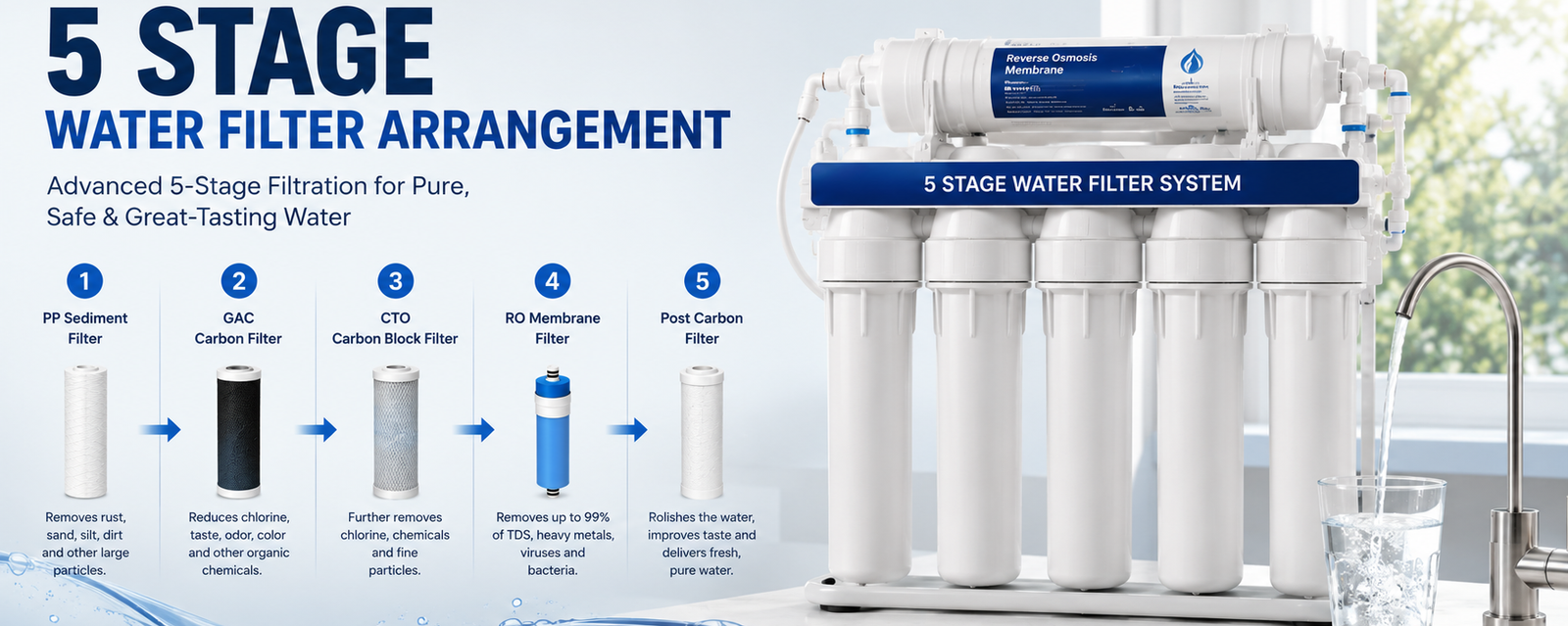
5 stage water filter arrangement schematic, visually presenting the five distinct cartridges in sequence, highlighting the progression of filtration from sediment to final polishing. Detailed guide from a pp cotton household water purifier company.

Water is the most essential element of our daily lives, yet the journey it takes from a municipal treatment plant to your glass is fraught with potential contamination. Old pipes, chemical disinfectants, and groundwater runoff all contribute to a cocktail of impurities that a single-layer filter simply cannot handle. This is where the engineering marvel of modern purification comes into play.

To achieve truly pure, safe, and great-tasting water, we rely on a specific sequence of filtration technologies. This is widely known in the industry as the 5 stage water filter arrangement. It is the gold standard for residential and light commercial water treatment, striking the perfect balance between comprehensive purification, system longevity, and cost-effectiveness.

In this deep dive, we will explore why this specific arrangement exists, the function of each stage, why the order is non-negotiable, and how it benefits both households and small businesses like cafes and restaurants.https://yourwatergood.com/product/ro-water-purifier/.

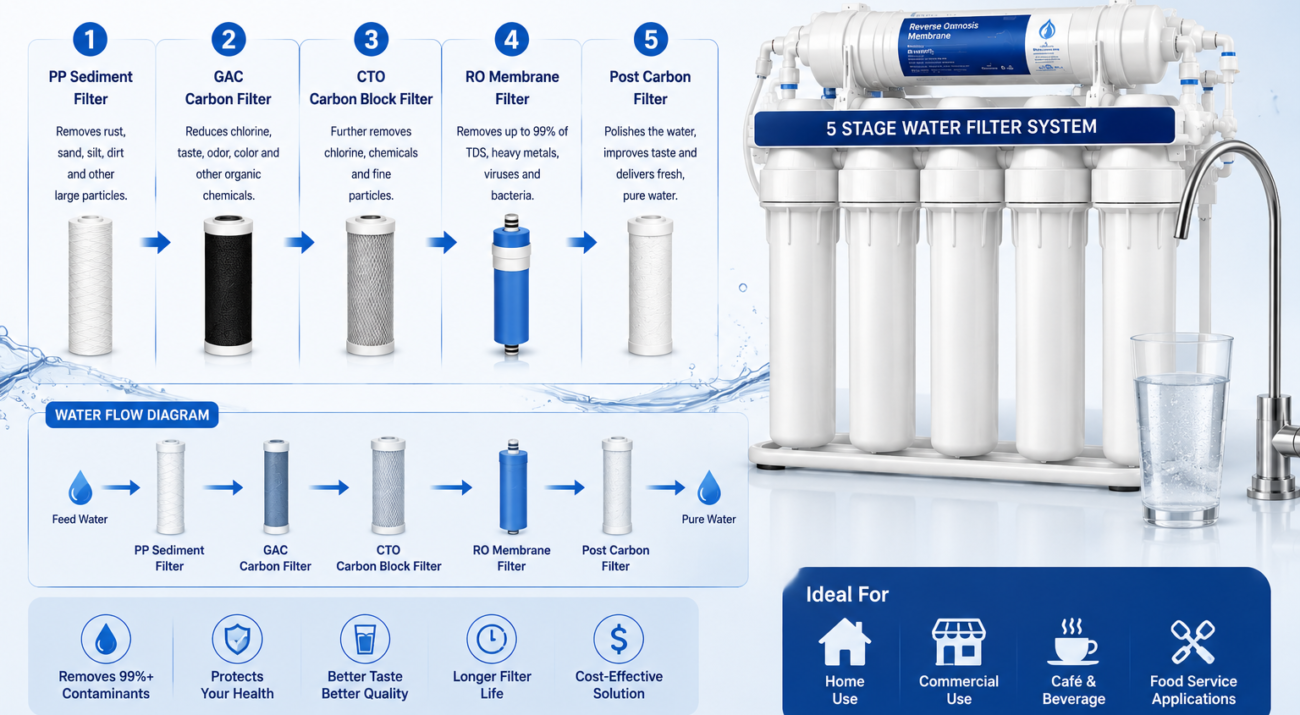
Diagram illustrating the function of each filter in a 5 stage water filter arrangement, specifically showing the path of water through the pp cotton sediment filter, pre-carbon, post-carbon, and specialty stages. Technical chart from a pp cotton household water purifier company.

Why “Arrangement” Matters More Than Components

You might wonder, “If I have an RO membrane and a carbon filter, does it matter which one the water hits first?” The answer is a resounding yes. The 5 stage water filter arrangement is not arbitrary; it is a tactical defense strategy.

Think of it like a security system. You don’t put the safe inside the vault before the front door. You have a perimeter fence, then a locked door, then a security guard, and finally the vault. Water filtration works on the same principle of “Graduated Filtration.”

  1. Coarse Filtration: Stops the big stuff that would clog the fine filters.
  2. Chemical Adsorption: Removes chemicals that would chemically damage the delicate membranes.
  3. Hyper-Filtration: The core removal of dissolved solids.
  4. Polishing: Final aesthetic adjustments for taste.

If you disrupt this 5 stage water filter arrangement, the system fails. Putting the delicate Reverse Osmosis (RO) membrane first would result in it being destroyed by chlorine and clogged by sand within days. By following the correct arrangement, we ensure each component protects the next, maximizing the lifespan of the system.

Stage 1: The First Line of Defense (Sediment PP Filter)

The journey begins at the intake. Water entering your home or business is often laden with physical debris. This includes rust flakes from iron pipes, sand grains from well water, and general turbidity (cloudiness).

The Component: 5-Micron Polypropylene (PP) Cotton Filter.

The Function: This stage acts as the “bouncers” at the club door. The PP cotton filter is a depth filter, meaning it catches particles not just on the surface, but throughout its fibrous structure. It is designed to trap particles larger than 5 microns (roughly 1/15th the width of a human hair).

Why It Is First: If this sediment were allowed to pass to the subsequent carbon filters, it would coat the carbon granules, rendering them useless. Worse, if it reached the RO membrane, it would physically plug the microscopic pores immediately.

For any pp cotton household water purifier company, the quality of this first stage is paramount. A cheap sediment filter that collapses under pressure jeopardizes the entire expensive system. High-quality PP cotton ensures that the water moving to Stage 2 is physically clear, even if it is still chemically loaded.

! Alt: A used sediment filter from a pp cotton household water purifier company showing captured rust and dirt.

Stage 2: The Chemical Neutralizer (Granular Activated Carbon)

Once the water is physically clear, it enters the chemical warfare stage. Municipal water is treated with chlorine or chloramines to kill bacteria. While this keeps us safe from cholera, chlorine is a harsh chemical oxidizer.

The Component: Granular Activated Carbon (GAC) Filter.

The Function: Activated carbon is charcoal that has been treated with oxygen to open up millions of tiny pores between the carbon atoms. This creates a massive surface area. As water flows through the granules, organic contaminants and chemicals are attracted to the carbon surface and trapped—a process called adsorption.

Key Removals:

  • Chlorine (Taste and Odor).
  • Volatile Organic Compounds (VOCs).
  • Pesticides and Herbicides.
  • Benzene.

The “Arrangement” Logic: We place this after the PP cotton to keep the carbon pores from getting plugged with mud, but before the RO membrane. This is critical because chlorine destroys the Thin Film Composite (TFC) material of an RO membrane. If Stage 2 fails or is placed incorrectly, the RO membrane (Stage 4) will literally be eaten away by oxidation.

Stage 3: The Protector (Carbon Block / CTO)

The third stage in the 5 stage water filter arrangement is often a point of confusion for consumers, but it serves a vital dual purpose.

The Component: Carbon Block Filter (often called CTO – Chlorine, Taste, Odor).

The Function: Unlike the loose granules in Stage 2, this is a solid block of compressed carbon powder. It is much denser.

  1. Fine Sediment Removal: It usually acts as a secondary sediment filter, often down to 1 micron, catching any “fines” (carbon dust) released by Stage 2 or smaller particles that escaped Stage 1.
  2. Polishing Chemical Removal: It ensures any residual chlorine that bypassed the looser GAC filter is caught.

Why It Is Here: It acts as the final gatekeeper before the main event. It ensures the water is physically particle-free and chemically neutral. This maximizes the efficiency of the RO membrane, allowing it to focus solely on dissolved solids rather than fighting dirt or bleach.

Stage 4: The Heart of the System (Reverse Osmosis Membrane)

This is the stage that defines the system. Up until now, we have only filtered out suspended solids and chemicals. We haven’t touched the dissolved minerals, heavy metals, or salts.

The Component: Reverse Osmosis (RO) Membrane (0.0001 Micron).

The Function: Water is forced under pressure through a semi-permeable membrane. The pores are so small that only pure water molecules can squeeze through. Everything else is rejected and flushed down the drain line.

Contaminants Removed:

  • Heavy Metals (Lead, Mercury, Arsenic).
  • Dissolved Salts (Fluoride, Nitrates, Sulfates).
  • Bacteria and Viruses (Cysts, Giardia).
  • Radioactive Isotopes.

This process removes up to 99% of Total Dissolved Solids (TDS). This is the technology that turns seawater into drinking water.

If you are looking for a system that perfectly executes this critical stage with high-efficiency membranes, you should explore the RO Water Purifier from YourWaterGood. It utilizes a precision-engineered membrane designed to handle varying water pressures while delivering consistent purity, embodying the pinnacle of the 5 stage water filter arrangement.

Stage 5: The Finishing Touch (Post-Carbon Filter)

After the water passes through the RO membrane, it is incredibly pure. It flows into a storage tank (in most residential setups) to wait until you turn on the tap. However, water sitting in a rubber-lined tank can sometimes develop a slightly flat or “stale” taste.

The Component: Inline Post-Carbon Filter (often called T33).

The Function: When you open your faucet, the water leaves the tank and passes through this final filter. It is made of high-quality coconut shell carbon. It “polishes” the water, removing any lingering tastes from the tank and imparting a crisp, sweet flavor.

Why It Is Last: It must be the final step before the glass. If you put this before the tank, the water would sit and lose that freshness. The placement ensures that the water you drink is freshly polished seconds before consumption.

Commercial Applications: Why Small Businesses Need This Arrangement

While we often discuss this in the context of a home kitchen, the 5 stage water filter arrangement is the secret weapon of successful small businesses, particularly in the food and beverage industry.

The Coffee Shop Scenario

For a cafe, water is an ingredient. An espresso is 98% water.

  • Without Stage 1 & 2: Sediment damages the solenoids in the espresso machine.
  • Without Stage 4 (RO): Hard water (calcium) builds up in the boiler (scale), leading to expensive repairs and downtime.
  • The Result: A 5-stage system protects the expensive machinery and ensures the coffee tastes exactly how the roaster intended, without the interference of chlorine or metallic flavors.

The Small Restaurant

Customers notice details. If the ice water served at the table smells like the swimming pool (chlorine), or if the ice cubes are cloudy and soft (dissolved solids), it lowers the perception of quality. A standard 5-stage unit, or a higher capacity version of it, ensures crystal clear ice and pristine water for soups and stocks.

At www.yourwatergood.com, we specialize in providing these systems not just for homes, but for the specific needs of small commercial ventures where water quality directly impacts the bottom line.

! Alt: Barista making coffee using water from a pp cotton household water purifier company system

5-Stage vs. Other Arrangements

You will see 3-stage, 6-stage, and even 7-stage filters on the market. How do they compare to the standard 5 stage water filter arrangement?

The 3-Stage System

Usually consists of Sediment -> Pre-Carbon -> Carbon Block.

  • Missing: The RO Membrane.
  • Result: It removes dirt and chlorine, but it does not remove lead, fluoride, or dissolved salts. It is essentially a fancy taste filter, not a purifier.

The 6+ Stage System

These usually take the standard 5-stage arrangement and add “Remineralization” or “Alkaline” stages after Stage 5.

  • Addition: They add calcium or magnesium back into the water to raise the pH.
  • Verdict: These are excellent if you prefer alkaline water, but the core purification work is still done by the fundamental 5 stages.

The 5-stage setup remains the industry “sweet spot”—providing medical-grade purity without unnecessary complexity or cost.

Installation and the Importance of Flow Direction

When installing or maintaining a system utilizing a 5 stage water filter arrangement, paying attention to flow direction is critical. Each filter cartridge usually has an arrow indicating which way the water should flow.

The “Flushing” Ritual

When you install a new system or replace filters, you must respect the arrangement:

  1. Flush the Carbon: New carbon filters release black dust (carbon fines). You should flush Stage 2 and 3 before connecting them to Stage 4 (RO). If you don’t, that black dust will coat the membrane and ruin it on day one.
  2. Flush the Membrane: Most manufacturers recommend discarding the first tank of RO water to flush out the preservative fluids used to ship the membrane.

This attention to detail during installation ensures the arrangement functions as intended.

Troubleshooting the Arrangement

Understanding the order of the filters helps in troubleshooting common issues.

Problem: Low Water Pressure/Slow Flow

  • Diagnosis: Look at the early stages. The Stage 1 PP Cotton filter is likely clogged with sediment. It sacrificed itself to save the others.
  • Solution: Replace Stage 1.

Problem: Water Tastes Like Tap Water

  • Diagnosis: The RO membrane (Stage 4) may have ruptured, or the Pre-Carbon (Stage 2) is exhausted, allowing chlorine to damage the membrane.
  • Solution: Test the TDS (Total Dissolved Solids). If it’s high, replace the membrane.

Problem: Milky Water

  • Diagnosis: Air trapped in the system, usually after a filter change.
  • Solution: It will clear up on its own. It is an aesthetic issue, often related to the Stage 5 Post-Carbon filter interacting with air pockets.

Maintenance: Keeping the Arrangement Intact

To maintain the integrity of the 5 stage water filter arrangement, a strict replacement schedule is necessary. Ignoring one stage causes a domino effect of failure down the line.

  • Stage 1, 2, 3 (Pre-Filters): Change every 3 to 6 months.
    • Risk of delay: If Stage 1 fails, Stage 2 gets clogged. If Stage 2 fails, chlorine hits the membrane.
  • Stage 4 (RO Membrane): Change every 24 to 36 months.
    • Risk of delay: TDS creep up; water quality degrades.
  • Stage 5 (Post-Carbon): Change every 12 months.
    • Risk of delay: Bacteria growth can occur; taste becomes flat.

For high-quality replacement cartridges that fit standard housings, referring to a reliable pp cotton household water purifier company ensures you are getting filters with the correct density and adsorption ratings.

The Environmental Impact

Critics often point to the wastewater produced by RO systems (the brine that carries the rejected contaminants away). However, the 5 stage water filter arrangement has evolved.

Modern systems, like the RO Water Purifier, utilize permeate pumps and improved membrane technology to drastically reduce waste ratios. While older systems wasted 4 gallons for every 1 gallon made, modern efficient arrangements can approach a 1:1 ratio.

Furthermore, by using a home filtration system, a family can eliminate the use of thousands of single-use plastic water bottles per year. The environmental cost of manufacturing, shipping, and disposing of plastic bottles far outweighs the water used in the filtration process.

Conclusion: The Perfect Sequence for Pure Water

The 5 stage water filter arrangement is not just a marketing term; it is a scientifically proven sequence designed to tackle the complex reality of modern water contamination. From the physical removal of rust by the PP cotton to the chemical adsorption of chlorine, and finally the molecular separation of heavy metals by the RO membrane, every step is essential.

For homeowners, it means safety and health. For business owners, it means product consistency and equipment protection.

Don’t leave your water quality to chance. Invest in a system that respects the science of filtration. Visit www.yourwatergood.com to explore our range of products, from household units to commercial solutions, and find the perfect system to meet your hydration needs.

Frequently Asked Questions (FAQ)

Q: Can I change the order of the filters? A: No. The 5 stage water filter arrangement is designed specifically so that cheaper filters protect more expensive ones. Changing the order will result in rapid clogging or permanent damage to the RO membrane.

Q: Does Stage 5 add minerals back? A: A standard T33 Post-Carbon filter focuses on taste and odor. However, you can swap Stage 5 for a Mineral Stone cartridge if you wish to add Calcium and Magnesium back into the water (making it a remineralization stage).

Q: How do I know if Stage 1 (PP Cotton) needs changing? A: Many systems have clear housings for the first stage. If the white cotton has turned dark brown or rust-colored, it is time to change it. If you can’t see it, a noticeable drop in water production speed is the main indicator.

Q: Is this arrangement suitable for well water? A: Generally, yes. However, if your well water has extremely high iron, sulfur smell, or bacteria, you may need additional pre-treatment (like a UV light or a dedicated iron filter) before the water enters the standard 5-stage unit.

Q: Why is my RO system making noise? A: A gurgling sound is usually air trapped in the system, common after a filter change (Stage 5). A clicking sound might be the auto-shutoff valve. A continuous running sound indicates a leak or that the system isn’t shutting off properly when the tank is full.

5 stage water filter arrangement schematic, visually presenting the five distinct cartridges in sequence, highlighting the progression of filtration from sediment to final polishing. Detailed guide from a pp cotton household water purifier company.

Leave a Reply

Your email address will not be published. Required fields are marked *