
The Barista’s Secret: Choosing the Right Commercial Water Filter for Coffee Shop Success

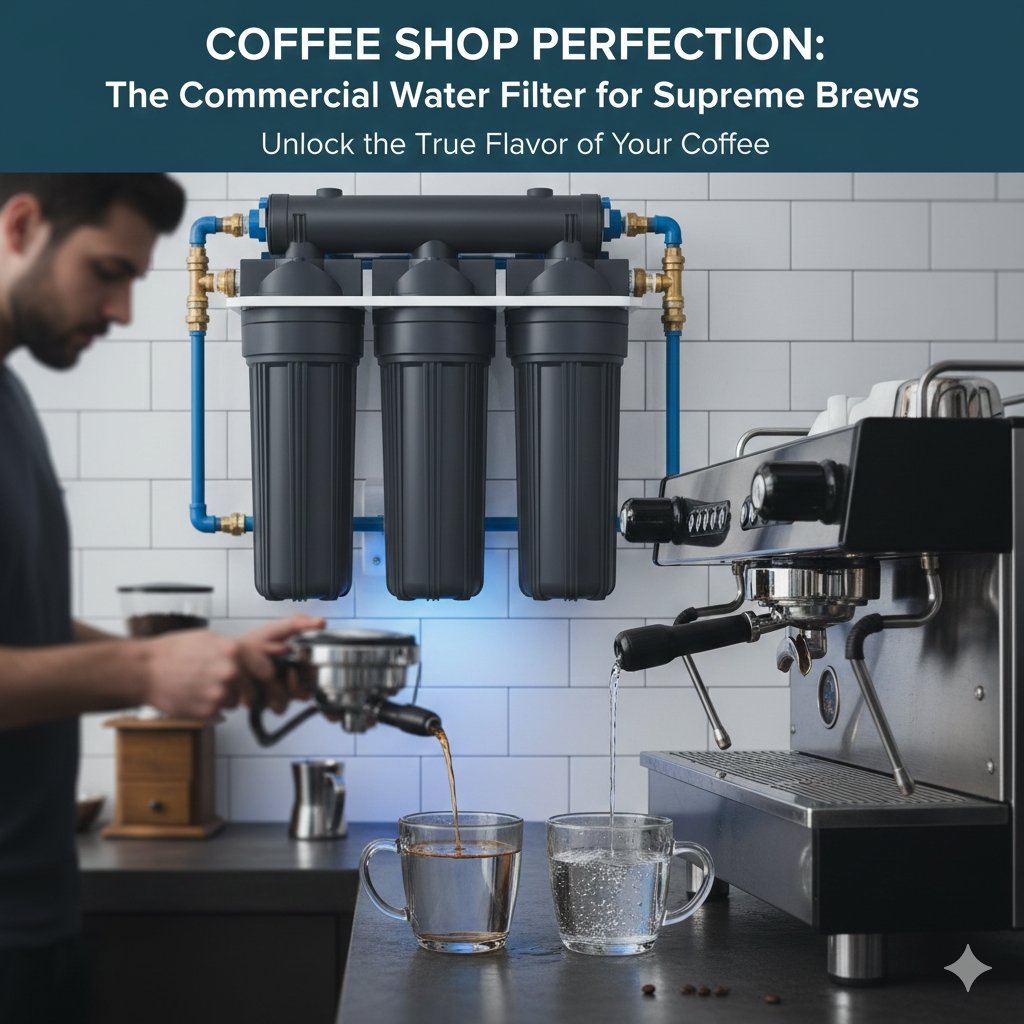
In the high-stakes world of specialty coffee, business owners obsess over every variable. You spend thousands on a La Marzocco or Synesso espresso machine. You source single-origin beans from high-altitude farms in Ethiopia or Colombia. You train your baristas to dial in the perfect grind size and tamp pressure.
Yet, despite this meticulous attention to detail, one massive variable is often overlooked: Water.
Coffee is 98% water. If your water quality is poor, 98% of your product is compromised before the brewing even begins. No amount of barista skill can fix a cup of coffee brewed with chlorinated, hard, or sediment-heavy water. Furthermore, water quality is the single biggest factor in the longevity of your expensive equipment.
For the savvy cafe owner, the “secret ingredient” isn’t a new syrup or a fancy tamper—it’s a high-performance commercial water filter for coffee shop operations. In this guide, we will explore the science of brewing water, the equipment-killing dangers of scale, and how to choose the right filtration system to secure both your flavor profile and your bottom line.https://yourwatergood.com/product/whole-house-water-filtration-system-for-home/&https://yourwatergood.com/product/5-stage-ro-water-filter-for-home-busines/.
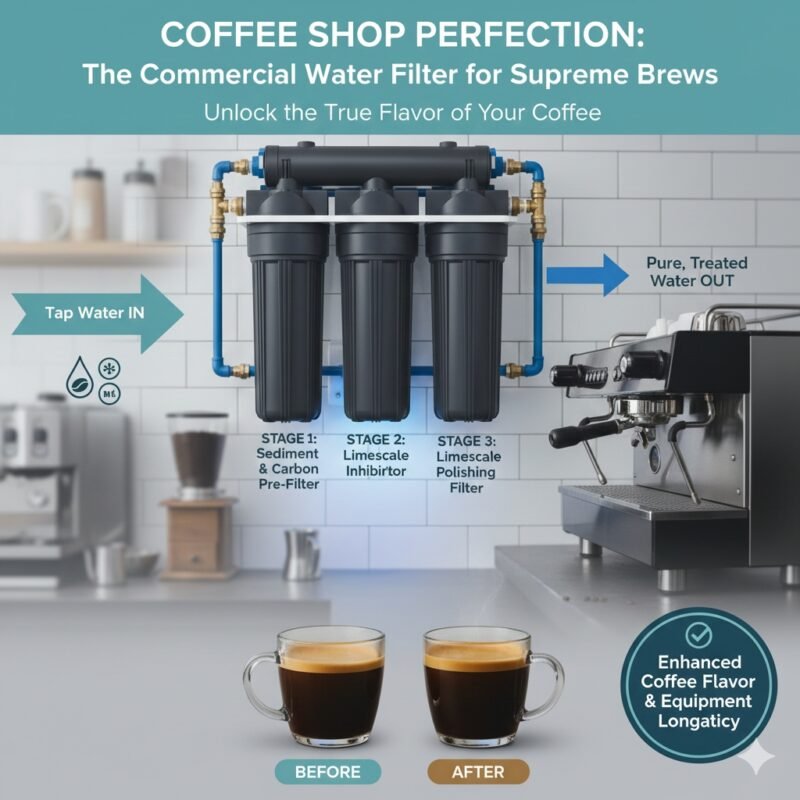
The Chemistry of a Perfect Cup
To understand why filtration is non-negotiable, we have to look at the chemistry of extraction. Water is the solvent that pulls the flavor compounds (oils, acids, sugars) out of the coffee grounds.
1. The Mineral Balance (TDS)
Not all water is created equal. “Hard” water is full of minerals like calcium and magnesium. “Soft” water lacks them.
- Magnesium: This is the barista’s best friend. It sticks to flavor compounds, helping to extract the fruity and acidic notes that make specialty coffee shine.
- Calcium: While it adds body and creaminess, it is a double-edged sword. Too much calcium leads to heavy, chalky flavors and, more dangerously, limescale buildup.
- The Sweet Spot: The Specialty Coffee Association (SCA) recommends a Total Dissolved Solids (TDS) level of around 150 mg/L. Raw tap water often exceeds this, leading to muddled, bitter flavors.
2. The Chlorine Problem
Municipal water is treated with chlorine or chloramines to kill bacteria. While this keeps the water safe to drink, it is a disaster for coffee. Chlorine is an oxidizer. When it interacts with coffee grounds, it destroys the delicate aromatics and leaves a distinct chemical, medicinal aftertaste. If your customers complain that your coffee tastes “bitter” or “harsh,” chlorine is often the culprit.
3. Sediment and Turbidity
Old city pipes often shed rust, sand, and dirt. This “turbidity” doesn’t just look unappealing; it acts like sandpaper inside your machine’s rotary pumps and solenoids, causing premature wear and leaks.
The Equipment Killer: Limescale
Beyond flavor, the most urgent reason to invest in a commercial water filter for coffee shop use is asset protection.
Your espresso machine is a boiler. It takes water and heats it to near-boiling temperatures. When hard water is heated, the calcium carbonate “precipitates” out of the liquid and turns into solid rock—this is limescale.
- The Insulator Effect: Scale coats your heating elements. Since rock is a good insulator, your heating element has to work twice as hard to heat the water. This spikes your energy bills and eventually causes the element to burn out.
- The Clog: Scale builds up in the tiny flow restrictors (giggleurs) and solenoid valves. A clogged valve means your machine is down.
- The Cost of Downtime: If your espresso machine goes down on a Saturday morning, you aren’t just paying for the $500 emergency plumber call; you are losing thousands in revenue and damaging your reputation.
Prevention is infinitely cheaper than repair. This is where strategic filtration comes in.
Strategy 1: The “Whole Shop” Protection
Many coffee shop owners make the mistake of only filtering the water going into the espresso machine. While this protects the machine, it ignores the rest of your business.
Think about your ice machine. Cloudy, soft ice that melts instantly is caused by high mineral content and sediment. Think about your dishwasher. Hard water leaves spots on your glassware, forcing your staff to hand-polish every cup. Think about your hand-washing sinks and prep areas.
For smaller cafes, especially those in converted spaces or independent buildings, a “Point-of-Entry” system is a game-changer. By installing a robust filtration system where the water enters the building, you protect everything.
We highly recommend exploring the Whole House Water Filtration System for Home. Don’t let the name fool you; this high-capacity system is perfect for light commercial applications.
- Sediment Defense: Its high-density PP cotton pre-filter acts as a firewall against rust and dirt, protecting the sensitive intake valves of your ice machines and dishwashers.
- Carbon Power: The massive carbon block capacity strips chlorine from the entire building’s water supply. This means your ice tastes better, your tap water is palatable, and your pre-rinse sprayers aren’t blasting chlorine vapor into the kitchen air.
- Flow Rate: Designed for high flow, this system ensures that flushing a toilet in the customer restroom won’t drop the pressure at your espresso bar—a critical factor for consistent shot extraction.
Strategy 2: The “Blank Slate” Approach (Reverse Osmosis)
Sometimes, the local water is just too hard or too contaminated to fix with a standard carbon filter. If you operate in an area with extremely high TDS (over 300 ppm) or dangerous contaminants like lead, you need a more aggressive solution.
In these cases, Reverse Osmosis (RO) is the gold standard. RO forces water through a semi-permeable membrane, stripping away 95-99% of all dissolved solids, minerals, and contaminants. It gives you a “blank slate”—pure H2O.
For cafes needing absolute purity, specifically for tea brewing or manual pour-overs where clarity is key, the 5 Stage RO Water Filter for Home & Business is an ideal choice.
- Consistency: Unlike tap water, which changes chemically with the seasons, RO water is consistent year-round. This allows you to create a recipe that never fluctuates.
- Tea Service: Tea is even more sensitive to minerals than coffee. RO water allows delicate white and green teas to express their subtle floral notes without the interference of heavy metals or hardness.
- The Remineralization Factor: It is important to note that pure RO water can be too clean for espresso (remember, we need some magnesium for flavor). Many shops use this 5-stage system to create a pure base, and then blend it or use a remineralization cartridge to add back the exact amount of minerals needed. This gives you total control over your water chemistry.
Selecting the Right System: A Buyer’s Checklist
When shopping for a commercial water filter for coffee shop applications, avoid the temptation to buy the cheapest option. Use this checklist to vet your purchase:
1. Flow Rate Requirement
Calculate your peak usage. If you are running a 3-group espresso machine, a rapid-cycle dishwasher, and an ice machine simultaneously, you need a system that can deliver at least 4-5 gallons per minute (GPM) without a pressure drop.
- Standard Filters: Often restrict flow too much, starving the espresso machine pump (cavitation).
- Solution: The Whole House Water Filtration System for Home is designed for high flow (up to 15 GPM), making it superior to small under-counter units for busy shops.
2. Capacity and Maintenance Cost
Commercial filters work hard. A small cartridge might need changing every month in a busy shop, driving up labor and parts costs.
- Look for “Big Blue” housings: These large 20-inch filters hold 4x the dirt and carbon of standard filters, extending your maintenance intervals to 3-6 months.
- Pressure Gauges: Always install pressure gauges before and after your filter. This is the only way to know when a filter is clogged. If the “out” pressure drops, it’s time to change the cartridge.
3. Space Constraints
Real estate in a cafe is expensive.
- RO Systems: Require a storage tank because the filtration process is slow. Ensure you have under-counter space for the tank provided with the 5 Stage RO Water Filter for Home & Business.
- Flow-Through Systems: Carbon and sediment systems (like the Whole House unit) are tankless and can be mounted on a wall in a utility closet, saving precious bar space.
Maintenance: The Ritual of Quality
Installing the filter is only step one. A neglected filter is worse than no filter at all. As it traps contaminants, it can eventually become a breeding ground for bacteria if not changed regularly.
Create a maintenance culture in your shop:
- Taste the Water: Make it part of the opening shift ritual. If the plain water tastes like tap water, the carbon is exhausted.
- Check the Pressure: Low pressure at the group head often means a clogged pre-filter.
- Schedule It: Don’t wait for a breakdown. Schedule filter changes seasonally. A fresh filter before the holiday rush is the best insurance policy you can buy.
The Economic Argument
Let’s look at the ROI.
- Cost of a high-quality filtration setup: $300 – $600.
- Cost of a single espresso machine boiler descaling service: $600+.
- Cost of a new rotary pump due to sediment damage: $300+.
- Cost of lost customers due to inconsistent coffee flavor: Incalculable.
The math is simple. A proper water filter pays for itself within the first year by preventing a single service call. It is an investment in stability.
Conclusion: Elevate Your Craft
In the end, running a successful coffee shop is about consistency. You want your latte to taste amazing whether it’s served at 7 AM or 4 PM, in January or July. Since water is the primary ingredient in that cup, you cannot achieve consistency without controlling your water quality.
Don’t let municipal water dictate the quality of your product. Take control of your brewing variables. Whether you choose the comprehensive protection of a Whole House Water Filtration System for Home to safeguard your entire facility, or the precision purity of a 5 Stage RO Water Filter for Home & Business for your brew bar, the investment will taste sweet in every sip.
Your customers might not see the filter hidden under the counter, but they will taste the difference. And that is the secret to a coffee shop that thrives.
FAQ: Commercial Water Filtration
Q: Can I just use a water softener for my espresso machine? A: A softener removes calcium (scale) but does not remove chlorine or sediment. Chlorine will still ruin your coffee’s flavor, and sediment can still damage your pump. You need a filtration system (Carbon + Sediment) in addition to, or combined with, softening.
Q: How often should I change filters in a coffee shop? A: In a commercial setting, we recommend changing sediment and carbon pre-filters every 3 to 6 months depending on volume. RO membranes typically last 1-2 years.
Q: Will RO water make my coffee taste sour? A: Pure RO water has zero minerals, which can lead to “flat” or slightly sour coffee because there is no buffer for the acidity. However, using RO water ensures zero scale. Most shops blend a little tap water back in or use a remineralization stage to hit that perfect 150 TDS sweet spot.
Q: My ice is cloudy. Will a filter fix this? A: Yes. Cloudy ice is caused by dissolved minerals and trapped air. An RO system removes the minerals, resulting in dense, crystal-clear commercial ice.