
The Hidden Enemy in Your Pipes: A Complete Guide to Finding the Best Water Filter for Scale Reduction

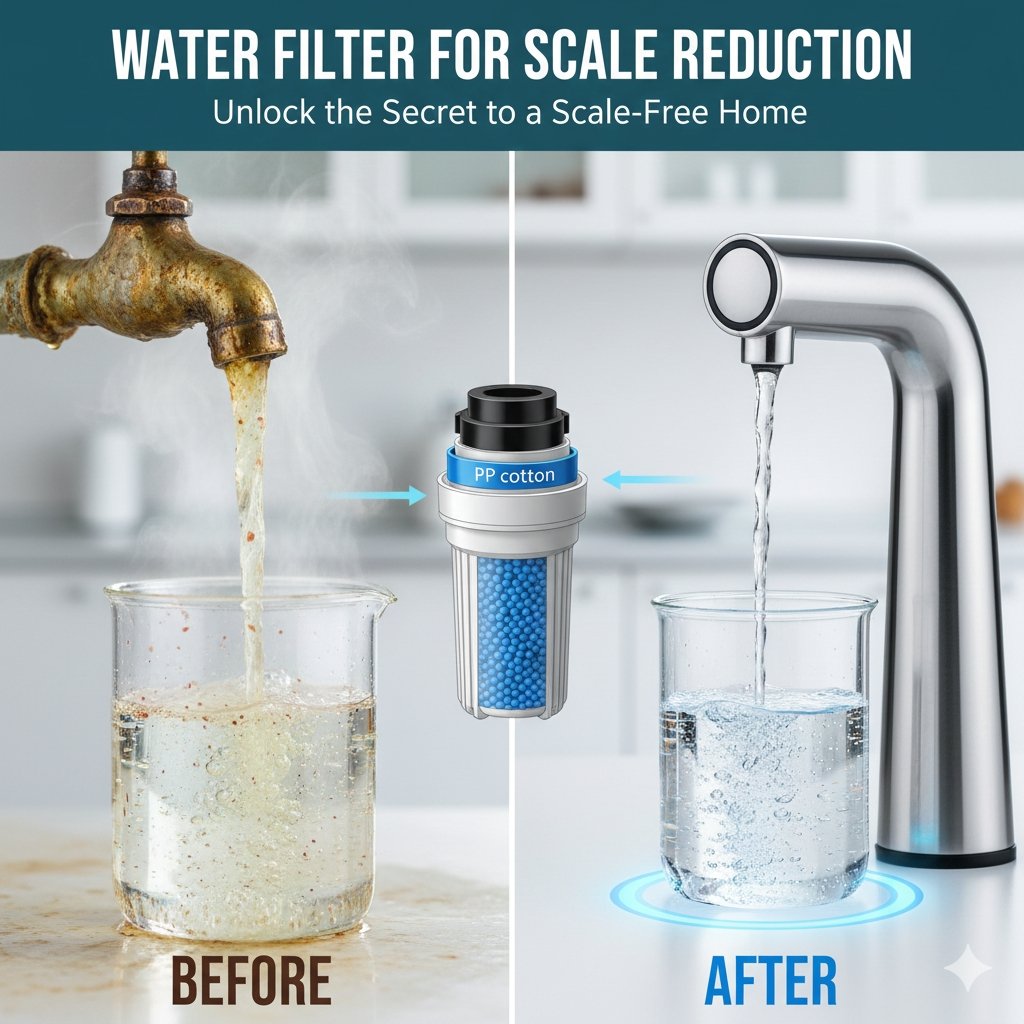
It starts as a faint white ring around your bathtub drain. Then, your favorite wine glasses begin to emerge from the dishwasher with a cloudy haze that no amount of polishing can remove. Soon after, you notice the water pressure in your morning shower feels weaker, and your kettle takes twice as long to boil.
The culprit is invisible, relentless, and expensive: Limescale.
For millions of homeowners, hard water is a daily reality that drains wallets and destroys infrastructure. Naturally, the solution is to treat the water. But when you type “water filter” into a search engine, you are bombarded with a dizzying array of options: softeners, conditioners, descalers, and purifiers.
The confusion is real. Most people start their journey looking for a water filter for scale reduction, not realizing that standard filters and scale solutions are two very different tools. To truly banish scale while ensuring your water is safe and clean, you need a strategy that goes beyond simple filtration.
In this extensive guide, we will dismantle the science of hard water, expose the hidden financial costs of ignoring it, and reveal why the “best” solution is actually a powerful combination of technologies—starting with a robust filtration foundation.https://yourwatergood.com/product/whole-house-water-filtration-system-for-home/.
Part 1: The High Price of the “White Crust”
Before we discuss the solution, we must understand the magnitude of the problem. Hard water isn’t just an annoyance; it is an infrastructure crisis for your home.
1. The Energy Vampire
Limescale is a phenomenal insulator. It has thermal properties similar to firebrick. When it coats the heating element of your electric water heater or the heat exchanger of your gas boiler, it acts as a barrier.
- The Stat: Just 1/4 inch of limescale can increase your energy consumption by up to 40%. You are essentially paying to heat the rock before you heat the water.
- The Result: Massive electricity or gas bills and a water heater that takes forever to recover hot water.
2. The Appliance Graveyard
Modern appliances are sophisticated machines filled with delicate sensors and tiny spray jets. Hard water wreaks havoc on them.
- Gas Water Heaters: Operating on untreated hard water, they fail up to 48% faster than those on treated water.
- Dishwashers: Scale clogs the spray arms, leading to dirty dishes.
- Washing Machines: Hard water destroys rubber seals and clogs inlet screens, leading to leaks and pump failures.
3. The Personal Toll
Hard water is tough on the human body. The same minerals that coat your pipes also coat your skin and hair.
- Soap Scum: Hard water prevents soap from lathering and rinsing clean. It leaves a microscopic layer of “curd” on your skin, clogging pores and exacerbating eczema and dryness.
- Hair: Minerals lift the scales on the hair shaft, making it rough, frizzy, and difficult to manage.
Part 2: The Great Confusion: “Filter” vs. “Softener”
This is the most critical section of this guide. When consumers search for a water filter for scale reduction, they often expect a simple carbon filter (like a giant version of a fridge filter) to do the job.
Here is the hard truth: Standard carbon filters do not remove dissolved minerals. If you pour hard water into a standard filter, it comes out clear and chlorine-free, but it is still hard.
To effectively combat scale, you typically need Ion Exchange (a water softener) or Template Assisted Crystallization (a salt-free conditioner).
HOWEVER, installing a softener directly onto your main water line without protection is a recipe for disaster.
- Chlorine Damage: Municipal water contains chlorine. Chlorine is an oxidizer that turns the expensive resin beads inside a softener into mush, cutting their lifespan in half.
- Sediment Damage: Rust and sand from city pipes clog the control valves of softeners and coat the media in salt-free systems, rendering them useless.
The Winning Strategy: The “One-Two Punch”
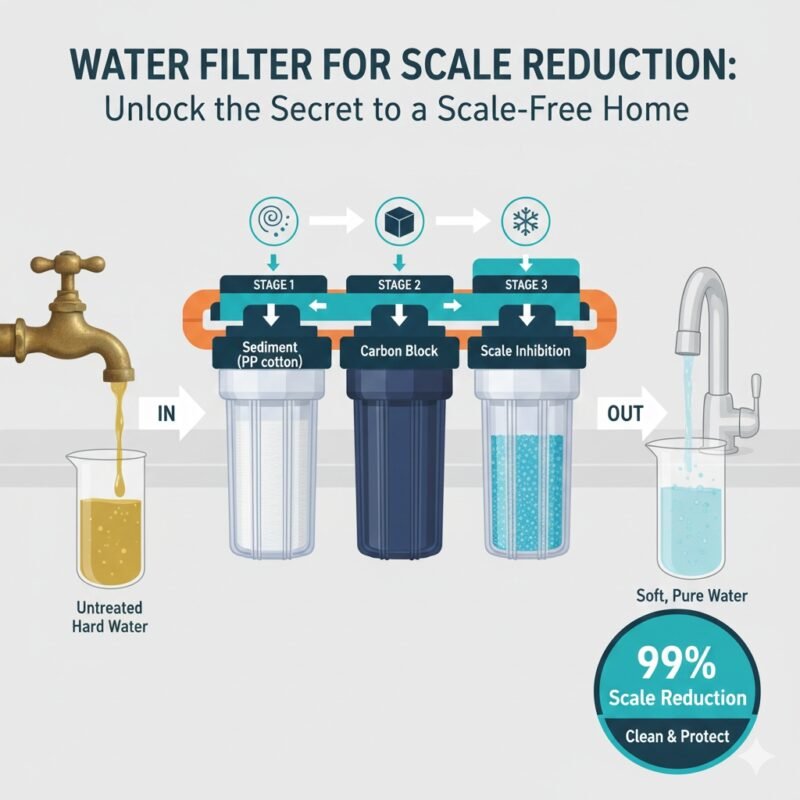
Therefore, the ultimate water filter for scale reduction is not a single tank—it is a two-step system.
- Step 1: Filtration. A robust Pre-Filter System to remove sediment, rust, and chlorine.
- Step 2: Treatment. The Softener or Conditioner to handle the hardness.
Part 3: Step 1 – The Foundation of Protection
If you want your limescale solution to last more than a few years, you must start with a high-quality pre-filter. This is the “Bodyguard” for your plumbing.
We highly recommend the Whole House Water Filtration System for Home as the foundational layer of your defense.
Why This System is Essential
This system is engineered to handle the “dirty work” so your softener doesn’t have to.
- Sediment Removal: It uses high-capacity Polypropylene (PP) Cotton filters to trap rust flakes, sand, and turbidity. This prevents “dirty scale” (a mix of mud and calcium) which is even harder to clean than white scale.
- Chlorine Removal: It uses premium Activated Carbon to strip chlorine and chemicals from the water. By feeding chlorine-free water to your softener, you protect the resin beads, ensuring they stay efficient for 15 years instead of 5.
By installing this system first, you are creating the optimal environment for scale prevention. It effectively makes any downstream equipment the best water filter for scale reduction it can be, simply by feeding it clean water.
Part 4: Step 2 – Choosing Your Weapon Against Scale
Once your water is clean (thanks to Step 1), you have three main technology choices for tackling the minerals.
Option A: The Salt-Based Softener (The Heavyweight)
- How it works: Ion Exchange. It physically swaps Calcium ions for Sodium ions using resin beads.
- Best for: Very hard water (over 10 GPG) and large families.
- Pros: 100% scale removal; slick feeling on skin; rich soap lather.
- Cons: Requires salt bags; uses water for regeneration; adds sodium to water (not ideal for drinking if on a low-sodium diet).
Option B: The Salt-Free Conditioner (The Eco-Choice)
- How it works: Template Assisted Crystallization (TAC). It changes the mineral structure so they form microscopic crystals that don’t stick to pipes.
- Best for: Moderate hardness (under 10 GPG) and eco-conscious homes.
- Pros: No salt; no electricity; zero wastewater.
- Cons: Does not remove minerals (water spots may still appear, but wipe off easily); no “soft water” feel.
Option C: The Polyphosphate Filter (The Compact Choice)
This is a true “filter cartridge” solution.
- How it works: A cartridge releases food-grade phosphates that coat the minerals, preventing adhesion.
- Best for: Small apartments or protecting specific appliances (like a water heater or washing machine).
- Pros: Cheap; easy to install inline.
- Cons: Cartridges need frequent replacement; less effective at high temperatures (over 140°F).
Part 5: Commercial Applications (The Small Business Edge)
For our readers who own cafes, restaurants, or salons, finding a water filter for scale reduction is a matter of business survival.
The Espresso Machine Crisis
An espresso machine is essentially a boiler with tiny, precision valves.
- The Failure: Limescale is the #1 cause of commercial coffee equipment failure. It jams solenoid valves and insulates temperature sensors.
- The Flavor: Hard water prevents proper extraction of coffee oils, leading to sour espresso. Over-softened water creates flat coffee.
- The Fix: A commercial system that combines the sediment protection of our Whole House Water Filtration System for Home with a specialized decarbonization filter allows you to protect the machine while keeping just enough mineral content for perfect crema.
The Salon Benefit
Hard water destroys hair color and prevents shampoo from lathering. For a salon, installing a softening system protected by a carbon pre-filter ensures that clients leave with softer, shinier hair, and the business saves money on expensive shampoos.
Part 6: Myths About Scale Removal
In your search for a water filter for scale reduction, you will encounter gadgets that promise miracles. Let’s debunk the pseudoscience.
Myth 1: Magnetic Wraps remove scale.
- The Claim: Wrapping magnets around a pipe alters the ions so they don’t stick.
- The Reality: Scientific consensus is that these are largely ineffective for residential use. They do not remove minerals. The water remains hard. Do not trust your $3,000 water heater to a $20 magnet.
Myth 2: Vinegar is a permanent fix.
- The Claim: You can just flush your appliances with vinegar.
- The Reality: Vinegar (acid) does dissolve scale. However, flushing a water heater is a messy, difficult annual chore that most homeowners neglect. It is a reactive repair, not a proactive solution.
Myth 3: All filtered water is soft.
- The Reality: A standard fridge filter does nothing to hardness. You need specific ion-exchange or crystallization technology.
Part 7: Environmental Considerations
Sustainability is a growing factor in choosing a water filter for scale reduction.
The Salt Issue
Traditional softeners discharge salty brine into the sewage system. In some drought-stricken areas (like parts of California), these are restricted because they make wastewater recycling difficult.
The Eco-Friendly Approach
- Protection: By using a pre-filter like the Whole House Water Filtration System for Home, you extend the life of your appliances. Keeping a washing machine out of a landfill for an extra 5 years is a massive environmental win.
- Efficiency: Preventing scale buildup maintains the energy efficiency of your water heater, lowering your home’s carbon footprint.
- Salt-Free: Consider TAC conditioners if you want to avoid salt discharge entirely.
Part 8: Making the Decision
So, what is the right strategy for you?
- Test Your Water: Buy a simple hardness test strip. Know your number.
- 3-7 GPG: A Salt-Free conditioner is likely sufficient.
- 10+ GPG: You need a Salt-Based Softener.
- Prioritize the Pre-Filter: Regardless of the softener type, you must protect it from chlorine and dirt. The Whole House Water Filtration System for Home is the essential partner in this strategy.
- Consider the Kitchen: If you don’t want to drink softened water, add a Reverse Osmosis unit under the kitchen sink for drinking and cooking.
Conclusion: A Scale-Free Future
Limescale is a relentless adversary. It works silently inside your walls, insulating your heating elements and clogging your valves. But it is an adversary you can defeat.
The search for a water filter for scale reduction ends with a comprehensive strategy. It isn’t just one magic box; it is a system. It is about removing the sediment and chlorine first, then treating the minerals second.
By investing in high-quality filtration alongside your softening solution, you transform your home’s water from a liability into an asset. You save money on energy bills, you protect your expensive renovations, and you enjoy the luxury of better skin and hair.
Don’t let dissolved rocks dictate your quality of life. Start your journey to scale-free living by securing the foundation of your water system today. Visit YourWaterGood to explore the high-capacity filtration solutions that make effective water treatment possible.
Frequently Asked Questions (FAQ)
Q: Does the Whole House Water Filtration System for Home remove scale on its own? A: No. This system is a Filtration unit (Sediment + Carbon). It removes dirt, rust, and chlorine. It does not remove dissolved hardness minerals. However, it is the essential partner to any scale system. Without it, your scale filter will get clogged with mud and destroyed by chlorine.
Q: Can I drink water from a scale reduction system? A: Yes.
- Salt-Free: Safe to drink; retains healthy minerals.
- Salt-Based: Safe for most, but adds sodium. Those on a low-sodium diet should drink from an RO tap.
- Polyphosphate: Safe if the cartridge is rated “Food Grade.”
Q: Will this remove white spots on my car? A:
- Salt-Based Softener: Replaces calcium spots with sodium spots (which are easier to wipe off).
- Reverse Osmosis (RO): Removes all minerals, providing a truly spot-free rinse.
Q: How often do I change the pre-filters? A: For the Whole House system, we recommend changing the sediment (PP Cotton) filter every 3 to 6 months. If you notice a drop in water pressure, change it immediately—it means it has done its job and caught a load of sediment.
Q: Is hard water bad for my pets? A: Generally, no. Pets can drink hard water safely. However, highly mineralized water might contribute to urinary crystals in some cats prone to the condition. Filtered or RO water is often recommended for sensitive pets.