
The Strategic Evolution of the small water purifier machine: Driving Efficiency and Purity for Modern Small Businesses

This topic is covered in full in our main guide: The Ultimate B2B Engineering Guide to Commercial Water Systems.
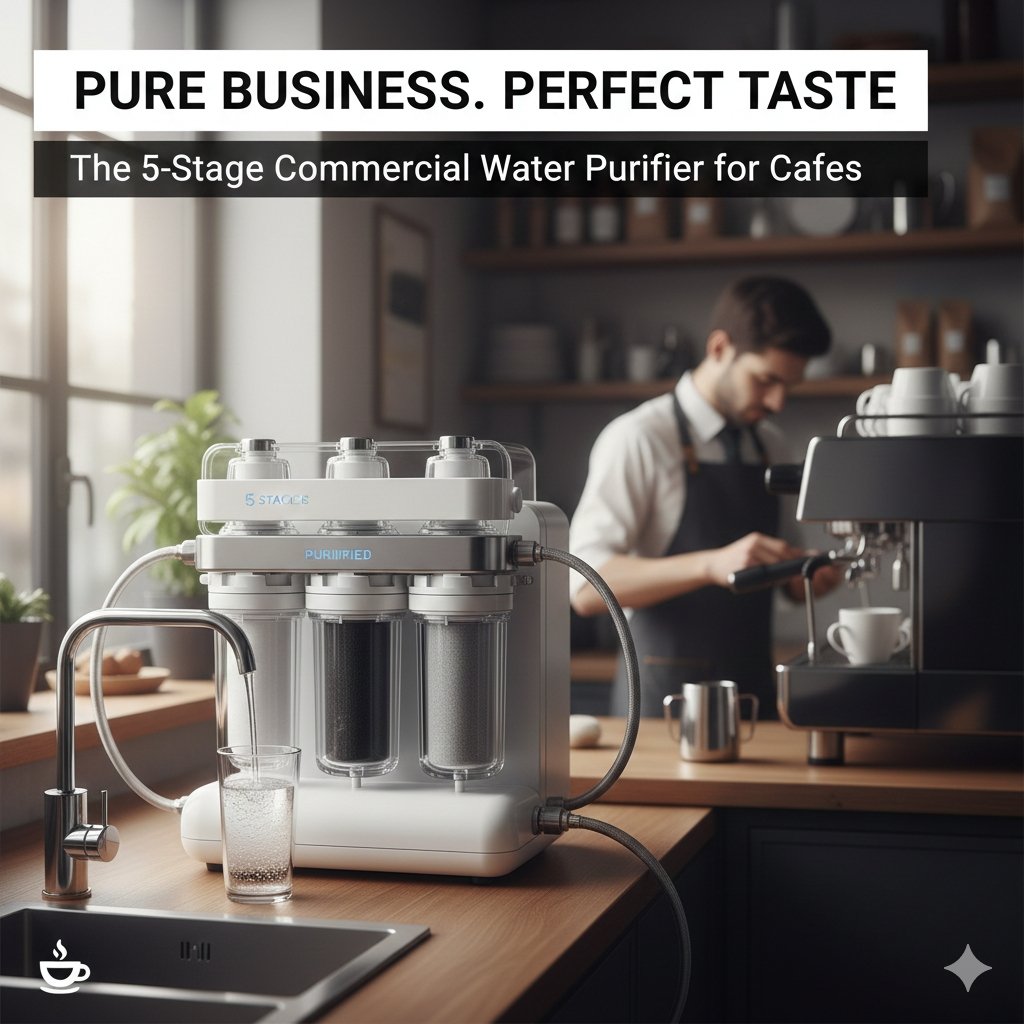
In the modern landscape of commercial operations, space is one of the most valuable commodities. Whether you are managing a high-traffic boutique cafe, a localized small restaurant, or a bustling startup office, the physical footprint of your infrastructure directly impacts your overhead and operational agility. Traditionally, high-level water purification was the domain of massive, industrial-scale skids that required dedicated utility rooms. However, a significant engineering shift has occurred, bringing forth the era of the small water purifier machine.
For the professional stakeholder, a small water purifier machine is no longer just a consumer appliance; it is a precision-engineered tool designed to deliver industrial-grade water quality within a compact chassis. This guide provides a deep-dive into the technical architecture, economic ROI, and strategic advantages of implementing compact purification technology to protect your assets and elevate your product quality.
The Engineering of Compact Purity: What Defines a small water purifier machine?
The term small water purifier machine refers to a category of filtration systems engineered for high-density environments. These systems are designed to fit under standard commercial counters, within narrow utility closets, or even as sleek countertop units, all while maintaining the high-pressure throughput required for professional use.
Redefining the Footprint
Modern engineering has allowed for the miniaturization of pumps, housings, and membrane configurations. A professional-grade small water purifier machine utilizes high-flux membranes that can process more gallons per day per square inch than older, bulkier models. This “high-density” approach ensures that a boutique coffee shop can produce enough high-purity water for hundreds of espressos without needing a massive storage tank that consumes half their storage area.
The Synergy of Multi-Stage Integration
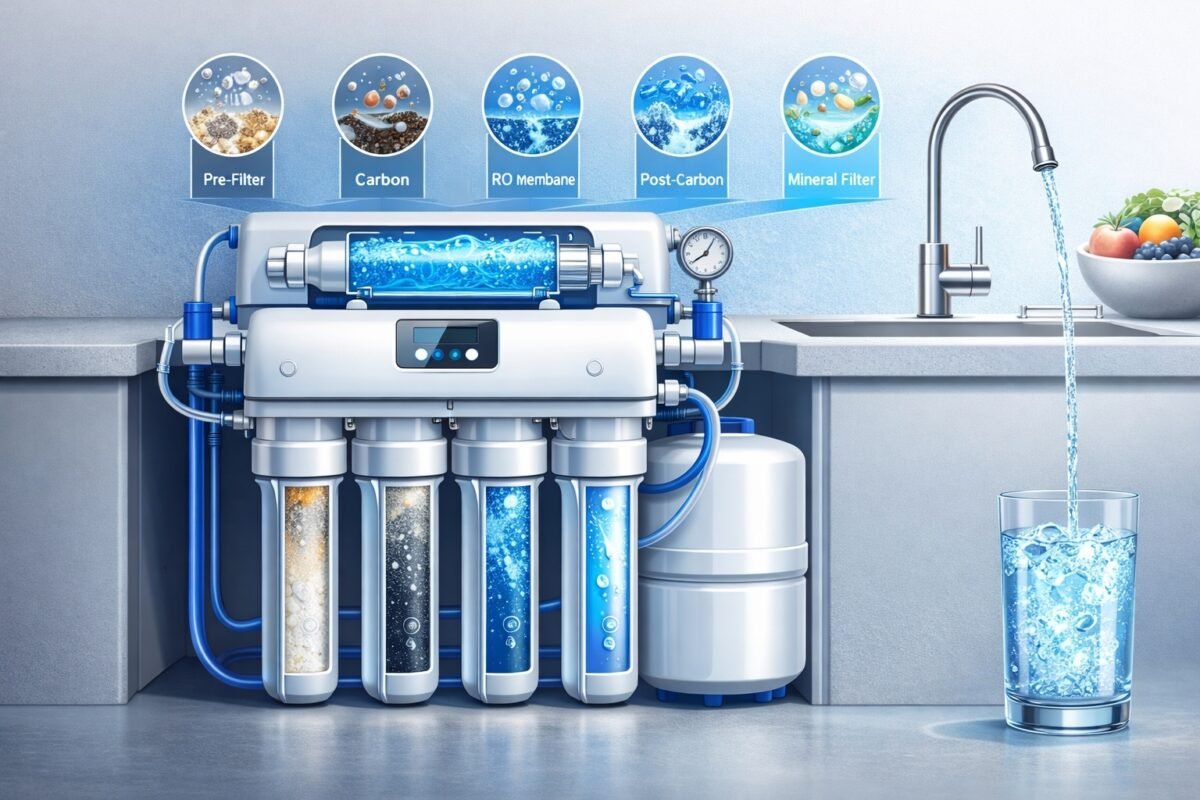
Despite its reduced size, a top-tier small water purifier machine does not compromise on the number of filtration stages. By utilizing vertical stacking and integrated manifolds, these machines can house sediment filters, carbon blocks, and Reverse Osmosis (RO) membranes in a single, streamlined enclosure. This integration reduces the number of potential leak points and simplifies the installation process for facility managers.
The Role of PP Cotton in Asset Protection
Every sophisticated water system begins with a robust mechanical defense. At YourWaterGood, we recognize that the first stage of any small water purifier machine is the most critical for the survival of the system’s more delicate components.
The Science of Melt-Blown Polypropylene
The sediment stage, often referred to as “PP Cotton,” is the “bodyguard” of the purification process. Melt-blown PP cotton is made by a process in which molten polypropylene is spun into a multi-layered, three-dimensional web.
- Graduated Density: The fiber structure is designed to be looser on the outside and tighter on the inside. This allows the filter to trap large particles of rust and silt on the exterior while the inner core provides a final micro-polish.
- Depth Filtration: Unlike surface screens, the depth media provided by a PP cotton filter manufacturer can hold a significant volume of debris, preventing the high-pressure pumps in a small water purifier machine from experiencing “cavitation” or mechanical strain due to clogging.
Why Material Purity Matters for B2B
In a restaurant or cafe environment, the materials must be food-grade and chemically inert. Our expertise in PP cotton media ensures that no binders, glues, or surfactants are used in the creation of the filter media. This guarantees that the water remains taste-neutral, providing a clean canvas for your coffee beans or culinary ingredients.
ROI and Equipment Longevity: The Business Case for Compact Systems
For a small business owner, the purchase of a small water purifier machine is a strategic investment in “avoided costs.” The impurities found in municipal water—specifically sediment and dissolved minerals—are the leading cause of premature failure in commercial kitchen equipment.
Protecting the Espresso and Brewing Workflow
Specialty coffee machines are highly vulnerable to water quality.
- Scale Prevention: While sediment filters remove physical grit, the RO stage of a small water purifier machine removes the dissolved minerals that cause scale. Scale acts as an insulator on heating elements, forcing the machine to use more energy and eventually causing the boiler to fail.
- Precision Orifice Protection: Modern espresso machines use flow restrictors as small as 0.6mm. Even a microscopic flake of rust passing through an inferior filter can cause an instant breakdown. By implementing a professional small water purifier machine, you extend the service life of these high-value assets by years, significantly lowering your total cost of ownership.
Enhancing Culinary Consistency
In a small restaurant, the “signature taste” is your brand. Chlorine and organic volatiles in city water can ruin the flavor of delicate broths or steamed vegetables. A small water purifier machine provides a consistent, high-purity baseline, ensuring that your customers experience the same quality every time they visit, regardless of seasonal changes in the municipal water supply.
Spotlight on the 5-Stage RO Water Filter for Home and Business
For professionals seeking the ultimate balance of compact design and industrial performance, we recommend the 5-Stage RO Water Filter for Home and Business. This specific model is the quintessential small water purifier machine for the B2B sector.
Why 5 Stages are the Professional Standard
- Stage 1: High-Density PP Cotton: This stage stops rust, sand, and silt.
- Stage 2: GAC (Granular Activated Carbon): Eliminates the “swimming pool” smell of chlorine.
- Stage 3: CTO (Carbon Block): Removes organic chemicals and VOCs that affect taste.
- Stage 4: High-Flux RO Membrane: Strips away up to 99% of dissolved solids (TDS), including lead and nitrates.
- Stage 5: Post-Carbon Polish: Provides the final crisp, refreshing finish to the water.
This small water purifier machine is uniquely suited for small businesses because it provides the volume necessary for a commercial kitchen while maintaining a footprint small enough to hide under a standard prep sink.
Maintenance and Operational Efficiency for Facility Managers
One of the primary benefits of a modern small water purifier machine is the ease of maintenance. In a busy commercial environment, you cannot afford hours of downtime for complex filter changes.
Quick-Change Cartridge Technology
Modern systems are moving toward modular designs. Instead of wrestling with heavy canisters and messy leaks, many small water purifier machine models allow for a “twist-and-lock” replacement. This allows staff to perform routine maintenance in minutes, ensuring the system is always protecting your equipment.
Monitoring System Health
High-end compact units now feature integrated TDS (Total Dissolved Solids) monitors and pressure gauges. This data allows facility managers to move from “reactive” maintenance to “proactive” management. By seeing exactly when the membrane efficiency begins to dip, you can schedule a replacement before it impacts the flavor of your product or the health of your machines.
Sustainability: The Environmental Impact of Compact Filtration
In the current global market, sustainability is a core pillar of B2B content marketing and brand value. Adopting a small water purifier machine directly supports your ESG (Environmental, Social, and Governance) goals.
- Reducing Single-Use Plastics: For small offices or boutique hotels, providing high-purity water through a small water purifier machine eliminates the need for plastic water bottles.
- Energy Efficiency: By preventing scale buildup in water heaters and boilers, these machines ensure that your appliances operate at peak thermal efficiency, reducing your building’s overall energy consumption.
- Pure Materials: At YourWaterGood, we ensure our filter media is recyclable and produced with minimal environmental impact compared to chemically-treated alternatives.
Comparing Small vs. Large Purification Systems
| Feature | Small Water Purifier Machine | Large Industrial Skid |
| Footprint | Compact (Under-sink/Countertop) | Large (Requires dedicated room) |
| Installation | Simple (Standard plumbing) | Complex (Requires specialized engineering) |
| Flow Rate | Optimized for small-to-medium demand | Optimized for high-volume manufacturing |
| Maintenance | User-serviceable | Requires specialist service contract |
| Capital Cost | Lower (Immediate ROI) | High (Long-term amortization) |
For the majority of small restaurants, cafes, and professional offices, the small water purifier machine provides the best balance of performance and practicality.
Frequently Asked Questions (FAQ) for B2B Buyers
Q: Can a small water purifier machine handle the demand of a busy cafe? A: Yes. Many modern units are rated for 400 to 800 GPD (Gallons Per Day). When paired with a small pressurized storage tank, they can easily manage peak morning rushes in a specialty coffee shop.
Q: Does it remove heavy metals? A: Absolutely. A high-quality small water purifier machine utilizing Reverse Osmosis technology is highly effective at removing lead, arsenic, and chromium, which are common concerns in urban infrastructures.
Q: How often should I replace the PP Cotton stage? A: At YourWaterGood, we recommend changing the sediment stage every 3 to 6 months in a commercial setting. This prevents the “fines” from clogging the more expensive RO membrane.
Q: Is the water “too pure” for coffee? A: While RO water has very low TDS, many baristas use a “re-mineralization” stage or a bypass valve to add back a controlled amount of minerals. A small water purifier machine gives you the “blank canvas” needed to create the perfect custom water profile.
Conclusion: Securing Your Business with Compact Technology
The transition to a small water purifier machine represents a shift toward smarter, more efficient infrastructure management. For small business owners in the US and Europe, it is an essential step in safeguarding expensive equipment, ensuring product consistency, and meeting the growing demand for sustainable operations.
By utilizing the material expertise of a specialist PP cotton filter manufacturer, you provide your facility with a robust defense that starts at the microscopic level. Don’t let the constraints of your physical space limit the quality of your output.
Elevate your water quality and protect your bottom line today. Explore the 5-Stage RO Water Filter for Home and Business at YourWaterGood. Our team is dedicated to helping you find the perfect compact solution that ensures your water—and your business—is truly good for the future.