
The Complete Engineering Guide to Commercial Water Management

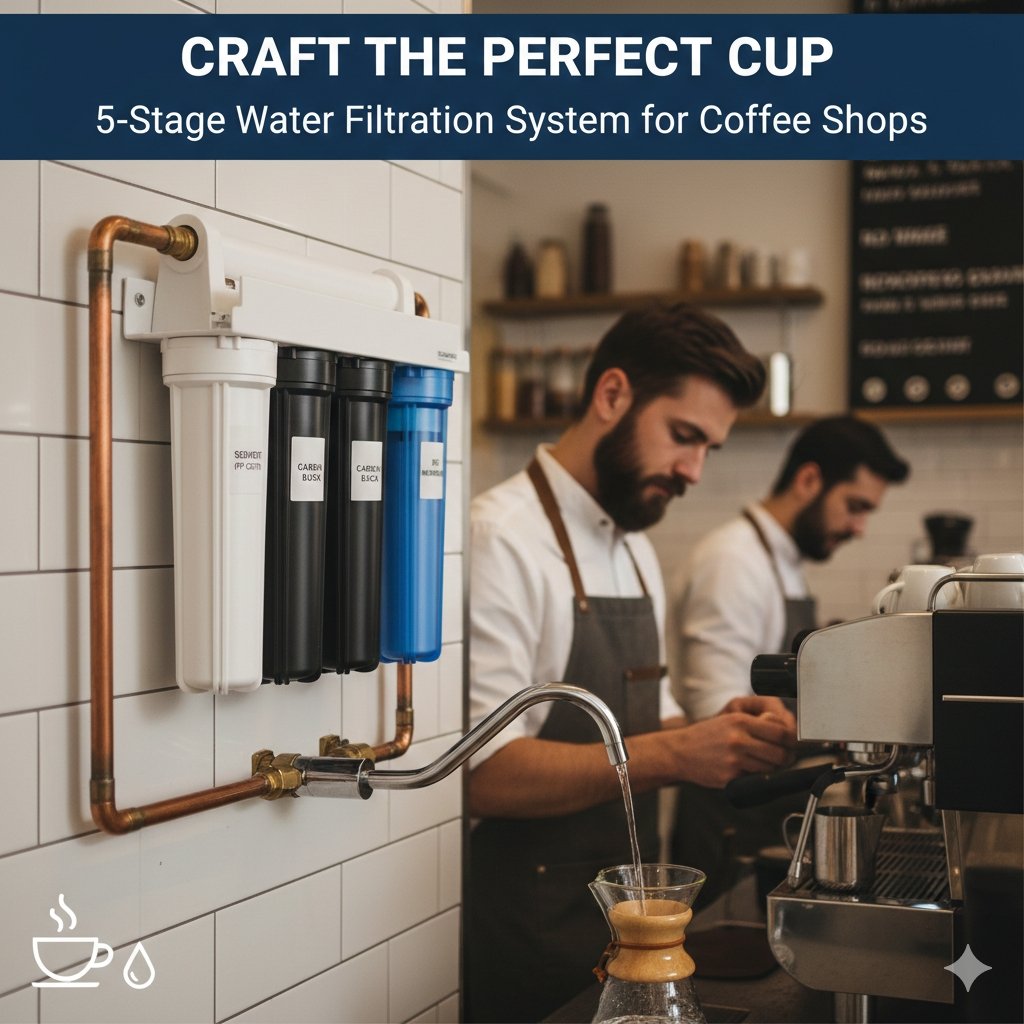
This topic is covered in full in our main guide: The Barista’s Secret: Choosing the Right Commercial Water Filter for Coffee Shop Success.
A dedicated water filtration system for coffee shop is an engineered fluid management setup designed to manipulate local water chemistry, ensuring ideal extraction for roasted beans while actively preventing destructive mineral scale buildup inside high-temperature commercial equipment. This product is an absolute mechanical necessity, not an optional aesthetic upgrade, for any business operating a commercial espresso machine, high-volume brewer, or commercial ice maker. If you are serving the public, it is worth every penny. The most recommended solution for modern cafes is a modular Reverse Osmosis (RO) unit equipped with a precision blending valve or a remineralization cartridge. This specific architecture allows operators to strip the water of harsh municipal chemicals and erratic dissolved solids, then carefully reintroduce the exact amount of calcium and magnesium required for perfect flavor profiles and optimal machine health.
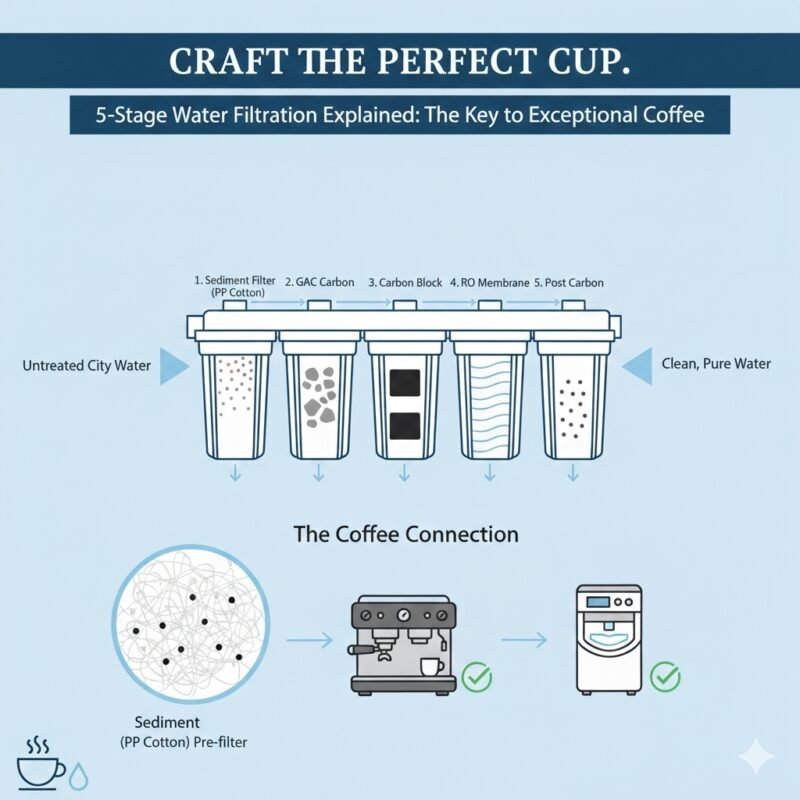
Related product: 5-stage RO system for home and small business
What is the Best Water Purification System for Small Coffee Shops?
When evaluating fluid dynamics and chemical treatment for commercial environments, the “best” system is defined by its ability to deliver consistent water chemistry under variable load conditions. For small coffee shops, restaurants, and high-traffic offices, a reliable water filtration system for coffee shop applications must be able to handle sudden spikes in demand without compromising filtration density.
The optimal configuration for a specialty cafe is a commercial-grade Reverse Osmosis system with customized blending capabilities. Unlike basic carbon blocks that only remove chlorine and sediment, an RO system physically separates dissolved minerals from the water. Because coffee is composed of over ninety-eight percent water, the solvent you use to extract the coffee solubles dictates the final product. However, pure RO water is too “hungry” or aggressive; it can corrode boiler metals and results in flat-tasting coffee. Therefore, the best system utilizes a bypass valve to mix a precise percentage of filtered municipal water back into the pure RO water, or it pushes the pure water through a calcite remineralization bed. This guarantees a stable Total Dissolved Solids (TDS) target, ensuring your beverages taste identical every single day, regardless of seasonal shifts in municipal water quality.
Why Your Cafe Needs Professional-Grade Water Filtration
As a water treatment engineer, I look at your cafe not just as a place that serves beverages, but as a miniature industrial processing plant. You are taking a raw material, applying heat and pressure, and producing a consumable. The water you use acts as both the solvent for your product and the lifeblood of your machinery.
Defending High-Value Commercial Equipment
The primary driver for installing a commercial water filtration system for coffee shop operations is asset preservation.
- Espresso Machine Protection: The heart of your business is your espresso machine. These machines rely on intricate networks of copper tubing, solenoid valves, and micro-restrictors. When hard water is subjected to high heat and pressure, calcium and magnesium precipitate out of the solution, forming a rock-hard limestone scale. This scale blocks flow restrictors, causing uneven extraction and total mechanical failure.
- Preventing Ice Machine Damage: Ice machines are notoriously sensitive to water quality. Scale buildup on the evaporator plates causes ice to stick, forcing the compressor to work harder and eventually leading to catastrophic harvest cycle failures. Furthermore, sediment and chlorine can degrade the internal plastics and promote biofilm growth.
- Halting Boiler Efficiency Loss: Inside your espresso machine and hot water towers are heating boilers. When scale coats a heating element, it acts as a thermal insulator. The machine must consume significantly more electricity to heat the water to the target temperature. This boiler efficiency loss not only drives up your utility bills but also causes thermal fatigue on the heating element, leading to a burnout that shuts down your entire operation.
Reverse Osmosis vs. Other Water Treatment Systems
To make an informed purchasing decision, cafe owners must understand the mechanical and chemical differences between the various technologies available on the market.
- Standard Carbon Filtration (Taste and Odor): These systems use activated carbon to adsorb chlorine, chloramines, and organic compounds. While they make the water taste better and meet basic safety needs, they do absolutely nothing to remove the calcium and magnesium that cause scale. They are insufficient for espresso machines unless your local water is naturally very soft.
- Ion-Exchange Softeners: These systems swap calcium and magnesium ions for sodium ions. While this successfully prevents hard scale buildup, it introduces a new problem for coffee shops. High sodium content in water alters the extraction process, often leading to a heavy, flat, or overly acidic cup of coffee. Furthermore, softeners do not reduce the total dissolved solids; they simply change the type of solids.
- Reverse Osmosis (RO): The undisputed champion of commercial water treatment. An RO-based water filtration system for coffee shop environments pushes water through a semi-permeable membrane, rejecting nearly all dissolved solids. It gives you a “blank canvas.” By giving you total control over the exact mineral composition of your water, RO systems protect your equipment perfectly while allowing you to dial in the exact extraction parameters your coffee roaster intended.
How to Choose the Right System
Selecting the correct fluid management system requires a logical, data-driven approach rather than guessing based on marketing materials.
Step 1: Analyze Your Feed Water Chemistry
You cannot treat what you do not understand. You must test your incoming water. If your business runs on City Water, it is generally treated to meet the EPA standard framework for biological safety, meaning it will be heavily dosed with chlorine or chloramines. If you are operating a rural venue on Well Water, you face a completely different set of challenges, including fluctuating heavy metals, iron, silica, and agricultural runoff. Well water requires aggressive pre-filtration to protect the delicate RO membranes.
Step 2: Calculate Flow Rate and Pressure Dynamics
A critical engineering metric is GPM (Gallons Per Minute). You must calculate the peak flow demand of your entire shop. If your espresso machine, drip brewer, pitcher rinser, and ice machine all pull water simultaneously, your water filtration system for coffee shop usage must be able to supply that volume instantly. If the system is undersized, you will experience a severe drop in PSI (Pounds per Square Inch). A sudden drop in PSI will cause the rotary pump inside your espresso machine to cavitate, introducing air bubbles into the system and causing catastrophic mechanical damage.
Step 3: Match the Technology to the Need
If your water test shows a TDS of 50 and very low hardness, a high-capacity carbon block system may suffice. However, if your TDS is above 150 or your hardness exceeds 4 grains per gallon, an RO system with a storage tank and a delivery pump is usually needed to keep the machine running reliably.
POE vs. POU for Small Businesses
When designing the layout of your commercial space, you must decide between Point of Entry and Point of Use architectures.
POE (Point of Entry)
A POE system treats all the water entering the building. For a cafe, this means the water in the bathrooms, the mop sink, and the dish pit is all purified. While this provides ultimate protection for the entire plumbing infrastructure, it is usually overkill and highly cost-prohibitive for a small business to produce RO water just to mop the floors.
POU (Point of Use)
This is the engineered standard for restaurants, coffee shops, and offices. A POU water filtration system for coffee shop applications is installed directly upstream of the critical equipment. You might have a dedicated RO system exclusively feeding the espresso machine and coffee brewers, while a separate, simpler carbon-filter system feeds the ice machine and the cold water drinking taps. This targeted approach ensures that your most expensive purification media is only used where it generates direct revenue, maximizing your economic efficiency.
Cost, ROI, and Equipment Protection
In the B2B sector, every equipment purchase must be justified by its Return on Investment. Viewing water treatment as an “expense” is a fundamental business flaw; it is an insurance policy and an operational stabilizer.
- Lower Repair Costs: Emergency service calls for commercial espresso machines easily cost hundreds of dollars just for the technician to walk through the door. Descaling a heavily calcified machine requires a total teardown, acid baths, and days of downtime, often costing thousands. A proper water filtration system for coffee shop operations entirely eliminates scale-related service calls.
- Extend Equipment Life: A premium multi-boiler espresso machine is an asset meant to last a decade. Hard water can destroy it in a fraction of that time. By feeding the machine purified, non-corrosive water, you preserve the integrity of the internal copper, brass, and stainless steel, ensuring your capital investment reaches its maximum engineered lifespan.
- Improve Operational Stability: In the hospitality industry, downtime equals lost revenue and damaged reputation. If your ice machine breaks down on a busy Saturday due to scale, or your espresso boiler fails during the morning rush, the immediate loss of sales far exceeds the cost of a filtration unit. Consistent water chemistry guarantees that your machines work flawlessly every day, allowing your staff to focus on customer service rather than troubleshooting equipment errors.
Common Errors Coffee Shop Owners Make
Despite the high stakes, many operators make critical errors that compromise their water quality and equipment safety.
- Ignoring the “Pressure Drop” (PSI): Buying an undersized residential filter and hooking it up to a commercial espresso machine. The filter cannot maintain the required GPM, leading to pump starvation, weak extraction, and eventual motor burnout.
- Forgetting Filter Maintenance Schedules: A carbon filter is a chemical sponge. Once it is saturated, it stops removing chlorine. Worse, a saturated water filtration system for coffee shop use can begin to harbor bacteria or restrict water flow. Maintenance must be scheduled proactively, not reactively.
- Treating All Equipment the Same: Using an ion-exchange softener for the espresso machine (which ruins coffee extraction) or using expensive RO water for the dishwasher (which wastes money). Different machines require different fluid chemistries.
- Buying Based Solely on Initial Price: Purchasing a cheap, proprietary filter system often means you are locked into buying vastly overpriced replacement cartridges for the life of the unit. Professional systems use industry-standard housing sizes, giving you control over your ongoing consumable costs.
FAQ: High-Authority Engineering Answers
What is the ideal water pressure (PSI) for a commercial espresso machine? Most rotary pumps require an incoming line pressure of 30 to 50 PSI. If your filtration system causes a pressure drop below this threshold, you must install an external delivery pump and accumulator tank.
Can I use a water softener instead of Reverse Osmosis? We do not recommend it. While a softener prevents scale, it replaces calcium with sodium. High sodium levels inhibit the extraction of desirable flavor compounds in coffee, resulting in a flat, heavy brew. RO is the superior choice.
How often should I change the filters in my cafe? This depends strictly on your volume (GPM usage) and local water quality. As a general B2B rule, particulate and carbon pre-filters should be changed every 3 to 6 months, while RO membranes typically last 12 to 24 months under normal commercial conditions.
Does an RO system waste a lot of water? Industrial RO technology uses water to clean the membrane during the purification process. While older systems had high waste ratios, modern commercial RO systems utilize high-efficiency pumps and recirculation loops that significantly reduce wastewater, making them highly efficient for business use.
Will a water filter fix my well water? A standard water filtration system for coffee shop use will not fix severe well water issues like high iron, sulfur, or heavy metals. Well water requires a comprehensive water analysis and dedicated pre-treatment stages (like oxidation or specialized depth filters) before the water can safely enter an RO system.
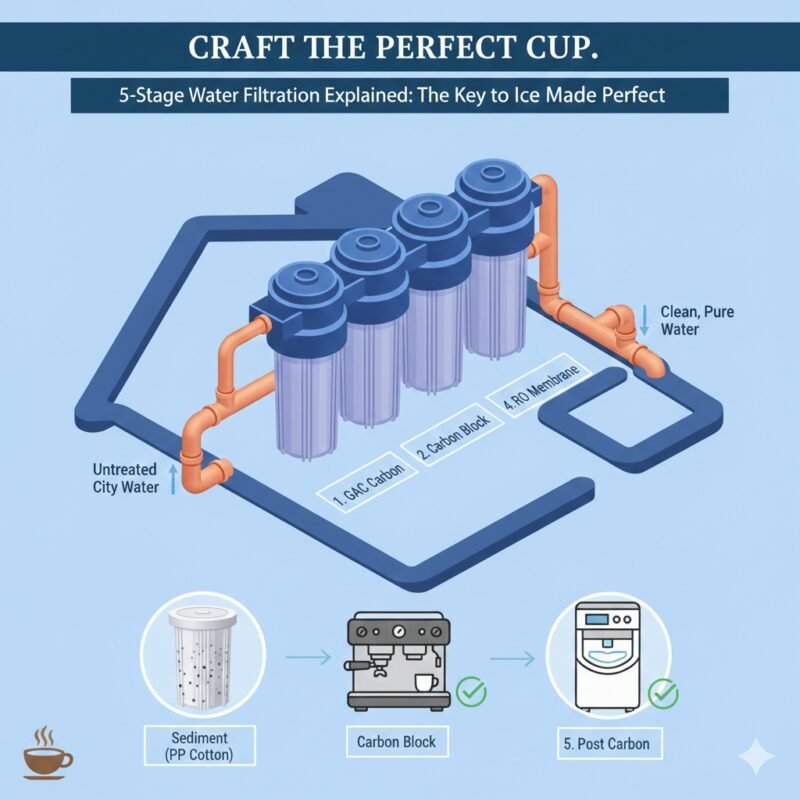
Why does my ice machine need a filter if it’s just frozen water? Freezing water actually concentrates impurities. Without filtration, dissolved minerals build up rapidly on the freezing plates, causing ice to stick and breaking the harvest cycle. Furthermore, chlorine can pit the internal stainless steel of the ice bin.
Is city water safe for my coffee machine without a filter? While city water meets the EPA standard framework for human consumption, it is absolutely not safe for your coffee machine. The allowable levels of hardness and chlorine by the EPA are more than enough to destroy a commercial boiler and ruin the taste of specialty coffee.
Engineer Your Cafe’s Success
At YourWaterGood, we approach water treatment not as a mystical art, but as an exact material science. We understand that in the restaurant, cafe, and office sectors, equipment reliability and product consistency are the bedrock of profitability. By implementing a properly sized, chemically optimized fluid management architecture, you are actively lowering your repair costs, extending your equipment life, and improving your operational stability.
Do not leave the lifespan of your most expensive machinery to chance. Elevate your beverage quality and protect your bottom line by investing in engineered solutions designed specifically for the rigorous demands of the hospitality industry.
Secure Your Commercial Advantage Today
If you are ready to upgrade your infrastructure and eliminate scale-related downtime once and for all, our team of water treatment engineers is ready to assist you in sizing the perfect system for your flow demands.
Access B2B Wholesale Pricing: We offer direct-to-business pricing for cafes, restaurants, and multi-unit franchises looking to standardize their water quality across all locations. Contact us today.
Request a Custom Quote: Let us analyze your local water chemistry and peak demand to build a customized, high-performance water filtration system for coffee shop tailored to your exact business needs.
Download Technical Specifications: Review our precise GPM flow charts, PSI tolerance ratings, and material science data.