
The Strategic Necessity of High Volume Water Filtration for Restaurants: Protecting Equipment, Flavor, and ROI

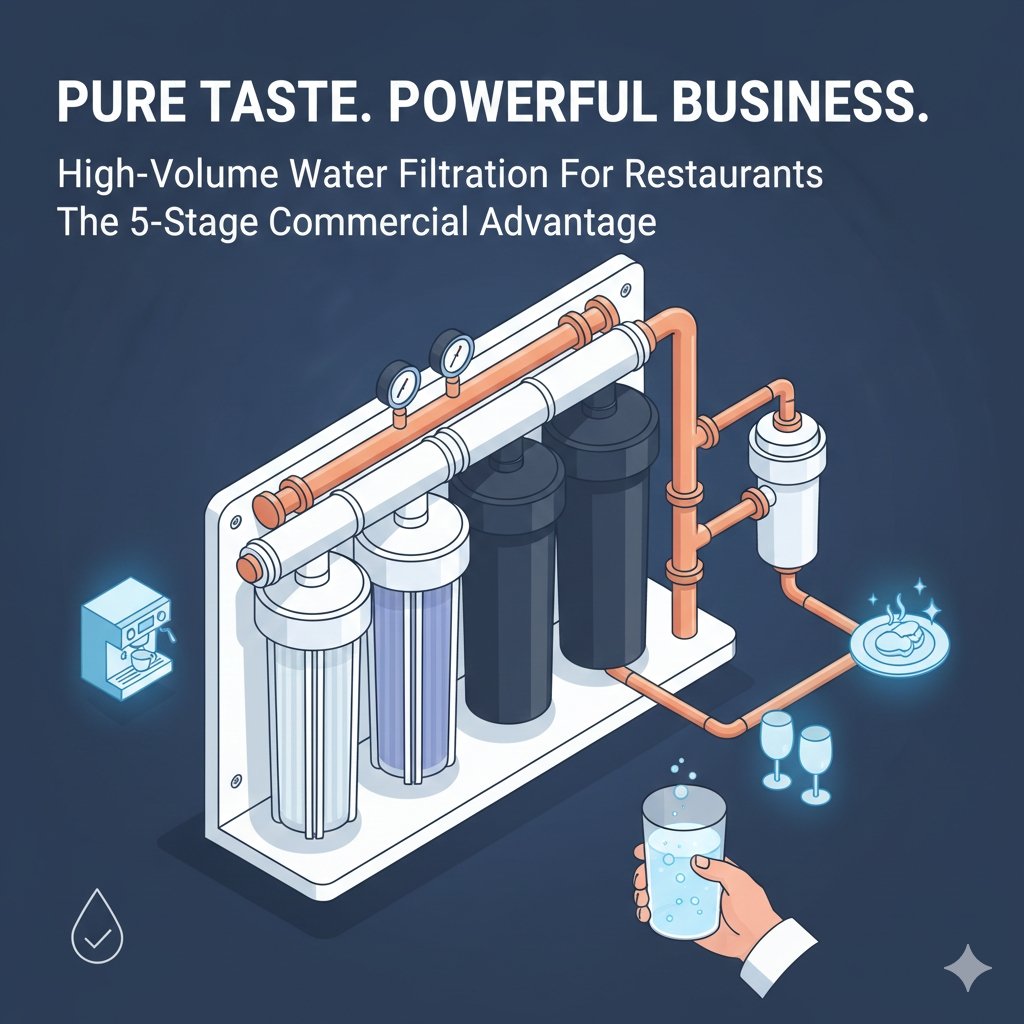
This topic is covered in full in our main guide: High Flow Water Purification Systems for Commercial Kitchens & Multi-Unit Facilities.
In the competitive American foodservice landscape, from bustling urban diners to secluded farm-to-table establishments, success is often measured by the consistency of the guest experience. While chefs spend hours sourcing the finest proteins and local produce, many overlook the single most prevalent ingredient in the kitchen: water. Whether it is used for ice production, fountain beverages, specialty coffee, or high-pressure steaming, water quality directly impacts the bottom line. Implementing professional high volume water filtration for restaurants is not merely an aesthetic choice; it is a fundamental business strategy designed to safeguard expensive capital assets and maintain a flawless brand reputation.
Commercial water demands are very different from residential needs. The sheer volume of water required during a peak lunch rush puts immense stress on filtration media. For small business owners and restaurant operators, understanding the nuances of regional water challenges and the technical specifications of filtration systems is the key to long-term operational stability.
Regional US Water Challenges: Navigating the Geological Landscape
The United States features a diverse and often problematic geological profile that complicates water safety for commercial operators. For restaurants relying on private wells or even those on municipal lines in aging districts, a robust high volume water filtration for restaurants system is the only way to ensure consistency.
The Midwest: Agricultural Runoff and Heavy Metal Risks
In the American Midwest, the primary concern for restaurant owners is often the infiltration of heavy metals and agricultural byproducts into the water table. Well water in this region frequently tests high for nitrates and iron. Nitrates, originating from large-scale farming applications, can introduce off-tasting metallic notes into drinking water and pose significant health risks if left untreated. Furthermore, dissolved iron can lead to “red water” issues, staining porcelain and clogging the intricate valves of high-spec commercial equipment.
Texas and the Southwest: The Hard Water Crisis
Texas and the surrounding Southwestern states are notorious for extreme hard water. The aquifers in these regions are rich in calcium and magnesium minerals. When this water is heated—as it is in every commercial dishwasher, steamer, and espresso machine—the minerals precipitate out to form rock-hard scale. Without high volume water filtration for restaurants specifically designed for scale inhibition, a brand-new steamer can be rendered inefficient or completely broken within a matter of months.
Coastal Regions: Sediment, Turbidity, and Salt Intrusion
Along the Atlantic and Gulf Coasts, the challenge is often mechanical. High levels of suspended sediments and silt can enter the water line, especially after heavy storms or tidal shifts. This turbidity acts like an abrasive, physically grinding down the seals and pumps inside commercial kitchen appliances. Coastal operators must prioritize sediment removal to prevent their plumbing systems from being compromised by grit and fine sand.
The Economics of Filtration: ROI and Asset Protection
For any B2B operator, the decision to install high volume water filtration for restaurants must be justified by a clear return on investment (ROI). The cost of a professional filtration system is a fraction of the cost of the equipment it protects.
Protecting the Espresso Machine and Beverage Program
A high-specification commercial espresso machine is often a five-figure investment. These machines rely on tiny orifices and precise thermal sensors to function. When untreated water flows through these components, scale buildup acts as a thermal insulator, forcing the machine to draw more power to heat the water. Eventually, the heating elements burn out. By utilizing high volume water filtration for restaurants, owners can extend the life of these machines by years, significantly lowering the total cost of ownership.
Ice Machine Longevity and Hygiene
Ice makers are perhaps the most sensitive machines in any restaurant. Poor water quality leads to “slime” buildup, foul odors, and cloudy ice cubes. More importantly, scale on the evaporator plates prevents the ice from dropping correctly, leading to mechanical freeze-ups. A dedicated high volume water filtration for restaurants system ensures that the ice is crystal clear and that the machine remains in peak operating condition, reducing the need for expensive descaling service calls that can cost hundreds of dollars per hour.
Brand Reputation and Consistency
Consistency is the cornerstone of brand reputation. A customer expects their favorite drink to taste the same every time they visit. If your municipal water source suddenly increases chlorine dosing due to a local main break, or if seasonal well fluctuations alter the mineral content, the flavor of your fountain sodas and brewed teas will change. Professional filtration provides a “blank canvas,” stripping away contaminants and ensuring that the taste of your product is determined by your recipe, not the local utility company.
Strategic Implementation: POE vs. POU Systems
When designing a water strategy, restaurant owners must choose between “Point of Entry” (POE) and “Point of Use” (POU) filtration. Each serves a specific purpose in a high-volume commercial environment.
Point of Entry (POE) / Whole-Store Filtration
A POE system is installed where the main water line enters the building. This provides a baseline level of filtration for every faucet and appliance in the restaurant. The primary benefit of POE is the protection of the building’s plumbing and water heaters. By removing bulk sediment and chlorine at the source, you prevent the entire facility from suffering the effects of corrosion and scale.
Point of Use (POU) / Targeted Filtration
POU systems are installed directly at the appliance, such as under the counter for an espresso machine or behind the soda fountain. POU allows for “surgical” filtration—for example, using a reverse osmosis system to create ultra-pure water for brewing, while using a simpler sediment filter for the vegetable prep sink.
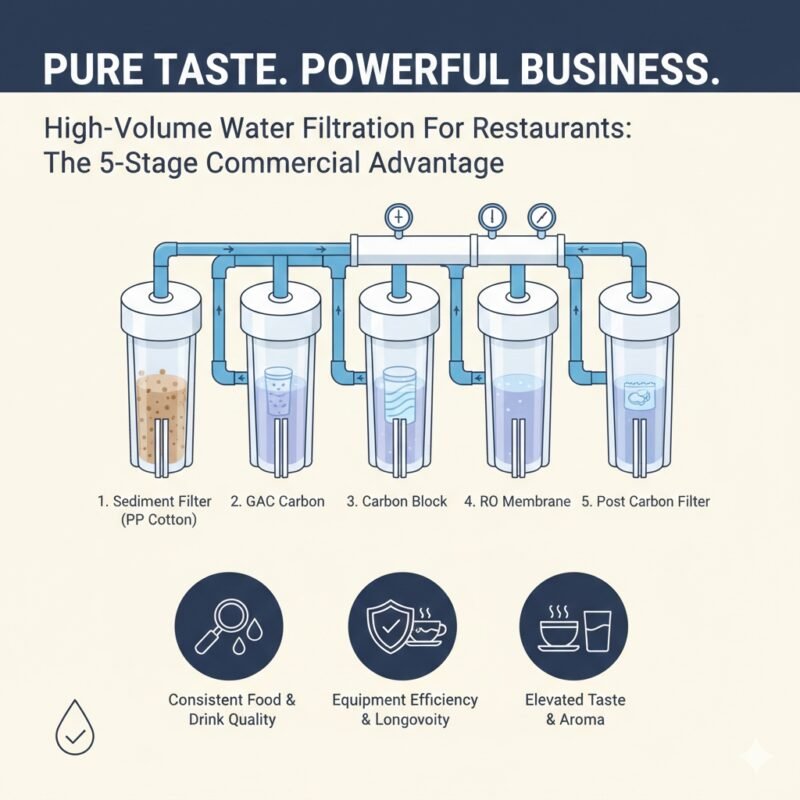
For many small businesses, a hybrid approach is ideal. We often recommend a high-capacity whole-house or whole-store system to handle the bulk of the filtration, supplemented by a specialized unit like our 5-Stage RO Water Filter for Home & Business. This specific RO system is an excellent choice for high volume water filtration for restaurants because it offers the precision of reverse osmosis with a flow rate capable of supporting busy commercial beverage stations, all while maintaining a low footprint and low maintenance cost.
Material Science and E-E-A-T: The Power of PP Cotton
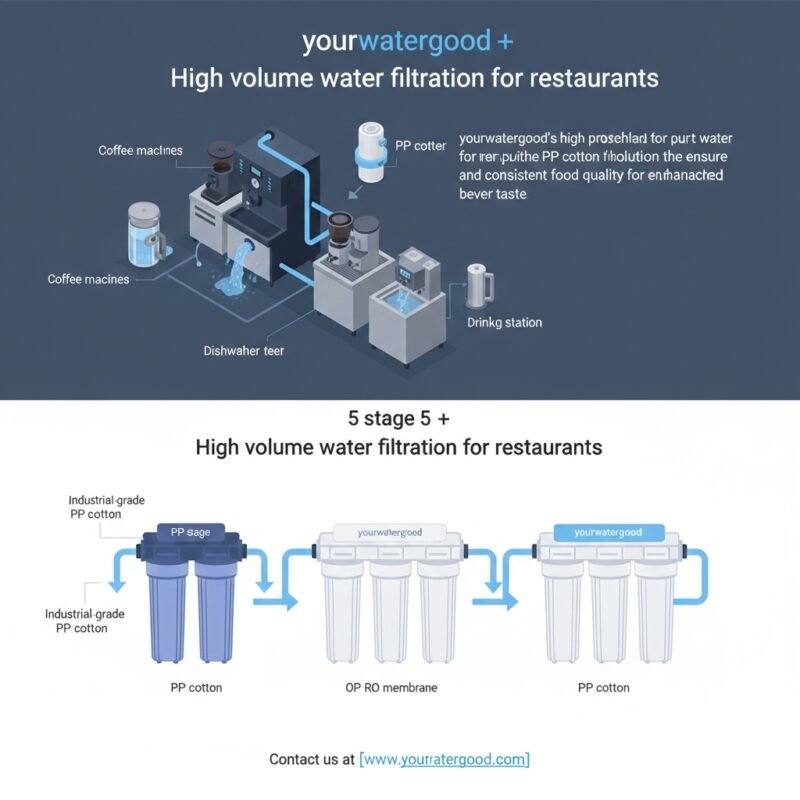
The “first line of defense” in any commercial system is the sediment pre-filter, typically made from Polypropylene (PP) cotton.
In a high volume water filtration for restaurants environment, the PP cotton filter must be engineered for extreme durability. Commercial kitchens often experience rapid surges in water demand, leading to high Gallons Per Minute (GPM) flow rates and fluctuating Pounds Per Square Inch (PSI).
Our high-density PP cotton filters are designed with a gradient structure—dense on the inside and porous on the outside. This allows the filter to trap large particles like rust and sand on the outer surface while capturing microscopically fine silt in the core. This multi-layered approach prevents the filter from clogging prematurely and ensures that the water pressure remains stable across the facility. For a restaurant, this means that even when the dishwasher and the prep sinks are running at full capacity, the filtration system maintains the necessary GPM to keep the operation moving.
Compliance and Safety: The EPA Standards Framework
While the United States Environmental Protection Agency (EPA) sets the standards for municipal drinking water, the responsibility for maintaining those standards within a private facility—especially one using well water—falls on the business owner.
The EPA framework focuses on both primary and secondary contaminants. Primary standards involve health-related risks, such as nitrates and heavy metals, while secondary standards address aesthetic qualities like taste, odor, and color. Professional high volume water filtration for restaurants is designed to bring your water into alignment with these frameworks. By removing unwanted chemicals and particulates, you ensure that your facility is not only compliant with local health codes but is also serving a product that meets the highest safety expectations of the American public.
Technical Specifications for Commercial Operations
When selecting high volume water filtration for restaurants, you must pay close attention to the technical ratings of the system.
- Flow Rate (GPM): A standard residential filter might offer 1 to 2 GPM. A busy restaurant may require 10 to 15 GPM or more to support multiple stations. Ensure your filtration array is sized to handle your peak period without causing a drop in water pressure.
- Operating Pressure (PSI): Most commercial appliances require a minimum of 30 to 50 PSI to function. If your filtration system is too restrictive, it will drop the pressure, causing ice machines to time out and coffee machines to struggle.
Maintenance Guide for American Restaurant Owners
To ensure the longevity of your high volume water filtration for restaurants, a proactive maintenance schedule is non-negotiable.
- Monthly Visual Inspections: Check for any leaks around the filter housings. In regions with high sediment, like coastal areas, observe the color of the PP cotton filters. If they appear dark brown or black, they are nearing capacity.
- Pressure Gauge Monitoring: Install pressure gauges before and after the filtration system. A significant difference in PSI between the two gauges is a clear indicator that the filters are clogged and need immediate replacement.
- Scheduled Cartridge Replacement: Do not wait for the water to stop flowing. Replace sediment and carbon filters based on your GPM usage. For most high-volume restaurants, this means a change-out every three to six months.
- Sanitization: Every time you change your filters, ensure the housings are cleaned and sanitized to prevent any bacterial growth within the system.
FAQ for US Restaurant Owners
Q: Can I use a residential filter for my small cafe? A: We strongly advise against it. Residential filters are not built to withstand the high PSI and GPM demands of a commercial environment. They will clog quickly, potentially starving your equipment of water and causing mechanical failure.
Q: How do I know if I have hard water? A: If you see white, chalky buildup on your faucets or cloudy spots on your glassware, you likely have high mineral content. In Texas and the Southwest, this is almost guaranteed. A professional water test can confirm the exact mineral levels.
Q: Will a point of entry system affect my water pressure? A: When correctly sized for high volume water filtration for restaurants, the pressure drop is negligible. It is essential to choose a system that matches your peak GPM requirements to ensure all your appliances work correctly.
Q: How does filtration help with nitrates? A: Nitrates are common in Midwest well water. Removing them requires specific filtration technology, such as reverse osmosis or specialized ion-exchange resins. This is a critical safety step for restaurants in agricultural zones.
Conclusion: Partner with a Trusted Water Filter Company
The quality of your water is the foundation of your success. By investing in professional high volume water filtration for restaurants, you are choosing to protect your equipment, your flavors, and your reputation.
At YourWaterGood, we specialize in providing high-performance solutions that meet the rigorous demands of the American foodservice industry. From protecting high-spec espresso machines to ensuring crystal-clear ice in every glass, our systems are built for reliability and ease of maintenance.
Ready to secure your water quality?
Explore our commercial solutions at YourWaterGood. Whether you need a robust point of entry system or a targeted high volume water filtration for restaurants, we have the material science expertise to keep your kitchen running perfectly.