
5 Stage Water Filter Manufacturer & Supplier: What to Verify Before You Order

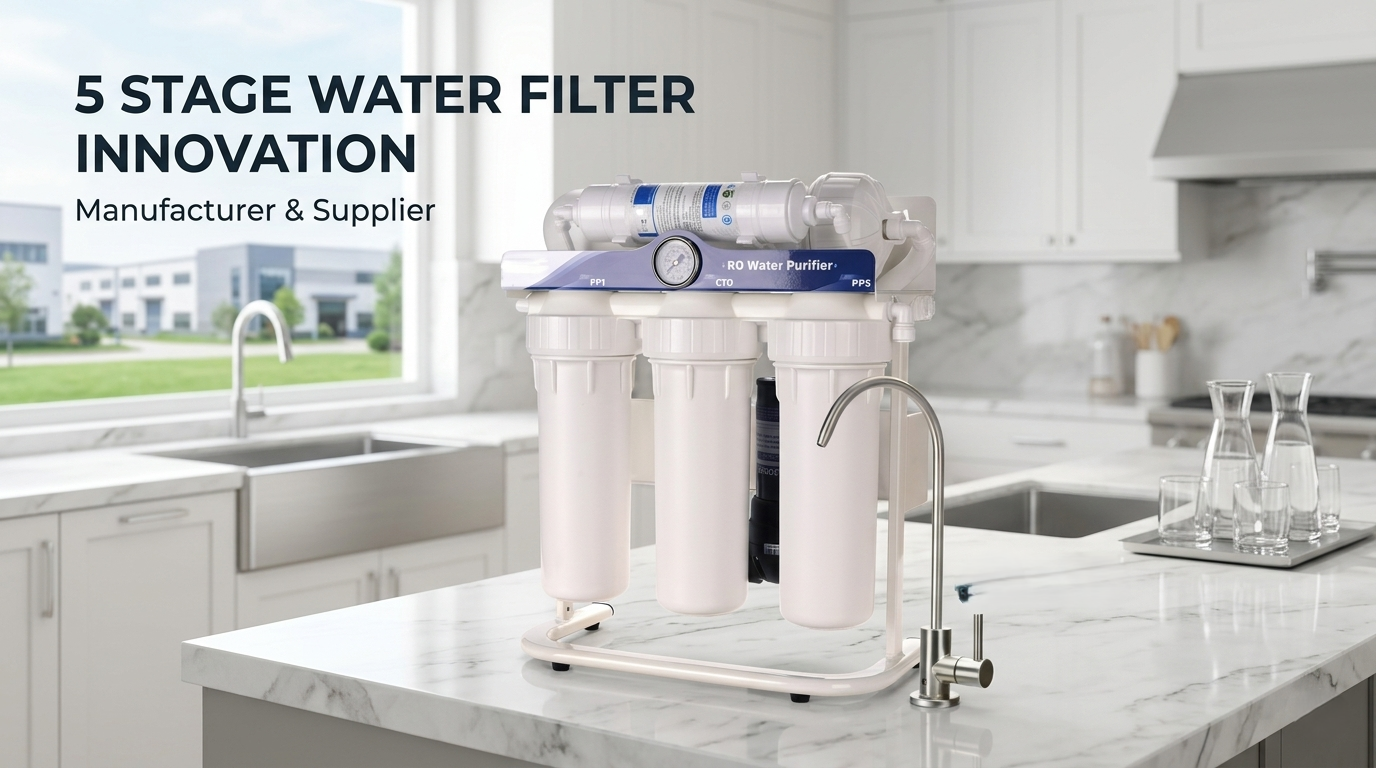
A 5 stage water filter manufacturer & supplier should be able to document every stage of the cartridge stack on request — not just quote a price for “a 5-stage system.” Before a purchase order moves, confirm:
- Per-stage replacement intervals — documented in months, not a vague “long-lasting” claim
- RO membrane rejection rate — tested and stated, not assumed from the housing label
- Feed pressure and TDS tolerance — the range each stage was actually validated against
- Tooling and MOQ transparency — mold cost, amortization schedule, and minimum order quantity disclosed up front
- Factory-of-record clarity — one confirmed production line, not a rotating pool of subcontracted assembly shops
A supplier that hesitates on any of these five is asking you to underwrite the risk on their behalf.
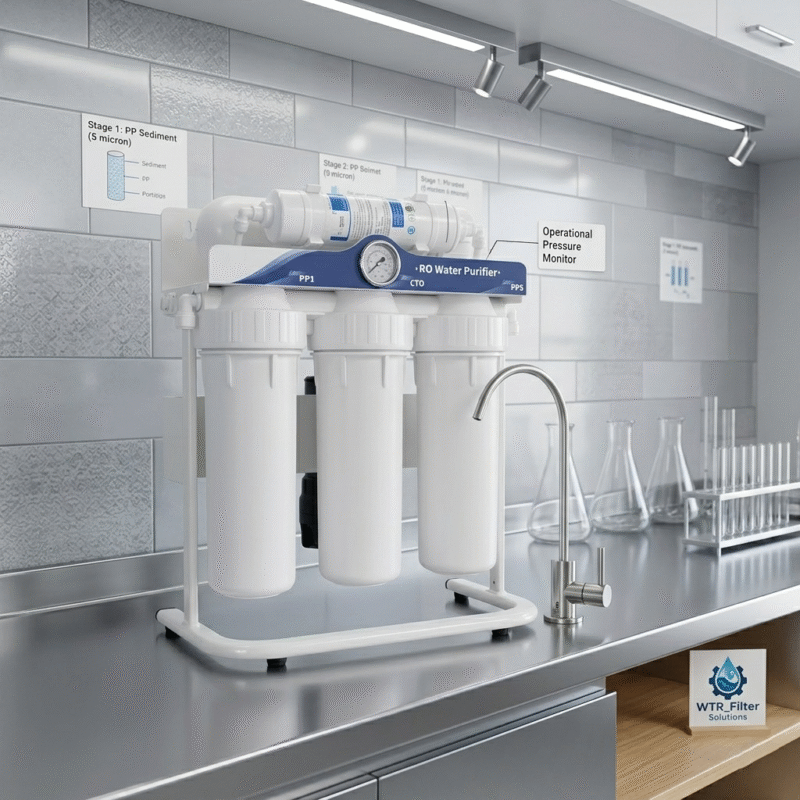
Fast Check Product: https://yourwatergood.com/product/5-stage-ro-water-filter-for-home-busines/
What Buyers Are Actually Vetting in a 5-Stage System
“Manufacturer” and “supplier” get used almost interchangeably in this category, but they answer different questions.
Manufacturer — who engineered the cartridge stack, controls tooling, and can produce CAD drawings and pressure-test data on request.
Supplier — who you actually place the purchase order with. Sometimes that’s the factory directly. Sometimes it’s a trading company sourcing membranes and housings from more than one mill.
A buyer who only asks about price is really only vetting half the relationship. The other half — who controls the tooling and who stands behind the test data — determines whether your second container matches your first.
The practical difference shows up at reorder time. A brand working with a factory-direct manufacturer can lock the same membrane supplier and housing tooling for every batch. A brand working through a trading-company supplier may get a perfectly good first shipment and a noticeably different second one — same listing, different membrane source, different rejection-rate performance — without ever being told the source changed.
Inside the 5-Stage Architecture: What Each Stage Should Document
A 5-stage under-sink RO system earns its name from a specific cartridge sequence, and a serious manufacturer documents each one individually rather than bundling them into one generic spec line.
- Stage 1 — 5-Micron PP/FPP Cotton: graded-density melt-blown cotton, looser outer layer and tighter inner layer, catches sand, turbidity, and rust ahead of the membrane. Typical replacement: 3–6 months.
- Stage 2 — CTO Compressed Carbon: adsorbs residual chlorine and heavy metals, strips discoloration and odor, and protects everything downstream. Typical replacement: 6–9 months.
- Stage 3 — 1-Micron PPF/PP Cotton: a tighter second sediment pass, catching colloids and fine particulate the first stage let through. Typical replacement: 6–9 months.
- Stage 4 — RO Membrane: the core of the system, rejecting down to roughly 0.0001 microns — bacteria, viruses, and dissolved heavy-metal ions included. Typical replacement: 12–24 months.
- Stage 5 — T33 Post-Carbon Polishing: coconut-shell activated carbon with a high iodine number, finishing the taste profile right before the tap. Typical replacement: 12 months.
Ask your manufacturer to confirm these intervals in writing. A supplier who can’t produce per-stage replacement data is quoting a system they haven’t actually tested end to end.
Request a Factory Component Blueprint — see cartridge dimensions, membrane housing specs, and per-stage media grade before committing to a PO.
Off-the-Shelf RO Components vs. Full OEM/ODM Engineering Support
Every 5-stage manufacturer sells at two different levels of engagement, and the gap between them is where buyers lose margin or lose customers.
| Factor | Off-the-Shelf Components | Full-Scale OEM/ODM Support |
|---|---|---|
| MOQ | 300–800 units, fixed housing configuration | Negotiable from pilot batch, custom tank/faucet branding |
| Lead Time | 20–25 days, shared production queue | 40–60 days, dedicated line scheduling |
| Tooling / Mold Fee | None — shared mold and standard housing | One-time fee, amortized into unit cost over volume |
| Technical Drawings | Generic spec sheet only | Full CAD drawings, membrane housing cross-section, pressure-test data |
| Private Labeling | Sticker-only branding | Injection-molded logo, custom faucet finish, branded packaging |
Off-the-shelf sourcing works for a first test order or a pilot market. Full OEM/ODM support is what protects margin and consistency once volume justifies the tooling investment.
Tank sizing and faucet finish are the two customizations buyers underestimate. A standard pressure tank ships in one or two fixed capacities; a full OEM program can size the tank to your target household segment and finish the faucet to match your packaging line — but both require tooling lead time factored into your launch schedule, not requested after the first PO is placed.
Confirming Real Capacity: GPD Output, PSI Feed Range, and TDS Rejection
RO capacity claims are where marketing copy and engineering reality diverge fastest.
- GPD (gallons per day): output tiers vary by membrane size and configuration — ask your manufacturer for the tested GPD rating of the specific model you’re quoting, not a category-wide figure
- Feed pressure (PSI): most residential and light-commercial RO platforms are engineered around municipal supply pressure; confirm the manufacturer’s tested minimum and maximum PSI rather than assuming standard tap pressure is sufficient
- TDS rejection: ask for the percentage reduction the membrane was tested at, and at what feed TDS level — a rejection rate quoted at low feed TDS won’t hold at high feed TDS
- GPM at the tap: for small-business use — cafes, break rooms — confirm sustained flow rate, not just static tank capacity
A manufacturer that can hand over this data as a one-page sheet, on request, has actually tested their own product. One that answers in adjectives hasn’t.
The gap matters most in mixed-fleet orders. A distributor stocking units for both quiet residential kitchens and a busy cafe break room needs the sustained GPM figure, not the peak tank capacity — a system that fills a tank quickly but recovers slowly will disappoint the higher-draw location even though the spec sheet looks identical to the one serving a household of four.
Municipal vs. Well-Water Feed: Where 5-Stage Systems Succeed or Fail
Municipal tap water and well water are different design briefs, and a 5-stage system built for one doesn’t automatically perform on the other.
Municipal supply is chemically consistent, so Stages 1–3 mainly manage chlorine, sediment, and taste ahead of the membrane. Well water introduces variables municipal testing never sees — iron staining, sediment spikes after rain, and hardness levels that swing membrane fouling rates considerably.
A manufacturer serving both markets should be able to state which feed-water range their pre-filtration stages were validated against, and whether the membrane warranty changes for well-water installs. If they can’t answer that, assume the system was only ever tested on one water type.
Request a Technical Parameter Sheet — compare rejection rate, feed PSI range, and per-stage replacement intervals against your current supplier’s documentation.
Field Engineering Insight: The Detail That Actually Shortens Membrane Life
Buyers ask about the membrane. Almost none ask about the carbon block sitting in front of it.
Low-grade activated carbon blocks use a binder that swells slightly once saturated. That swelling raises the initial PSI drop across the carbon stage — and since that pre-filtered water feeds directly into the RO membrane, the added inlet pressure loss shortens membrane life well before its rated 12–24 month interval.
A second detail worth checking: the O-ring compound sealing each housing. Units installed in unconditioned spaces — under a sink against an exterior wall, in a garage — cycle between cold feed water and warm ambient air. A generic nitrile O-ring can develop a micro-leak at that seam within a year, and the brand owner, not the factory, absorbs the resulting claim.
Neither detail shows up on a catalog spec sheet. Both are worth asking about before a mold is cut.
FAQ
What’s the difference between a 5 stage water filter manufacturer and a supplier? A manufacturer engineers and controls the tooling behind the cartridge stack. A supplier is who you place the order with — sometimes the factory itself, sometimes a trading company sourcing from more than one mill.
How long does each stage in a 5-stage RO system typically last? Sediment stages (1 and 3) generally run 3–9 months depending on feed water; the carbon stages (2 and 5) run 6–12 months; the RO membrane itself is typically rated 12–24 months.
What GPD output should I ask for in a wholesale quote? GPD ratings vary by membrane size and system configuration — request the specific tested GPD figure for the exact model you’re quoting rather than a general category number.
Can a 5-stage system handle well water as well as municipal water? Only if the pre-filtration stages were specifically validated against well-water sediment and hardness ranges — municipal-only test data doesn’t confirm well-water performance.
What MOQ should I expect from a 5 stage water filter manufacturer & supplier? Off-the-shelf configurations typically start around 300–800 units. Full OEM/ODM programs negotiate lower pilot volumes in exchange for tooling amortization.
What lead time is typical for custom-branded 5-stage systems? Off-the-shelf orders usually ship in 20–25 days. Full OEM/ODM programs with tooling or custom branding typically run 40–60 days.
What warranty terms should a wholesale buyer negotiate on the RO membrane? Ask for membrane claim-rate data from existing production runs, and confirm whether warranty terms differ for well-water installs versus municipal-water installs.
Get Your Custom OEM Quote
A 5 stage water filter manufacturer & supplier earns a wholesale relationship with documentation, not adjectives. If a supplier can’t produce the paperwork covered above on request, treat that as your answer. Before your next purchase order, request:
- A Custom OEM Quote scoped to your target MOQ and branding requirements
- Full Technical Parameter Sheets covering GPD output, feed PSI range, TDS rejection, and per-stage replacement intervals
- Current B2B Wholesale Pricing across off-the-shelf and full OEM/ODM configurations
Compare those documents against your current 5 stage water filter manufacturer & supplier before you commit to your next container.