
Professional Grade Filtration Solutions for Restaurants: Protect Your Highest-Value Equipment First

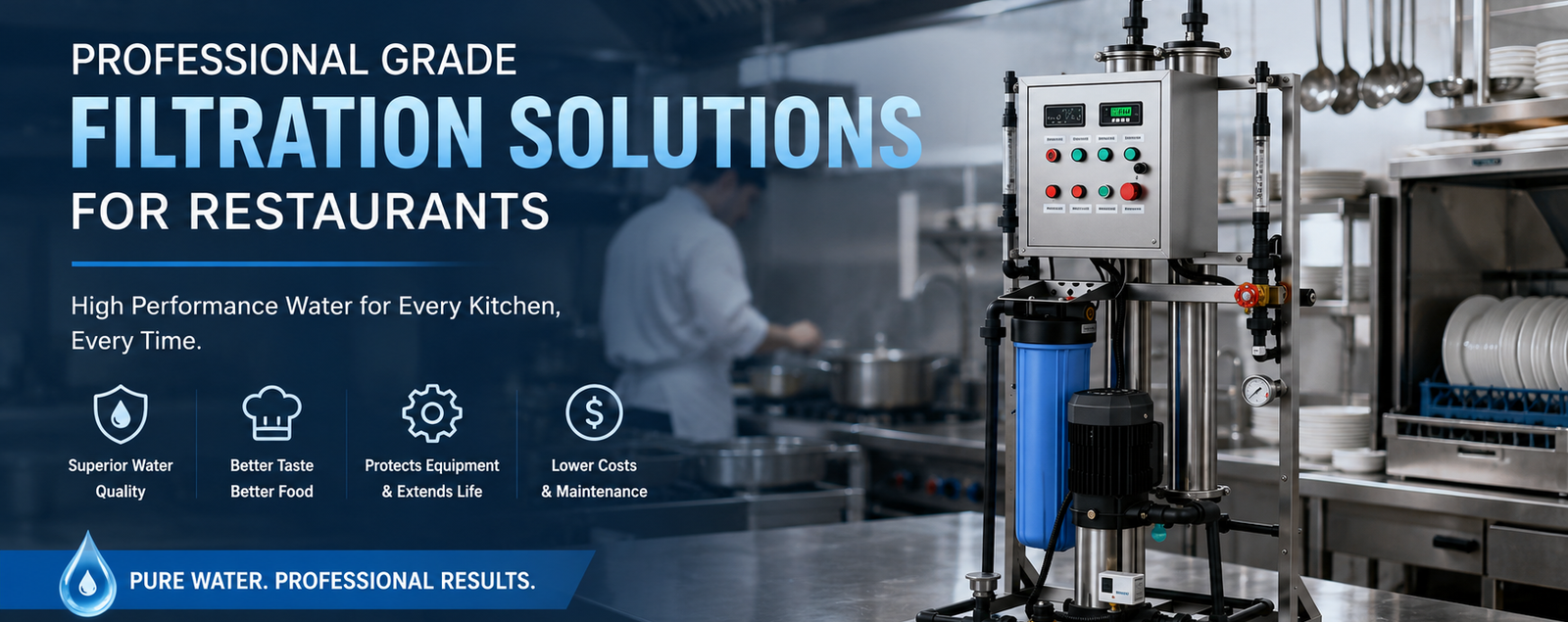
Professional grade filtration solutions for restaurants aren’t one filter cartridge doing one job. Different equipment fails in different ways when water quality is wrong, and a single blanket filter rarely protects all of it equally.
Before you spec anything, get these five decisions right:
- Rank equipment by cost and water throughput — protect what’s most expensive and most exposed first, not what’s cheapest to fix.
- Match filtration to each machine’s actual failure mode — scale, corrosion, and sediment don’t call for the same treatment.
- Set a TDS target per application, not one number for the whole kitchen.
- Size for combined peak draw (GPM) across every station that pulls water at once.
- Build in monitoring, so a filter that’s already failed doesn’t quietly become an equipment failure.
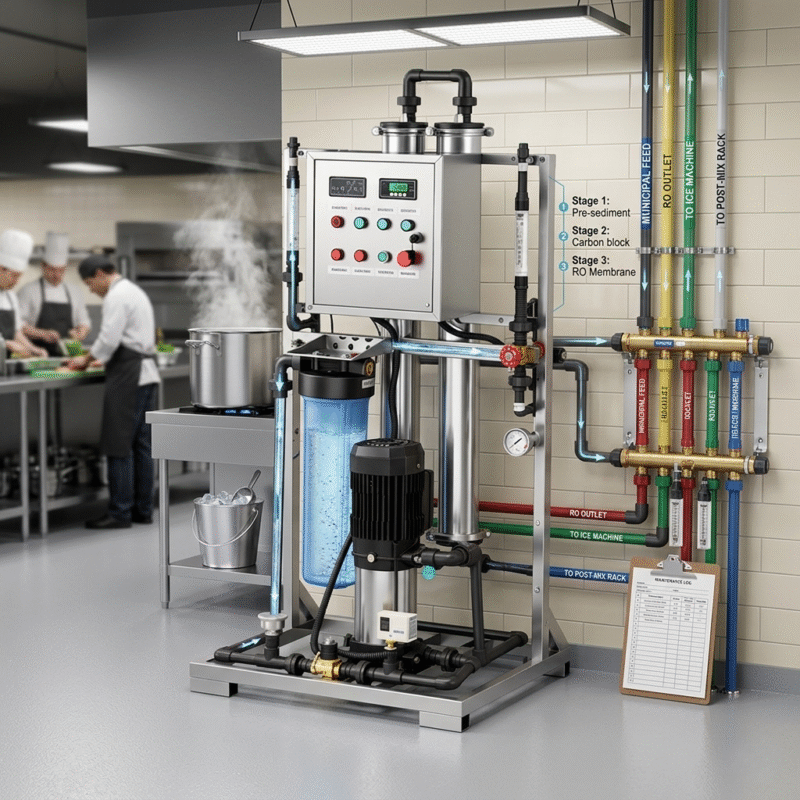
Fast Check Product: https://yourwatergood.com/product/commercial-reverse-osmosis-system/
Which Equipment to Protect First: A Priority Framework, Not a Blanket Filter
A single commercial water filter for restaurant install rarely treats every machine identically — and it shouldn’t. Prioritize by replacement cost and water throughput, not by whichever line item is cheapest to add.
| Equipment | Primary Water Risk | Target Water Quality | Consequence if Unprotected |
|---|---|---|---|
| Espresso Machine | Scale + corrosion on the copper boiler | 30–50 ppm TDS, low hardness | Flat extraction, boiler failure, costly descale-or-replace |
| Ice Machine | Scale on the evaporator plate | Low hardness, moderate TDS | Reduced ice output, higher energy use, shortened compressor life |
| Combi Oven / Steamer | Scale on heating elements and steam generator | Low hardness | Warranty claims denied, uneven cooking, frequent service calls |
| Dish Machine | Hardness spotting and streaking | Low-to-moderate hardness | Guest-facing spotting complaints, higher detergent and energy use |
Espresso and ice equipment usually come first — they’re the most expensive to replace and the most sensitive to scale and TDS extremes. Combi ovens and dish machines follow, since their failure modes tend to be gradual rather than sudden.
Espresso and Coffee Equipment: The TDS Balance That Protects Boilers Without Flattening Flavor
Here’s the detail most first-time buyers miss: chasing 0 ppm TDS on an espresso line isn’t protection — it’s a different problem.
Water with no dissolved minerals pulls flat, under-extracted shots. There’s nothing left for the coffee to extract into. Worse, mineral-free water is corrosive and attacks copper boiler components over time — the opposite of what “pure water” sounds like it should do.
Experienced commercial installers solve this with a bypass or blending setup that holds finished water in the 30–50 ppm TDS range instead of stripping it to zero. That band is low enough to keep scale off the boiler and group head, and high enough to extract properly. An inline water quality monitor on the output side confirms the number is actually holding, rather than trusting a filter that might already be exhausted.
Ice Machines and Beverage Dispensers: Scale, Capacity Loss, and GPD Demand
Ice machines fail slowly, which is exactly why they’re expensive to ignore. Scale builds on the evaporator plate a little at a time — output drops before anyone notices a hard failure.
The costs compound quietly:
- Reduced ice output means running the machine longer or supplementing with bagged ice during rush.
- Higher energy use per pound of ice produced as scale insulates the evaporator.
- Shortened compressor life from the machine working harder to hit the same output.
Beverage dispensers carry a second risk: any TDS or flavor inconsistency in the water shows up directly in the drink, with no cooking process to mask it.
Sizing matters here more than most kitchens plan for — ice machines and beverage dispensers often run on a GPD (gallons per day) basis rather than a single peak GPM number, since they draw steadily across service instead of in short bursts. A system sized only for instantaneous flow can still fall short on total daily volume.
Request a Commercial Kitchen Water Layout Design before finalizing equipment placement — it’s the fastest way to catch a GPD shortfall before the ice machine is plumbed in.
Combi Ovens and Steamers: The Warranty Clause Most Kitchens Never Read
Scale on heating elements and steam generators is one of the most common reasons manufacturers deny warranty claims on combi ovens and steamers — and it’s rarely disclosed clearly at the point of sale.
The failure pattern is predictable: scale insulates the heating element, the unit works harder to hit temperature, cook times drift, and eventually a service call reveals mineral buildup the warranty explicitly excludes.
Low hardness at the feed line is the target here, more than a specific TDS number. Steam generation concentrates minerals as water evaporates, which means even moderately hard feed water can leave scale behind faster than the same water would in a straight cold-water application.
Dish Machines: Where Hard Water Shows Up on the Table, Not the Equipment
Dish machines are the equipment category where water quality problems get blamed on the wrong thing most often. Spotting and streaking on glassware reads as a dish crew or detergent problem — it’s usually a water hardness problem.
Beyond the guest-facing complaint, hard water reduces detergent efficiency, which means either more chemical per cycle or a wash quality drop-off — both are ongoing cost, not one-time cost.
Dish machines don’t typically need the same TDS precision as espresso equipment. Low-to-moderate hardness control is usually enough to solve spotting without the tighter blending setup coffee equipment requires.
Matching Filtration Type and Flow Capacity to a Multi-Station Kitchen
Once equipment is prioritized, filtration has to be sized for all of it pulling water at once — not each machine tested independently.
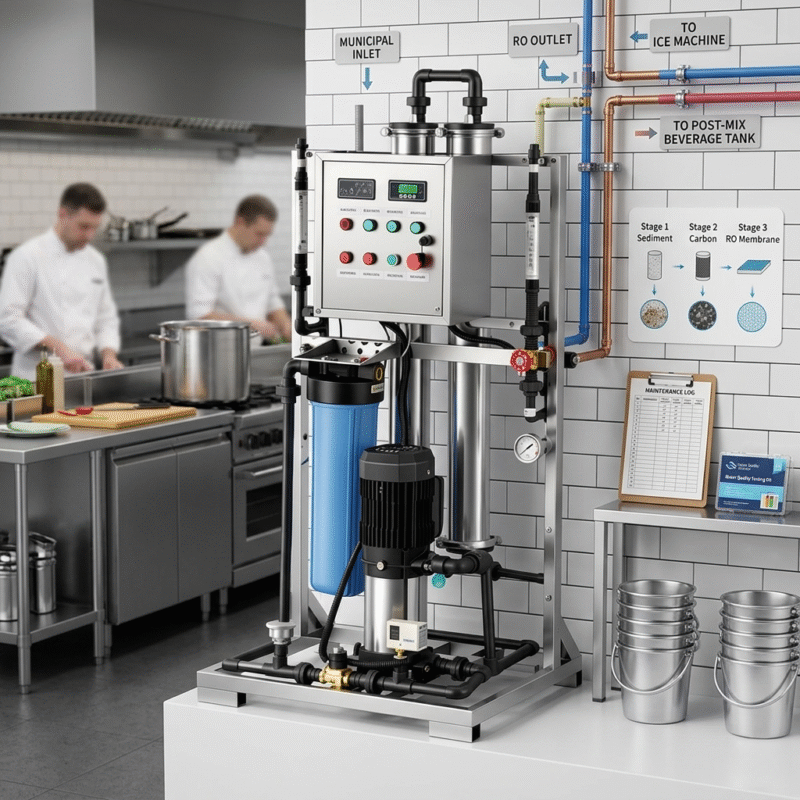
Modular commercial RO platforms handle this with configurable output rather than a single fixed rating. Ours run 250 to 1,000 liters per hour (0.25 to 1 ton/hr, roughly 1.1 to 4.4 GPM), sized to combined peak demand across every station being protected, not just the loudest one.
Two components do the actual protecting once the system is running:
- Dual inline flow meters on the product-water and concentrate-water lines confirm the system is recovering water at the rated ratio in real time — not just producing some output.
- An auto-flush solenoid valve reduces fouling between production cycles, which matters more in a multi-station kitchen where the system rarely gets a long idle period to sit clean.
An integrated online water quality monitor closes the loop: it’s the difference between a filter that’s silently exhausted and one that’s confirmed still doing its job — the gap where “protected” quietly becomes “unprotected” without anyone noticing until a machine fails.
Back-of-house prep, cooking, and dishwashing water have their own priorities separate from the beverage side — worth a look at cooking and dish-specific filtration if that’s the station driving your project.
Get a Technical Parameter Sheet before finalizing which machines get protected in phase one — it’s easier to build in capacity for stations you’ll add later than to retrofit for them.
FAQ
What are professional grade filtration solutions for restaurants? Equipment-specific water treatment sized and configured for each machine’s actual failure mode — scale protection for ice machines and steamers, TDS control for espresso and beverage equipment, and hardness control for dish machines — rather than one blanket filter for the whole kitchen.
Which restaurant equipment should be protected first? Prioritize by replacement cost and water throughput. Espresso machines and ice machines usually come first since they’re expensive to replace and sensitive to scale and TDS extremes; combi ovens and dish machines typically follow.
What TDS level protects an espresso machine without hurting flavor? Most commercial installers target 30–50 ppm TDS. Zero-TDS water under-extracts coffee and corrodes copper boiler components over time.
Do ice machines need a different filtration approach than combi ovens? Yes. Ice machines are typically sized on a GPD (gallons per day) basis and need scale control on the evaporator plate; combi ovens and steamers need low hardness at the feed line to protect heating elements and steam generators.
Why do dish machines get blamed for water quality problems? Spotting and streaking on glassware looks like a detergent or technique issue, but it’s usually hard water. Hard water also reduces detergent efficiency, adding ongoing chemical and energy cost.
How do I size filtration for a kitchen with multiple stations? Size for combined peak draw across every station pulling water at once, not each machine tested individually. Flow meters and pressure monitoring confirm the system holds capacity under real, simultaneous demand.
How do I know if a filter has failed before a machine is damaged? An inline water quality monitor on the output side is the only reliable way to confirm filtration is still working. Without one, a spent cartridge or fouled membrane can fail silently until equipment damage shows up.
Get Equipment-Specific Protection Specced for Your Kitchen
A blanket filter protects nothing precisely. Matching filtration type, TDS target, and flow capacity to each machine is what actually prevents the service call.
Request a custom commercial quote, a technical parameter sheet, or B2B wholesale pricing for your equipment lineup — and get protection specced around the machines that are actually at risk, not a one-size-fits-all filter.