Industrial RO Water Purifier Manufacturers: Engineering Purity for 24/7 Production


Feedwater rarely stays constant on an industrial site. A municipal main can spike in total dissolved solids (TDS) after a distribution flush. A deep well can shift its iron, manganese, or silica load between wet and dry seasons.
Either swing can put a production line on standby.
Before comparing suppliers, lock down these hard technical criteria:
- Continuous duty cycle rating — GPM at 24/7/365 operation, not a peak burst number
- Automated CIP (Clean-in-Place) integration with its own dosing skid
- Membrane flux decay compensation built into the design margin, not added later
- Redundant train configuration (N+1 or N+2) so maintenance never stops production
- Full instrumentation and PLC data logging for QA traceability and audit trail
Evaluating industrial RO water purifier manufacturers against these five criteria — rather than a generic spec sheet — is what separates a system that survives a decade of plant operation from one that scales within eighteen months.

Fast Check Product: https://yourwatergood.com/product/industrial-reverse-osmosis-system/
Municipal vs. Deep-Well Feedwater: Divergent Pretreatment Engineering Logic
Municipal supply and deep well water are not interchangeable design inputs. Treating them as the same problem is the most common sizing error in industrial procurement.
Municipal feedwater is engineered around:
- Chlorine and chloramine removal (carbon or catalytic carbon beds ahead of the membrane)
- Soluble inorganic salt rejection at moderate, relatively stable TDS
- Lower particulate and biological fouling load, but tighter oxidant control to protect thin-film composite membranes
Deep well feedwater is engineered around a different fouling profile:
- Iron and manganese oxidation/filtration ahead of the RO train
- Hardness reduction via softening or dealkalization
- Silica scaling risk, which drives recovery rate limits and antiscalant selection
A pretreatment train sized for municipal chemistry will foul or scale prematurely on well water, and vice versa. The design logic has to start with a current water analysis, not a catalog model number.
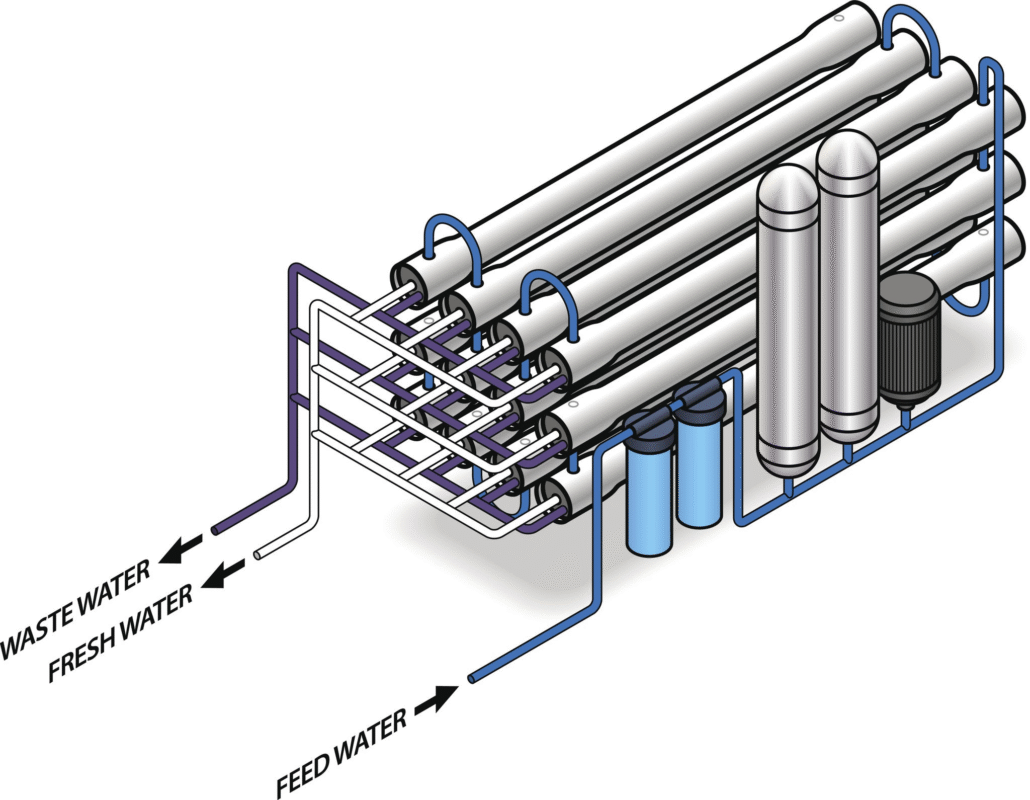
Sizing Industrial RO Skids for Continuous 24/7/365 Duty Cycles
Two GPM numbers matter, and vendors frequently blur them: peak instantaneous flow and continuous duty flow.
A skid rated for 200 GPM at peak may only sustain 150 GPM in continuous production without accelerating membrane fatigue. Daily output is expressed in GPD (gallons per day), and that figure should be built from the continuous number — not the peak.
Design inputs an engineering team needs before quoting a system:
- Feed TDS (ppm) and full water analysis (hardness, iron, manganese, silica, chlorides)
- Required continuous GPM and daily GPD demand at the point of use
- Target recovery rate — typically 75–85% on municipal feed, often held to 50–65% on high-silica well water to manage scaling
- Available feed pressure and target high-pressure pump discharge in PSI
- Redundancy requirement (single train vs. N+1/N+2)
Margin matters here. A skid engineered with zero flux-decay buffer looks correctly sized on day one and undersized by month eight.
PLC-Driven Automation: CIP, Remote Monitoring & Fault Tolerance
Manual valve sequencing has no place in a continuous industrial process. Automation is what keeps a skid producing consistent water quality without an operator standing over it.
A properly automated system includes:
- PLC control (Siemens or Allen-Bradley platforms are the industrial standard) governing startup sequencing, differential pressure monitoring, and shutdown logic
- Automated CIP cycles triggered by differential pressure across the membrane stage, not a fixed calendar interval
- HMI touchscreen operation with alarm history and trend logging
- Remote monitoring and dial-out alarms for conductivity excursions, low feed pressure, or pump faults
- SCADA/historian integration where the facility already runs a plant-wide control system
Differential-pressure-triggered CIP matters more than it sounds. Calendar-based cleaning either cleans membranes that don’t need it — wasting chemical and downtime — or misses early-stage fouling between scheduled cycles.
Materials of Construction: Why 316L Stainless Steel Skid Architecture Matters
Frame and piping material choice determines whether a skid survives high-chloride feedwater or corrodes from the inside out within a few production years.
316L stainless steel is the standard for industrial skid frames and interconnect piping because it resists chloride-induced pitting far better than 304 stainless or carbon steel, particularly on feedwater with elevated TDS.
Other construction details worth checking on any quote:
- Pressure vessel housings rated for the system’s actual operating PSI, not just the pump’s shutoff pressure
- Gasket and seal materials compatible with the process — food and pharmaceutical applications call for materials suited to product-contact service
- Piping schedule sized for the full operating pressure range, including CIP cycle pressures
Pre-Engineered Skids vs. Fully Customized Turnkey Systems
Not every facility needs a fully custom build, and not every application can run on a catalog skid. The decision point is usually flow range, redundancy requirement, and how tightly the system needs to integrate with existing plant controls.
| Parameter | Pre-Engineered Skid | Fully Customized Turnkey System |
|---|---|---|
| Flow Range | 10 – 150 GPM | 150 – 2,000+ GPM |
| CAPEX Profile | Lower entry cost, fixed configuration | Higher upfront investment, engineered to feedwater and load |
| Lead Time | 4 – 8 weeks | 12 – 24 weeks |
| PLC Integration | Standard HMI, basic alarm set | Full SCADA/historian integration, custom control logic |
| Redundancy | Single train (N) | Configurable N+1 / N+2 for zero-downtime maintenance |
A pre-engineered skid is often the right call for a single production line with a stable, well-characterized feedwater source. A custom turnkey build earns its higher CAPEX when downtime cost, redundancy requirements, or feedwater variability make a fixed configuration too risky.
The Cold-Water Flux Penalty: Temperature Correction & Antiscalant Dosing Logic Most Vendors Miss
Here’s a detail that separates an experienced system designer from a spec-sheet reseller: membrane flux is temperature-dependent, and most quotes ignore it.
As feed temperature drops toward 50°F (10°C) — common with groundwater in winter — water viscosity increases significantly. Without correction, the system simply produces less water at the same pressure.
A properly engineered skid accounts for this with:
- A temperature correction factor applied at the design stage, typically adding 30–40% additional membrane area to hold rated output across the site’s full seasonal temperature range
- Antiscalant dosing rates calculated against the feed’s actual silica and calcium concentration, not a generic default dose
Skip either step and the consequence is predictable: the high-pressure pump gets pushed to compensate for lost flux, energy draw climbs, and irreversible scaling begins forming on the membrane surface. Production output can fall off within a single week of continuous operation at those elevated pressures.
This is a pretreatment and design-margin problem, not something that can be fixed later with a cleaning cycle.
If your current system is losing output every winter, that’s usually a design margin problem, not a membrane problem. Request a custom CAD skid diagram or a water analysis review before assuming replacement membranes are the fix.
Frequently Asked Questions
What GPM range do industrial RO systems typically cover? Industrial skids range from roughly 10 GPM for a single process line up to 2,000+ GPM for full-facility systems, depending on feedwater chemistry and production demand.
What recovery rate should I expect from an industrial RO system? Standard municipal-fed systems run 75–85% recovery. High-silica deep well feed often limits recovery to 50–65% to manage scaling risk.
How much extra membrane area is needed for cold groundwater? Design teams typically add 30–40% additional membrane area when feed temperature drops toward 50°F (10°C) to offset viscosity-driven flux decay.
What’s the real difference between a pre-engineered skid and a custom turnkey system? Flow range, lead time, PLC integration depth, and redundancy configuration — see the comparison table above for specifics.
How long is the lead time for a custom industrial RO system? Custom turnkey builds typically run 12–24 weeks depending on redundancy configuration and PLC customization scope; pre-engineered skids ship in 4–8 weeks.
Does an industrial RO system need automated CIP? Yes, for any continuous-duty system. Differential-pressure-triggered CIP prevents both under-cleaning and unnecessary chemical use.
What regulatory frameworks apply to industrial process water systems? The EPA Water Quality Framework governs source and discharge water quality. Facilities producing food or pharmaceutical products should also evaluate their process against FDA/USP Purified Water monographs when specifying system design and materials.
Feedwater chemistry, duty cycle, and redundancy requirements are specific to your facility — a generic skid quote can’t account for any of them.
Get an industrial engineering quote, request full technical data sheets and P&ID drawings, or ask about B2B wholesale and factory-direct pricing on a fully specified industrial ro water purifier manufacturers sized to your actual water analysis.