ROI of RO Water Systems for AI Data Centers: Where the Payback Actually Comes From

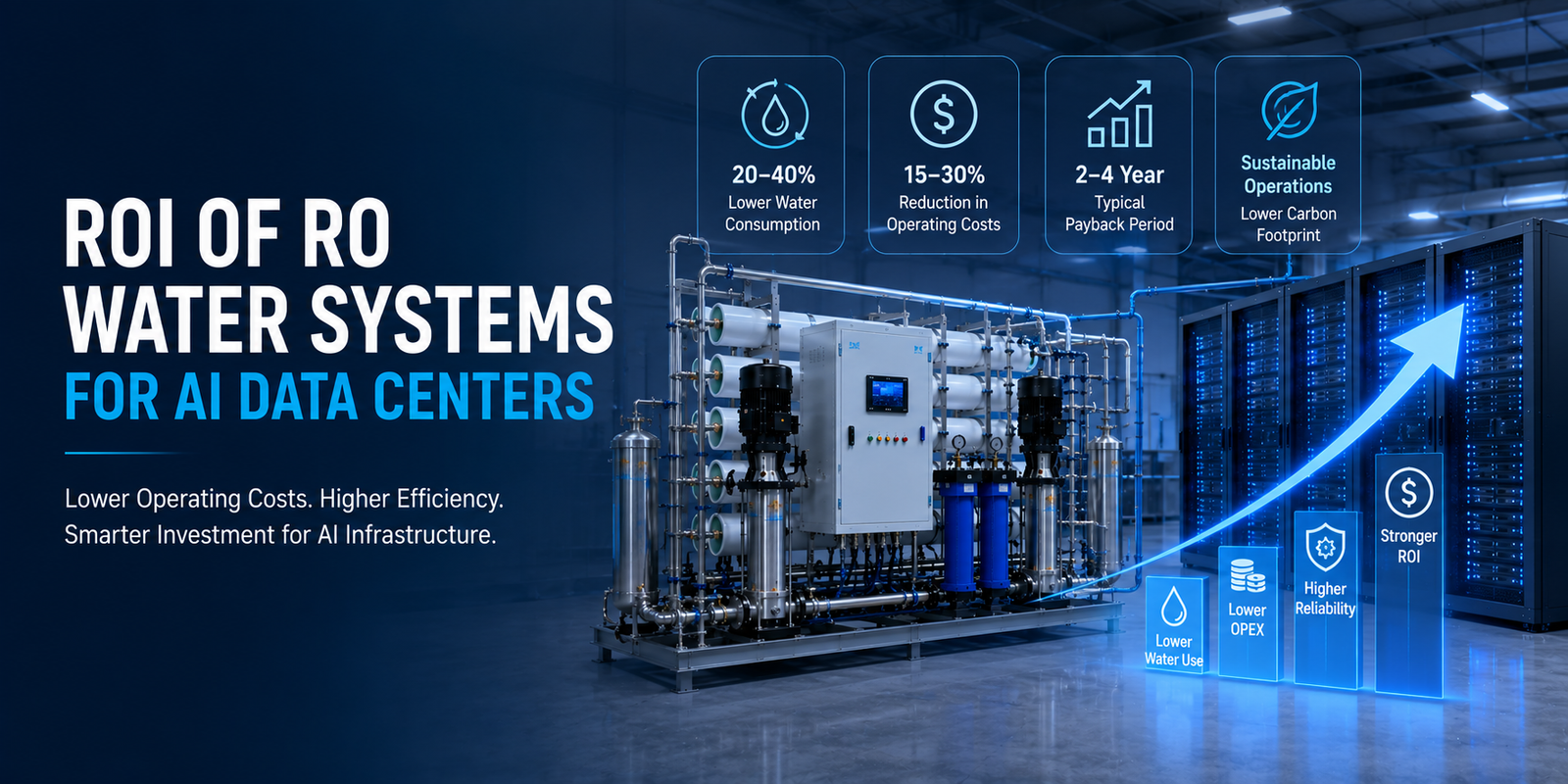
An RO water system in an AI data center is usually justified on the wrong number. Teams calculate the payback from visible savings — water, chemicals, energy — conclude the return is modest, and buy the cheapest system that clears the hurdle.
The dominant return is the one they leave out: the outage that never happens. A single avoided failure in a mission-critical hall can exceed the system’s entire cost, yet it appears nowhere in a naive payback calculation.
Modeling the roi of ro water systems for ai data centers correctly means counting both the visible operating savings and the far larger cost avoidance that water treatment delivers.
Before building the business case, account for every return the system generates:
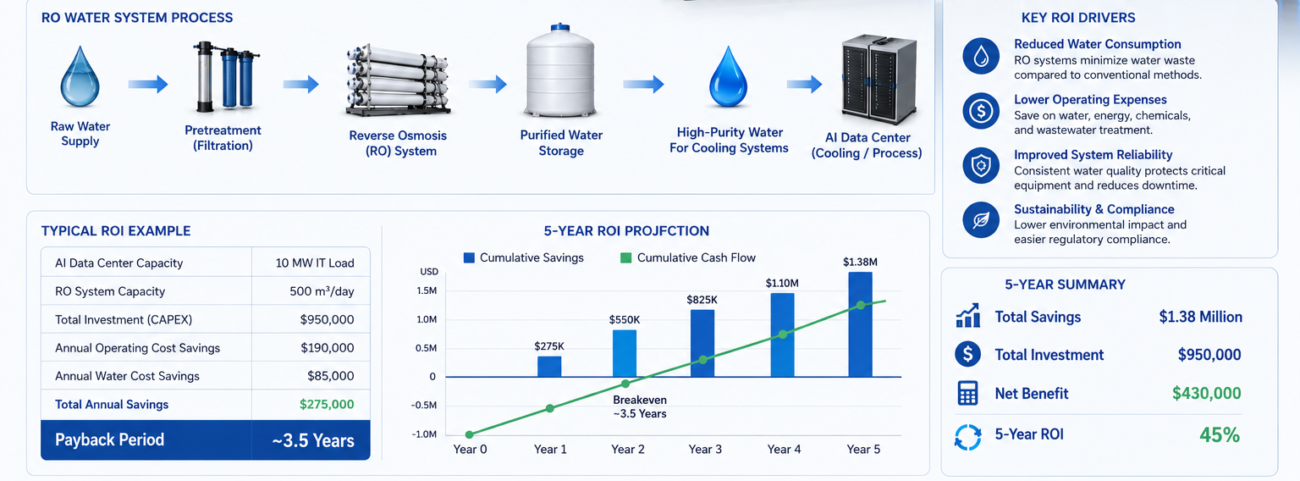
- Water savings — high Cycles of Concentration and reuse cut both makeup and discharge cost.
- Chemical savings — EDI eliminates the acid and caustic that mixed-bed systems consume.
- Energy savings — clean heat-transfer surfaces protect PUE continuously.
- Asset-life extension — avoided replacement of cold plates, CDUs, membranes, and fill.
- Downtime avoidance — the single largest return, and the one most often omitted.
The sections below separate the returns you can see from the ones that actually dominate the ROI.
Fast Check Product: https://yourwatergood.com/product/industrial-reverse-osmosis-system/
The ROI Most Teams Calculate Is Too Low: What Gets Left Out
The core error in estimating the roi of ro water systems for ai data centers is counting only the savings that show up as line items, which are the smallest part of the return.
A naive payback model includes:
- Reduced water purchase from running higher CoC.
- Reduced chemical spend from EDI and efficient dosing.
- Reduced energy from cleaner heat-transfer surfaces.
These are real, but they are incremental, and on their own they produce a multi-year payback that makes a premium system look hard to justify. So the team buys cheaper.
What the model omits is cost avoidance — the failures the system prevents:
- Unplanned downtime from a water-induced thermal event.
- Premature replacement of cold plates, CDUs, and high-pressure pumps.
- Emergency cleaning and intervention when an under-treated loop fouls.
Because these are events that did not occur, they never appear on a savings spreadsheet. The largest return on the system is invisible to the calculation that decides whether to buy it — which is exactly how mission-critical facilities end up under-invested in water treatment.
The Visible Returns: Water, Chemicals, and Energy
The visible side of the ROI is straightforward to quantify, and it is where most payback models correctly start. These savings are continuous and accrue for the full asset life.
Water savings:
- Running the highest safe CoC cuts the makeup water purchased and the blowdown discharged — two bills reduced at once.
- Reuse and blowdown recovery via RO return water to the loop instead of buying and discharging more.
Chemical savings:
- Continuous electrodeionization (EDI) regenerates electrically, eliminating the acid and caustic that conventional mixed-bed systems buy, store, and dispose of.
- Automated dosing paced to load avoids the chemical waste of manual overdosing.
Energy savings:
- Scale-free and biofilm-free heat-transfer surfaces reject heat efficiently, holding pump and chiller energy down and protecting PUE.
- A thin fouling layer is a continuous energy penalty; removing it is a continuous return.
These returns are real and worth counting. But they are the floor of the ROI, not the bulk of it. A system justified on visible savings alone is justified on a fraction of its actual return.
The Invisible Returns: Asset Life and Avoided Downtime
The returns that dominate the ROI are the ones a spreadsheet does not prompt you to enter. They are larger than the visible savings by a wide margin, and they are the real reason the system is worth buying.
Extended capital asset life:
- Clean water keeps cold plates, CDUs, membranes, and cooling-tower fill in service for their full design life.
- Under-treatment silently halves the life of these assets, so proper treatment avoids replacement CAPEX that arrives years early.
- One avoided cold-plate or CDU replacement event can rival a meaningful share of the water plant’s cost.
Avoided downtime:
- Unplanned outage in a mission-critical hall is measured in dollars per minute.
- A single water-induced thermal event — scale or biofilm driving a hot spot, or a leak from corrosion — can take capacity offline at a cost that exceeds the entire water system many times over.
- The water plant’s job is to make these events not happen, which is the largest return it produces and the hardest to see.
These returns require a deliberate choice to model. Count the cost of the failures the system prevents, and the ROI inverts — from a marginal multi-year payback to an investment that protects assets worth far more than itself.
Source Water Changes the Return: Municipal vs Reclaimed
The ROI shifts with the source water, because municipal and reclaimed feeds change both the cost side and the return side of the equation.
Municipal potable feed:
- Lighter, lower-CAPEX treatment, but higher ongoing water-purchase cost.
- The return leans on chemical and energy savings and asset protection, with less water-cost upside.
- Pre-treatment centers on activated carbon for chlorine/chloramine and chloride control to protect 316L from pitting.
Reclaimed and recycled feed — increasingly mandated for WUE targets in Ashburn, VA and Phoenix, AZ:
- Heavier, higher-CAPEX treatment, but much lower water-purchase cost.
- Adds compliance and permitting value — meeting reclaimed mandates can be what allows the facility to operate or expand at all.
- Requires multimedia filtration, softening, and antiscalant for high TDS and silica above ~150 ppm.
The return on a reclaimed-fed system includes a category municipal systems lack: license to operate. Where reclaimed water is mandated, the treatment that makes it usable is not optional — its ROI includes the entire facility’s ability to run, consistent with ASHRAE TC 9.9 and EPA frameworks.
Standard Skids vs Data-Center-Grade Systems: The Return Difference
The return on a commercial skid and a data-center-grade system are not the same, because the cheaper system protects far less of what is downstream.
| Engineering Parameter | Standard Pre-Engineered Skids | Data Center Grade High-Redundancy Systems |
|---|---|---|
| Primary return | Marginal OPEX savings | Asset protection + downtime avoidance |
| Flow capacity (GPM) | 10–50 GPM | 100–1,000+ GPM, parallel trains |
| Redundancy | Single train (downtime exposure) | N+1 / N+2 / 2N (downtime avoided) |
| Purity | 10–20 µm nominal | RO to 0.0001 µm, EDI to 18.2 MΩ·cm |
| Asset life protected | Minimal | Cold plates, CDUs, pumps, fill |
| Energy / PUE return | Low | Continuous, from clean surfaces |
| BMS integration | Analog (4–20 mA) | Modbus TCP / BACnet IP / SNMP |
| Support | Generic spares | Documented P&ID, standardized spares |
The redundancy and asset-protection rows are where the return lives: a single-train skid saves a little on OPEX while leaving the facility exposed to the outage that dwarfs every saving. The cheaper system has the lower return precisely because it protects less.
To build the business case, quantify the downtime and asset replacement the system prevents, not just the OPEX it trims. That is the number that justifies the investment.
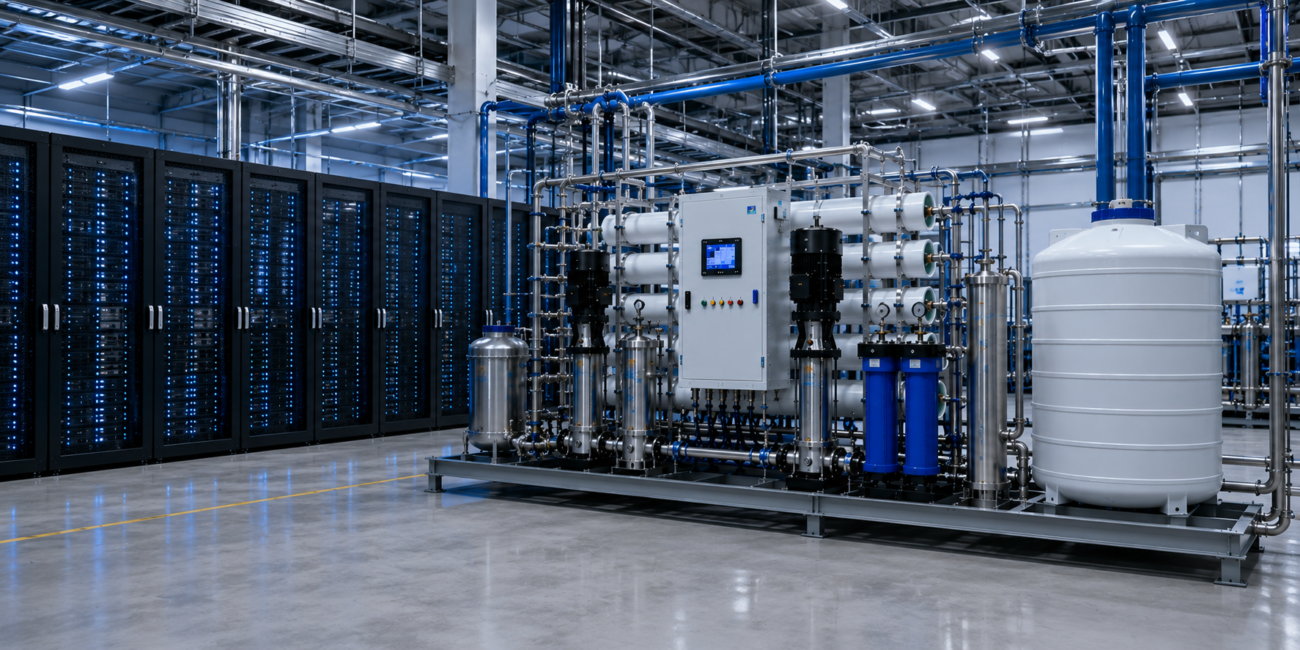
Field Engineering Insight: The Biggest Return Is the Failure That Never Happens
Here is the detail that reframes every water-treatment ROI: the largest return on an RO system is the catastrophe it prevents — and a catastrophe that does not happen never appears as a line item.
A standard payback model counts visible savings — water, chemicals, energy — and produces a modest, multi-year return. It does not prompt anyone to enter the value of the outages, scaled cold plates, premature membrane and fill replacements, and emergency cleanings that the system makes not happen.
Those avoided events are the dominant return:
- A single avoided unplanned outage in a mission-critical hall can exceed the system’s full cost.
- One avoided cold-plate or CDU replacement event can rival a large share of it.
- Avoided emergency cleanings and unplanned interventions recur across the asset life.
Because none of these show up as a “saving,” teams systematically understate the ROI and under-invest — buying the cheapest system, then paying for it in the failures that materialize.
The defense is to model cost avoidance explicitly:
- Estimate the cost of the failures the system prevents — downtime per hour, asset replacement, emergency response — and put them on the ledger.
- Weight them by the risk the under-treated alternative actually carries.
- Compare on total return, visible savings plus avoided cost, not OPEX deltas alone.
This is the kind of detail that never appears on a payback summary but decides whether the investment is judged correctly. It is also where the return compounds: a correctly specified system lowers OPEX, extends asset life, protects PUE, and holds 99.999% uptime — the avoided-catastrophe return that a too-cheap system quietly forfeits.
ROI of RO Water Systems for AI Data Centers FAQs
What is the ROI of an RO water system for an AI data center? The return comes from water savings, chemical savings, energy/PUE, extended asset life, and — the largest — avoided downtime. The dominant return is cost avoidance, which naive payback models leave out, understating the true ROI.
How does an RO system pay back? Through lower makeup and discharge (high CoC plus reuse), no regeneration chemicals (EDI), lower energy from clean surfaces, longer cold plate, membrane, and fill life, and the outages it prevents.
What is the payback period? It varies with capacity, source water, and what is counted. Visible OPEX savings alone give a multi-year payback; including avoided downtime and asset replacement shortens it sharply.
Why is the ROI usually understated? Because the biggest returns — avoided outages and avoided replacements — are cost avoidance that never appears as a line item. Only visible savings like water and chemicals get counted, so the system looks less valuable than it is.
Does reclaimed water improve or hurt ROI? It raises treatment cost but cuts water-purchase cost and adds compliance and permitting value. Where reclaimed water is mandated, the treatment’s ROI includes the facility’s ability to operate at all.
How does water treatment protect energy ROI and PUE? Clean heat-transfer surfaces reject heat efficiently. A scale or biofilm layer raises pump and chiller energy continuously, so keeping surfaces clean is a continuous energy return that protects PUE.
What single factor dominates the ROI? Avoided downtime. A single prevented outage in a mission-critical hall can exceed the system’s full cost, dwarfing the visible OPEX savings — which is why downtime avoidance, not water savings, is the core of the return.
Build the Business Case on the Full Return
The ROI of an RO water system for an AI data center is far larger than a visible-savings payback suggests, because the dominant return is the downtime and asset loss the system prevents. The facilities that invest correctly are the ones that put cost avoidance on the ledger, not just OPEX deltas.
Whether you are justifying a system for a single high-density server room or a larger buildout, YourWaterGood sources the right system through our manufacturing partner and a network of vetted factories — roi of ro water systems for ai data centers starts with industrial RO, EDI, softening, filtration, and dosing, with quality inspection, logistics, and English-language support handled for you.
- Get an Infrastructure Engineering Quote: send your cooling load and uptime requirement for a configured proposal and the return it supports.
- Request Technical Data Sheets: recovery rates, consumption, and lifecycle specs for your ROI model.
- Get Competitive B2B Pricing: sourced through our supplier network, with QC and shipping managed end to end.