
Industrial RO System Price for Data Center: What Drives the Number and What’s in the Skid

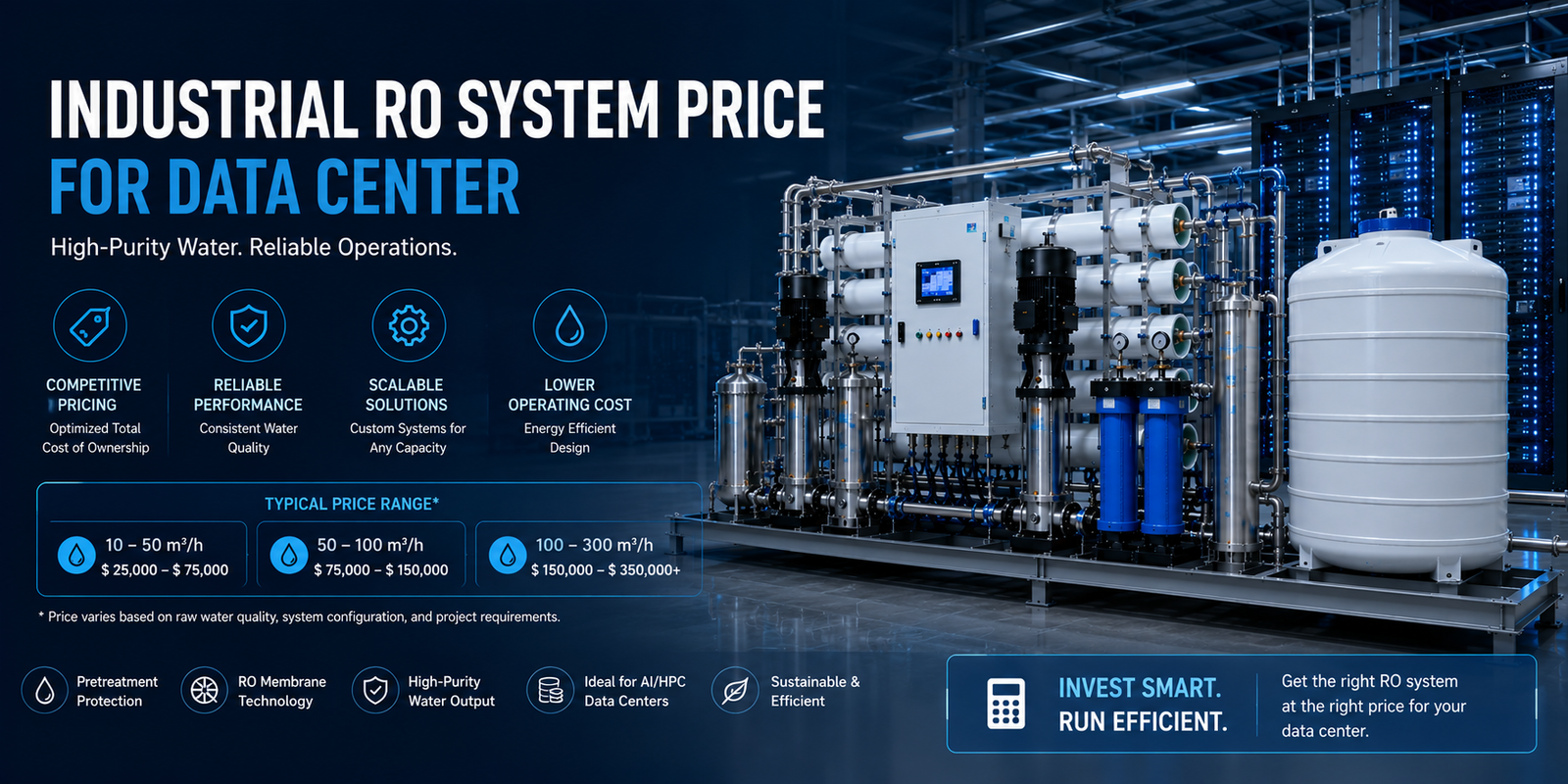
There is no list price for an industrial RO system in a data center. Two skids rated at the same GPD can differ in membrane count, pump, materials, and automation — and therefore in price by a wide margin. The number on the quote reflects those choices, not just the flow rating.
That is why an RO quote means little without its specification. A low headline price usually signals a different skid underneath — fewer membranes, a cheaper pump, lighter materials — not a better deal.
Understanding the industrial ro system price for data center projects means knowing what sits inside the skid price and which choices move it.
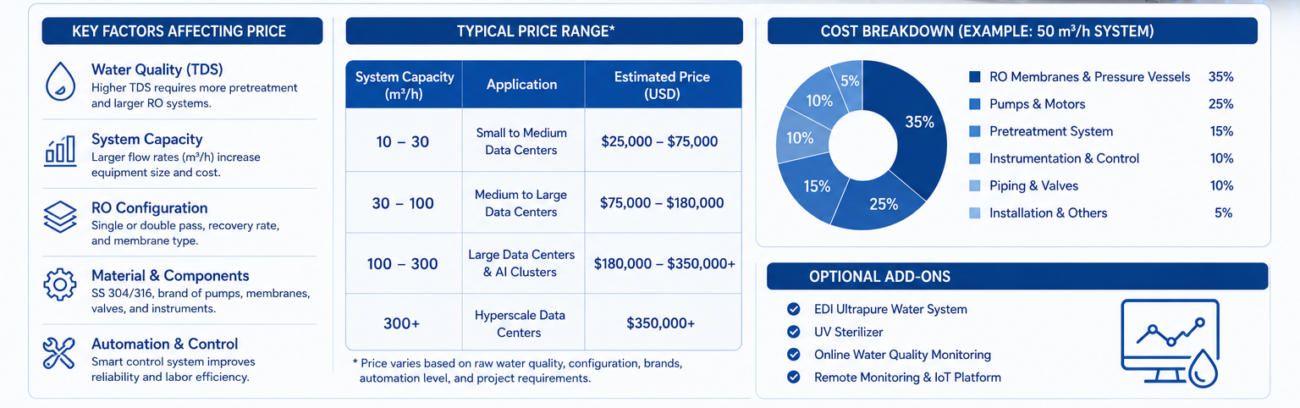
Before comparing RO quotes, pin down the variables that set the price:
- Capacity — permeate output in GPD or GPM, the base driver.
- Pass configuration — single-pass versus two-pass, which roughly doubles the RO core.
- Membrane element count and type — set by design flux and feed quality.
- Recovery rate and high-pressure pump — including whether it is VFD-controlled.
- Materials and automation — 304 vs 316L stainless and the level of instrumentation.
The sections below break down what you are paying for.
Fast Check Product: https://yourwatergood.com/product/industrial-reverse-osmosis-system/
There’s No List Price: Why Two RO Systems at the Same GPD Cost Differently
The most common error in reading an industrial ro system price for data center use is assuming that two systems with the same GPD rating are the same system. They rarely are.
The same permeate output can be built in very different ways:
- Membrane count — a system run at high design flux uses fewer elements (cheaper); one run at conservative flux uses more (dearer but longer-lived).
- Pass count — single-pass hits cooling-tower quality; two-pass is required for ultrapure loops and adds a second membrane array.
- Pump and VFD — a fixed-speed pump is cheaper than a VFD-controlled one, with consequences covered in the field insight below.
- Materials — 304 stainless costs less than 316L, which resists chloride pitting.
- Automation — basic gauges versus online analyzers and BMS integration.
Each of these moves the price without changing the headline GPD. An RO quote is only comparable against an identical specification — flow rating alone tells you almost nothing about what you are buying.
What’s in the RO Skid Price: The Components You’re Paying For
An industrial RO skid is an assembly of components, and the price is the sum of them. Knowing the parts lets you see what a quote includes and where a cheaper one has economized.
The components inside the RO skid price:
- Membrane elements — the consumable heart of the system, priced by count and grade.
- Pressure vessels — FRP or stainless housings holding the elements.
- High-pressure pump (and VFD) — drives the feed across the membranes; a major cost and the dominant energy consumer.
- Skid and frame — continuous-duty stainless framework and piping.
- Cartridge pre-filters — guard filtration protecting the membranes.
- Instrumentation and controls — flow, pressure, and conductivity monitoring, plus the control panel and BMS interface.
What often sits outside the RO skid price — and must be confirmed:
- Pre-treatment (multimedia, carbon, softening) that protects the membranes.
- Freight, installation, and commissioning.
A credible RO quote itemizes these. A vague one hides which components were downgraded or which scope was excluded.
The RO-Specific Price Drivers
Once the skid is scoped, a handful of RO-specific factors set where the price lands. Each is a real engineering choice with a cost consequence.
The factors that move the RO price:
- Capacity (GPD/GPM) — the base driver; price scales with output.
- Pass configuration — two-pass roughly doubles the membrane and vessel count versus single-pass, and is required for ≤ 10 µS/cm ultrapure loops.
- Membrane count and design flux — more elements (lower flux) cost more upfront but foul slower and last longer.
- Recovery rate — higher recovery reduces reject volume but demands more robust design on high-TDS feed.
- Materials — 316L, PVDF for chloride and ultrapure duty raise cost over standard 304.
- Pump and VFD — energy-efficient, soft-starting drives cost more upfront and less over the service life.
- Automation — analyzers and BMS integration add cost but enable unattended 24/7/365 operation.
The principle for controlling the RO price: change the specification deliberately, not by accepting a cheaper unknown. A lower price that comes from fewer elements or a fixed-speed pump is a cost deferred, not avoided.
Feed Water Changes the RO Price: Municipal vs Reclaimed
The same RO duty costs differently depending on the feed water, because the feed determines membrane selection, recovery, and the pre-treatment the RO depends on.
Municipal potable feed:
- Allows standard high-rejection membranes and higher recovery.
- Needs activated carbon upstream for chlorine and chloramine, which destroy membranes, and chloride control for 316L.
Reclaimed and recycled feed — increasingly mandated for WUE targets in Ashburn, VA and Phoenix, AZ:
- Requires fouling-resistant membranes and typically a lower recovery rate, changing the element count and price.
- Demands heavier multimedia, softening, and antiscalant ahead of the RO because of high TDS and silica above ~150 ppm.
- Pushes toward 316L and more robust pre-filtration.
An RO price quoted on municipal assumptions will be too low for a reclaimed-fed site. Lock the feed-water analysis before comparing RO prices, consistent with ASHRAE TC 9.9 and EPA frameworks.
Standard Skids vs Data-Center-Grade RO Systems
A commercial RO skid and a data-center-grade RO system carry different prices because they are engineered for different duty. The gap is real and buys reliability the loop requires.
| Engineering Parameter | Standard Pre-Engineered Skids | Data Center Grade High-Redundancy RO Systems |
|---|---|---|
| Relative price | Lower | Higher (buys redundancy & efficiency) |
| Flow capacity (GPM) | 10–50 GPM | 100–1,000+ GPM, parallel trains |
| Redundancy | Single train | N+1 / N+2 / 2N |
| Pass / purity | Single-pass | Two-pass + EDI to 18.2 MΩ·cm |
| Pump | Fixed-speed | VFD-controlled, soft start |
| Materials | 304 stainless | 316L / PVDF |
| Controls | Basic gauges | Online analyzers, BMS integration |
| Support | Generic spares | Documented P&ID, standardized spares |
The redundancy, pump, and purity rows are where the price difference sits — and where the value is. A single-pass, fixed-speed skid and a two-pass, VFD, redundant system are different products, and pricing them as equals is the most common RO purchasing mistake.
To compare fairly, put every RO quote on the same capacity, pass count, materials, and pump specification. A lower price on a lighter build is not a saving.

Field Engineering Insight: The Pump and VFD Are Where a Cheap RO Price Is Cut
Here is the detail that catches teams comparing RO quotes on price: the high-pressure pump is a major share of the skid cost and the dominant energy consumer for the RO’s entire life — and it is the first place a cheap quote economizes.
Buyers focus on GPD and the headline number, and almost never ask what pump is inside. A cheaper skid commonly uses an undersized or fixed-speed pump with no VFD, which lowers the purchase price and raises the lifetime cost.
Without a VFD (variable frequency drive):
- There is no soft start — every startup hits the membranes and pump with a pressure spike that shortens their life.
- There is no ability to trim energy to actual demand, so the pump draws full power continuously.
- The energy cost runs higher for the full 10–15 year service life, often exceeding the upfront saving many times over.
So the “cheaper” skid wins on the quote and loses on energy and equipment life — and the buyer who compared on price alone rewarded the wrong design.
The defense is to ask the questions a price comparison skips:
- Ask the high-pressure pump make, model, and whether it is VFD-controlled.
- Compare RO quotes on purchase price plus energy, not the headline number alone.
- Confirm soft-start protection, which extends membrane and pump life.
- Treat a fixed-speed pump as a cost deferred into the energy bill, not a saving.
This is the kind of detail that never appears on a flow-rated quote but decides the real cost of the RO. It is also where a correctly specified RO pays back: an efficient, VFD-driven, properly elemented system lowers energy and membrane OPEX, protects the downstream loop and cold plates, and holds 99.999% uptime.
Industrial RO System Price for Data Center FAQs
How much does an industrial RO system for a data center cost? There is no list price. The cost depends on capacity (GPD), single- versus two-pass, membrane count, recovery rate, materials, and automation. A configured quote against your feed water and purity target is the only accurate number.
What is included in an industrial RO system price? Membrane elements, pressure vessels, the high-pressure pump (ideally VFD-controlled), the skid and frame, cartridge pre-filters, instrumentation, and controls. Pre-treatment, freight, and commissioning are often quoted separately.
What drives the price of an RO system? Capacity, pass count (two-pass roughly doubles the RO core), membrane count and design flux, recovery rate, materials (304 vs 316L), pump and VFD, and automation level.
Why are two RO systems at the same GPD priced differently? They are different builds — different membrane counts (design flux), pump quality, materials, and controls. Equal GPD does not mean an equal system, so quotes must be compared on identical specifications.
Does a VFD on the RO pump matter? Yes. A VFD soft-starts the pump (protecting membranes), trims energy to demand, and lowers lifetime energy cost. A fixed-speed pump is cheaper upfront but costlier to run for the system’s life.
How does feed water affect the RO price? Reclaimed or high-TDS feed needs more pre-treatment, fouling-resistant membranes, and a lower recovery rate, which changes the element count and raises the delivered RO cost versus municipal feed.
Single-pass or two-pass — how does it affect price? Two-pass roughly doubles the RO core but is required for ultrapure ≤ 10 µS/cm direct-to-chip loops. Single-pass suffices for cooling-tower makeup at lower cost.
Get an Itemized RO Price for Your Specification
The industrial RO system price for a data center is set by capacity, pass count, membrane count, pump, and materials — not by a catalog figure. The route to a real number is a configured, itemized quote built on your feed water and purity target.
Whether you are pricing a single skid or RO trains for a larger buildout, YourWaterGood sources the right RO system through our manufacturing partner and a network of vetted factories — industrial ro system price for data center quotes cover single- and two-pass RO, EDI, softening, and dosing, with quality inspection, logistics, and English-language support handled for you.
- Get an Itemized RO Quote: send your capacity, water analysis, and purity target for a line-by-line configuration and price.
- Request Technical Data Sheets: membrane, pump, recovery, and materials detail so you can compare quotes on equal footing.
- Get Competitive B2B Pricing: sourced through our supplier network, with QC and shipping managed end to end.