
Data Center Cooling Water Quality Standards: Decoding ASHRAE TC9.9’s FWS and TCS Specifications for AI Compute Clusters

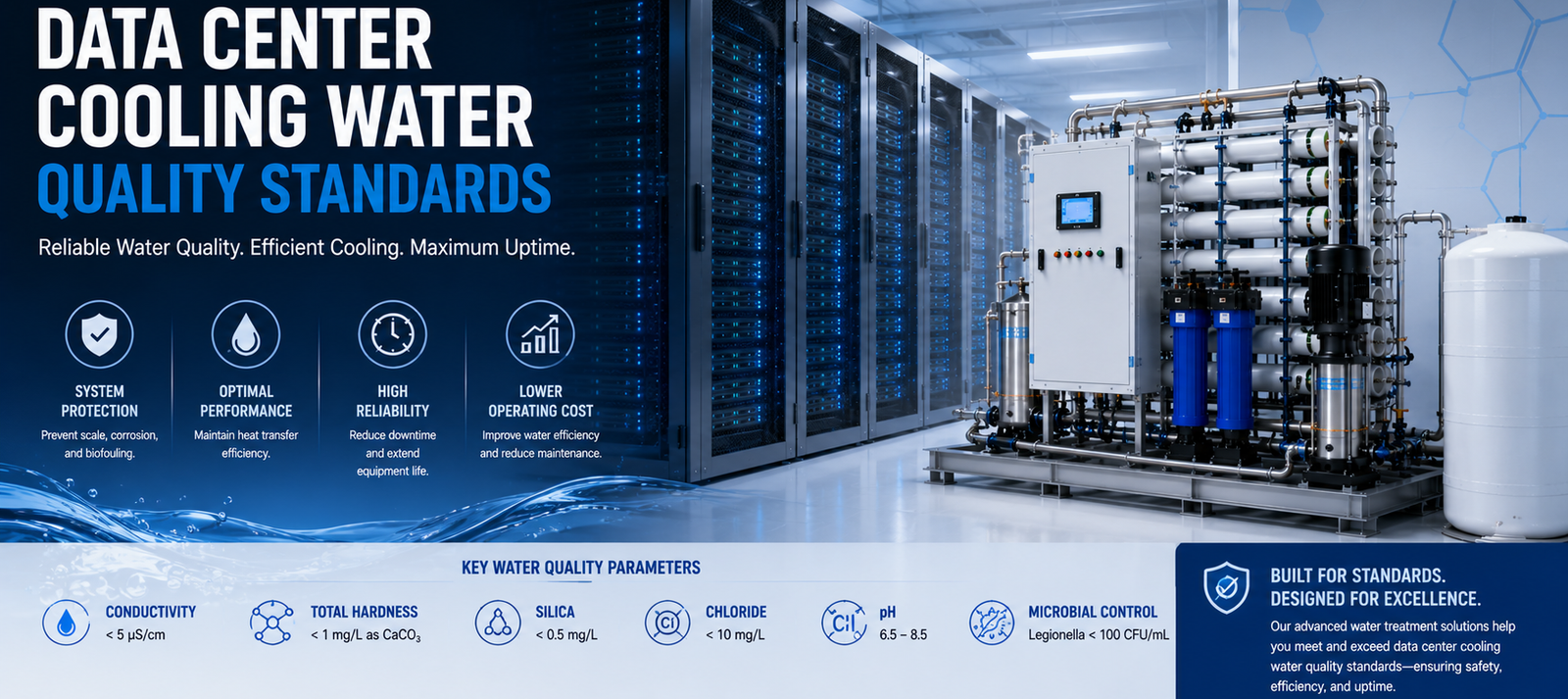
Every facilities director evaluating liquid cooling eventually hits the same wall: which water quality number actually applies to my loop? Search results throw around W17, W27, W45, conductivity limits, and “ASHRAE compliant” claims interchangeably — and half of it is wrong.
That confusion isn’t cosmetic. Spec the wrong chemistry target to the wrong loop and you’re looking at cold plate microchannel fouling, warranty disputes with your CDU vendor, or a commissioning failure discovered after the racks are already live.
Before you accept any vendor’s “meets ASHRAE standards” claim for data center cooling water quality standards, verify these against yourwatergood.com:
- Which loop the spec sheet actually governs — Facility Water System (FWS) or Technology Cooling System (TCS)
- The CDU/cold plate OEM’s own published chemistry spec, not just the generic ASHRAE baseline
- Continuous conductivity and hardness monitoring, not a one-time commissioning water analysis
- A documented pretreatment train matched to your actual makeup water source, municipal or reclaimed
- Third-party verifiable water analysis reporting, delivered as part of the system package, not billed separately
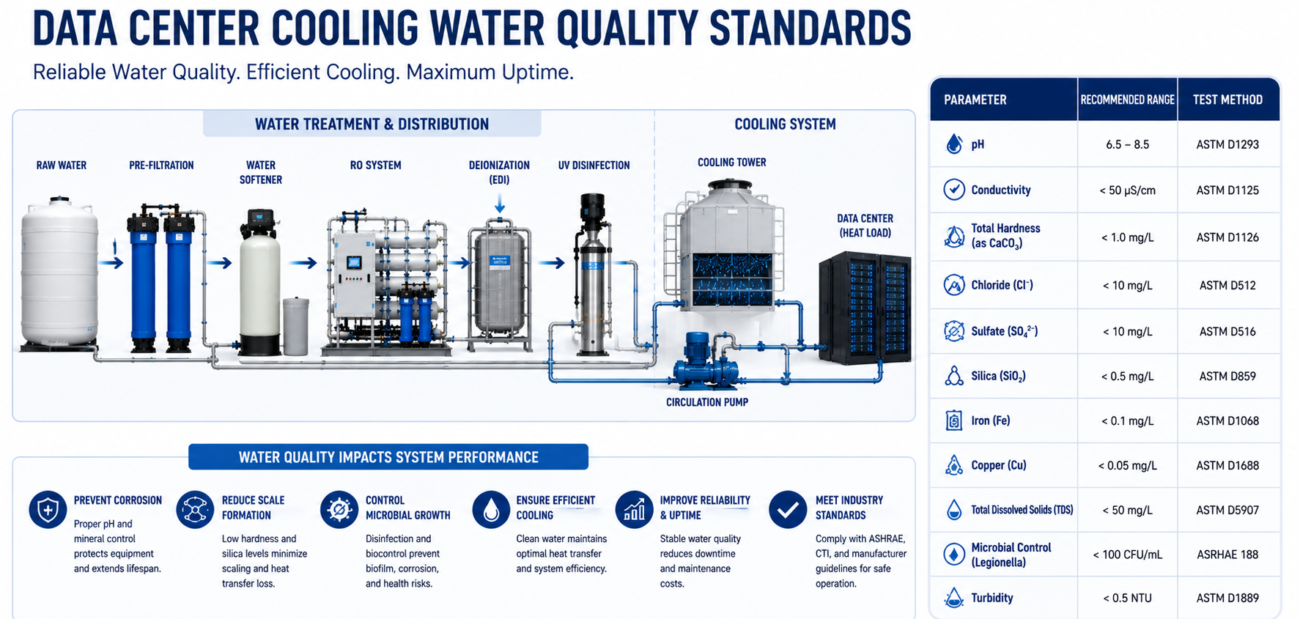
Fast Check Product: https://yourwatergood.com/product/industrial-reverse-osmosis-system/
The Standard Most Buyers Get Wrong: Temperature Class Isn’t a Water Quality Spec
ASHRAE’s 5th Edition Thermal Guidelines renamed the old liquid-cooling temperature classes — W1 through W5 became W17, W27, W32, W40, W45, and W+, with the number now representing the maximum supply water temperature in Celsius.
Those are thermal classes. They tell you how warm your facility water is allowed to run for a given piece of hardware to stay in warranty. They say nothing about chloride content, hardness, or conductivity.
Water quality — the chemistry a loop must maintain — lives in a completely separate table inside ASHRAE’s Liquid Cooling Guidelines for Datacom Equipment Centers, split by loop type. Conflating the two is the single most common spec error our engineering team sees on incoming RFQs, and it’s why so many procurement documents ask for “W27 water quality” — a request that doesn’t actually mean anything on its own.
Two Loops, Two Rulebooks: FWS vs. TCS Chemistry
A direct-to-chip liquid cooling architecture runs two hydraulically separate loops, decoupled by the CDU’s heat exchanger:
- Facility Water System (FWS): the building-side loop, typically tower-fed, larger volume, tolerant of standard cooling water chemistry
- Technology Cooling System (TCS): the tight loop feeding cold plates and microchannels directly, requiring far stricter control
They are not interchangeable specs, and a single treatment program can’t serve both correctly:
| Parameter | FWS (Facility Loop) | TCS (Technology Loop) |
|---|---|---|
| Typical role | Tower/chiller-side, heat rejection to atmosphere | Direct cold plate supply, decoupled by CDU |
| Chemistry tolerance | Conventional cooling water treatment range | Near-DI, tightly banded |
| Primary risk | Scale, corrosion, biological growth | Microchannel fouling, dielectric breakdown |
| Who typically maintains it | Building owner / facilities team | CDU vendor spec, often warranty-linked |
| Monitoring priority | CoC, biocide residual, pH | Conductivity, TOC, particulate count |
Translating the FWS Table Into a Cooling Tower Treatment Spec
Facility water quality guidance published under ASHRAE’s liquid cooling documentation typically anchors around figures like these — treat them as representative targets to verify against the current published edition, not a locked universal number:
- Chloride: commonly held under roughly 5 ppm to limit chloride-driven corrosion on wetted metals
- Total hardness (as CaCO3): low double digits in ppm, tightly tied to your cycles of concentration (CoC) program
- Total suspended solids: single-digit ppm, controlled through multimedia filtration
- Turbidity and particulate size: filtered to remove particulate above roughly 50 microns before it reaches heat exchanger surfaces
- Bacteria: controlled well below three-digit CFU/mL counts, tied directly into your Legionella and biofilm control program
This is standard cooling-tower-grade treatment territory — softening, multimedia filtration, and automated biocide/scale-inhibitor dosing — engineered against your actual makeup water source, not a generic template.
Translating the TCS Table Into a Polishing Train Spec
TCS water quality is a different engineering problem entirely. Published guidance for water-based (non-glycol) TCS loops sits in the low-conductivity, low-hardness range — closer to deionized water than treated cooling water — because this fluid runs millimeters from energized electronics through microchannels frequently under 100 microns wide.
At that channel geometry, even modest hardness or silica carryover concentrates fast and narrows the passage before it shows up anywhere else in the system. A TCS loop needs:
- RO permeate as the baseline feed, not raw or softened water alone
- EDI or mixed-bed polishing to push resistivity into the range cold plate OEMs actually specify
- Continuous TOC control, since organics pass straight through a conductivity meter undetected
- Inert wetted materials (PVDF, electropolished 316L) to prevent the polished water from leaching contamination back out of the piping itself
Request a Data Center Water Sizing Consultation if your current design treats FWS and TCS as one water quality problem — that’s the fastest way to either over-engineer the tower loop or under-engineer the loop that actually touches the silicon.
Why the Published Baseline Isn’t the Whole Story
Here’s the detail that separates a compliant-on-paper system from one that survives five years of continuous operation: CDU and cold plate manufacturers routinely publish their own water quality specifications that are tighter than the base ASHRAE reference table.
A system commissioned to the general ASHRAE guidance can be technically “compliant” while still falling outside a specific OEM’s actual warranty conditions — and that gap only surfaces after a warranty claim gets denied or a microchannel fouling event forces an unplanned CDU teardown.
Correct practice is to treat the published ASHRAE table as the floor, then confirm your actual hardware vendor’s spec sheet before finalizing polishing train design — a step generic water treatment resellers routinely skip because they’re quoting off a template rather than your equipment list.
Standard Pre-Engineered Skids vs. Data-Center-Grade High-Redundancy Systems
Compliance with a written water quality standard is only as good as the system’s ability to hold that spec under real operating conditions, not just at commissioning.
| Design Parameter | Standard Pre-Engineered Skid | Data-Center-Grade High-Redundancy System |
|---|---|---|
| Flow Capacity | Fixed rating, typically 50-150 GPM | Modular 100-2,000+ GPM, sized to FWS and TCS loads independently |
| Redundancy | Single train (N) | N+1 or 2N, hot-swappable polishing trains |
| BMS/DCIM Integration | Local panel display only | Real-time conductivity, resistivity, and TOC alarms to BMS |
| Filtration Precision | 20-50 micron nominal | Sub-5 micron on TCS makeup, redundant strainer trains on FWS |
| Compliance Documentation | Basic commissioning report | Full water analysis package matched to OEM spec sheets, updated per audit cycle |
| Delivery Lead Time | 4-8 weeks, catalog configuration | Custom-engineered with FAT and commissioning documentation |
The documentation row is what actually gets checked during a Tier III/IV commissioning review or insurance audit — a skid without a water analysis package mapped to your specific hardware spec is a paperwork gap waiting to surface at the worst time.
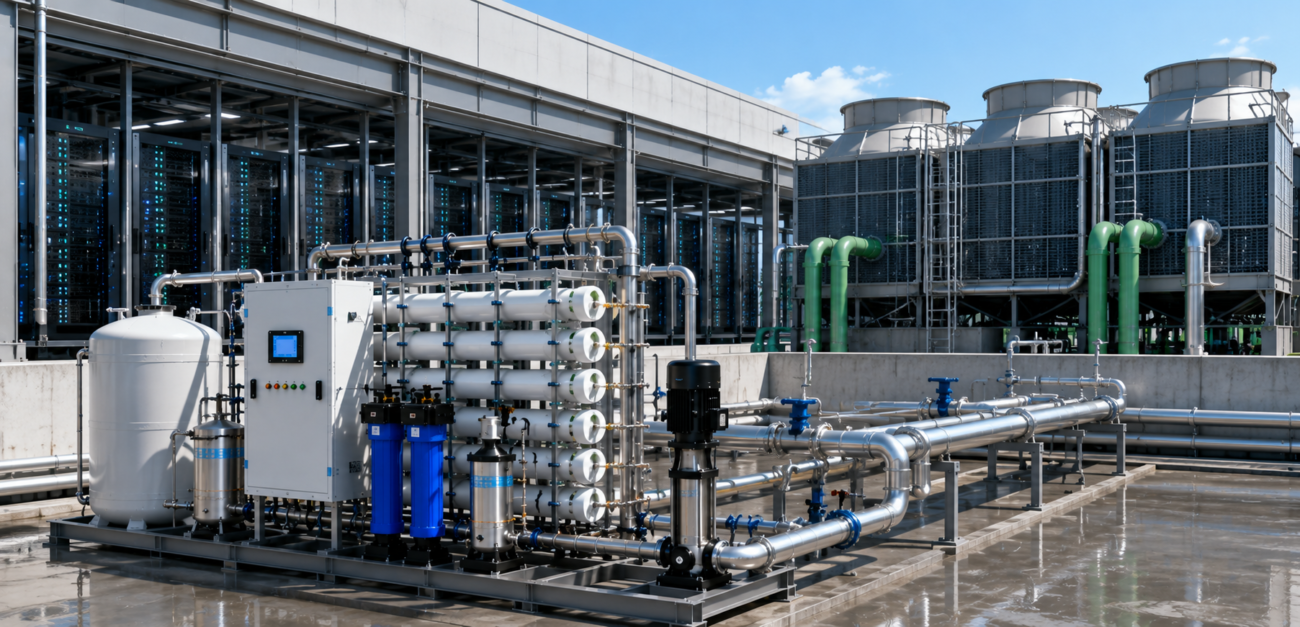
Protecting Capital Assets Through Correct Spec Separation
Getting FWS and TCS chemistry right isn’t a compliance exercise for its own sake — it’s what keeps capital-intensive hardware in service:
- Cold plates and CDU heat exchangers avoid premature microchannel fouling when TCS conductivity and hardness stay inside spec continuously, not just at startup
- Cooling towers and chillers avoid accelerated scale and corrosion when FWS chemistry is matched to actual makeup water rather than a generic assumption
- 24/7/365 uptime depends on catching a chemistry drift through continuous monitoring before it becomes a hot spot or a forced shutdown for emergency remediation
Feed water source drives the pretreatment design on both loops. Municipal makeup water needs pretreatment built around chlorine/chloramine-resistant media to protect downstream membranes, while recycled or reclaimed water — increasingly required in water-stressed markets under state and EPA discharge frameworks — carries elevated TDS and silica risk that demands heavier pretreatment before it ever reaches an RO train.
YWT’s data center product line is built around this exact FWS/TCS split: industrial reverse osmosis systems and skid-mounted softening trains for facility-side loops, paired with EDI ultrapure polishing and automated chemical dosing packages engineered to whichever loop, and whichever OEM spec, you’re actually trying to hold.
FAQ: Data Center Cooling Water Quality Standards
What’s the difference between FWS and TCS water quality standards? FWS (Facility Water System) is the building-side, tower-fed loop and tolerates conventional cooling water chemistry. TCS (Technology Cooling System) is the tight loop feeding cold plates directly and requires near-DI water quality, hydraulically separated from FWS by the CDU.
Are W17, W27, and W45 water quality standards? No. These are ASHRAE’s supply water temperature classes (the number is the maximum Celsius supply temperature), not chemistry specifications. Water quality is defined in a separate FWS/TCS chemistry table.
What conductivity should TCS water maintain? Published guidance for water-based TCS loops targets a low-conductivity range close to deionized water, achieved through RO plus EDI or mixed-bed polishing — but the exact number should always be confirmed against your specific CDU and cold plate manufacturer’s spec sheet.
Does ASHRAE TC9.9’s water quality guidance override the hardware manufacturer’s spec? No — treat the published ASHRAE table as a floor. CDU and cold plate OEMs frequently publish tighter chemistry requirements tied directly to warranty conditions.
Do EPA regulations affect data center cooling water quality? Indirectly. EPA discharge frameworks and state permitting govern blowdown and reclaimed water use, which shapes pretreatment design, but day-to-day loop chemistry targets come from ASHRAE and OEM specifications, not EPA standards directly.
How often should FWS and TCS water quality be tested? FWS should follow a continuous-monitoring cooling tower program (conductivity, pH, biocide residual). TCS should be continuously monitored for conductivity and TOC, with a full laboratory water analysis at commissioning and at defined audit intervals.
Can one filtration system serve both FWS and TCS? No. The chemistry tolerances differ by an order of magnitude or more — a single treatment train sized for FWS will not reliably hold TCS spec, and over-engineering the entire facility loop to TCS purity wastes CAPEX on flow volumes that don’t need it.
Get an Infrastructure Engineering Quote, request detailed Technical Data Sheets mapped to your CDU and cold plate OEM’s actual water quality spec, or ask about B2B wholesale / factory-direct pricing on industrial RO, EDI, and dosing systems built around your FWS and TCS split — not a generic single-loop template.