
Legionella Control in Data Center Cooling Towers: Engineering an ASHRAE 188 Water Management Program for AI Compute Clusters

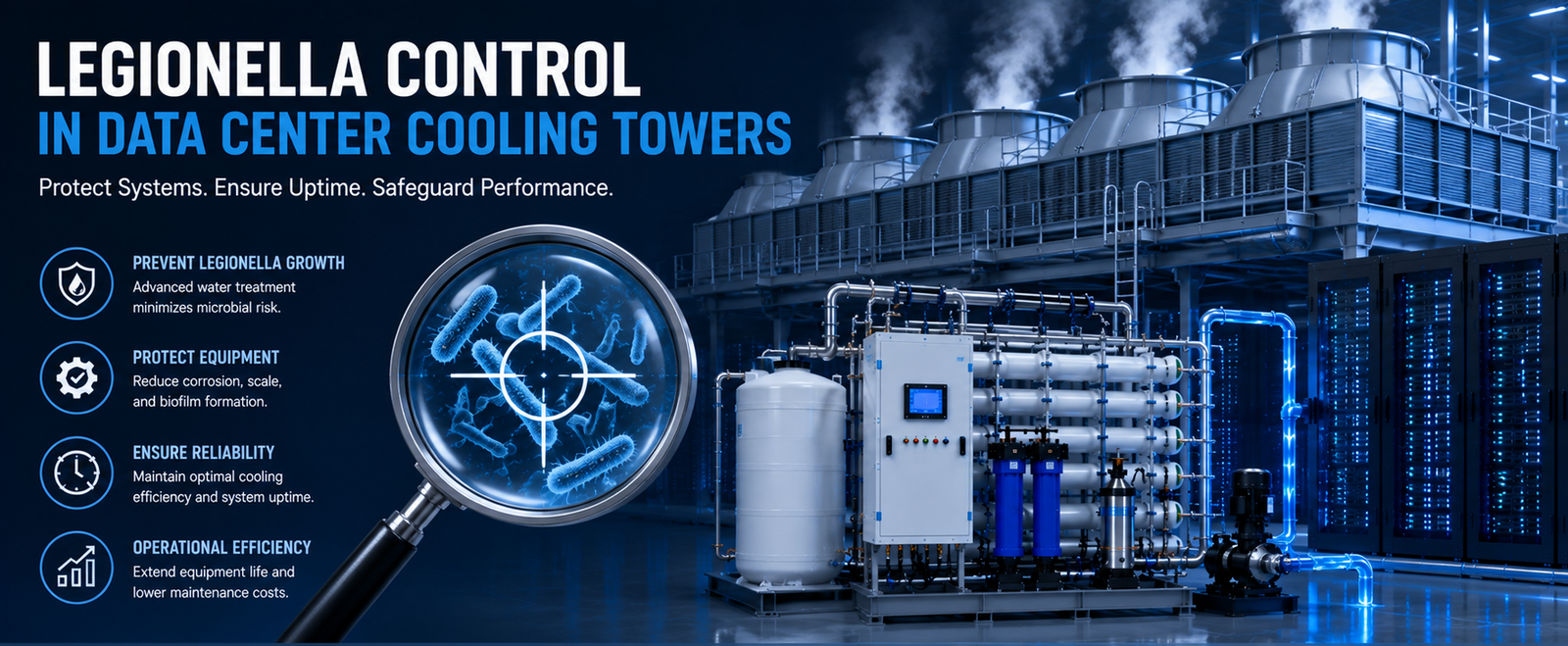
Rack densities climbing past 40 kW and into the 80-100 kW+ range have pushed most AI compute facilities onto hybrid liquid-cooling architectures — cold plates and CDUs feeding heat back to an outdoor cooling tower loop. That evaporative loop is also the single largest Legionella exposure point on the entire site.
A biofilm-fouled tower doesn’t just lose thermal performance. It sits inside a public health compliance exposure that can shut down a cell for offline emergency disinfection with zero notice — a direct hit to uptime that has nothing to do with GPU hardware.
Before evaluating any water treatment partner for Legionella control in data center cooling towers, lock in these non-negotiables:
- Documented ASHRAE 188 Water Management Program (WMP) design, not a generic maintenance checklist
- Automated, residual-verified disinfectant dosing (ORP or amperometric control, not timer-based injection)
- Continuous-duty biocide feed skids rated for 24/7/365 operation, sized to your actual cycles of concentration
- Culture testing and action-level response protocol built into the commissioning package, not sold separately
- N+1 / 2N redundancy on dosing and monitoring hardware — a single failed pump should never mean an unmonitored tower
Fast Check Product: https://yourwatergood.com/product/industrial-reverse-osmosis-system/
Why Variable AI Workloads Push Condenser Water Into the Legionella Growth Band
Legionella proliferates between roughly 68°F and 113°F (20-45°C), with laboratory-optimum growth near 99°F (37°C). It does not survive above 140°F (60°C) and rarely propagates below 68°F.
Traditional enterprise data halls run a fairly flat, predictable heat load. Condenser water temperature stays consistent, and a chemistry program tuned once tends to hold.
AI training clusters don’t behave that way. Batch job scheduling, checkpointing pauses, and cluster-wide power capping create swing loads that VFD-controlled towers chase in real time — and that swing regularly parks condenser water inside the 68-113°F growth window for hours at a stretch, especially during shoulder-season operation (spring/fall ambient conditions, partial-load overnight training runs).
A site engineered around a single peak-load setpoint will under-treat during these low-load windows. The chemistry program has to be designed for the full load curve, not the design-day maximum.
Building an ASHRAE 188 Water Management Program for a Mission-Critical Loop
ANSI/ASHRAE Standard 188-2021 requires any building with a cooling tower to maintain a documented Water Management Program (WMP) — this isn’t optional guidance, it’s the baseline compliance framework insurers and MEP consulting engineers now expect on a data center project.
A defensible WMP built around a mission-critical cooling loop needs:
- System survey and flow diagram — every tower cell, CDU loop interface, makeup line, and blowdown point mapped
- Control limits for temperature, disinfectant residual, pH, and conductivity, tied to your actual cycles of concentration (CoC) target
- Monitoring schedule with frequency tied to system stability, not a flat calendar interval
- Verification and validation records — documented proof the program is running as designed, reviewed at minimum annually and after any system modification
- A written response protocol escalating from routine treatment adjustment through offline emergency disinfection
ASHRAE Guideline 12-2023 is the companion implementation document — it’s where the “how” lives, including the specific response-protocol hierarchy 188 references but doesn’t spell out step-by-step.
Request a Data Center Water Sizing Consultation if your current WMP was written against a generic commercial building template rather than your actual condenser water chemistry and load profile — this is the single most common gap our engineering team finds during site audits.
Disinfection Chemistry: Why General Biofilm Control Isn’t the Same as Legionella Control
Here’s the field detail most facility teams miss: a tower running a clean, low-ATP biofilm control program can still be harboring active Legionella.
Quaternary ammonium compounds are widely used in cooling tower biofouling programs because they’re effective, low-corrosivity biocides against general slime-forming organisms. OSHA’s own Legionella control guidance flags that quat-based biocides at standard manufacturer dosing don’t reliably inactivate Legionella growing inside biofilm — the bacteria’s protective matrix, and its habit of colonizing inside free-living amoebae, shields it from biocides that clear surface biofouling just fine.
That distinction matters operationally: a biofilm-efficiency program (ATP monitoring, visual fouling checks) can report a “clean” tower on every metric that program tracks, while Legionella culture counts climb undetected.
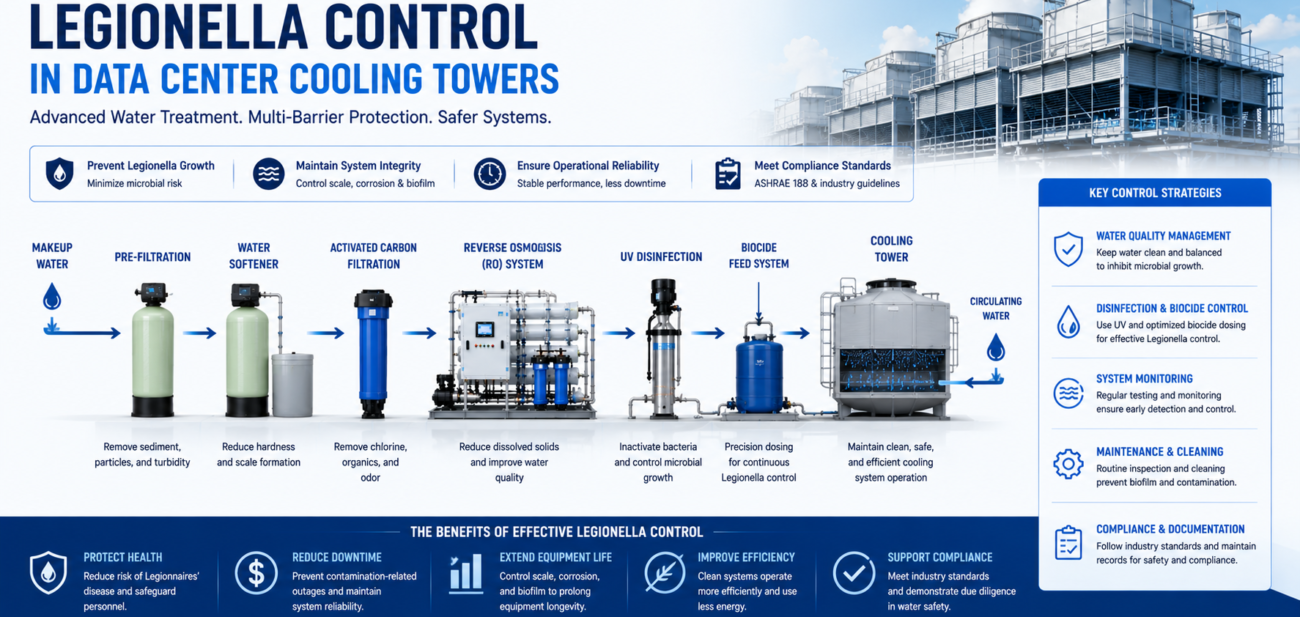
Effective Legionella-specific disinfection design typically pairs:
- Continuous oxidizing biocide residual — sodium hypochlorite, bromine, or chlorine dioxide, dosed against a real-time ORP or amperometric setpoint rather than a fixed timer
- Periodic non-oxidizing shock treatment to break down biofilm matrix and expose embedded organisms to the oxidizer
- Automated interlock logic that halts fan operation or flags an alarm to the BMS if residual drops out of band
This is where a properly specified automatic chemical dosing system earns its cost — a fixed-rate injection pump can’t respond to the CoC swings a variable AI load creates, and under-dosing during a load dip is exactly when the growth window opens.
Culture Testing, Action Levels, and the Remediation Escalation Ladder
ASHRAE 188 doesn’t mandate routine Legionella culturing, but it’s the most direct validation method available, and most defensible WMPs use it as their primary verification tool.
A typical tiered response structure — customized in your program to your facility’s risk tolerance and AHJ requirements — looks like this:
- Low counts: continue routine monitoring at scheduled frequency
- Elevated counts: increase sample frequency, re-evaluate disinfectant residual and CoC control, inspect for dead legs or scale harboring biofilm
- High counts: initiate hyperchlorination or equivalent shock disinfection per your documented response protocol, then re-sample to confirm clearance
- Outbreak-associated or AHJ directive: offline emergency cleaning and disinfection per ASHRAE Guideline 12, full system drain and mechanical clean
Testing frequency and numeric action levels should be set in the WMP itself rather than borrowed from a generic template — jurisdictions differ (some cities mandate cooling tower registration and testing; most U.S. data center markets, including Northern Virginia and Phoenix, rely on ASHRAE 188 as the contractual and insurance-driven standard rather than a local ordinance), so the program has to be written to match your actual regulatory exposure.
Mechanical and Design Controls Beyond Water Chemistry
Chemistry alone doesn’t close the risk. CDC’s cooling tower control guidance is explicit that mechanical design controls carry equal weight:
- High-efficiency drift eliminators, inspected and replaced on schedule — degraded eliminators are a primary aerosolization pathway that a perfect chemistry program can’t offset
- Tower placement at least 25 feet from building air intakes, to prevent drift plume re-entrainment into make-up air or IT space ventilation
- Elimination of dead legs and low-flow piping runs, flushed weekly at minimum if they can’t be designed out
- Balanced run-time across multi-cell towers rather than letting one cell idle and stagnate while others carry load
For any AI campus scaling past a single tower bank, this mechanical layer is where design review earns its keep — a P&ID that doesn’t show flush points on every dead leg is a red flag during commissioning review, not a detail to catch after startup.
Standard Pre-Engineered Skids vs. Data-Center-Grade High-Redundancy Systems
Most Legionella control failures at data center scale trace back to one root cause: a commercial-building water treatment skid dropped into a mission-critical application it was never engineered for.
| Design Parameter | Standard Pre-Engineered Skid | Data-Center-Grade High-Redundancy System |
|---|---|---|
| Flow Capacity | Fixed rating, typically 50-150 GPM | Modular 100-2,000+ GPM, engineered for full load-curve turndown |
| Redundancy | Single train (N) | N+1 or 2N configurable, hot-swappable dosing and monitoring trains |
| BMS/DCIM Integration | Local panel display only | Full BACnet/Modbus integration, real-time residual and CoC alarms |
| Filtration Precision | 20-50 micron nominal | 1-5 micron absolute, redundant strainer trains |
| Disinfectant Control | Timer or manual-set injection | ORP/amperometric closed-loop dosing with fail-safe interlocks |
| Delivery Lead Time | 4-8 weeks, catalog configuration | Custom-engineered with FAT and commissioning documentation |
The gap that matters most for uptime is the BMS integration row — a Legionella exceedance you don’t see in real time on the DCIM dashboard is one you find out about from a culture lab report two weeks later.
Request a Data Center Water Sizing Consultation
Protecting Capital Assets: The OPEX and Uptime Case
Legionella-driven biofouling and the mechanical cleaning it forces don’t stay contained to the tower deck. Downstream impact includes:
- Elevated heat exchanger and CDU cleaning frequency, driving OPEX beyond a properly chemically-controlled program
- Accelerated fouling of cold plate microchannels — deposits and biological slime that migrate downstream concentrate fastest in microchannel passages under 100 microns, where even modest fouling raises thermal resistance enough to trigger GPU thermal throttling long before any alarm trips on the tower itself
- Shortened service life on high-pressure pumps and heat exchanger cores, compounding capital replacement cost
- Offline emergency disinfection events, which take a cooling loop — and potentially a compute cell — out of service on short notice
A correctly engineered Legionella control in data center cooling towers program, paired with properly sized pretreatment, is what keeps that risk from ever reaching the IT load.
Feed water source matters here too. Municipal makeup water needs pretreatment designed around chlorine/chloramine-resistant media to protect downstream membranes, while recycled or reclaimed water — increasingly mandated in water-stressed markets — carries higher TDS and elevated silica risk, requiring a fundamentally different pretreatment train (typically multimedia filtration, dedicated antiscalant dosing, and higher-rejection RO staging) than a straight municipal-fed design.
YWT’s data center product line — industrial reverse osmosis systems, skid-mounted softening and DI trains, EDI ultrapure polishing, and automated chemical dosing packages — is built around this exact distinction: makeup water pretreatment and biocide dosing engineered to your actual feed source, CoC target, and load profile, not a generic catalog skid.
Request a Data Center Water Sizing Consultation to have your feed water analysis, load profile, and current WMP reviewed against ASHRAE 188 and Guideline 12 requirements before your next commissioning cycle or third-party audit.
FAQ: Legionella Control in Data Center Cooling Towers
What temperature range allows Legionella to grow in cooling towers? Growth occurs roughly between 68°F and 113°F (20-45°C), with laboratory-optimum growth near 99°F (37°C). Legionella does not survive above 140°F (60°C) and rarely propagates below 68°F.
Is Legionella testing required under ASHRAE 188? Not explicitly mandated by the standard itself, but culture testing is the most direct validation method available and is used by most defensible Water Management Programs as their primary verification tool.
What’s the difference between ASHRAE 188 and ASHRAE Guideline 12? Standard 188 defines the minimum requirements — what a WMP must contain. Guideline 12-2023 is the implementation companion — it details how to execute control measures, testing, and the tiered response protocol.
Are quaternary ammonium biocides effective against Legionella? Not reliably at standard dosing. OSHA guidance notes quat-based biocides that control general biofouling may not inactivate Legionella growing within biofilm or hosted inside free-living amoebae — oxidizing biocides with verified residual control are the more defensible primary control measure.
How often should data center cooling towers be tested for Legionella? Frequency should be set in the facility’s own WMP based on system stability and risk factors, with increases during startup, shoulder-season load swings, or following any elevated result — not a fixed industry-wide interval.
Does a data center need to register its cooling towers for Legionella compliance? It depends on jurisdiction. A small number of cities mandate cooling tower registration and testing; most U.S. data center markets rely on ASHRAE 188 as the contractual and insurance-driven compliance baseline rather than a local ordinance.
Can a general biofilm control program substitute for a Legionella-specific program? No. Biofilm-efficiency metrics like ATP monitoring track fouling and heat-transfer performance, not pathogen presence — a tower can pass every biofilm metric while Legionella culture counts remain elevated.
Get an Infrastructure Engineering Quote, request detailed Technical Data Sheets, or ask about B2B wholesale / factory-direct pricing on industrial RO, EDI, and automated dosing systems sized to your cooling tower’s actual load curve and feed water chemistry — not a generic template.