
Colocation Data Center Cooling Water System Design: Zone Isolation for Multi-Tenant SLAs

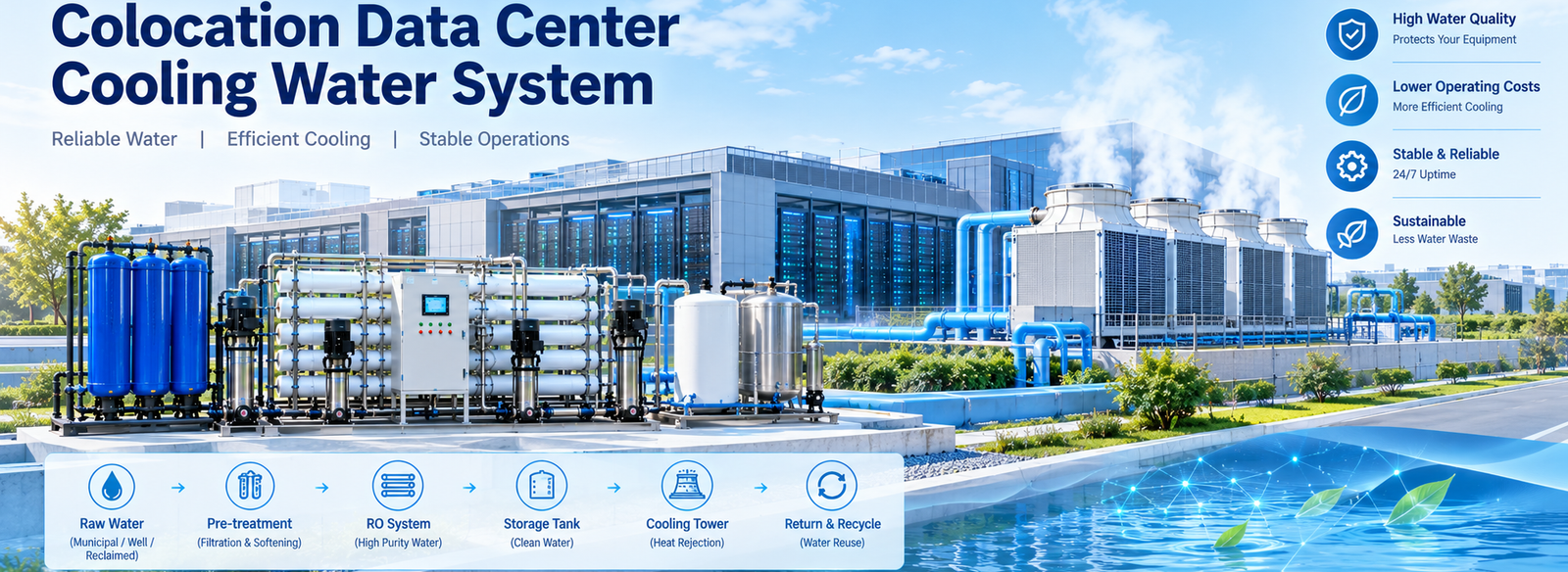
In a single-tenant campus, one bad water quality event is an internal incident. In a colocation facility, it’s a breach notice to every tenant on the shared loop.
Before specifying a system for a multi-tenant facility, lock these into the RFQ:
- Per-zone water quality guarantee: makeup water conductivity and TDS specified at each hall or suite inlet, not just at the central plant header
- Isolation architecture: valved, independently monitored branches so one tenant’s load swing or maintenance event can’t degrade another tenant’s cooling loop
- Continuous duty cycle: 24/7/365 automatic backwash operation — colocation SLAs don’t have a maintenance window a tenant agreed to in advance
- Auditable telemetry: real-time PSI differential and flow logging per branch, retrievable for SLA compliance reporting
- Incremental capacity: a plant architecture that adds trains as leases fill, without derating water quality to tenants already live
The rest of this piece is the engineering logic behind those five requirements — and where a modular colocation data center cooling water system actually earns its keep over a single shared plant.
Fast Check Product: https://yourwatergood.com/product/industrial-reverse-osmosis-system/
Why Colocation Cooling Water Can’t Run on a Single Shared Spec
A hyperscale campus has one operator, one load profile, and one growth curve. A colocation facility has none of that consistency.
Suite A might run 8 kW racks with air cooling. Suite C, leased eighteen months later, might run 60 kW racks on direct-to-chip liquid cooling. Both draw makeup water from the same central plant, and both signed an SLA that assumes their cooling performance is independent of what’s happening in the suite next door.
That’s the structural problem a single shared water spec can’t solve:
- Load variance across tenants means peak demand on one branch can transiently starve another if the plant and distribution header aren’t sized with margin
- Contamination isolation matters more than in a single-tenant plant — a fouling event traced to one tenant’s loop shouldn’t be able to migrate upstream through a shared header
- SLA liability requires the operator to prove, with data, which branch a water quality deviation occurred on — a single combined meter can’t do that
None of this is solved by a bigger pump. It’s solved by architecture.
Zone-Level Isolation: Protecting One Tenant’s SLA from Another’s Load
The fix is treating each hall or suite as its own hydraulic zone, fed from a common pretreatment train but isolated at the distribution level.
- Branch isolation valves at every zone tap allow a single suite to be taken offline for maintenance or CIP without touching supply to any other tenant
- Independent flow and pressure instrumentation per branch turns “water quality was fine at the plant” into “water quality was fine at Suite C’s inlet, timestamped” — the difference matters when an SLA credit is on the line
- Dedicated conductivity sensors at zone inlets, not just at the central RO outlet, catch localized degradation (a fouled branch strainer, a leaking isolation valve) before it becomes a tenant-visible event
This is the same logic large multi-tenant office buildings apply to electrical sub-metering — except the failure mode here is a thermal event, not a billing dispute.
Five-Stage Pretreatment as the Common Denominator Across Mixed-Density Suites
Regardless of what a given tenant runs downstream — CRAC-cooled air, rear-door heat exchangers, or direct-to-chip cold plates — the makeup water quality requirement converges on the same numbers.
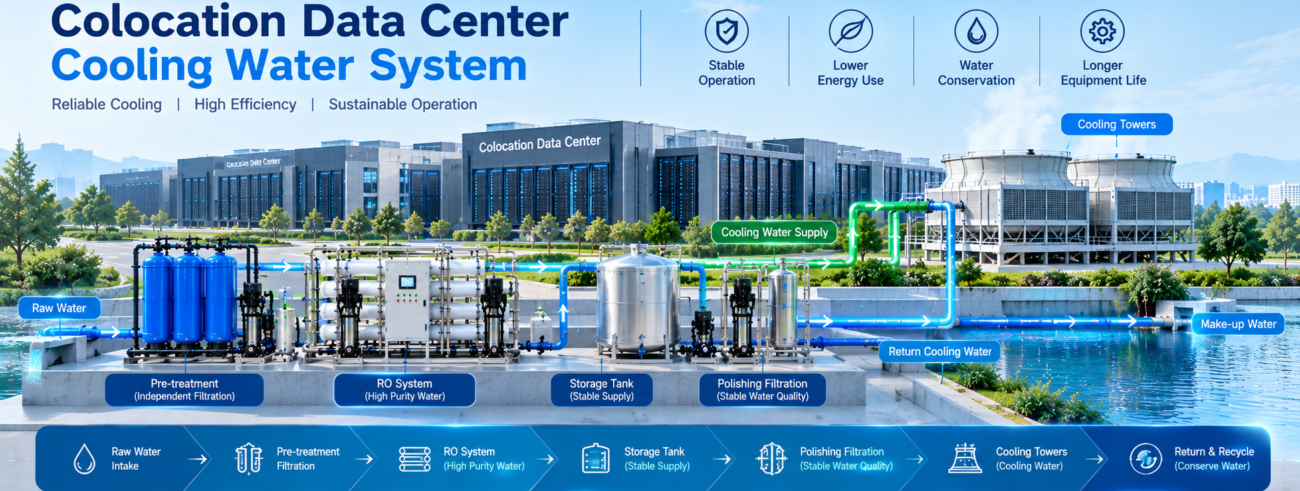
A five-stage pretreatment train — multimedia filtration, activated carbon, ion-exchange softening on a dedicated brine-regenerated salt box, precision security filtration, and a final RO membrane array — takes raw feedwater from roughly 1,300 mg/L TDS down to under 20 mg/L in a single pass, or under 10 mg/L across a two-stage configuration.
That output is what lets a colocation operator quote the same water quality guarantee to every tenant regardless of their cooling method, instead of negotiating a different pretreatment spec every time a new lease with a different rack density signs.
Ion-exchange softening carries particular weight in a multi-tenant plant: it’s the stage that determines how far the shared cooling tower can run cycles of concentration before hitting the calcium carbonate saturation limit — and cooling tower economics are typically shared infrastructure cost across all tenants, so undersizing this stage taxes everyone’s OPEX line, not just one suite’s.
Metering, Monitoring, and the Data an SLA Actually Requires
An SLA credit dispute is won or lost on data, not on the memory of what the plant was doing that afternoon.
Three data points need to exist per zone, logged continuously and retrievable on demand:
- Conductivity at zone inlet — the direct proxy tenants and auditors will ask about first
- Differential pressure (PSI) across the branch strainer or filter — the leading indicator that a zone-level fouling event is developing, days before it shows up as a flow reduction
- Flow rate per branch, cross-referenced against the tenant’s contracted makeup water allocation
Real-time PSI and flow telemetry off the central RO plant, standard on a properly automated skid, only tells the operator that the plant is healthy. Zone-level instrumentation is the layer that gets added on top to make that data legally and contractually useful in a multi-tenant environment.
Request a Colocation Cooling Water Consultationto work through branch metering and isolation valve placement against your actual leasing floor plan, not a generic single-tenant layout.
Phased Capacity: Adding Trains as Leases Fill Without Touching Live Tenants
Colocation build-out rarely matches design-day capacity from day one. A plant sized for a fully leased facility, commissioned at 30% occupancy, either runs badly undersized-for-turndown or sits oversized burning OPEX on trains nobody needs yet.
A modular architecture in the 1 t/h–10 t/h range per train (roughly 4.4 GPM–44 GPM, or 6,300 GPD–63,400 GPD) sidesteps that trade-off:
- Trains come online in step with leasing velocity, not in one lump capital outlay
- Adding a train means valving in a new skid on the common header — it does not require taking existing tenant branches offline
- N+1 redundancy at the train level means a CIP cycle or cartridge changeout on one skid doesn’t force a capacity reduction to live tenants
This is the same modular logic a hyperscale operator uses for growth, applied instead to leasing uncertainty rather than a known GPU roadmap.
OPEX and Capital Protection: Standard Skid vs. Data Center Grade System
| Parameter | Standard Pre-Engineered Skid | Data Center Grade High-Redundancy System |
|---|---|---|
| Flow control | Fixed setpoint, manual valve trim | PID-modulated, remote setpoint capability |
| Redundancy | Single train, no standby | N+1 / 2N parallel trains |
| Zone-level metering | Not included | Per-branch conductivity, PSI, and flow instrumentation |
| Controls integration | Local PLC readout | PLC standard; BMS/SCADA integration available as custom engineering |
| Typical lead time | 8–12 weeks | 12–20 weeks (engineered-to-order) |
| Filtration precision | 5-micron pre-RO cartridge | Down to 1-micron pre-RO stage, continuously monitored |
The economics compound across tenants, not just across time. Fewer unplanned heat exchanger acid washes and fewer emergency strainer cleanings reduce OPEX passed through the operating budget; longer service life on cold plates, CDU internals, and pump seals protects capital that, in a colocation model, the operator owns even when the tenant doesn’t.
BMS/SCADA integration is not standard on a pre-engineered skid — if zone-level data needs to feed a tenant-facing SLA dashboard or the facility’s central BMS, specify that integration at RFQ stage. Adding it after fabrication costs materially more than engineering it in from the start.
Specifying a colocation data center cooling water system around per-branch isolation and metering at RFQ stage, rather than bolting it on after tenants are live, is what keeps an SLA defensible instead of aspirational.
Field Notes: Micro-Channel Fouling in a Mixed-Tenant Water Loop
One risk is specific to colocation and rarely shows up in single-tenant literature: direct-to-chip liquid cooling suites sharing a plant with air-cooled suites.
Cold plate micro-channels running under 100 microns are far less tolerant of hardness or silica slip-through than a CRAC coil ever was. A pretreatment train validated against an air-cooled tenant’s requirements for years can still be inadequate the day a liquid-cooled tenant signs a lease on the same shared header — because the failure threshold for a micro-channel cold plate is an order of magnitude tighter than what an air-cooled suite ever exposed the plant to.
The practical implication: pretreatment specs for a colocation plant should be set against the tightest downstream cooling method the facility could plausibly lease to, not the mix that’s live on day one. Re-qualifying pretreatment after a high-density liquid-cooling tenant signs is a retrofit; designing for it up front is a spec line.
This sits alongside general water quality references in ASHRAE TC 9.9 and EPA water quality and discharge frameworks — engineering inputs for the pretreatment spec, not a compliance checkbox filled in after the plant is built.
FAQ: Colocation Data Center Cooling Water Systems
Can one shared water treatment plant serve multiple colocation tenants with different SLAs? Yes, provided the plant is designed with zone-level isolation valves and independent branch instrumentation — a single combined meter cannot support per-tenant SLA reporting.
What water quality should a colocation SLA specify at the tenant inlet? Conductivity and TDS measured at the zone or suite inlet, not just at the central plant — typically under 20 mg/L TDS off single-stage RO, or under 10 mg/L in a two-stage configuration.
How is redundancy handled in a multi-tenant cooling water plant? N+1 at the train level minimum, so a single skid’s CIP cycle or cartridge changeout doesn’t reduce capacity to any live tenant branch.
Can colocation water treatment capacity be added after the facility is already leasing tenants? Yes — a modular train architecture (1 t/h–10 t/h per skid) allows new trains to be valved onto the common header without taking existing tenant branches offline.
Do air-cooled and liquid-cooled tenants need different pretreatment specs on a shared plant? No — the plant should be sized to the tightest requirement (typically direct-to-chip micro-channel loops) so it doesn’t require a retrofit when a higher-density tenant signs.
What inlet pressure does a colocation water treatment skid require? A stable minimum of 0.2 MPa (about 29 PSI) at the skid, with booster pump integration available for sites that can’t guarantee it at the property line.
What data should be logged for colocation SLA compliance? Per-branch conductivity, differential pressure across zone filtration, and flow rate against contracted allocation — continuously logged and retrievable on demand.
A colocation cooling water plant carries a liability profile a single-tenant campus doesn’t: every water quality deviation is potentially a contractual event with a specific tenant’s name on it. Zone isolation and per-branch instrumentation aren’t optional line items — they’re what makes an SLA defensible.
Get an Infrastructure Engineering Quote — request technical data sheets, zone-metering and isolation layout recommendations for your leasing floor plan, and B2B wholesale / factory-direct pricing for modular RO skid deployments.